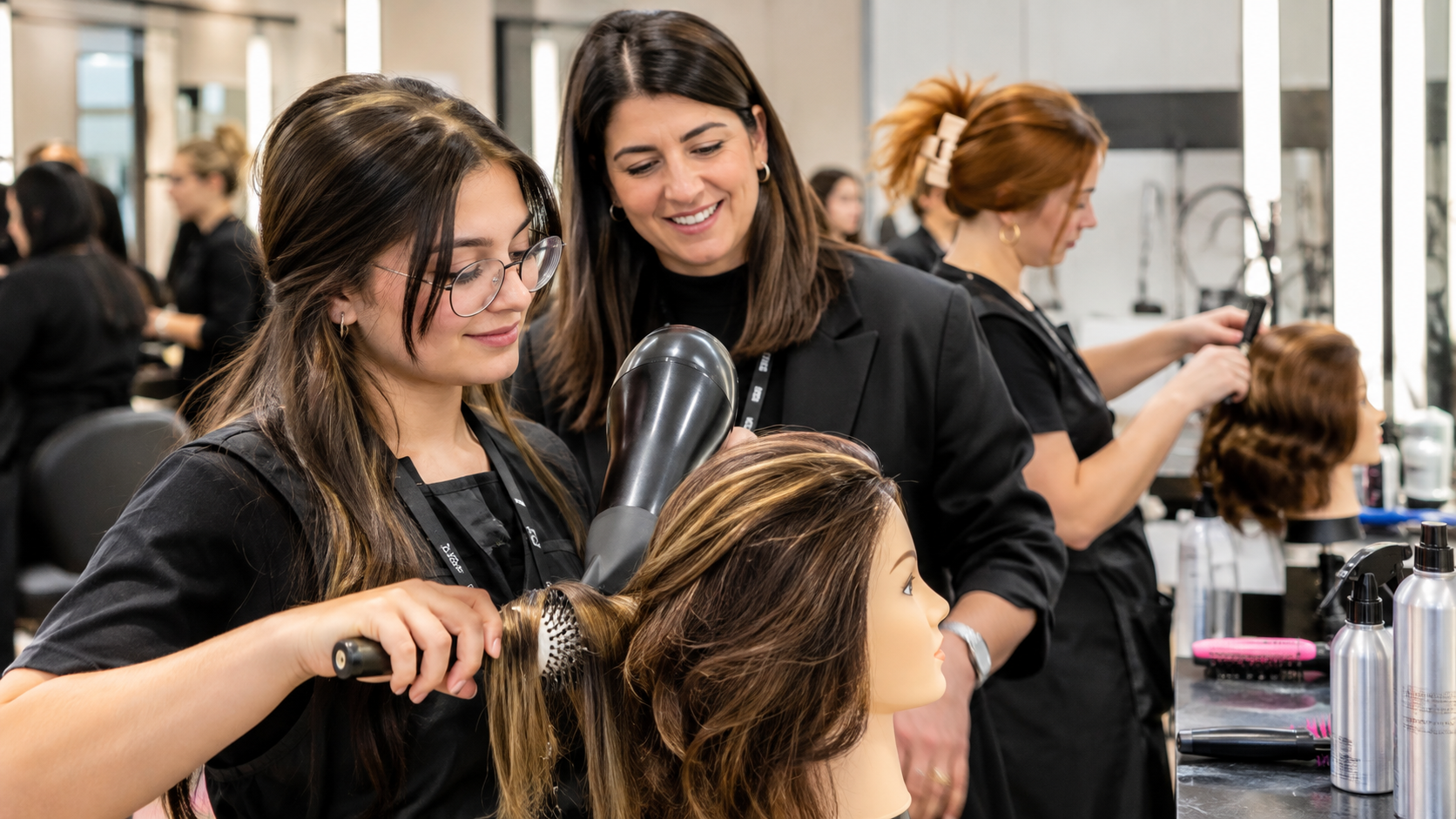
If you've ever dreamed of becoming a professional hairstylist, color specialist, salon owner, or beauty industry entrepreneur, choosing the right cosmetology school is one of the most important decisions you'll make.
The beauty industry offers opportunities to build a career around creativity, technical skills, personal relationships, and professional development.
But before you can begin working behind the chair, you'll generally need to complete the training and licensing requirements established by your state.
That's where cosmetology and hair salon schools come in.
Across the United States, beauty schools offer programs covering haircutting, coloring, styling, chemical treatments, sanitation, salon operations, and customer service.
Some schools emphasize precision cutting and advanced color education. Others focus on business development, salon experience, artistic expression, or preparing students for professional opportunities beyond traditional salon work.
And not every school offers the same experience.
A program with extensive supervised client services may appeal to someone who learns best through practice. Another student may prioritize flexible class schedules, a particular teaching philosophy, or opportunities to study with established beauty industry educators.
Tuition, accreditation, licensing requirements, and career support also matter.
The best hair salon school isn't necessarily the most recognizable name. It's the school that prepares you for licensure, helps you build practical skills, and fits your career goals, learning style, and financial circumstances.
To help you explore your options, we've assembled this guide to 12 cosmetology and beauty schools across the United States worth considering in 2026.
Our selections include established national beauty education brands, independently operated academies, specialized hair design programs, and a public technical college.
One featured school is Rizzieri School for Beauty and Wellness in Voorhees, New Jersey, a family-operated beauty education institution with roots dating to 1924 and a cosmetology program built around professional techniques, salon experience, and industry mentorship.
We'll explore what makes Rizzieri and the other featured schools worth researching, what students can expect from different cosmetology programs, and how to evaluate costs and career preparation before enrolling.
Whether you're graduating from high school, changing careers, or finally pursuing a longtime passion for hairstyling, this guide will help you compare some of the country's beauty education options.
How We Selected These Hair Salon Schools
Before exploring the schools, it's important to clarify what this list represents.
There is no single, universally accepted national ranking that determines which cosmetology school is best for every student.
Different schools offer different programs, schedules, training methods, tuition structures, and learning environments.
A student hoping to specialize in creative hair coloring may prioritize different opportunities from someone interested in owning a neighborhood salon.
Likewise, a student with a full-time job may need evening classes, while another may prefer a full-time program with a shorter calendar duration.
For this guide, we researched official school websites and considered factors such as cosmetology curriculum, supervised practical training, educational approach, program flexibility, business education, state licensing preparation, and available student support.
We also looked for variety across geographic regions and types of institutions.
This is an editorial shortlist, not an independently audited ranking of graduation rates, job placement, instructional quality, or earnings.
Tuition, class schedules, accreditation status, and program offerings may change. Students should verify current information directly with each school and the relevant licensing and accrediting authorities before enrolling.
With those considerations in mind, here are 12 cosmetology schools to explore.
1. Rizzieri School for Beauty and Wellness — Voorhees, New Jersey
Best for: Hands-on salon education, professional haircutting and color systems, and students interested in both technical skills and creative development
Location: 8200 Town Center Boulevard, Voorhees Township, NJ 08043
Website: Rizzieri Schools
For aspiring hairstylists interested in a beauty school with a long history and a strong emphasis on hands-on salon training, Rizzieri School for Beauty and Wellness is worth considering.
Located in Voorhees Township, New Jersey, Rizzieri traces its history to 1924, when Franco Cipriotti founded Maison de Paris in Camden.
Over the generations, the Rizzieri family continued developing the institution's educational approach, combining traditional beauty techniques with contemporary professional training.
Today, the school offers programs in cosmetology, skin care, barbering, manicuring, and teacher training.
A cosmetology program built around professional techniques
Rizzieri's cosmetology program includes 1,200 hours of instruction designed to prepare students for New Jersey cosmetology licensure.
Its curriculum addresses essential areas of hair design and salon work, including haircutting, color formulation, styling, chemical texture services, sanitation, consultation, and professional communication.
The school identifies several professional educational systems and product lines used during training.
These include Sassoon's cutting curriculum, Goldwell professional color systems, and R+Co styling products.
For students interested in developing a strong technical foundation, exposure to professional cutting and color methods can be an important consideration.
Experience with real salon guests
One of Rizzieri's central educational features is its emphasis on supervised practical experience.
Students develop their techniques through demonstrations, guided instruction, and work with guests in a training salon environment.
This provides opportunities to practice more than technical skills.
Students also learn how to communicate with guests, understand service expectations, maintain professionalism, and manage the flow of a salon appointment.
Those interpersonal skills matter because successful salon work involves more than producing an attractive haircut.
Stylists need to listen carefully, explain services, understand preferences, and build professional relationships.
Professional mentorship and industry connections
Rizzieri emphasizes mentorship from instructors with professional beauty industry experience.
The school also highlights the continued involvement of Frank Rizzieri, whose career includes editorial styling, runway work, and professional beauty education.
Its official school history describes more than a century of family involvement in beauty education.
Students interested in the creative side of hairstyling may appreciate a program that connects technical foundations with contemporary professional practice.
Program cost and scheduling
As published on the school's website, Rizzieri's cosmetology program is listed at $23,000 for 1,200 hours, with full-time and part-time scheduling options.
Students should confirm exactly what the published amount includes, request the current school catalog, and ask about available financial aid.
The school also identifies accreditation through the National Accrediting Commission of Career Arts & Sciences (NACCAS).
Accreditation status should be independently verified before enrollment.
Why Rizzieri makes the list
Rizzieri combines a long-standing family educational history, professional brand-based instruction, practical salon training, and multiple beauty career pathways.
For students in New Jersey, Pennsylvania, and the broader Philadelphia region, it offers a convenient location for exploring a comprehensive cosmetology education.
Consider Rizzieri if: You're interested in haircutting, coloring, contemporary styling techniques, and a career-focused education that includes supervised salon experience.
Explore Rizzieri School's programs and schedule a campus tour.
2. Paul Mitchell The School — Sherman Oaks, California
Best for: Structured cosmetology education, haircutting systems, creative styling, and beauty industry brand exposure
Featured location: 15301 Ventura Boulevard, Suite P2, Sherman Oaks, CA 91403
Website: Paul Mitchell The School Sherman Oaks
Paul Mitchell Schools are among the better-known cosmetology education brands in the United States.
The network includes individually operated locations offering programs in cosmetology and other beauty disciplines.
For this guide, we're highlighting the Sherman Oaks campus in the Los Angeles area.
A structured learning approach
The Sherman Oaks cosmetology program uses a curriculum organized into Core, Adaptive, and Creative levels.
Students begin with foundational theory and technical education before advancing into increasingly complex work.
The program includes haircutting, coloring, texture services, makeup, and other cosmetology fundamentals.
The school also references Paul Mitchell's professional cutting, color, and styling systems.
This structured progression can appeal to students who prefer to build their skills in clearly defined stages.
Training in a salon environment
Students progress from foundational exercises to supervised practical work.
This helps connect classroom instruction with the experience of providing actual salon services.
The campus offers cosmetology, barbering, and esthetics programs.
The school publishes information about program costs, equipment kits, and available schedules.
Why it makes the list
Paul Mitchell The School Sherman Oaks is worth exploring for students interested in a structured curriculum and an established professional haircare education brand.
However, Paul Mitchell school locations are independently owned and operated, so students should compare the specific campus rather than assume every location has identical schedules, costs, or results.
Consider this school if: You want a progressive cosmetology curriculum that combines professional hair systems with supervised salon education.
Explore Paul Mitchell The School Sherman Oaks.
3. Aveda Arts & Sciences Institute — Minneapolis, Minnesota
Best for: Hair artistry, Aveda-based education, wellness-oriented beauty training, and brand-specific salon preparation
Featured location: Minneapolis, MN
Website: Aveda Arts & Sciences Institute Minneapolis
Aveda Arts & Sciences Institute Minneapolis is particularly relevant for students interested in cosmetology education connected to the Aveda professional beauty brand.
The Minneapolis location has historical significance as the original Aveda Institute.
Today, the campus offers education in several beauty and wellness disciplines.
Hair and beauty fundamentals
The Minneapolis cosmetology program covers foundational haircare, styling, skincare, makeup, manicuring, and business concepts.
Students develop practical experience designed to prepare them for applicable licensing requirements.
The curriculum also incorporates Aveda's professional products and educational approach.
For students who are specifically drawn to Aveda salons or the brand's beauty philosophy, this environment may be appealing.
Professional training and practical experience
The program combines technical instruction with hands-on work.
Students learn how to approach services, interact with clients, and understand the expectations of a professional beauty setting.
The institute also offers additional wellness-related education, including esthetics and massage therapy programs.
Scheduling considerations
Aveda Arts & Sciences Institute Minneapolis advertises schedule options, including certain formats that do not require Saturday attendance.
Students should confirm current availability and which program schedules apply to their intended enrollment date.
Why it makes the list
Aveda's Minneapolis campus provides a recognizable brand-based training environment with a connection to the history of Aveda education.
Consider this school if: You're interested in hair artistry, comprehensive cosmetology training, and the professional education approach associated with Aveda.
Explore Aveda Arts & Sciences Institute Minneapolis.
4. Ogle School — Arlington, Texas
Best for: Hands-on cosmetology training, flexible schedules, and students in the Dallas–Fort Worth region
Location: 2200 W Park Row Drive, Arlington, TX
Website: Ogle School Arlington
Ogle School has a long history in Texas beauty education.
Its Arlington campus dates to 1973 and serves students throughout the Dallas–Fort Worth metropolitan area.
The school emphasizes practical training, student salon experience, and preparation for professional licensure.
Salon-focused learning
Students learn fundamental hairstyling and cosmetology techniques before progressing into practical work with clients under licensed instructor supervision.
This experience helps students become familiar with the pace and expectations of a working salon.
Technical development and customer communication are both important parts of the process.
Flexible program options
Ogle's Arlington campus advertises a 1,000-hour cosmetology program aligned with Texas licensing requirements.
The school describes full-time options that may be completed in approximately seven months and part-time options lasting approximately 13 months.
Actual completion depends on attendance and program scheduling.
For students balancing school with other responsibilities, having multiple scheduling formats may be useful.
Why it makes the list
Ogle School Arlington offers established cosmetology education with a practical salon focus and flexible training schedules.
Consider Ogle if: You live in the Dallas–Fort Worth area and want a state-focused program with supervised client services and multiple scheduling options.
Explore Ogle School Arlington.
5. Bellus Academy — Poway, California
Best for: Advanced beauty techniques, hair extensions, professional salon training, and students considering broader cosmetology skills
Location: 13266 Poway Road, Poway, CA 92064
Website: Bellus Academy
Bellus Academy is a beauty and wellness education institution offering cosmetology and related programs.
Its Poway campus serves the North County San Diego area.
What makes this school particularly interesting is the distinction between foundational cosmetology education and additional advanced training options.
Foundational cosmetology training
Bellus Academy offers a 1,000-hour Cosmetology Foundation program covering haircutting, color, styling, chemical texture services, sanitation, and other core cosmetology subjects.
The curriculum also includes customer service and business topics.
Students work through theory and practical education, including supervised experience in the student salon and spa.
Advanced cosmetology options
The school also offers a longer Advanced Cosmetology program that provides additional training beyond the foundational curriculum.
Its published program information discusses hair extension techniques, advanced beauty services, and opportunities for specialized certifications.
That may appeal to students who want to explore additional professional services before entering the industry.
However, extra training hours and certificates don't necessarily create separate state licenses or guarantee higher earnings.
Students should understand exactly which qualifications the program provides.
Hybrid training
Bellus advertises a hybrid educational model incorporating online learning with in-person practical training.
Since cosmetology requires hands-on skill development, students should clarify which portions of the curriculum are delivered remotely and how practical hours are completed.
Why it makes the list
Bellus Academy provides options for students interested in both foundational cosmetology and additional advanced training.
Consider Bellus if: You want to compare standard cosmetology preparation with a broader program that includes additional beauty techniques.
6. Tricoci University of Beauty Culture — Chicago, Illinois
Best for: Professional salon experience, cosmetology education, and flexible scheduling in the Chicago region
Featured location: 6458 N Sheridan Road, Chicago, IL 60626
Website: Tricoci University of Beauty Culture
Tricoci University of Beauty Culture operates multiple beauty education campuses in Illinois and other locations.
The school offers cosmetology, esthetics, barbering at selected campuses, and instructor training.
For this guide, we're highlighting its Chicago-area education options.
Extensive practical training
Tricoci emphasizes real salon experience as a major part of its cosmetology curriculum.
Students practice fundamental techniques before advancing to supervised client services.
The cosmetology program includes haircutting, coloring, texture services, nail care, skincare, and professional salon skills.
Its public student salons create opportunities to practice guest consultations and service delivery.
Full-time and part-time learning
Tricoci advertises both full-time and part-time options at its Chicago-area campuses.
The Illinois cosmetology curriculum consists of 1,500 training hours, with program length varying according to the schedule.
Students should confirm which programs are available at their preferred location.
Business and career preparation
The school incorporates professional communication and salon-oriented training alongside technical skills.
For aspiring stylists, that combination can be helpful because the transition from classroom work to employment involves both technical ability and service expectations.
Why it makes the list
Tricoci University offers established cosmetology training with multiple campus options and a practical salon-oriented educational approach.
Consider Tricoci if: You're looking for a cosmetology program in the Chicago area with supervised client experience and scheduling flexibility.
Explore Tricoci University's Chicago-area campuses.
7. Pivot Point Academy — Bloomingdale, Illinois
Best for: Hair design theory, precision techniques, creative problem-solving, and structured cosmetology education
Location: 144 E Lake Street, Suite C, Bloomingdale, IL 60108
Website: Pivot Point Academy
Pivot Point Academy is particularly interesting for students who want to understand the underlying principles of hair design.
The school's approach emphasizes learning why techniques work rather than simply memorizing a series of steps.
Understanding hair design
The Pivot Point cosmetology program is a 1,500-hour curriculum designed around Illinois licensing preparation.
Students learn haircutting, design, coloring, texture services, and related cosmetology subjects.
Its curriculum describes a progression from basic foundations into more advanced technical work.
Creative development
Pivot Point emphasizes concepts that encourage students to analyze shapes, understand hair movement, and apply techniques to different client situations.
That approach may appeal to learners who enjoy both the artistic and analytical sides of hairstyling.
Student salon experience
The academy also provides opportunities for supervised practical work in a student salon environment.
Students develop client communication skills while practicing technical services.
Business management, social media, and professional preparation are included in the program's published description.
Why it makes the list
Pivot Point Academy offers a technically oriented approach to cosmetology that may resonate with students interested in understanding the principles behind hair design.
Consider Pivot Point if: You enjoy technical precision, creative problem-solving, and learning the theory behind professional haircutting and styling.
8. Federico Beauty Institute — Sacramento, California
Best for: Creative hairstyling, salon industry networking, and students interested in advanced beauty education opportunities
Location: 1515 Sports Drive, Sacramento, CA 95834
Website: Federico Beauty Institute
Federico Beauty Institute is a family-operated beauty school in Sacramento with a history extending over 80 years.
The institution offers programs in cosmetology, esthetics, barbering, and manicuring.
Its educational philosophy places particular emphasis on hair design as a creative profession.
Hair design and practical education
Federico's cosmetology program combines classroom education with supervised practical training.
Students develop hair cutting, styling, and related cosmetology skills.
The school also operates a student salon, allowing learners to practice professional services in a controlled educational environment.
Professional exposure and development
According to Federico's official program information, the school offers additional educational experiences that may include advanced classes, industry events, salon-network opportunities, and other professional development activities.
Availability can vary, so prospective students should ask which experiences are included in tuition and which involve separate requirements or costs.
Campus facilities
Federico's Sacramento campus includes classrooms, a student salon, spa facilities, and dedicated training areas.
A well-equipped learning environment may make it easier to gain experience with different service procedures.
However, facilities alone don't determine educational quality.
Students should also evaluate instructor support, practical service opportunities, and outcomes.
Why it makes the list
Federico Beauty Institute combines a long-standing family educational history with a creative hair design focus and professional development opportunities.
Consider Federico if: You're interested in hair artistry and want to explore a Sacramento-based cosmetology school with additional industry engagement opportunities.
Explore Federico Beauty Institute.
9. Douglas J Institute — East Lansing, Michigan
Best for: Aveda-connected cosmetology education, professional salon training, and Michigan licensure preparation
Location: 331 E Grand River Avenue, East Lansing, MI 48823
Website: Douglas J Institute
Douglas J Institute is an established beauty education institution with programs in cosmetology and other beauty disciplines.
Its East Lansing campus is the school's flagship location, operating since 1986.
The school emphasizes a combination of practical salon learning, professional development, and beauty industry education.
A cosmetology program for Michigan students
The East Lansing campus advertises a 1,500-hour cosmetology program designed to prepare students for Michigan's licensing process.
Training begins with classroom instruction and progresses to supervised work with guests.
Students learn technical skills while also developing the communication and service abilities needed in a professional salon.
Multiple scheduling options
Douglas J advertises full-time and part-time programs.
Its published information describes a full-time cosmetology option of approximately 11 months and a part-time option of approximately 15 months.
Students should confirm current class availability and completion expectations.
Recognition for student salon education
Douglas J's East Lansing campus announced that it received the 2026 Golden School Award for Student Salon & Spa from the American Association of Career Schools.
The award recognizes aspects of the student salon learning experience.
It's a relevant distinction for students interested in hands-on training, although awards should be considered alongside costs, completion data, instructor quality, and licensure preparation.
Why it makes the list
Douglas J East Lansing offers structured Michigan cosmetology education, supervised salon practice, and a long-established campus.
Consider Douglas J if: You're looking for Michigan licensure preparation and want to explore a school with a strong emphasis on practical salon training.
Explore Douglas J Institute East Lansing.
10. Avalon Institute — Phoenix, Arizona
Best for: Broad cosmetology training, salon business education, and students interested in entrepreneurship
Location: 410 E Bell Road, Suite G-100, Phoenix, AZ 85022
Website: Avalon Institute
Avalon Institute operates beauty education programs in several western states.
Its Phoenix campus offers cosmetology training with an emphasis on technical foundations and practical career preparation.
Comprehensive cosmetology skills
Avalon's cosmetology curriculum covers haircutting, coloring, hairstyling, chemical treatments, skincare, nail care, and sanitation.
Students progress through educational phases combining foundational theory with practical skills.
The goal is to prepare graduates for the applicable state licensing process and entry into the beauty industry.
Business education for future professionals
One of Avalon's highlighted features is its emphasis on the business side of beauty.
The Phoenix campus promotes access to Prosper U, an educational component covering marketing, customer relationships, and the operational aspects of a beauty career.
That may be particularly relevant for students who hope to become independent stylists or salon owners.
Technical ability is essential, but self-employed beauty professionals also need to understand scheduling, customer retention, pricing, and business expenses.
Student salon experience
Avalon operates a supervised student salon that serves members of the public.
Students gain practical experience interacting with guests and performing services under instructor guidance.
Why it makes the list
Avalon Institute combines cosmetology fundamentals with a focus on business skills and professional independence.
Consider Avalon if: You're interested in hairstyling and want to develop knowledge about both technical services and the business side of a beauty career.
Explore Avalon Institute Phoenix.
11. Empire Beauty School — Philadelphia, Pennsylvania
Best for: Career-focused cosmetology education, accessible campus options, and supervised student salon training
Featured location: 1522 Chestnut Street, Philadelphia, PA 19102
Website: Empire Beauty School
Empire Beauty School operates cosmetology education campuses in multiple states.
Its Philadelphia Center City location provides an option for students interested in attending beauty school in an urban setting.
The school focuses on foundational cosmetology training and preparation for professional licensure.
Hair, skin, and nail education
The Philadelphia Center City program includes 1,250 hours of cosmetology training.
Students study haircutting, hairstyling, coloring, sanitation, and other related cosmetology subjects.
The curriculum also includes supervised practical work.
Working with real clients
Empire emphasizes the importance of student salon experience.
This gives students opportunities to develop technical confidence while practicing consultations and customer service.
For aspiring hair professionals, understanding how to manage a client appointment can be as important as learning an individual styling technique.
Published tuition and aid information
Empire's Philadelphia Center City campus currently publishes a total cosmetology cost of $20,095, including listed tuition, kit, fees, and taxes.
It also advertises financial aid and scholarships for eligible students.
Since costs and aid eligibility can change, applicants should request the latest written breakdown and financial aid information.
Why it makes the list
Empire Beauty School offers a recognizable cosmetology education network with campus-specific program information and practical student salon training.
Consider Empire if: You're looking for a cosmetology program in Philadelphia or another area served by its schools and want to compare structured training with published cost information.
Explore Empire Beauty School Philadelphia Center City.
12. Tennessee College of Applied Technology — Knoxville, Tennessee
Best for: Public technical education, cost-conscious students, and state-focused cosmetology training
Location: 1100 Liberty Street, Knoxville, TN 37919
Website: TCAT Knoxville Cosmetology
Not every worthwhile cosmetology program operates through a private beauty academy.
Public technical colleges can also offer vocational education designed to prepare students for state licensing requirements.
Tennessee College of Applied Technology Knoxville is an example.
Career-focused cosmetology instruction
TCAT Knoxville offers a 1,500-hour cosmetology diploma program.
The curriculum covers haircutting, hairstyling, color services, chemical treatments, sanitation, customer relations, salon management, and related skills.
It combines classroom instruction with practical training.
The program is intended to prepare graduates for the Tennessee Board of Cosmetology licensing examination.
A different cost model
One of the most important reasons to compare public technical education is affordability.
TCAT Knoxville's published program information lists tuition and fees of $5,480, along with separate textbook and supplies costs of $1,756.
Those are published figures rather than a personalized financial aid quote.
Students should confirm current charges, residency requirements, aid eligibility, and additional expenses before enrolling.
Program length and schedules
The program is listed at approximately 16 months, with daytime and evening instructional options.
This can be relevant for students who want to balance training with other responsibilities.
However, applicants should confirm admission dates, program capacity, attendance requirements, and the availability of their preferred schedule.
Why it makes the list
TCAT Knoxville demonstrates that prospective cosmetologists should look beyond private beauty school brands.
A public technical college may offer a different combination of tuition, training structure, and career preparation.
Consider TCAT Knoxville if: You're interested in a public cosmetology diploma program and want to compare the costs and structure of technical education with private beauty schools.
Explore TCAT Knoxville's cosmetology program.
What Should You Look for in a Good Hair Salon School?
Now that we've explored 12 schools, the next question is how to choose between them.
A recognizable brand or beautiful campus might make a school appealing, but those factors aren't enough to determine whether the program is right for you.
Your education needs to prepare you for licensing requirements and real professional work.
That means evaluating several practical details before enrolling.
1. State licensing eligibility
Cosmetology is a regulated profession.
According to the U.S. Bureau of Labor Statistics, all states require barbers, hairstylists, and cosmetologists to be licensed.
The exact education and examination requirements vary by state and license category.
For example, Rizzieri's cosmetology program in New Jersey is 1,200 hours, while schools in Illinois commonly offer 1,500-hour programs.
Texas cosmetology programs may follow a 1,000-hour requirement.
Before enrolling, verify that the program is approved for the license you intend to pursue.
If you expect to work in another state after graduation, investigate license endorsement or reciprocity requirements in advance.
Completing a program in one state doesn't automatically guarantee eligibility in every other state.
2. Accreditation
Accreditation is another important consideration.
The National Accrediting Commission of Career Arts & Sciences is a recognized accrediting organization for relevant career arts and sciences schools.
Many cosmetology schools identify NACCAS accreditation.
You can review the organization's accredited school search to investigate individual institutions.
However, accreditation and state licensure approval are different things.
A school should have the necessary state authorization, and students should verify the status of the specific institution and program.
Accreditation also does not automatically guarantee job placement, a particular salary, or that all credits will transfer.
3. Supervised client experience
Hair styling is a hands-on profession.
You can learn theory from books and demonstrations, but developing confidence requires practical repetition and feedback.
Ask each school how students progress from mannequins to real salon guests.
Find out how much practical experience is provided, how instructors supervise services, and which treatments students may perform.
A school tour can help you understand the training environment.
4. Instructor experience
Instructors play a significant role in technical development.
Ask about their qualifications, professional backgrounds, and teaching approach.
Experienced educators should be able to explain techniques, provide constructive feedback, and help students correct mistakes safely.
It's also worth asking about the student-to-instructor ratio in both classroom and practical settings.
5. Hair cutting and color education
If you're especially interested in hair services, examine how much emphasis the curriculum places on haircutting, color theory, formulation, styling, and texture services.
Some programs highlight specific professional systems.
For example, Rizzieri advertises Sassoon's cutting curriculum and Goldwell color education.
Other schools emphasize their own structured systems.
The best approach for you depends on how you prefer to learn and what services you eventually want to perform.
6. Business and client-building skills
Technical skill alone doesn't guarantee a successful career.
Professional stylists also need to communicate effectively, retain clients, manage appointments, and understand the business side of the industry.
Students considering self-employment should pay attention to education involving pricing, retail products, marketing, and financial management.
These skills become particularly important if you eventually rent a salon suite or open a business.
How Much Does Hair Salon School Cost in the U.S.?
Cosmetology tuition varies significantly.
The type of institution, state licensing requirements, program length, included supplies, and local operating expenses can all influence the cost.
Some private programs cost tens of thousands of dollars.
Public technical colleges may publish substantially different tuition structures.
For example, Rizzieri's website currently lists its cosmetology program at $23,000, while TCAT Knoxville lists much lower tuition and fees for its public technical program.
These amounts shouldn't be compared without accounting for what is included, where the schools operate, and whether residency or other eligibility requirements apply.
Understand the complete cost
When comparing schools, request a written breakdown that includes tuition, application and registration fees, student kits, books, supplies, uniforms, licensing examination fees, and any additional charges.
Also consider transportation, parking, childcare, and living expenses where relevant.
A program with lower tuition may not necessarily have the lowest overall cost for a student who needs to relocate.
Don't evaluate schools by tuition alone
A more expensive school isn't automatically better.
A lower-cost program isn't automatically worse.
Look at training quality, completion rates, licensure outcomes, available practical experience, and the total financial commitment.
The U.S. Department of Education recommends evaluating costs, graduation outcomes, student debt, and earnings when choosing a career school.
Its Federal Student Aid guidance also points prospective students toward College Scorecard as a research resource.
Can You Get Financial Aid for Cosmetology School?
Some eligible cosmetology schools participate in federal financial aid programs.
Depending on your circumstances and the institution, you may qualify for grants, loans, scholarships, or other assistance.
However, accreditation alone does not guarantee federal aid eligibility.
The school and specific program must meet applicable requirements, and the student must also qualify.
Complete the FAFSA
The Free Application for Federal Student Aid, or FAFSA, is used to determine eligibility for various federal student aid programs.
According to Federal Student Aid's FAFSA instructions, students can list multiple colleges or career schools when submitting their application.
That can be useful when comparing more than one cosmetology program.
Submitting the FAFSA doesn't obligate you to accept loans.
Ask about grants and scholarships
Some schools advertise institutional scholarships or help students identify external funding opportunities.
Eligibility criteria and application deadlines vary.
Ask the financial aid office which grants or scholarships are available and what requirements apply.
Understand loans before borrowing
If you're considering student loans, review the amount borrowed, interest rate, repayment obligations, and total cost.
A loan can help pay for training, but it remains a financial responsibility.
Use available school outcome data to evaluate whether the potential cost makes sense for your career objectives.
How Long Does It Take to Become a Licensed Hairstylist?
The time required to complete cosmetology school depends on your state's training requirements, the program, and your attendance schedule.
Some schools offer full-time programs that can be completed in less than a year.
Others may take more than a year, particularly when students attend part-time or require additional instructional hours.
For example, Bellus Academy's foundational cosmetology program in California is designed around 1,000 hours.
Rizzieri's New Jersey program includes 1,200 hours.
Tricoci University's Illinois cosmetology curriculum includes 1,500 hours.
But training hours don't always translate into the same calendar duration.
School holidays, daily schedules, attendance requirements, and practical training arrangements can affect completion time.
Licensing is a separate step
Graduating from a cosmetology program doesn't necessarily mean you can immediately begin providing regulated services independently.
Students generally must also meet applicable state examination and licensing requirements.
Ask the school to explain the process from enrollment through eligibility for licensure.
Clarify who schedules examinations, what fees apply, and whether additional requirements exist.
What Can You Do After Graduating From Cosmetology School?
A cosmetology education can provide a foundation for several beauty career directions.
However, the specific services you're legally permitted to perform depend on your professional license and state regulations.
Hairstylist
Many cosmetology graduates begin by working in professional salons.
They may provide haircuts, styling, coloring, and other services within the scope of their licenses.
Early career development often involves continuing technical education and building client relationships.
Hair color specialist
Some stylists pursue additional education in color formulation, blonding, corrective color, and other specialized techniques.
Advanced training can help develop expertise, although additional certificates are not necessarily equivalent to separate state licenses.
Bridal or editorial stylist
Stylists with an interest in fashion, events, or photography may explore bridal hair, editorial styling, or other creative work.
These paths often involve portfolio development, networking, and additional experience.
Salon owner
Some professionals eventually open their own salons or operate independently.
Business ownership involves responsibilities beyond hair services, including licensing, accounting, staffing, marketing, customer service, and compliance.
Educator
Experienced professionals may pursue instructor training where state requirements permit.
Teaching can provide opportunities to help prepare future beauty professionals.
A school such as Rizzieri offers a separate teacher training program for qualifying students.
Is Becoming a Hairstylist a Good Career in 2026?
Hairstyling can appeal to people who enjoy creative work, direct client interaction, and developing practical skills.
But it's important to evaluate career opportunities realistically.
According to the U.S. Bureau of Labor Statistics Occupational Outlook Handbook, employment for barbers, hairstylists, and cosmetologists combined is projected to grow approximately 7% between 2025 and 2035.
The BLS also reports a median hourly wage of $17.21 for hairdressers, hairstylists, and cosmetologists in May 2025.
These are national occupational figures, not starting salary guarantees or predictions for an individual graduate.
Actual earnings can vary significantly based on location, employment arrangements, experience, clientele, hours worked, and business expenses.
Tips may form part of a stylist's income, while self-employed professionals may have additional overhead costs.
Creativity and independence
One attraction of hairstyling is the opportunity to develop a personal creative approach.
Stylists may specialize in different services and work with diverse client needs.
Some professionals enjoy salon employment, while others pursue independent arrangements.
Physical and operational demands
Hairstylists often spend substantial time standing.
They may work evenings or weekends to accommodate client schedules.
The work also requires attention to sanitation, product safety, client communication, and ongoing skill development.
Self-employed stylists must manage additional business responsibilities.
A long-term learning profession
Graduating from cosmetology school is a starting point rather than the end of professional education.
Hair trends, products, techniques, and customer expectations evolve.
Professionals often continue learning throughout their careers.
Choosing a school that encourages sound fundamentals and ongoing development can help prepare you for that reality.
Should You Choose a Large Beauty School Brand or a Smaller Independent Academy?
Both approaches can offer valuable education.
Large beauty school networks may provide recognizable curricula, multiple campus locations, and standardized instructional resources.
Smaller independent schools may emphasize personalized relationships, specialized instruction, or a particular educational philosophy.
But size alone doesn't determine quality.
Advantages of comparing established networks
A larger brand may offer several convenient locations and structured learning systems.
For example, Paul Mitchell Schools, Empire Beauty School, Ogle School, and Tricoci University operate multiple campuses.
Students should still research individual locations because accreditation, scheduling, costs, facilities, and outcomes may differ.
Advantages of family-operated schools
Family-operated institutions can offer another type of educational environment.
Rizzieri School, for example, emphasizes generations of family involvement in beauty education.
Federico Beauty Institute also describes a long family-operated history.
For some students, that kind of continuity may be appealing.
However, historical reputation should not replace reviewing current instruction and outcomes.
Compare the actual experience
The most useful question isn't whether a school is large or small.
It's whether the specific program offers the training, supervision, licensing preparation, and practical experience you need.
Questions to Ask Before Enrolling in Hair Salon School
Before paying an application fee or signing an enrollment agreement, ask for clear answers about the program.
You should understand whether it meets the licensing requirements in the state where you intend to work.
Ask about the total cost, included supplies, financial aid, and refund policies.
Find out how much supervised practical training students receive and when they begin working with real salon guests.
Ask whether the school can provide current completion, licensure, and placement data, including how those figures are defined.
Request information about attendance rules, schedules, make-up hours, and what happens if you need to interrupt your education.
You should also ask about the instructors' experience, how students receive feedback, and what career assistance is actually provided.
A school that provides placement support is not guaranteeing that every graduate will receive employment.
The purpose of these questions is to understand what you're purchasing before you make a significant educational commitment.
Why Touring a Cosmetology School Is Worth the Effort
A website is a useful starting point, but it can't show you everything about a training environment.
If possible, schedule a campus tour before enrolling.
Observe how students work.
Ask whether you can see classrooms and practical training areas.
Pay attention to how instructors interact with learners and how the student salon operates.
Does the environment appear organized?
Are sanitation procedures treated seriously?
Can the admissions team explain the program clearly?
Do you understand what training looks like during the first month and later clinical stages?
Consider touring more than one school.
Even two programs with similar hours and tuition may feel different in practice.
For students near New Jersey and Philadelphia, visiting Rizzieri School in Voorhees could be one part of that comparison.
Students elsewhere can use the same evaluation approach when exploring local institutions.
Frequently Asked Questions
1. What are the best hair salon schools in the United States?
Several schools worth exploring include Rizzieri School for Beauty and Wellness in New Jersey, Paul Mitchell The School, Aveda Arts & Sciences Institute, Ogle School, Bellus Academy, Tricoci University, Pivot Point Academy, Federico Beauty Institute, and Douglas J Institute.
The best choice depends on your location, tuition budget, learning preferences, and career goals.
There is no single school that is best for every aspiring hairstylist.
2. Is Rizzieri School a good option for cosmetology education?
Rizzieri School for Beauty and Wellness is worth considering for students interested in a comprehensive cosmetology program with professional haircutting and color systems.
Its Voorhees, New Jersey campus offers a 1,200-hour cosmetology program and supervised salon experience.
Prospective students should review current costs, accreditation, licensing preparation, and outcomes before enrolling.
3. Where is Rizzieri School located?
Rizzieri School for Beauty and Wellness is located at 8200 Town Center Boulevard in Voorhees Township, New Jersey.
The campus serves students interested in cosmetology, skincare, barbering, manicuring, and teacher training.
Visit Rizzieri Schools for admissions and tour information.
4. How long does it take to finish cosmetology school?
Completion time varies by state requirements and school schedule.
Some full-time programs can be completed in less than a year, while others take longer.
Part-time students generally spend more calendar time completing the required instructional hours.
Graduates may also need to complete examinations and other licensing steps.
5. How much does cosmetology school cost?
Costs vary significantly among institutions.
Some private beauty schools publish tuition and program costs in the tens of thousands of dollars, while public technical colleges may have different pricing structures.
Compare total attendance costs, including supplies, fees, transportation, and living expenses.
Always request current written costs from the specific school.
6. Can I get financial aid for beauty school?
Eligible students attending eligible programs at participating institutions may qualify for federal student aid.
Some schools also offer scholarships, grants, or payment plans.
Complete the FAFSA when appropriate and consult each institution's financial aid office.
Financial aid availability and award amounts are not guaranteed.
7. Do I need a cosmetology license to become a hairstylist?
Yes, states require licensing for regulated barbering, hairstyling, and cosmetology work, although license categories and requirements vary.
You generally need approved education and must meet applicable examination requirements.
Check your intended state's licensing board for the exact rules.
8. What's the difference between cosmetology school and barber school?
Cosmetology programs generally provide broad training in hairstyling and related beauty services.
Barbering programs often emphasize haircutting, clipper techniques, grooming, and other services within the state's barbering scope.
Specific training and licensing requirements vary by state.
Some schools, including Rizzieri, offer separate programs for both pathways.
9. Can I become a hair color specialist after cosmetology school?
Yes, cosmetology graduates can pursue additional professional color education and build expertise through training and experience.
Some schools introduce professional color systems during their core programs.
However, advanced education certificates are not the same as guaranteed employment or separate state professional licenses.
10. Are online cosmetology schools legitimate?
Some approved programs use hybrid instruction for eligible theory components.
However, cosmetology is a hands-on profession, and practical training must meet state requirements.
A fully online course should not be assumed to qualify you for licensure.
Verify the school's authorization and the state's rules before enrolling.
11. Is an accredited beauty school better than a non-accredited school?
Accreditation can provide important information about institutional oversight and quality standards.
However, it should be evaluated alongside state approval, practical instruction, licensing outcomes, cost, and student support.
Accreditation alone doesn't guarantee career success.
Students should independently verify current accreditation status.
12. Can I attend cosmetology school part-time?
Many cosmetology schools offer full-time and part-time options.
Rizzieri, Tricoci University, Ogle School, and several other institutions in this guide advertise flexible program formats.
Availability varies by campus and program.
Part-time study may extend the calendar time required to graduate.
13. How much can a hairstylist earn after graduating?
Earnings vary by experience, location, employer, clientele, and employment arrangements.
The Bureau of Labor Statistics reported a median hourly wage of $17.21 for hairdressers, hairstylists, and cosmetologists in May 2025.
This figure doesn't guarantee any individual graduate's starting income.
14. Can I open my own salon after cosmetology school?
A cosmetology education can help prepare you for a career that may eventually include business ownership.
However, operating a salon typically involves additional state and local licensing, business registration, insurance, compliance, and financial responsibilities.
Many professionals gain practical salon experience before opening a business.
15. How do I know whether a beauty school has good job placement results?
Ask the school for its current published placement data and how the figures are calculated.
Look at the reporting period, which graduates are counted, what types of employment qualify, and whether data is externally reviewed.
You can also consult available federal institutional information.
Don't assume that an advertised career-services program guarantees employment.
16. Should I choose a beauty school close to home or relocate?
That depends on program availability, educational fit, and total cost.
Attending a nearby school may reduce transportation or living expenses.
Relocating may provide access to a particular curriculum or educational environment.
Compare the complete financial commitment and licensing requirements before deciding.
Final Thoughts: Choosing the Best Cosmetology School for Your Future
Choosing a hair salon school is the beginning of an important professional journey.
A strong education should help you develop technical abilities, understand safe salon practices, communicate with clients, and prepare for the licensing process.
But not every school teaches in the same way.
Some emphasize established professional hair systems.
Others focus on creative design, intensive practical experience, flexible schedules, business education, or specialized skills.
The right choice depends on what you want from your education.
If you're interested in traditional haircutting foundations, color education, and a long-standing family-operated beauty school, Rizzieri School for Beauty and Wellness is one option worth investigating.
Its New Jersey campus combines technical training with professional products, supervised salon experience, and a history of beauty education extending back to 1924.
But students should compare several programs before committing.
Research licensing eligibility, verify accreditation, examine the complete cost, review outcome information, and visit campuses when possible.
The best cosmetology school isn't simply the one with the most recognizable name. It's the one that helps you build the knowledge, practical skills, and confidence to take the next step toward your professional goals.
Own a Cosmetology School or Beauty Education Business? Make Sure Future Students Can Find You.
For cosmetology schools, building a strong reputation is only part of attracting prospective students.
People researching beauty education often compare programs, tuition, training hours, accreditation, instructor experience, career support, and campus locations before making an enrollment decision.
If your school isn't visible for relevant searches or your website doesn't clearly explain what makes your programs different, prospective students may never discover what you offer.
Ritner Digital helps education and beauty-industry businesses strengthen their online visibility through SEO, local search optimization, content strategy, website improvements, and conversion-focused digital marketing.
Whether your goal is to attract qualified student inquiries, improve program-page visibility, strengthen your local search presence, or make admissions information easier to access, the right digital strategy should reflect your school's actual strengths.
A beauty school doesn't need generic marketing promises.
It needs accurate program information, compelling educational content, and a website experience that helps prospective students make informed decisions.