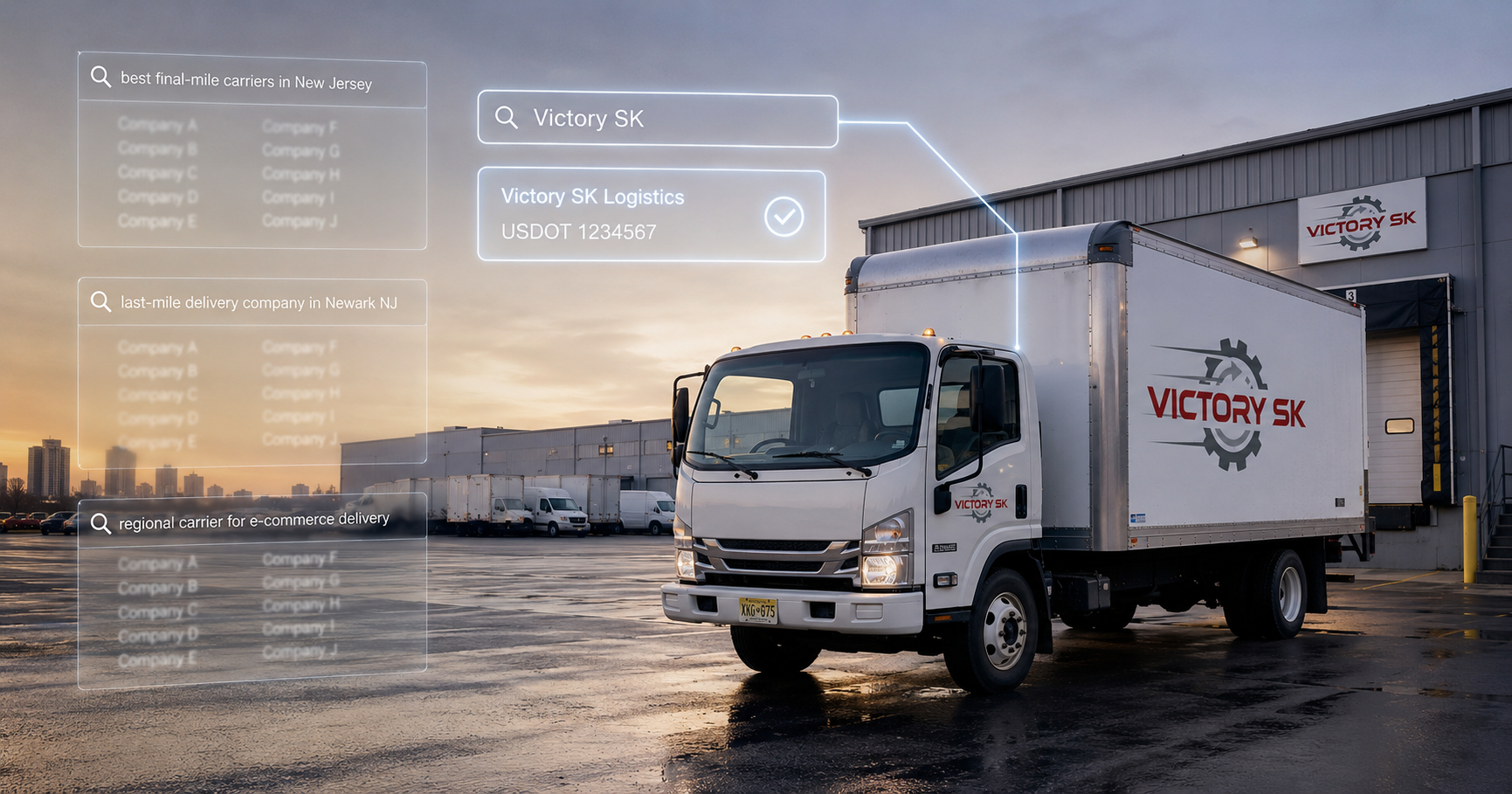
This is the second half of our Victory SK audit. Part one examined the backlink profile and found something unusual: a federal record that's current and accurate, wrapped in directory profiles nobody has claimed, describing a general freight van carrier while the website sells final-mile white glove delivery in 26-ft box trucks. That audit relied on third-party data. This one asks the engines themselves.
We wrote 10 prompts a real buyer might type — four local, three regional, three industry — and ran every one through ChatGPT, Claude, and Gemini in fresh, logged-out sessions with default settings on August 31, 2026. One point each time an engine named Victory SK. Thirty points possible. Every transcript is published unedited below, the same way we did it for Mount Holly Nissan and True Blue Autos.
The result: 11 out of 30 — and a pattern we've now seen enough times to name.
Mount Holly Nissan produced the narrow entity: perfectly resolved, tightly caged, 12/12 on identity and 0/9 on category. Victory SK produces the version one step further back. Every point in this test came from a question that hands the engines the company name or the DOT number. Every question that asked for a category in a territory — furniture delivery in Mercer County, last mile in New Jersey, white glove in the NYC metro, liftgate in the tri-state, a furniture retailer's delivery partner, 26-ft box trucks for B2B — returned zero, while the engines named roughly sixty other carriers and described Victory SK's exact business model doing it.
The engines can look Victory SK up. Nothing on the open web gives them a reason to.
Methodology, stated plainly. Each prompt ran once per engine in a fresh, logged-out session with default settings and web search left as it ships, on August 31, 2026. One point per engine that named Victory SK; 30 possible. AI outputs are non-deterministic — re-running these prompts will produce different wording and possibly different results. We're claiming a diagnostic pattern, not statistical rigor.
One methodological note that matters, and it cuts against the subject. Our test location is Williamstown, in Gloucester County — roughly 45 miles from Princeton and in a different part of the state. Unlike the Mount Holly test, where a South Jersey IP worked in a South Jersey dealer's favor, here the location signal pulls answers away from the subject. You'll see it leak into the transcripts: Claude recommending a Logan Township sort center "in your part of the state," Empire Delivery "for South Jersey specifically." That makes the local-tier absences less damning than they'd otherwise be — and the statewide and category absences, where location explains nothing, more so.
Part One: The Local Tier — 8 of 12
Q1 — "What are the best final mile delivery companies near Princeton, NJ?" — 2/3
Two of three, and the split is the most useful data point in the whole test.
ChatGPT ranked Victory SK first in its comparison table and named it first again in "who I'd contact." Gemini placed it second under local specialists and cited victorysk.com four separate times, paraphrasing the site accurately — 26-foot box trucks, in-house drivers, no subcontractors, seven days a week, tri-state coverage. Both engines read the website and both found it persuasive.
Claude searched places, not the web. Its transcript shows a places tool, and its entire answer is built from Google-graph entities with ratings attached — Port Jersey's rough driver reviews, US 1 Express's local reputation, Nassau Courier. Victory SK has no meaningful Google presence and no reviews anywhere, so there was nothing in that graph to rank. Claude didn't rank them low. It never saw them.
That's the backlink audit's conclusion appearing live: web-retrieval engines find Victory SK because the website is genuinely good. Place-retrieval engines can't, because the entity infrastructure behind it is empty. One line worth sitting with — Claude closed by warning about "thin SEO pages for companies that broker your freight to someone else rather than running their own trucks," and to ask any candidate whether the crews are their employees. That is Victory SK's entire homepage argument, delivered as advice by the engine that omitted them.
Q2 — "Who delivers furniture and appliances to homes in Mercer County, New Jersey?" — 0/3
A shutout one question after a first-place finish, on a query the website answers almost verbatim. Victory SK's residential section reads: furniture, appliances, e-commerce purchases, curbside, threshold, and inside placement. This is that sentence, phrased as a question.
Each engine missed differently, which is what makes the zero diagnostic rather than random.
Claude read it as retailers who deliver what they sell and returned ten Google-graph entities with ratings — Mrs. G Appliances, P.C. Richard, plus movers for items you already own. ChatGPT read it correctly as third-party delivery, said so explicitly ("if you already bought the item"), and named RL Delivery Team in Trenton and Luxury Lifters in Hamilton with direct phone numbers — smaller operators doing precisely Victory SK's job. Gemini built a "Specialized & White-Glove Movers" category, used the phrase "room-of-choice placement," and filled it with Catlow Movers and Stella Delivery.
Note what ChatGPT did here: it ranked Victory SK first in Q1 and could not retrieve them one question later. The entity exists for ChatGPT, but only when the query matches the phrase the website leads with. Change "final mile delivery near Princeton" to "furniture and appliances in Mercer County" and the association breaks. This is the county-level anchor failing the same way "Burlington County" failed for Mount Holly Nissan — and the same way every category-and-territory query in this test will fail.
Q3 — "What's the address and phone number for Victory SK?" — 3/3
A clean sweep, correct on all three, and — as with Mount Holly — worth crediting because it isn't a given. The address and phone match the MCS-150 exactly on every engine.
The interesting part is where each one got it, because they didn't agree.
Gemini cited dot.gov and returned the full "Apt 1," which is how SAFER renders it. It's reading the federal record, not a business listing. ChatGPT returned the same data flatly with no source. Claude found a Google Business listing — it returned a category ("Transportation Service"), the website, and business hours.
Those hours are wrong. Claude reports weekdays 8 AM to 5 PM, closed weekends. Victory SK's website says seven days a week, 7:00 AM to 8:00 PM. That is a live, quotable NAP error in the field a customer actually acts on, and it's telling people the company is closed on Saturday. Part one of this audit recommended creating a Google Business Profile; this transcript corrects that recommendation. Something already exists in the Google graph. The job is to find it, claim it, and fix the hours.
One more detail for the monitor file: both Claude and Gemini offered to look again in case the user meant a different business. The entity resolves, but neither engine is confident it's the only Victory SK.
Q4 — "Is Victory SK LLC a reliable carrier? What's their safety record?" — 3/3
Another sweep, and the richest transcript in the test. This is the broker-vetting question, and all three engines answered it with real federal data.
The safety record itself is good, and both Claude and ChatGPT said so: zero vehicle out-of-service across seven inspections against a 22.26% national average, one driver OOS out of sixteen at roughly the national average, one tow-away crash with no injuries, no HOS or controlled-substance violations. For a four-truck fleet that's a clean sheet.
Three things happened around that clean sheet.
Claude reproduced part one's findings unprompted. It flagged the aggregator disagreement in detail — one directory listing West New York with 5 trucks and a different phone, another listing 18 Bredder Ct in Elmwood Park with 1 truck and a third phone, against SAFER's Princeton with 4 trucks — then framed the risk correctly: mostly stale scraped data, which is common, but mismatched addresses and phone numbers are also how double-brokering and identity theft present in freight, so confirm the contact info traces back to the DOT number on file. That is an AI engine telling a prospective customer to be cautious because of the stale directory records. The frozen 2021 snapshot from part one now has a documented commercial cost.
ChatGPT surfaced an authority lapse. Certificate revoked October 2022, formally reinstated August 4, 2023, and its verdict: "I wouldn't describe them as having ten straight years of uninterrupted operating authority even though the USDOT registration dates back to 2016." Victory SK's homepage says Since 2016 · 10+ Years in Operation. Both statements are defensible; they will not read as consistent to a broker seeing them side by side.
ChatGPT cited the empty CarrierSource profile as a reason to hesitate. "Public feedback is very thin; CarrierSource currently shows zero reviews, so there isn't much independent service history to rely on." Its overall read: 6.5–7 out of 10, conditional approval, verify cargo insurance and check Carrier411 before tendering a high-value load.
That is the unclaimed profile from part one, converted into a lower AI recommendation, in writing. The single cheapest fix in the backlink audit — claim the profile, collect five broker reviews — is the fix for this too.
Local verdict: 8/12. Strong on identity and compliance data. Zero on the one local question that asked for a category instead of a name.
Part Two: The Regional Tier — 0 of 9
Q5 — "Best last mile delivery carriers in New Jersey?" — 0/3
The statewide version of a query Victory SK won locally, and they vanish from it.
Both ChatGPT and Gemini built the exact category Victory SK sells and handed it to someone else. ChatGPT created a "Furniture / white glove" row for Metropolitan Warehouse & Delivery — "room-of-choice placement, assembly and debris removal" — then added G&S Transport Services, described as an "NJ-based specialist in two-person white-glove and furniture delivery, with operations across NJ/NY/PA." That is Victory SK's positioning almost word for word, assigned to a different company. Gemini built a "Specialized & White-Glove Services" bucket for Stella Delivery and separately named GoShare for "box trucks with liftgates" — both differentiators, both awarded elsewhere.
Claude went to parcel and national networks: OnTrac, Veho, UniUni, Jitsu, with Empire Delivery and GoBolt for big-and-bulky. Its answer led with OnTrac's Logan Township facility "in your part of the state," the location signal pulling toward Gloucester County again.
Q6 — "I need white glove delivery with inside placement in the New York City metro. Which carriers should I call?" — 0/3
The most expensive zero in the test, because the person typing this is a qualified buyer with an active shipment.
Roughly eighteen carriers named across three answers, and the engines produced a complete picture of the job Victory SK does: two-person crews, room of choice, assembly, debris removal, certificates of insurance, service-elevator coordination, per-flight charges for walk-ups. ChatGPT published direct phone numbers for six of them — the same behavior we documented when it reproduced a Ford dealer's fleet managers by name and direct line in the Mount Holly test. That is what a legible commercial entity earns.
Claude's answer contains the sharpest line in the audit. It explained that "inside delivery" in LTL tariff language means just past the threshold — no room of choice, no stairs, no assembly, no debris removal, one driver — and that if your spec says inside placement, that tier will fail you. Victory SK's website sells exactly that distinction. Claude drew it, then sent the reader to Metropolitan and Cory Home Delivery.
Nothing about location explains this one. The query has no tie to Princeton, and Victory SK's site claims the five boroughs.
Q7 — "Which carriers offer liftgate delivery for residential deliveries in the tri-state area?" — 0/3
All three engines read "liftgate delivery" as an LTL accessorial rather than a service a dedicated carrier provides. Claude said it outright: liftgate is a standard add-on, not a differentiator. So the category resolved to Old Dominion, Estes, XPO, Saia, R+L, ABF, FedEx Freight, TForce, and A. Duie Pyle.
Then Claude and ChatGPT both drew the distinction Victory SK exists to serve. Claude: liftgate is only curbside, the driver puts the pallet at the end of the driveway and leaves, and if it needs to go into a garage or a room you want a final-mile operator, not an LTL carrier. ChatGPT: residential plus liftgate does not automatically mean garage, threshold, inside-home, or room-of-choice. Both then named JB Hunt, AIT, and Ryder as the operators for that work.
Gemini went furthest and still missed. It built a section specifically for regional carriers running box trucks and straight trucks with hydraulic liftgates for residential delivery — Warp, MCS Courier, FMD Distribution, M&J Freight Line, RIST-AMA. That is a 26-ft box truck liftgate carrier list for the tri-state area. Victory SK is not on it.
Regional verdict: 0/9. Across three queries the engines named more than thirty carriers, described Victory SK's service model repeatedly, and never once named Victory SK. Their recognized radius ends at Princeton.
Part Three: The Industry Tier — 3 of 9
Q8 — "I'm a furniture retailer in New Jersey looking for a final mile delivery partner. Who should I contact?" — 0/3
The highest-intent B2B query in the set, and the most damaging zero. Q6 was a shipper with one load. This is a retailer looking for an ongoing partner — the exact buyer the website is written for, describing exactly the relationship it wants.
Sixteen carriers named, and the answers went well past names. ChatGPT published named humans with direct emails and mobile numbers — Miriam Khan and Mark Bannon at Metropolitan, with addresses and lines; Aria Logistics; AM Home Delivery; J.B. Hunt's final-mile inbox. Dedicated commercial content doesn't just get you into the answer. It gets you into the contact list.
Both Claude and ChatGPT then flagged the employees-versus-subcontractors question as the thing separating good partners from bad — and gave Metropolitan credit for it: "owned trucks and employed teams in Central NJ rather than simply brokering every delivery." Victory SK's homepage leads with in-house drivers and no subcontractors. The engines asked the question Victory SK's answer wins, and awarded the point to someone else.
Claude's closing advice is the one to sit with: under roughly 50 deliveries a week, the nationals will decline you or price you poorly, and a regional is the better call. Claude is telling small furniture retailers to hire a company exactly like Victory SK, then listing Metropolitan, Empire, Harrington, and Booth.
Q9 — "Which carriers in New Jersey run 26-ft box trucks for final mile B2B deliveries?" — 0/3
The definitive zero. This is a spec search: it names the exact equipment, the exact service, the exact state. There is no interpretation gap and no location excuse.
ChatGPT built a table of New Jersey 26-ft box truck carriers and cross-referenced each against FMCSA. MX Logistics in Piscataway, 34 power units. On Time Delivery Service in Fairfield, 9. Space Shipping near Edison, 11. D&C Global Transportations in Roselle — "currently a one-truck operation." A1 Xpress in Freehold. Amfast in Lakewood.
ChatGPT went into the same federal database that lists Victory SK with four power units and a clean inspection record, pulled six carriers out of it, included a one-truck operator, and never surfaced Victory SK.
That is the finding this entire audit rests on. Being in FMCSA's data is not the same as being retrievable from it. The engines reach the federal record when you hand them a name or a DOT number. They build carrier shortlists from websites, directories, and review platforms — surfaces where Victory SK is either absent, unclaimed, or classified as something else.
Two supporting details. ChatGPT rendered a map with review ratings for its six carriers — 4.7, 4.8, 3.8, 5.0, 4.9 — the same Google-graph layer that made Claude blind to Victory SK in Q1 and Q2. And Claude closed by warning that several "NJ final mile" sites surfacing in search are broker landing pages rather than operating carriers, and to pull the MC number in SAFER before signing. Victory SK is the asset-based operating carrier with the clean SAFER record that never appeared in either answer.
Q10 — "What is Victory SK LLC, USDOT 2920161?" — 3/3
A sweep to close, on maximum assistance — we handed the engines the DOT number. All three returned accurate federal data: active status, MC-984608, four power units, four drivers, 240,000 miles in 2025, the Princeton address, the April 2026 MCS-150, and the clean inspection record.
And then both Claude and Gemini did something we didn't expect.
Claude named the stale directories explicitly — Bubba.ai, BrokerSnapshot, PartnerCarrier — noted they "carry stale copies of this data with older addresses and fleet counts," and told the reader SAFER is the one to trust. Gemini flagged "prior history or ties listed in Elmwood Park, NJ" and sourced it to a third-party directory rather than the federal record.
The frozen 2021 snapshot identified in part one is now surfacing inside AI answers about the company, two ways: as a caution from one engine and as a contradictory location claim from another. Stale directory data used to be an SEO abstraction. It is now something a customer reads.
Industry verdict: 3/9.
What This Audit Actually Proves
1. There's a fourth failure mode: the unbuilt entity. True Blue Autos failed by geography. Troncalli failed by memory. Mount Holly Nissan failed by category while being perfectly resolved. Victory SK fails one step further back. Retrieval works — every engine could find the company when handed a name or a DOT number, and the federal data came back accurate every time. But nothing on the open web binds that name to a category or a territory, so no query that doesn't contain the name can reach it. An entity can be accurately resolved and functionally unreachable at the same time.
2. Name-anchored retrieval and category-anchored retrieval are different systems. All eleven points came from questions containing "Victory SK," the DOT number, or the exact phrase the website leads with tied to the town it sits in. Six category-and-territory queries returned zero. This is the cleanest version of the pattern we've documented across four audits now, and it's the one business owners consistently misread — searching their own name, seeing themselves appear, and concluding they're visible.
3. No reviews means invisible to place-retrieval, which is half the engines. Claude answered Q1, Q2, and Q9 from a places tool, ranking businesses by rating and review count. Victory SK has no reviews on any platform: zero on CarrierSource, zero on BrokerSnapshot, and a Google listing so thin that Claude surfaced it in Q3 with the wrong business hours. Web-retrieval engines read the website and liked it. Place-retrieval engines couldn't see the company at all. Reviews aren't reputation decoration in AI search — they're the index.
4. Being in the federal database is not the same as being retrievable from it. Q9 is the proof: ChatGPT queried FMCSA, extracted six New Jersey box-truck carriers including a one-truck operator, and missed the four-truck carrier in the same dataset. Compliance data makes you verifiable. It does not make you findable. Those require different work, and part one of this audit is that work.
5. Stale records have a voice now. Claude's Q4 answer warned a prospective customer that Victory SK's conflicting directory listings resemble the pattern of double-brokering and identity theft — while correctly noting it's probably just stale scraping. That's a reputational cost from an unclaimed directory profile, delivered directly to a buyer, and no amount of website copy intercepts it.
6. Metropolitan Warehouse & Delivery is the entity to study. They appeared in Q1, Q5, Q6, and Q8 — four different phrasings, three engines, twice as the first call. What they have that Victory SK doesn't isn't better trucks. It's a claimed, corroborated, category-legible presence: a documented history since 1989, named employees with direct lines, third-party coverage, and enough consistent signal that four separate queries converge on them.
The Roadmap
Everything above converges with part one into one sequenced plan.
First, become findable in the graph that half these engines read. Find and claim the existing Google listing, fix the business hours error Claude surfaced, set the categories to Delivery Service and Courier Service, and define the service area properly. Then claim CarrierSource and collect five to ten broker reviews from shippers already served. This is free, it takes days rather than months, and it is the single change most likely to move the score.
Second, bind the name to categories. The site currently ranks for its own name and its headline phrase. It needs pages that give the failed queries something to attach to: furniture and appliance delivery, white glove and inside placement, liftgate residential delivery, 26-ft box truck B2B capacity — each as a real page with real detail, not a service bullet.
Third, bind the name to territory. Mercer County, Burlington County, the NYC metro, the tri-state area, and the Newark–Elizabeth–Edison corridor Claude identified as where this work concentrates. Written as pages with proof, and reinforced in areaServed schema.
Fourth, fix the classification problem from part one. Every directory inherits "General Freight" from FMCSA. Use every free-text and category field on claimed profiles to state final-mile, white glove, liftgate, and box truck service explicitly. The engines describe this business correctly when they read the website; they need the same description from sources they trust more.
Fifth, resolve the record contradictions that are now reaching customers. Get Rose Rocket and the other stale scrapers corrected so Claude stops flagging address mismatches to prospective buyers. Reconcile the "Since 2016" claim with the 2022–2023 authority gap that ChatGPT surfaces unprompted.
Sixth, build the one thing the engines already asked for. Across Q6, Q8, and Q9, ChatGPT published named contacts with direct phone numbers and emails for competing carriers. A named human with a direct line, on the website, is a retrievable fact. Right now there isn't one.
Then re-run these ten prompts quarterly and watch the zeros. The honest timeline is months, not days — the same timeline part one gave for the backlink work, because it's the same work.
Frequently Asked Questions
How was this test scored?
Ten prompts, each run once through ChatGPT, Claude, and Gemini in fresh, logged-out sessions with default settings on August 31, 2026, from a Williamstown, New Jersey location. One point each time an engine named Victory SK; 30 possible. Victory SK scored 11 — Local 8/12, Regional 0/9, Industry 3/9; by engine, ChatGPT 4/10, Gemini 4/10, Claude 3/10. Every transcript is published unedited above. AI outputs are non-deterministic; re-running these prompts will produce different results. We claim a diagnostic pattern, not statistical rigor.
Is 11 out of 30 bad?
The number matters less than where the points came from. Every one of the eleven came from a question containing the company name, the DOT number, or the website's exact headline phrase tied to its own town. Six queries asking for a category in a territory returned zero. A carrier scoring an even 11 across all ten prompts would have a completely different problem and need a completely different plan. The split is the diagnosis; the total is just the headline.
Why did Victory SK win a first-place ranking in Q1 and disappear in Q2?
Because those questions retrieve differently. Q1 named the service the website leads with, tied to the town the company sits in, and ChatGPT and Gemini both read victorysk.com directly and liked what they found. Q2 asked for a product category in a county. Nothing on the open web associates Victory SK with "furniture and appliances" or "Mercer County," so there was nothing to retrieve — even though the website sells exactly that. Category associations are built by content and third-party corroboration, not by having the service on your site.
Why did Claude score lowest when it gave the most detailed answers?
Because Claude reached for a places tool on the category questions, and places data is Google-graph data — businesses ranked by rating and review count. Victory SK has no reviews anywhere and a thin Google listing, so it wasn't in the candidate pool. Claude scored well on the questions it answered from the open web (Q3, Q4, Q10) and missed every question it answered from places. That's not a weakness in the engine; it's a precise map of where the entity is missing.
What was the single most surprising result?
Q9. ChatGPT built a table of New Jersey carriers running 26-ft box trucks and cross-referenced each one against FMCSA — including a carrier in Roselle it described as "currently a one-truck operation." It queried the same federal database that lists Victory SK with four power units and a clean inspection record, and never surfaced them. Being in the data is not the same as being retrievable from it.
Do the AI engines say anything negative about Victory SK?
Yes, and it's fixable. ChatGPT's carrier-vetting answer landed on "6.5–7 out of 10, conditional approval," citing an authority revocation in October 2022 with reinstatement in August 2023, a driver-qualification violation, and — notably — that CarrierSource shows zero reviews so there's little independent service history to rely on. Claude separately warned that the conflicting addresses across directory sites resemble the pattern of double-brokering and identity theft, while correctly noting it's most likely stale scraped data. Both concerns trace back to unclaimed profiles and uncorrected records, which is exactly what part one of this audit recommended fixing.
Does the Williamstown test location explain the low score?
It explains part of the local tier and none of the rest. Williamstown is about 45 miles from Princeton in a different region of the state, so the location signal actively pulled answers away from the subject — you can see it in Claude's Q5 answer leading with a Gloucester County sort center. But Q6 asked about the NYC metro, Q7 about the tri-state area, and Q5, Q8, and Q9 about New Jersey statewide. Location doesn't explain a statewide or metro-wide absence. If anything, a Princeton-based test would likely have raised the local tier and left the regional and industry zeros untouched.
What's the fastest thing to fix?
Claim the Google listing and correct the business hours. In Q3, Claude reported Victory SK as open weekdays 8 AM to 5 PM and closed weekends; the website says seven days a week, 7 AM to 8 PM. An engine is currently telling potential customers this company is closed on Saturday. That's a free fix, it takes minutes, and it's live right now.
Can you run this test on my business?
Yes — it's the free visibility check, and it's this exact methodology: ten prompts written for your industry, run across ChatGPT, Claude, and Gemini, the unedited transcripts, your scorecard against the patterns from every audit we've published, and a plain-English read on which failure mode is holding you back and what we'd fix first. One email, real reply from the founder within a business day, whether or not you ever hire us.
Get your free AI visibility check →
Methodology and sources: All AI responses captured August 31, 2026 from ChatGPT, Claude, and Gemini in fresh, logged-out sessions with default settings from a Williamstown, NJ location; transcripts reproduced unedited above. Scoring framework is Ritner Digital's and is directional rather than statistical. Referenced throughout: Ritner Digital — Victory SK backlink audit · Ritner Digital — Mount Holly Nissan 30-prompt test · FMCSA SAFER Company Snapshot, USDOT 2920161 · victorysk.com