An 83.3 Accessibility Score Is Actually Exceptional — Here's the Data to Prove It
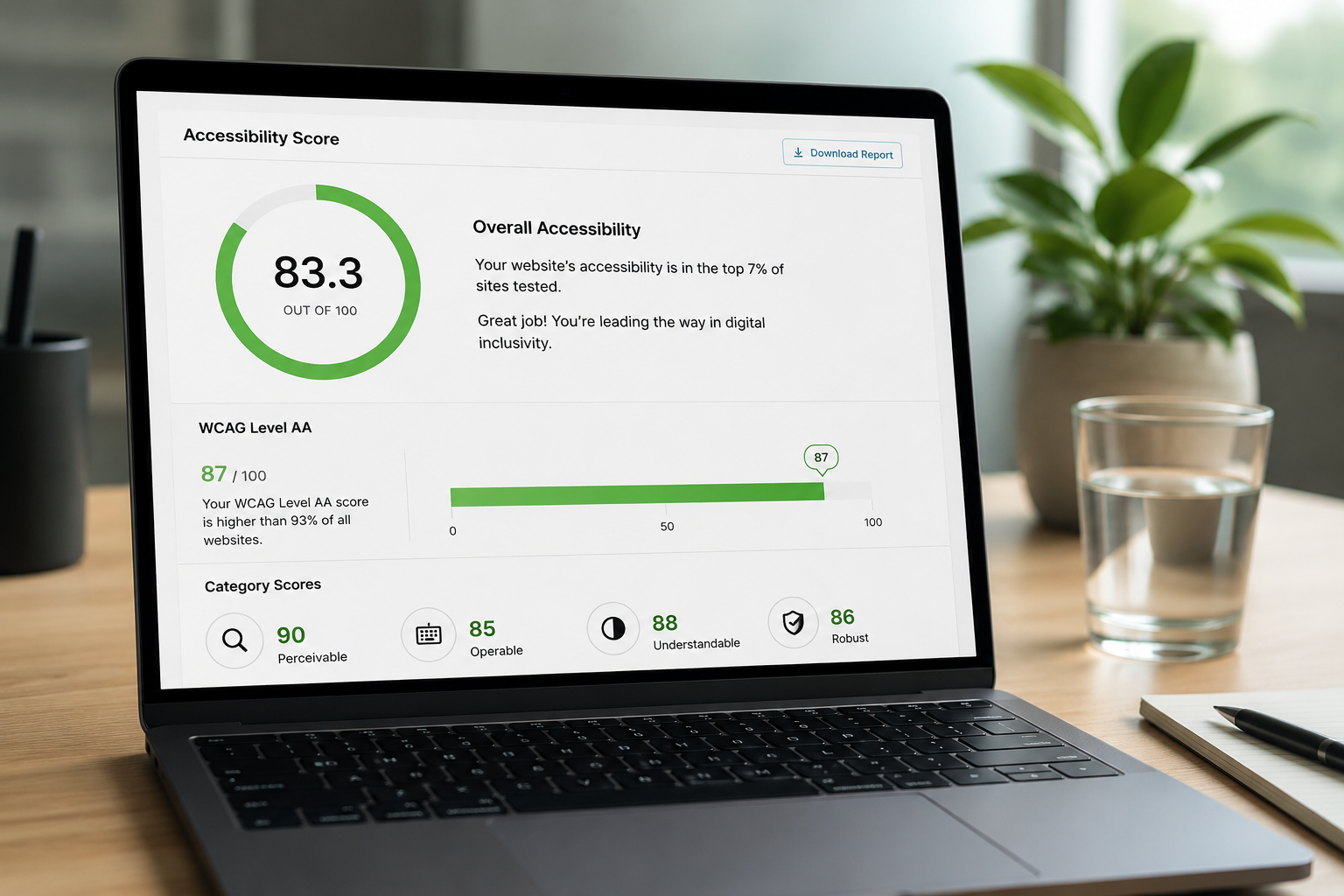
When most people glance at an accessibility score, they apply the same instinct they would to a school grade: 83 out of 100 sounds like a solid B, nothing to write home about. But web accessibility isn't graded on that curve. In reality, an overall score of 83.3 — combined with a 91.5 on Level A and an 87 on Level AA — puts a website in genuinely rare territory. This post breaks down exactly why, using current industry data, and explains what it means for your organization in today's legal and regulatory environment.
The Benchmark Nobody Talks About: Most Websites Are Failing Completely
Before you can appreciate what a score in the 80s means, you need to understand how catastrophically bad the average website performs.
According to WebAIM's 2026 Million report — the most comprehensive annual audit of web accessibility, covering the top one million homepages — 56,114,377 distinct accessibility errors were detected across those pages, averaging 56.1 errors per page. That number actually got worse year over year: errors increased 10.1% since the 2025 analysis. WebAIMWebAIM
More striking is the overall failure rate. 95.9% of home pages had detected WCAG 2 failures — reversing a trend of small improvements each of the previous six years. Because only automatically detectable failures were considered, this suggests that the rate of full WCAG 2 A/AA conformance was certainly lower than 4.1%. WebAIM
Read that again: fewer than 4 out of every 100 websites can be considered even automatically conformant at the baseline Level A/AA standard. The vast majority of the web is inaccessible by any meaningful measure.
Year-over-year data shows a slow but measurable decline in the percentage of sites with errors, from 98.1% in 2020 to 94.8% in 2025 — but six years of effort have produced only a 3.1% improvement. Accessibility
What "80 or Above" Actually Means
If you're wondering where a score of 83.3 sits in relation to the rest of the web, the answer is: near the very top.
Only 7% of sites achieved a score of 80 or above, which is considered a minimum threshold for reasonable accessibility. Accessibility
Seven percent. That means 93% of websites don't clear the bar that this score clears — and that bar is just the floor for what experts consider "reasonable." Scoring an 83.3 overall, with an 87 on Level AA, isn't mediocre. It's better than nine out of ten sites on the internet.
A good accessibility score typically ranges around 80–100%. This range indicates that the website meets most of the WCAG criteria, making it highly accessible to a variety of users. Scores in this bracket reflect a strong commitment to inclusivity and compliance with best practices in web design. AgencyAnalytics
Breaking Down the Score: Level A, AA, and AAA
Three distinct WCAG conformance levels appear in a typical accessibility overview, and understanding what each one demands puts the numbers in sharp relief.
Level A (91.5/100) is the baseline — the criteria that have the greatest potential impact on users with disabilities. A score of 91.5 here is excellent, and difficult to achieve across a complex, content-rich website. Level A includes issues with the greatest potential impact on real-life users — for example, prohibiting keyboard traps that prevent keyboard users from navigating content. Getting 91.5 on these critical criteria means the site is navigable for the users most at risk of being excluded entirely. AudioEye
Level AA (87/100) is the legal compliance standard. This is what the DOJ, the ADA, and international regulations require. Level AA includes all Level A criteria, along with additional requirements that could impact users — for example, requirements for color contrast. An 87 here is genuinely strong. In Silktide's analysis of 6,554 websites, the median WCAG AA score for private sector organizations was just 43 out of 100. An 87 is more than double the private sector median. AudioEyeSilktide
Level AAA (42.1/100) is where even the most advanced, accessibility-dedicated organizations struggle. AAA conformance demands a 7:1 contrast ratio for normal text — among many other stringent criteria that go far beyond what most websites are even attempting. A score of 42.1 here isn't a failure; AAA full conformance is considered aspirational even by accessibility specialists, and is not required by any law. Httparchive
The Most Common Failures — And Why Avoiding Them Is Harder Than It Looks
Context matters here. The single most pervasive accessibility problem on the web isn't something obscure or technical — it's text contrast. Low contrast text, below the WCAG 2 AA thresholds, was found on 83.9% of home pages in 2026 — the most commonly detected accessibility issue, with an average of 34 distinct instances of low-contrast text per home page. WebAIM
That single issue affects more than four out of five websites. A site scoring 87 on Level AA has largely addressed it. That's not a small thing.
Other common issues compound the problem. The three most common categories of web accessibility failures are image accessibility (missing or inadequate alt text), link accessibility (links without clear descriptive text), and form accessibility (form fields missing labels). AudioEye's research found that 38% of images had no alt text, 80% of pages had links that were not clear to users with disabilities, and 35% of forms failed to provide descriptive labels. AudioEye
The fact that an 87 Level AA score exists while the majority of the web is still tripping over contrast ratios and missing alt text illustrates exactly how much sustained effort goes into reaching this result.
Why This Matters More Than Ever: The Legal Stakes in 2025–2026
This isn't just a feel-good metric or a badge for the about page. Web accessibility has become one of the fastest-growing areas of litigation in the United States, and the risk is real for organizations of every size.
2025 was the highest-volume year ever recorded for ADA website accessibility lawsuits. Over 5,100 federal cases were filed, representing a 37% increase over the approximately 3,700 cases filed in 2024. Adascanpro
Settlements typically range from $5,000 to $75,000, plus attorney fees, redesign costs, and monitoring expenses. And those are just the cases that settle quietly. Clym
In the first half of 2025 alone, more than 2,000 ADA website accessibility lawsuits were filed — a 37% increase compared to the same period in 2024. Nearly 70% of these lawsuits targeted e-commerce retailers, many of them small businesses with annual revenues under $25 million. AudioEye
The regulatory side is tightening too. The Department of Justice's ADA Title II final rule requires state and local governments to conform to WCAG 2.1 AA by April 2026. And for any organization with a global audience: the European Accessibility Act took effect June 28, 2025, with penalties reaching €100,000 per violation or 4% of annual revenue. PR NewswireWCAGsafe
A strong Level AA score of 87 is one of the most concrete risk-reduction assets an organization can have in this environment.
The WAI-ARIA and Best Practices Scores in Context
Two additional dimensions round out a full accessibility picture: WAI-ARIA authoring practices and accessibility best practices.
WAI-ARIA (Accessible Rich Internet Applications) is a specialized technical layer that helps assistive technologies — screen readers, switch access devices, braille displays — understand dynamic, JavaScript-driven interfaces. It's notoriously difficult to implement correctly. A score in the low-to-mid 60s reflects a site that is actively using ARIA markup (many sites use none at all), with room to refine implementation. This is a common gap even among organizations with strong overall scores, because ARIA requires ongoing attention as interfaces evolve.
A best practices score in the mid-70s similarly reflects a site that is doing the work — scoring well above the majority of the web — while still having a clear roadmap for improvement. Together, these scores paint a picture of an organization that has invested meaningfully in accessibility and has actionable next steps rather than starting from zero.
What a Score History Tells You
When an accessibility dashboard shows a score trending upward over time, that's significant. It didn't happen overnight. An improving trend line represents iterative work — audits, fixes, retesting, and refinement across months or years. That's how real accessibility progress works.
The slow improvement in industry-wide accessibility scores suggests that efforts to reduce page complexity and improve accessibility may be gaining traction — but the gains are hard-won. A sustained upward trajectory in accessibility scoring is evidence of genuine organizational commitment, not a one-time checkbox exercise. Accessibility
The Business Case Beyond Compliance
The legal and ethical case for accessibility is clear — but the business case is just as compelling.
Over 61 million adults in the United States live with some type of disability, according to the CDC — approximately 1 in 4 US adults. Globally, the WHO estimates that 1.3 billion people, or 16% of the world's population, experience significant disability. AudioEye
Americans with disabilities have approximately $490 billion in disposable income. An accessible website reaches this audience. An inaccessible one does not. AudioEye
According to AudioEye's 2026 Accessibility Advantage Report, 62% of business leaders believe customers have abandoned transactions due to accessibility issues — representing measurable revenue loss for organizations that have not prioritized accessibility. AudioEye
An 83.3 overall score, and particularly an 87 on the legally mandated Level AA standard, means that the vast majority of users with disabilities can access, navigate, and use the site. That's not a compliance footnote. That's a meaningfully larger addressable audience.
The Bottom Line
Let's put the numbers side by side one more time:
95.9% of the top million websites have detectable WCAG failures
Only 7% of sites score 80 or above — the minimum threshold for reasonable accessibility
The private sector median Level AA score is 43 out of 100
Level AA score of 87 is more than double that median
Overall score of 83.3 places a site in the top 7% of the entire web
An 83.3 accessibility score isn't a "pretty good" result. It's a top-7% result, on a metric where the average organization is failing outright, in a legal environment where that failure is increasingly expensive.
This is a legitimate competitive differentiator, a meaningful risk reduction, and evidence of organizational values that extend to every user — regardless of ability.
Ready to Know Where Your Site Stands?
Whether you're curious about your current accessibility score, trying to understand your legal exposure, or ready to move the needle on WCAG compliance, Ritner Digital can help. We audit, strategize, and implement — turning accessibility data into action.
Get in touch with the Ritner Digital team →
Sources: WebAIM Million Report (2026); AudioEye Web Accessibility Statistics (2026); accessibility.build State of Web Accessibility (2026); Silktide Analysis of 6,554 Websites; AgencyAnalytics Accessibility Score KPI Definition; HTTP Archive Web Almanac Accessibility (2025); EcomBack Mid-Year ADA Lawsuit Report (2025); AdaScanPro ADA Lawsuit Statistics 2025; WCAGsafe ADA Lawsuit Statistics.
Frequently Asked Questions
What is a good website accessibility score?
A good accessibility score typically ranges around 80–100%. This range indicates that the website meets most of the WCAG criteria, making it highly accessible to a variety of users. In practice, only 7% of sites achieve a score of 80 or above, making anything in that range genuinely exceptional. AgencyAnalyticsAccessibility
What is the difference between WCAG Level A, AA, and AAA?
Level A covers the most critical barriers — things like keyboard navigation and missing alt text. Level AA adds requirements like color contrast and is the standard required by the ADA and most international accessibility laws. Level AAA is the most stringent tier and is considered aspirational; AAA conformance demands a 7:1 contrast ratio for normal text and is not required by any current law. Httparchive
Is an 87 Level AA score considered compliant?
No accessibility score alone guarantees legal compliance, since automated tools can't catch every issue. However, an 87 on Level AA places a site well above the industry average — the median WCAG AA score for private sector organizations is just 43 out of 100 — and demonstrates a serious, documented commitment to meeting the standard courts and regulators rely on. Silktide
Can my business be sued over website accessibility even if we're not a government agency?
Yes. Over 5,100 federal ADA website accessibility lawsuits were filed in 2025 alone — a 37% increase over 2024. Nearly 70% of these lawsuits targeted e-commerce retailers, many of them small businesses with annual revenues under $25 million. Private businesses of all sizes are being targeted. AdascanproAudioEye
What is WAI-ARIA and why does it matter?
WAI-ARIA (Accessible Rich Internet Applications) is a technical specification that helps assistive technologies like screen readers understand dynamic web content — things like dropdown menus, modal dialogs, and live-updating feeds. It's one of the harder areas of accessibility to implement correctly, which is why even sites with strong overall scores often have room to improve here.
How long does it take to improve an accessibility score?
It depends on the size and complexity of your site, but meaningful improvement is rarely instant. The sites with the strongest scores have typically gone through multiple rounds of auditing, remediation, and retesting over months or years. A rising score over time is the most reliable indicator of genuine progress.
What is the European Accessibility Act and does it affect US businesses?
The European Accessibility Act took effect June 28, 2025, with penalties reaching €100,000 per violation or 4% of annual revenue. If your organization serves customers in the EU — even through an e-commerce store — you may be subject to its requirements, which align closely with WCAG 2.1 AA. WCAGsafe
How do I find out my website's current accessibility score?
The best starting point is a professional accessibility audit that combines automated scanning with manual testing. Automated tools catch a significant portion of issues but miss others that require human review. Ritner Digital offers accessibility audits that give you a clear picture of where you stand and a prioritized roadmap for improvement. Reach out here.