Did Claude Get Worse at Writing? What the Data Actually Says in June 2026
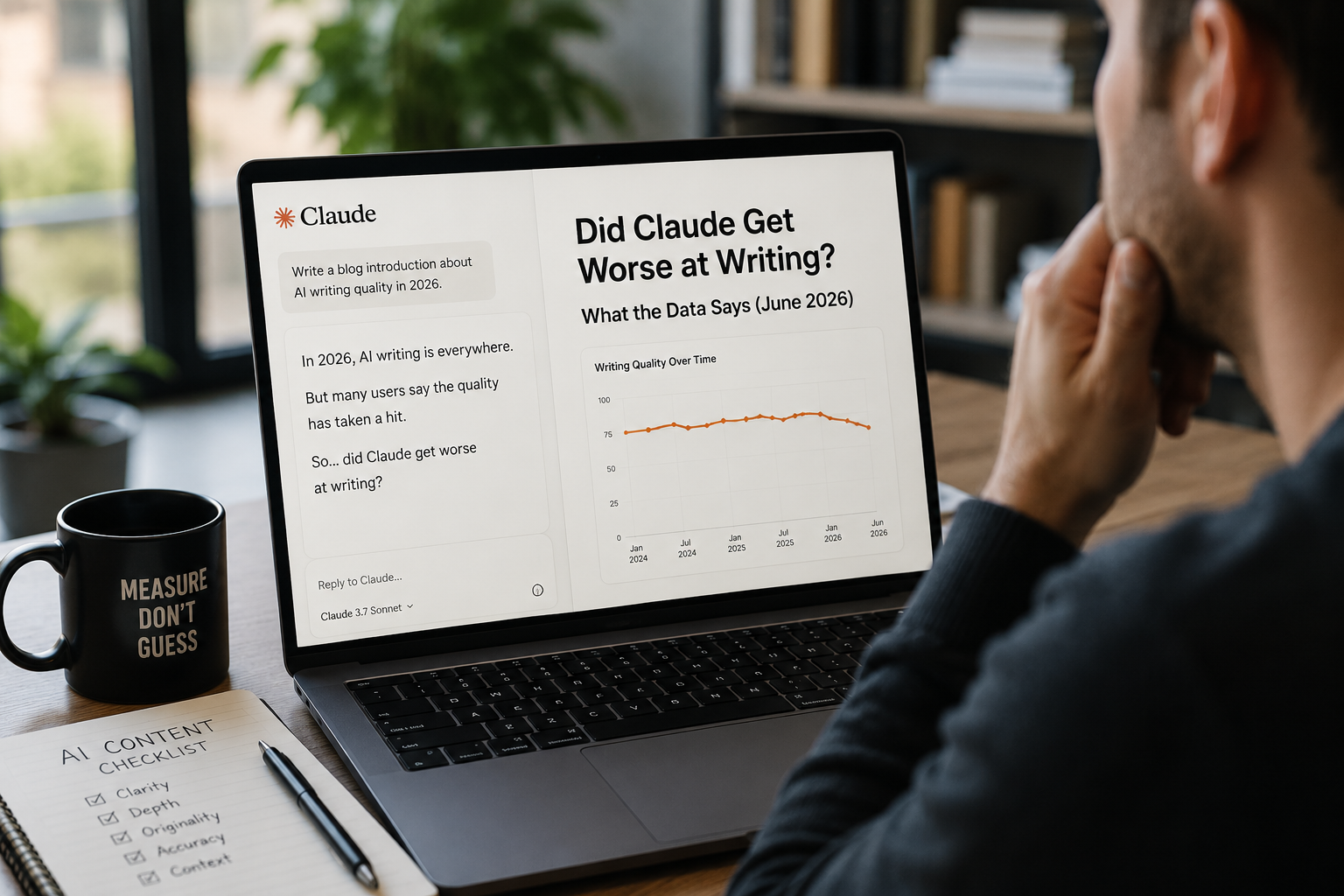
If you spend any time in AI communities, you've seen the posts. "Is it me, or has Claude gotten worse at writing?" The sentiment has been circulating on LinkedIn, Reddit, and developer forums for months. As of June 2026, it's one of the most persistent recurring complaints about the model.
So is it true? The honest answer is: partly, sometimes, and mostly not in the way people think. Here's what the evidence actually shows.
The documented regressions were real — but they were about coding, not writing
The single most important fact to get straight: nearly every confirmed Claude quality regression in 2026 has been about Claude Code, the agentic coding tool — not about writing in the consumer chat interface or the raw API.
On April 23, 2026, Anthropic published a technical post-mortem identifying three separate product-layer changes responsible for the reported quality issues. Critically, the company stated: "We never intentionally degrade our models, and we were able to immediately confirm that our API and inference layer were unaffected."
According to InfoQ's breakdown of the post-mortem, the three overlapping changes shipped between March and April 2026, each affecting a different slice of traffic: a reasoning-effort downgrade (default switched from "high" to "medium" on March 4 to fix UI latency), a caching bug, and a verbosity cap. All three were resolved by April 20 in version v2.1.116, and the underlying model weights and API were never affected.
The controversy had real teeth because the evidence was rigorous. Stella Laurenzo, a Senior Director in AMD's AI group, published an audit of 6,852 Claude Code session files and over 234,000 tool calls showing measurable performance decline. This wasn't gut feeling — it was logs.
Why this matters for the writing question
Here's the catch. The verbosity cap and the reasoning-effort downgrade are exactly the kinds of changes that would make writing feel worse, even if the model itself is unchanged.
When a system is told to be "short and concise" and to skip "narrating deliberation," it produces output that's faster but thinner — less re-reading of source material, less structural care, more "plausible and confident" over "matches the source," as the InfoQ analysis describes. For coding, that showed up as shallow fixes. For writing, the equivalent symptom is prose that feels flatter, more generic, less considered — the precise complaint people have been voicing.
So the people saying "writing feels worse" weren't necessarily wrong. They may have been feeling the downstream effect of product-layer tuning (especially in Claude Code, Cowork, and the Agent SDK) rather than a change to the model's actual writing ability.
The broader pattern: this keeps happening
The June 2026 grumbling didn't come from nowhere. There's a documented history:
August–September 2025: Anthropic confirmed two separate bugs degraded output quality for Sonnet 4 and Haiku 3.5, with the company emphasizing it "never intentionally degrade[s] model quality as a result of demand."
December 2025: Five documented incidents in a single month, per community tracking.
Late January 2026: A harness issue introduced on January 26 caused a quality regression that was rolled back on January 28.
March–April 2026: The six-week Claude Code episode covered above.
The recurring cycle, as one substack analysis put it: users report degradation, Anthropic stays quiet, external pressure mounts, and then a post-mortem attributes it to infrastructure or product bugs. Part of the strain is growth — a surge in users since late February reportedly doubled Anthropic's paid subscriber base, and more load means more routing changes and more chances for exactly these bugs.
"Perceived" vs. "actual" — the part nobody wants to hear
There's a second, less comfortable explanation that runs alongside the real bugs: a meaningful share of "it got worse" is perception, not regression.
Anthropic's own response to the controversy focused on separating perceived changes from actual model degradation. And a diagnostic guide on the "Opus got worse" complaint makes the point bluntly: a model can feel worse for at least four reasons that have nothing to do with the weights changing — the wrong thinking mode, long-thread "context rot," shared usage pressure, or routing differences between claude.ai, the API, and Claude Code.
That last point matters for writers specifically. "Context rot" — where instructions given early in a long session get "forgotten" because the model can't reliably retrieve them from deep in a bloated context — produces output that genuinely degrades over a session, even when the model is fine. If you've ever had a long editing conversation slowly drift off-tone, you've likely experienced this rather than a model downgrade.
So, did Claude get worse at writing in June 2026?
Pulling it together:
Confirmed model-weight regression in writing? No public evidence of that as of June 2026. Anthropic maintains the API and model layer were unaffected, and benchmark-based claims of decline have been disputed by some researchers as methodologically inconsistent.
Real product-layer changes that made writing feel worse? Yes — verbosity caps and reasoning downgrades, especially in Claude Code/Cowork, were documented and have since been reverted.
Perception, context rot, and surface differences? A large and underappreciated share of the complaints.
The most accurate summary is that "Claude got worse at writing" is a real signal pointing at a real cause — just not always the cause people assume. The fix was largely shipped by late April. If writing still feels off in your workflow, the more likely culprits now are long-session context decay, the surface you're using, or your prompting, not a secretly nerfed model.
The real lesson for anyone publishing with AI
This whole saga is a case study in a principle that goes well beyond Claude: you cannot manage what you don't measure, and you cannot trust what you can't verify.
The reason the truth eventually came out wasn't vibes — it was Laurenzo's 234,000-tool-call audit and detailed community reports Anthropic credited with isolating the bugs. For brands relying on AI to produce content at scale, the takeaway is the same one we apply to search visibility: don't run on impressions. Benchmark your output, document what good looks like, and you'll know the difference between a real regression and a bad week.
Building content and search authority you can actually measure
At Ritner Digital, we don't believe in hiding the scoreboard. We publish our own benchmark reports and Search Console data, and we apply that same measure-everything discipline to content built with — and around — AI tools.
Whether you're using Claude, ChatGPT, or Gemini to scale content, the brands that win in AI search aren't the ones producing the most output. They're the ones producing verifiable, authoritative content that ChatGPT, Perplexity, Gemini, and Google AI Overviews trust enough to cite.
Tell us where you are now and what you're trying to grow. You'll get clear next steps within one business day.
Sources
VentureBeat — Mystery solved: Anthropic reveals changes to Claude's harnesses caused degradation
VentureBeat — Is Anthropic 'nerfing' Claude? Users report performance degradation
InfoQ — Anthropic Traces Six Weeks of Claude Code Quality Complaints to Three Product Changes
Kingy AI — Anthropic Admits Claude Code Got Dumber — Not Claude (Post-Mortem)
Anthropic Status Page — August–September 2025 degradation incidents
Grizzly Peak Software — Claude Code Quality Drops & Context Rot
Laozhang Blog — Claude Opus 4.6 Got Worse? Diagnosing Thinking, Context Loss, and Routing
LinkedIn — "Is it me or has Claude gotten a bit worse at writing?"
Reflects reporting and community discussion available as of June 2026. Where claims are disputed or unconfirmed, that is noted inline. Verify any statistic before publishing
Frequently Asked Questions
Did Claude actually get worse at writing in 2026?
There's no public, benchmark-backed evidence of a writing-specific model regression as of June 2026. Anthropic maintains its API and inference layer were unaffected throughout the 2026 incidents, and some researchers dispute the benchmark comparisons that claimed decline as methodologically inconsistent. That said, real product-layer changes did make output feel worse for many users — so the complaint points at a real cause, just not a changed model.
What did Anthropic actually confirm was wrong?
On April 23, 2026, Anthropic published a post-mortem identifying three overlapping product-layer changes: a reasoning-effort downgrade (default switched from "high" to "medium" on March 4), a caching bug, and a verbosity cap. Per InfoQ's breakdown, all three affected Claude Code, Cowork, and the Agent SDK between March and April 2026 — not the raw model — and were resolved by April 20 in version v2.1.116.
Was the problem in Claude Code or in regular Claude chat?
Overwhelmingly Claude Code. The documented, confirmed regressions targeted the agentic coding tool and related surfaces. Anthropic stated the API and model weights were never affected. Complaints about the consumer chat or writing quality are largely a mix of downstream product tuning, perception, and session-level issues rather than a confirmed model change.
Why would coding changes make writing feel worse?
Because the same tuning that hurt code hits prose too. When a system is told to be "short and concise" and to skip narrating its reasoning, output gets faster but thinner — less re-reading of source material and a bias toward "plausible and confident" over careful. For code that meant shallow fixes; for writing it means flatter, more generic prose. A verbosity cap is exactly the kind of change that makes good writing feel worse without touching the model's actual ability.
Does Anthropic intentionally slow down or "nerf" Claude to save money?
Anthropic has repeatedly denied it. The company states it never intentionally degrades model quality as a result of demand or cost, and its Claude Code lead publicly called the "secretly nerfed" accusation false. The confirmed issues were attributed to infrastructure and product-layer bugs, not deliberate throttling — though the recurring pattern has understandably fueled user skepticism.
Is this the first time Claude has had quality issues?
No. There's a documented history through 2025–2026: Anthropic confirmed two bugs degraded output quality in August–September 2025, community trackers logged five incidents in December 2025, a late-January 2026 harness issue was rolled back within two days, and then the March–April 2026 Claude Code episode. Rapid user growth has stress-tested the infrastructure, increasing the odds of exactly these bugs.
What is "context rot" and could it be the real reason my writing feels worse?
Possibly, yes. "Context rot" is when instructions given early in a long session get effectively "forgotten" because the model can't reliably retrieve them from deep in a bloated context. Output drifts off-tone or off-instruction as the conversation grows — even when the model itself is fine. If a long editing session slowly degrades, this is a more likely culprit than a model downgrade.
How can I tell if Claude really regressed or if it's just my setup?
Isolate one variable at a time. A diagnostic guide on the issue recommends starting a fresh session on one fixed surface, then changing only one thing — thinking mode, thread length, usage load, or which surface you're on (claude.ai vs. API vs. Claude Code). If the same task still comes out shallow or inconsistent after the relevant fix, document it as a repeatable issue worth escalating. Most "it got worse" cases trace back to one of those four variables.
How should brands protect content quality when using AI?
Measure and verify rather than trust the vibe. The 2026 regressions were only proven through a 234,000-tool-call auditand detailed community reports Anthropic credited with isolating the bugs. Benchmark your output against a known-good standard, keep sessions focused to avoid context rot, and fact-check anything you publish — the same measure-everything discipline that separates real search authority from guesswork.