Why Video Accelerates Trust on Websites and for Brands
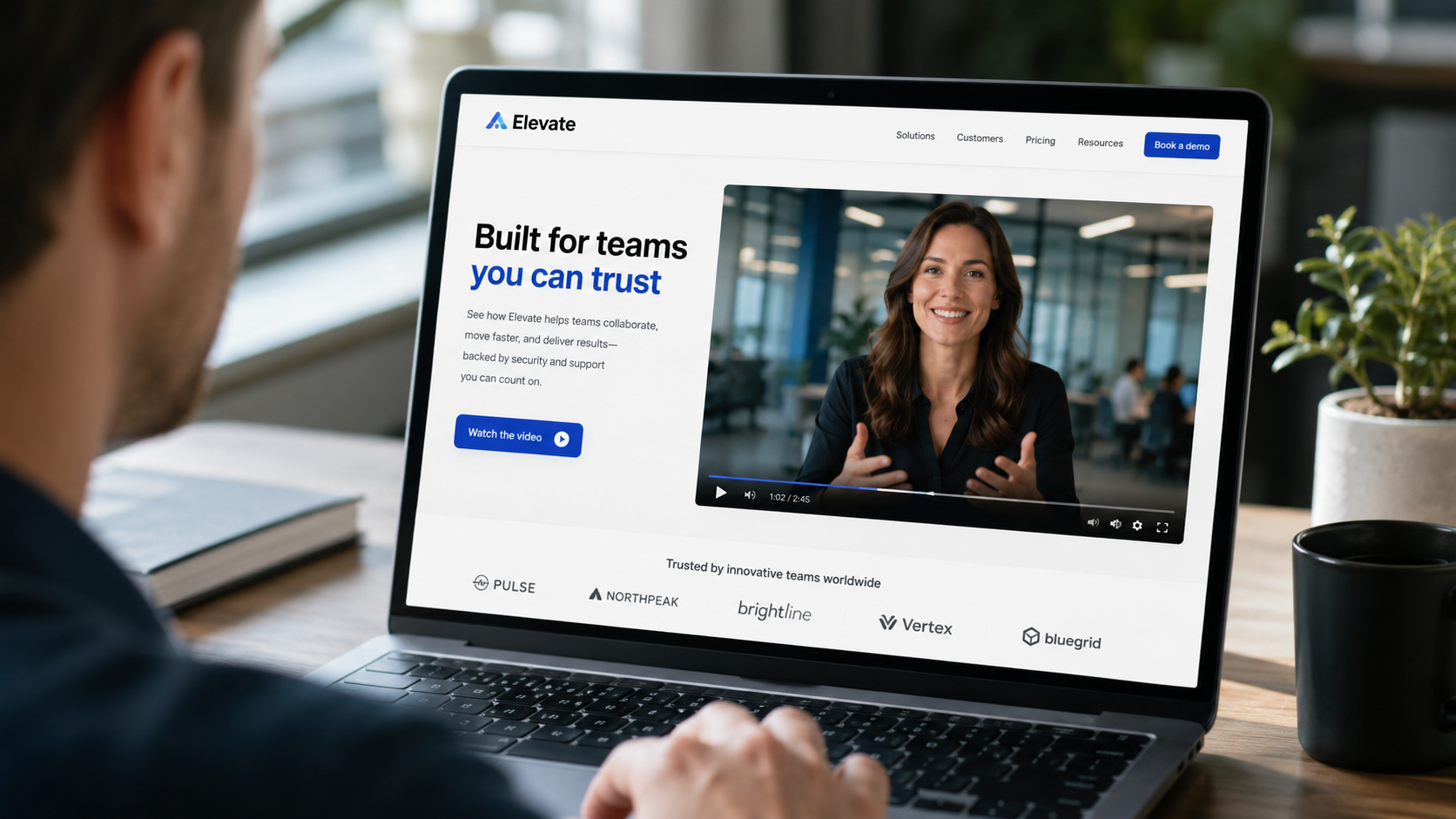
There's a moment that happens on every website that most brands never think about. A visitor lands on your page, and before they read a single word of your value proposition, before they evaluate your offer, before they even register what you do, their brain has already started forming a verdict: Can I trust these people?
That verdict is fast. Princeton psychologists found that people form impressions of strangers from their faces alone in roughly a tenth of a second, with the amygdala responding automatically based on how trustworthy a face appears. That is not a marketing statistic. That is neuroscience describing how the human brain has worked for as long as humans have existed. And it has a direct, measurable consequence for the way buyers behave online.
The problem is that most websites are built almost entirely out of the one medium the brain trusts least on first contact: text. Text is one-dimensional. It carries no face, no voice, no body language, no tone. It asks a skeptical visitor to do the work of believing you on words alone. Video does the opposite. It hands the brain exactly the signals it evolved to read.
This is why video doesn't just support trust on a website. It accelerates it.
Trust is the actual bottleneck, not attention
It's tempting to think the job of a website is to grab attention. But attention is rarely the constraint for a business that already has traffic. The constraint is conversion, and conversion is gated by trust. A visitor who doesn't trust you doesn't fill out the form, doesn't book the call, and doesn't buy.
The data on this is striking. Trust signals on a page — testimonials, badges, security seals, client logos — collectively increase conversion by 34 to 42%, because credibility is what removes purchase hesitation. Notice what that number is really measuring. It isn't measuring whether people saw your page. It's measuring whether they believed it enough to act. When you raise trust, conversion follows.
Video is the densest trust signal available because it stacks credibility cues that text cannot carry. Personalized and human-led videos use facial expressions, tone of voice, and body language — biological signals that bypass skepticism and build an emotional connection text can't replicate. The same principle is why video feels "safe" to a wary buyer: it mimics face-to-face interaction, which remains the gold standard for building relationships.
The conversion numbers are not subtle
If trust drives conversion and video drives trust, you'd expect video to move conversion rates meaningfully. It does — to a degree that, frankly, looks exaggerated until you see it replicated across independent sources.
Embedding a relevant video on a landing page has been found to increase conversions by as much as 86%, a figure that traces back to research by EyeView and has been cited consistently across the conversion-optimization industry. Marketers themselves rank video as the single most impactful page element: 38.6% say video content has the biggest positive effect on landing page conversion rates — more than any other element on the page.
The mechanism behind that lift is information retention. Viewers retain roughly 95% of a message when they watch it in video, compared with about 10% when they read it as text. Put plainly: video doesn't just persuade better, it sticks better. The message survives the gap between the moment of viewing and the moment of decision.
A few more data points that reinforce the same direction:
Adding a video to a product page can increase purchases by 85%, and 64% of consumers are more likely to buy a product after seeing it in a video.
73% of people say they prefer to learn about a product or service by watching a video rather than reading text — meaning text-first pages are working against the format buyers actually want.
None of this means video is a magic switch. Recent large-scale data shows mixed results in some industries, and success depends on matching the video to the audience and the complexity of the purchase rather than bolting a generic clip onto every page. But the pattern across the research is consistent: when video is relevant and well-placed, it accelerates the decision.
Why the brain trusts video: the psychology
The conversion data describes what happens. The psychology explains why, and understanding the why is what separates a video that builds trust from one that quietly erodes it.
Faces and voices are trust shortcuts.The brain recognizes human expressions and body language as trust signals. A genuine smile, direct eye contact, a confident and natural tone — these make a message more believable at a level below conscious reasoning. Source-credibility research, going back to classic work on persuasion, consistently finds that credibility is higher when the source is both visible and audible. A face on a screen reduces anonymity and uncertainty in a way a paragraph never can.
Authenticity beats polish. This is the counterintuitive part, and it's the part most brands get wrong. The instinct is to make video as glossy and scripted as possible. But overly polished, robotic delivery actually undermines trust, because audiences are extraordinarily good at sensing performance. A real professional working through an explanation — pausing, occasionally correcting themselves — reads as more credible than a flawless telemarketer, not less. Discomfort, within reason, communicates authenticity. The audience can feel when you're being yourself, and they mirror it.
Emotion creates connection, and connection creates trust.Video creates emotion instantly — a tone of voice, a moment of genuine enthusiasm, the right pacing forge a connection that plain information cannot. And people remember stories far better than facts, which is why a testimonial or a narrative-driven explainer outperforms a feature list. When viewers feel something, they trust more.
This is why testimonial video is so powerful.Video testimonials combine visual and auditory cues into a multidimensional experience — viewers read body language, energy, and tone, which makes the endorsement feel authentic rather than staged. 65% of consumers say they trust a brand more after watching its explainer video, and in the B2B world, 67% say authentic, real-customer content builds the most credibility. Testimonials are also nearly universally consumed: 92% of consumers read or watch them when considering a purchase, which makes their absence a conspicuous trust gap.
One important caveat on the psychology: quality still matters, just not in the way most people assume. The research shows that 91% of consumers say video quality affects their trust in a brand, and poor video quality actively damages brand perception. The resolution to the apparent contradiction — "be authentic" but "be high quality" — is this: production quality (clear audio, clean framing, intentional pacing) should be high, while performance should stay human. Bad audio destroys trust. A genuine, unscripted delivery builds it. You want both.
What this means for a website specifically
A website is the one channel you fully control, and it's where the trust decision usually gets made. A few principles fall directly out of the research:
Put the human early. Because trust is decided in the first moments, a short founder intro, an explainer, or a customer testimonial near the top of the page does more work than the same asset buried in a footer. The data on testimonials specifically suggests featuring them prominently early in the journey rather than relegating them to the bottom.
Keep it tight.Engagement drops sharply after about 90 seconds, and for personalized or outreach-style video, 30 to 60 seconds is often enough to establish context and value without overstaying. Length is not a measure of substance.
Don't sabotage the page. Video should support the page, not replace the headline and the call to action. And the classic mistakes still apply: don't autoplay with sound, and make sure the video doesn't slow your load time, since speed itself is a major conversion lever.
Caption everything.A large share of viewers watch without sound — by one estimate 83% — so captions aren't an accessibility afterthought but how most people will actually consume the video. An uncaptioned video is, for a big chunk of your audience, a silent one.
The trust layer is becoming the visibility layer
Here's where this connects to the larger shift happening in search. Discovery is moving away from ten blue links toward AI-generated answers, recommendation engines, and citation-based systems — environments where being trusted as a source is the entire game. The brands that win in AI search are the ones that have built genuine authority and contextual trust signals across their presence, not the ones with the most keywords.
Video sits squarely inside that shift. It builds the human trust that converts visitors on your website, it signals authority to search and AI systems that increasingly weight credibility, and it reinforces the entity-level trust that determines whether your brand gets recommended at all. Trust on the page and trust in the ecosystem are no longer separate problems. Video is one of the few assets that strengthens both at once.
The brands that treat video as a trust-building system — not a vanity asset — are the ones buyers believe, the ones that convert, and increasingly, the ones AI systems surface and recommend.
Build visibility that earns trust and compounds
Video accelerates trust on your website. But trust on the page only matters if the right buyers actually find you — across Google, AI Overviews, ChatGPT, Perplexity, and the search experiences shaping the future of discovery.
That's what we build at Ritner Digital. We combine AI search optimization, SEO, content systems, and conversion infrastructure — including the trust signals and video-supported pages that turn visibility into pipeline — into one integrated growth program. And we build it in public, with real benchmark reporting and no vanity metrics.
Tell us where you are now, what you're trying to grow, and the visibility problems you're trying to solve. You'll get clear next steps within one business day.
Sources
Colorlib — 40+ Landing Page Statistics: Conversion Rates & Benchmarks (2026)
RepliQ — Why Personalized Video Outreach Builds More Trust Than Text
Involve.me — 100+ Landing Page Statistics You Should Know (2026)
Firework — The Impact of Video Content on Landing Page Conversion Rates
Genesys Growth — Landing Page Conversion Rates: 40 Statistics
PEAKBOUND Studio — The Psychology Behind Why Testimonial Videos Work
FlowInk Pictures — The Psychology of Video: Why People Trust What They See
GetPassionfruit — How to Optimize Landing Pages for Higher Conversions (2026)
Statistics reflect industry research available as of 2026 and are cited inline. Figures vary by study, industry, and implementation — verify any you plan to feature prominently before publishing.
Frequently Asked Questions
Does adding video to a website actually increase conversions?
Yes, in most cases. Embedding a relevant video on a landing page has been found to increase conversions by as much as 86%, and 38.6% of marketers say video has the biggest positive effect on landing page conversion rates of any page element. The lift isn't universal — results vary by industry and by how well the video matches the audience and the complexity of the purchase — but relevant, well-placed video consistently moves the needle.
Why does video build trust faster than text?
Because the brain reads people faster than it reads words. Princeton research found we form impressions of strangers from their faces alone in about a tenth of a second. Video carries the facial expressions, tone of voice, and body language the brain evolved to evaluate, while text carries none of them. That's why video mimics the trust-building dynamics of face-to-face interaction in a way written copy can't.
Does video quality matter, or is authenticity enough?
Both matter, but in different ways. 91% of consumers say video quality affects their trust in a brand, and poor quality actively damages perception. At the same time, overly polished, scripted delivery can undermine trust because audiences sense performance. The resolution: keep production quality high (clear audio, clean framing) while keeping performancehuman and natural. Bad audio destroys trust; a genuine, unscripted delivery builds it.
How long should a website video be?
Short. Engagement drops sharply after about 90 seconds, and for personalized or outreach-style video, 30 to 60 seconds is usually enough to establish context and value. Length is not a measure of substance.
What type of video builds the most trust?
Authentic, human-led content. Video testimonials combine visual and auditory cues into a multidimensional experience that feels authentic rather than staged, 65% of consumers say they trust a brand more after watching its explainer video, and in B2B, 67% say authentic, real-customer content builds the most credibility. Explainers and customer testimonials featuring real people tend to outperform polished, faceless production.
Where should video go on a page?
Near the top, but supporting rather than replacing your headline and call to action. Because trust is decided in the first moments and testimonials work best featured early in the journey rather than buried in a footer, placement matters. Just avoid autoplaying with sound and make sure the video doesn't slow your load time, since speed is itself a major conversion lever.
Do I need to caption website videos?
Yes. A large share of viewers watch without sound — by one estimate 83% — so captions aren't an accessibility afterthought; they're how most people will actually consume the video. An uncaptioned video is effectively silent for much of your audience.
Does video help with AI search and getting cited?
It supports it. Video builds the human trust that converts visitors on your site, and it reinforces the kind of authority and credibility signals that AI answer engines increasingly weight when deciding which brands to surface and recommend. Trust on the page and trust in the AI ecosystem are no longer separate problems — video strengthens both.