TikTok vs. YouTube: Who's Actually on Each Platform — and Where Is the Money Audience?
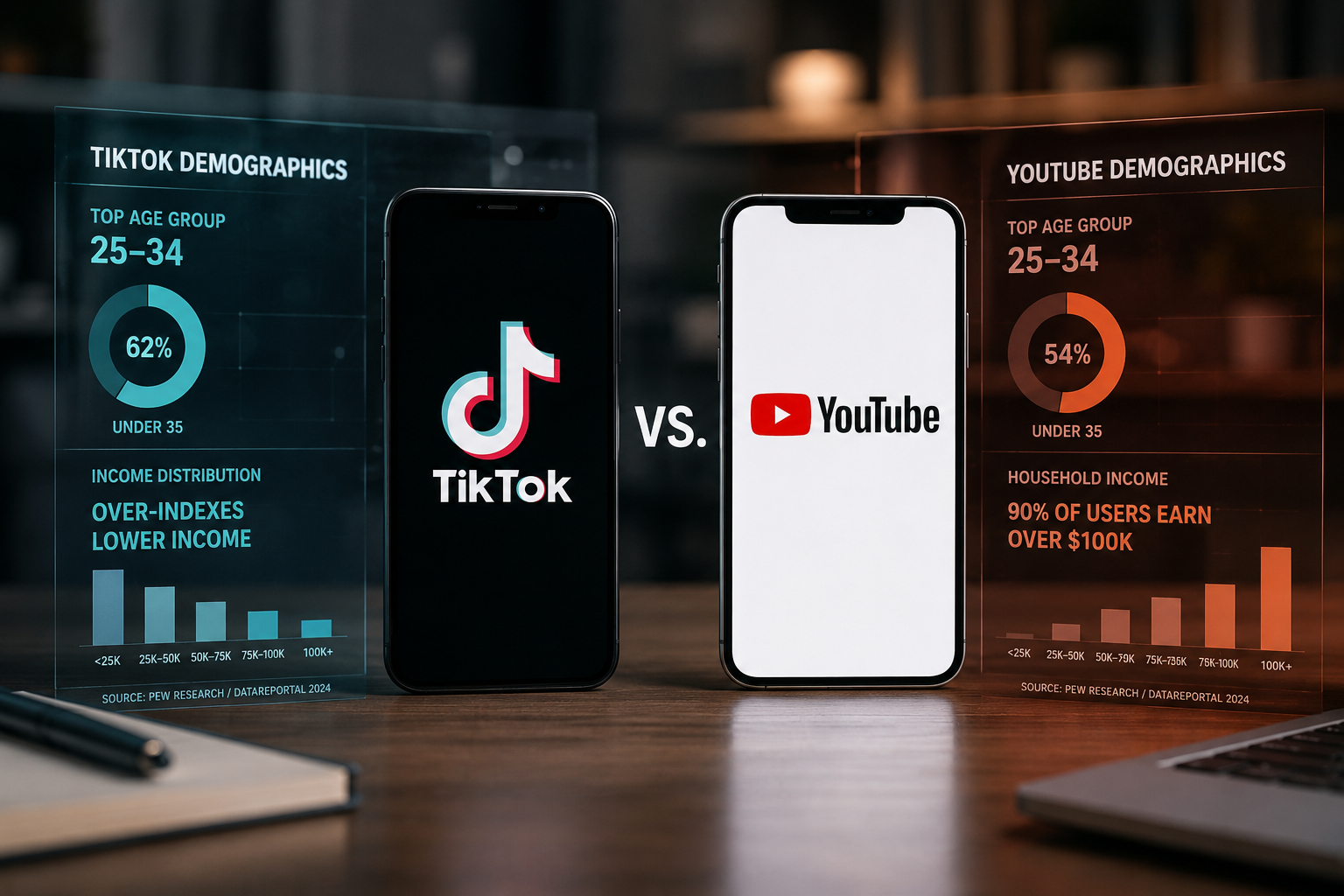
Age demographics and income data are two of the most underused inputs in platform strategy. Most brands pick TikTok or YouTube based on cultural perception — "TikTok is for Gen Z," "YouTube is for everyone" — without actually looking at what the data says about who is on each platform, what they earn, and what that means for where ad dollars should go.
The answer is more nuanced than either camp admits. And for brands trying to reach audiences with real purchasing power, the distinction matters more than almost any other platform decision you'll make this year.
The Age Breakdown: More Similar Than You'd Expect, Different Where It Counts
Let's start with the number that surprises most people.
Both platforms share the same largest demographic on paper. YouTube's age breakdown in 2026 shows 21.7% of users are 25–34 — the largest single segment — followed by 18.5% in the 35–44 range, 15.8% in the 18–24 bracket, roughly 14% aged 45–54, and 9–10% aged 55 and older. TranscribeTube
TikTok tells a similar story at the top — but diverges quickly as you move up the age scale. Around 39% of total TikTok users globally are aged 18–24, while 40.3% belong to the 25–34 group. Combined, more than 65% of TikTok's global audience is between 18 and 34 years old. SocialPilot
So both platforms are led by 25–34-year-olds. But TikTok's audience drops off sharply after 34, while YouTube's remains substantial well into the 45–54 and 55+ brackets. That's the key structural difference: TikTok is compressed into youth, YouTube is spread across life.
TikTok's audience is also aging up — but it's a recent trend, not an established reality. Teens aged 13–19 now represent 25% of TikTok users, down from 32% in 2021. Meanwhile, users 30 and older have grown from 22% to 38% of the platform. The average TikTok user globally is now 26.5 years old, up from 23 in 2021. SocialRails
That's meaningful directional movement. But it still leaves TikTok meaningfully younger and narrower in its age distribution than YouTube, which covers the full adult spectrum with real density at every bracket.
The practical implication: if your product, service, or brand needs to reach people over 40 — with the income, life stage, and decision-making authority that often comes with it — YouTube is simply where more of them are, by a wide margin.
The Income Question: Where the "Money Audience" Actually Lives
This is where the platform story gets genuinely interesting — and where a lot of marketers are operating on outdated assumptions.
YouTube reaches high-income audiences at a rate that no other platform matches. Among US adults, 90% of those with household incomes over $100,000 report using YouTube, as do 78% of those earning less than $30,000. YouTube sees widespread usage across income levels, educational backgrounds, and community types. Piktochart
That 90% figure is extraordinary. YouTube isn't just broadly popular — it is near-universally used by high-income American adults. That's not a demographic skew, that's near-total market saturation at the top of the income ladder.
TikTok's income story is more complicated. On the surface, the numbers look reasonable: according to Pew Research Center, among U.S. adult TikTok users, 37% have a household income above $100,000 and 34% hold a bachelor's degree or higher. Conbersa
But the distribution tells a different story when you look at over-indexing. Adults with a household income of less than $25,000 are 9% more likely than average to use TikTok, while those with household incomes of $60,000–$75,000 are actually 13% less likely than average to use the app. Lower-income adults over-index on TikTok. Middle-to-higher-income adults under-index. MarketingCharts
This doesn't make TikTok a bad platform — it makes it a specific platform. The affluent users are there, but they're not the structural core of TikTok's engagement base the way they are on YouTube. Brands selling premium products, high-consideration purchases, or anything that requires real disposable income should factor this distinction in heavily.
What the Advertiser CPM Gap Reveals About Audience Value
Advertisers price audiences based on what they're worth. CPM data — what brands actually pay to reach 1,000 viewers — is one of the most honest signals available about the perceived quality of each platform's audience.
The gap is significant. YouTube creators earn between $2,500 and $8,000 for one million views, and that figure can exceed $10,000 in high-value niches. TikTok provides massive reach but pays much less, with around $20 to $50 per million views. Views4You
That's not a small difference — it's an order-of-magnitude gap. And it's driven almost entirely by who is watching and what they're likely to do. Finance, legal, and B2B content on YouTube consistently commands 3–5 times higher CPM rates than entertainment or gaming content. YouTube's ability to concentrate intent-driven, high-income audiences in specific content categories is what makes advertisers pay premiums that TikTok simply can't match at scale. ColorWhistle
Users aged 35 and older are the fastest-growing segment on YouTube, reflecting the platform's widening appeal beyond younger demographics. As that cohort grows, the income and purchasing power represented in YouTube's audience only increases. Google
The TV Screen Shift: YouTube Is Now a Living Room Platform
One of the most important — and most overlooked — demographic stories in platform marketing right now is where YouTube is actually being watched.
According to Nielsen's Gauge reports, YouTube captured 13.4% of all US TV viewing in July 2025 — the highest share any single streaming platform has ever recorded. That's up from 7.9% in February 2023, a 53% increase in just two years. For context, Netflix held 8.8% of TV viewing in the same period. Google
YouTube is now the number one streaming platform on American television sets, beating Netflix. That is a demographic event, not just a device story. Living room viewing correlates strongly with older, higher-income audiences — households with smart TVs, family viewing habits, and the settled income and life stage that comes with homeownership and career maturity.
TikTok remains almost entirely a mobile-first, pocket-screen experience. It's thumb-driven, solo, and vertical. That's not a weakness, but it defines both the audience it captures and the life stage it reaches. The living room audience — which tends to skew 35 and up, with household income to match — is structurally YouTube's audience, not TikTok's.
Gen Z: The Asterisk in Every Demographic Claim
Any honest analysis of these platforms has to address Gen Z directly, because the conventional wisdom — "Gen Z is on TikTok, not YouTube" — is demonstrably incomplete.
72% of Gen Z users have a TikTok account, and this generation makes up about 60% of the platform's user base. TikTok's cultural dominance with Gen Z is real and not worth disputing. Sprout Social
But YouTube's Gen Z position is stronger than its reputation suggests. According to a survey by Morgan Stanley AlphaWise, 40% of YouTube Shorts users are not using Instagram Reels or TikTok at all, making Shorts an essential space for reaching Gen Z where other channels may fall short. Gen Z also over-indexes on Shorts, with YouTube Shorts now generating 70 billion views per day. DAC
And when it comes to purchase behavior specifically — where demographics translate into dollars — 56% of 16- to 24-year-olds turn to Google Search, YouTube, or Gemini first when researching products online, up 4 percentage points from a year ago, compared to just 12% who start their searches on TikTok. emarketer
Gen Z uses TikTok for culture, entertainment, and discovery. They use YouTube — including Shorts — for research, depth, and product evaluation. Both matter, but they're serving different stages of the decision journey.
The Practical Summary: What Each Platform's Audience Is Actually Worth to Your Brand
This is the question every marketing budget conversation should start with, and the data gives a clear framework.
TikTok's audience is: younger (18–34 skewed), highly engaged on a daily basis, increasingly broad in age but still compressed at the top income brackets, and optimized for impulse-driven discovery and cultural influence. It is the right platform for awareness, entertainment-driven brand building, and reaching audiences in the early stages of life-stage spending — first apartments, fashion, fast food, consumer tech, and trend-driven purchases.
YouTube's audience is: broader across age (with real density from 25–54), near-universally used by high-income adults in the US, intent-driven in its search behavior, and increasingly present in the living room alongside the highest-spending household decision-makers in the country. It is the right platform for considered purchases, B2B and professional audiences, high-ticket products, and content that needs to influence a decision rather than just generate a moment of awareness.
Neither audience is more valuable in the abstract. The question is which audience matches the buyer your business actually needs to reach — and at what stage of the funnel you're trying to reach them.
Understanding where your audience lives across platforms is one piece of a larger discovery strategy. As we've written about in our Search Everywhere Optimization framework, visibility in 2026 isn't a single-platform question. It's about showing up where the right buyer is at each stage of how they discover, research, and decide — whether that's YouTube search, a TikTok feed, a Google AI Overview, or a ChatGPT recommendation.
The brands allocating budget intelligently are the ones who've stopped asking "TikTok or YouTube" and started mapping their content strategy to their buyer's actual journey.
Frequently Asked Questions
What age group uses TikTok the most?
The 25–34 age group is now TikTok's largest single demographic globally, making up about 40% of users, followed closely by 18–24-year-olds at roughly 39%. Combined, these two groups account for more than 65% of TikTok's total audience. The platform is aging up steadily — the average TikTok user is now 26.5 years old, up from 23 in 2021 — but it remains heavily compressed in the under-35 demographic compared to YouTube.
What age group uses YouTube the most?
YouTube's largest demographic is also 25–34-year-olds at 21.7% of users, followed by 35–44-year-olds at 18.5%. Unlike TikTok, YouTube maintains meaningful audience density well into the 45–54 and 55+ age brackets, making it the more age-diverse platform by a significant margin. It is also the dominant platform for connected TV viewing, which skews older and higher income.
Does YouTube or TikTok reach higher-income audiences?
YouTube reaches higher-income adults at a rate unmatched by any other platform. In the US, 90% of adults with household incomes over $100,000 use YouTube. TikTok's income distribution actually skews slightly toward lower-income users, with adults earning under $25,000 over-indexing on TikTok usage, while middle-income adults ($60,000–$75,000) are less likely than average to use the app.
Why do advertisers pay more to reach YouTube audiences than TikTok audiences?
CPM and creator payout rates on YouTube are dramatically higher than TikTok's — often 50 to 100 times more per thousand views in high-value niches. This reflects the age, income, and intent profile of YouTube's audience. YouTube attracts viewers in high-consideration, high-purchase-power categories like finance, home, technology, and business. TikTok's audience skews younger and more impulse-driven, which commands lower advertiser premiums despite its massive scale.
Is TikTok good for reaching affluent consumers?
TikTok has affluent users — about 37% of US adult TikTok users report household incomes above $100,000 — but they don't over-index the way they do on YouTube or LinkedIn. If affluent consumers are your core target, YouTube is a more reliable and cost-efficient channel. TikTok is better suited to brands where cultural relevance, youth appeal, and high-frequency discovery matter more than income targeting.
Which platform should B2B brands prioritize?
YouTube. The combination of intent-driven search behavior, high-income and professionally educated audiences, long session times, and content that compounds over time through search makes it the stronger B2B discovery channel by a wide margin. LinkedIn remains the most targeted B2B platform by professional role, but YouTube's scale and search functionality make it a critical part of any B2B content strategy in 2026. TikTok is emerging in B2B awareness but is not yet where most purchase-decision influencers are spending significant research time.
Can a brand be effective on both TikTok and YouTube simultaneously?
Yes, and the best brands are. The key is treating each platform as a distinct function rather than the same content repurposed. TikTok drives awareness, cultural relevance, and top-of-funnel discovery. YouTube builds trust, supports consideration, and captures intent-driven search. Running both with platform-native content strategies — rather than cross-posting the same video — is what separates brands that win on both from those that underperform on each.
Ritner Digital helps brands build visibility infrastructure across search, AI, and modern discovery channels — including YouTube, TikTok, Google, and the AI platforms reshaping how buyers find businesses. If you want a clearer picture of where your audience actually is and how to reach them, let's talk.