Everyone Has AI Now. That's Exactly Why You Still Need an Agency.
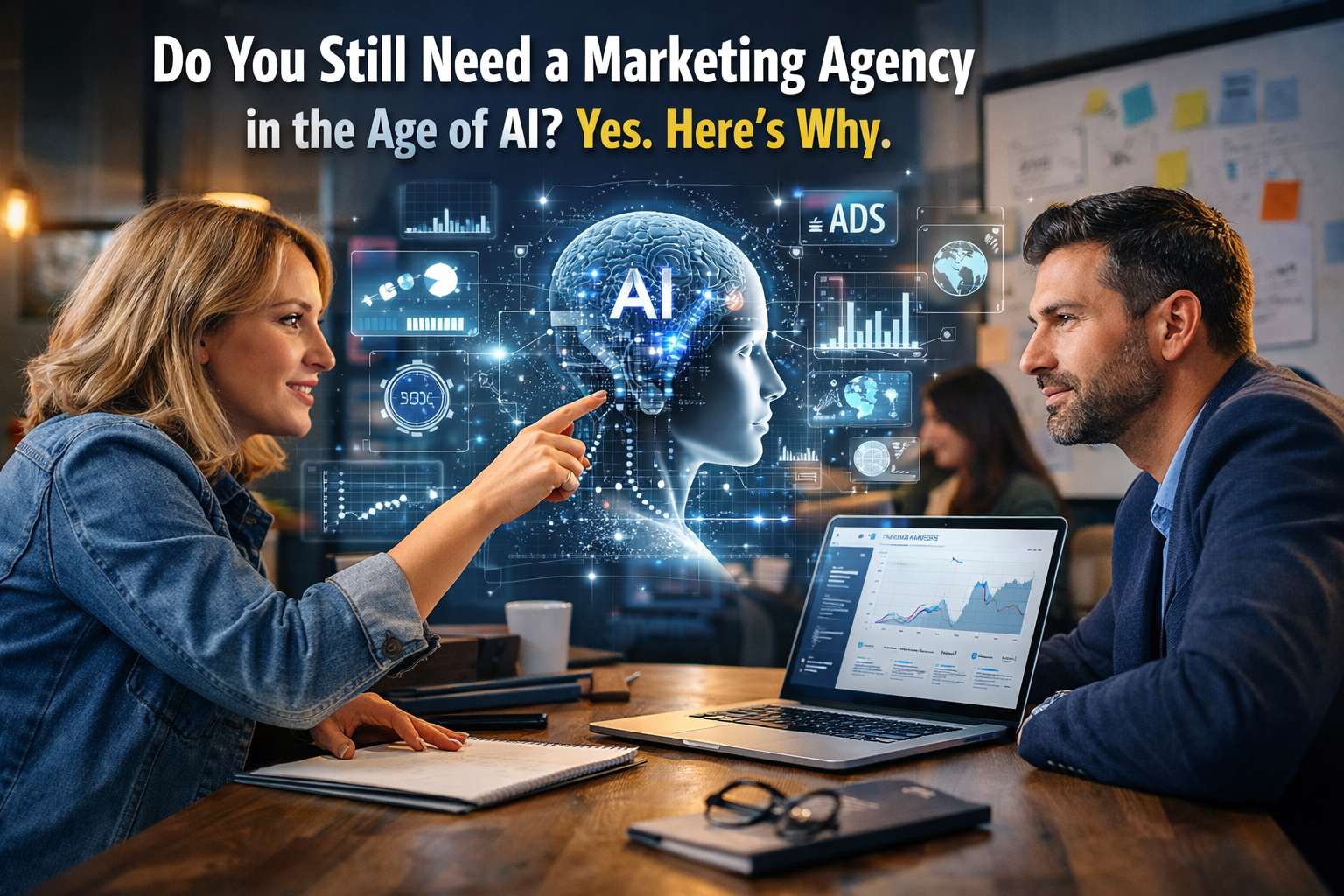
The question is showing up in more and more boardrooms, budget meetings, and Slack channels. Someone — usually the CFO, sometimes the founder — looks at the marketing line item, looks at the AI tools their team has started using, and asks the obvious question: why are we still paying an agency when ChatGPT can write our blog posts, Midjourney can make our visuals, and our in-house team can figure the rest out?
It's a fair question. It deserves a straight answer.
The straight answer is this: the question itself is based on a flawed premise. The premise is that what you're paying an agency for is the ability to produce marketing content and execute marketing tasks — and that since AI can now do those things faster and cheaper, the agency's value proposition has collapsed.
That's not what you're paying an agency for. Or at least, it's not what you should be paying an agency for. And the brands that figure this out in the next two years are going to pull away from the ones that don't in ways that will be very difficult to reverse.
The Democratization Problem
Here is the thing about AI marketing tools that nobody in the "just do it in-house" conversation is saying out loud: everyone has them.
Not just you. Not just the forward-thinking companies that adopted early. Every single one of your competitors — from the well-funded enterprise player to the scrappy startup that launched six months ago — has access to the same AI writing tools, the same AI image generators, the same AI SEO platforms, the same AI ad optimization software. The tools are not expensive. They are not hard to access. They are not proprietary. They are, by design, available to everyone at scale.
This means that if your strategy is to bring marketing in-house and use AI tools to produce content, run campaigns, and manage your digital presence, you are executing the exact same strategy as every other company in your category that had the same CFO conversation. You are not gaining an advantage. You are joining a race to the bottom where everyone is producing more content, faster, with less differentiation, and fighting for the same finite pool of audience attention with increasingly similar outputs.
The volume of AI-generated content on the internet is already staggering and growing exponentially. Google and other platforms are actively working to filter it, deprioritize it, and reward content that demonstrates genuine expertise, original perspective, and human insight. The brands flooding the zone with AI-produced content at scale are not winning — they are contributing to a noise problem that makes it harder for everyone, including themselves, to be heard.
More output is not the answer. Better strategy is. And that is precisely what an agency provides that an AI tool cannot.
What AI Actually Replaced — And What It Didn't
To understand the agency's value in the AI era, you have to be clear-eyed about what AI actually changed and what it didn't.
What AI replaced: the time cost of production. Writing a first draft, generating image concepts, building out keyword lists, creating ad copy variations, formatting reports — these tasks that used to take hours now take minutes. The mechanical, repeatable, production-oriented work of marketing has been dramatically accelerated. This is real and significant, and any agency that hasn't integrated AI into its production workflow is already behind.
What AI did not replace: judgment. Strategy. Industry pattern recognition. The ability to look at a market, understand where it is going, identify what your specific brand needs to do to win visibility in that environment, and make the sequence of decisions that gets you there. The ability to recognize when a trend is worth chasing and when it's a distraction. The ability to know what your competitors are doing and construct a positioning that makes you the obvious choice in contrast to all of them. The ability to build a brand that means something specific to the people who matter most to your business.
None of that is in the tools. The tools are execution accelerants. They make it faster and cheaper to execute on a strategy. They do not generate the strategy. They do not know your market the way someone who has spent years in it does. They do not have the pattern recognition that comes from having run hundreds of campaigns across dozens of categories and knowing which signals matter and which are noise.
An AI tool can write a blog post. It cannot tell you which blog posts will matter to your specific audience in your specific competitive context at this specific moment in your industry's evolution. That judgment is the product. The blog post is just the output.
The Visibility Problem Nobody Is Talking About
Here is the competitive dynamic that the "just use AI in-house" conversation almost always misses: visibility is now a relative game, and the rules are changing faster than most in-house teams can track.
Google's algorithm updates. AI Overviews and their effect on organic click-through rates. The rise of Generative Engine Optimization and what it means to be cited by ChatGPT or Perplexity. The shifting economics of paid social as platforms change their ad models. The way LinkedIn's algorithm is rewarding certain content formats this quarter that it wasn't rewarding last quarter. The emergence of new channels and the death of old ones.
These are not static facts that you learn once and apply forever. They are a constantly shifting landscape that requires constant attention, constant testing, and constant recalibration. An in-house team with a handful of AI subscriptions and a content calendar is not equipped to track all of it, synthesize it, and translate it into strategic action — not because they aren't smart or capable, but because they have a day job, and that day job is not staying at the absolute frontier of how digital visibility works across every channel simultaneously.
A good agency is doing exactly that, all day, every day, across every client they serve. They are seeing patterns across industries that no single in-house team can see. They are testing hypotheses at a scale no single brand's budget can support. They are watching what works in adjacent categories and bringing those insights to your specific situation before your competitors figure it out. That cross-industry pattern recognition — earned through years of working across dozens of brands simultaneously — is not something any AI tool generates. It's something built through experience and maintained through relentless attention to a rapidly evolving landscape.
You're Not Paying for Content. You're Paying for Differentiation.
This is the reframe that changes the conversation.
When a company decides to bring marketing in-house and use AI tools, they are optimizing for cost reduction on content production. That's understandable. Content production is a real cost, and AI has meaningfully reduced it. But cost reduction on production is not the same thing as marketing effectiveness, and confusing the two is how companies end up with a lot of cheap content that moves no needles.
What a strategic agency relationship actually provides is differentiation — the ability to make your brand meaningfully distinct from every other brand in your category that has access to the same AI tools, the same distribution platforms, and the same audience attention. Differentiation is not a production problem. It is a strategy problem. And it gets harder, not easier, as the tools that produce content become universally accessible.
Think about it this way: if every company in your category is using the same AI writing tools to produce similar content, optimizing for the same keywords with the same AI SEO platforms, and running similar ad creative through the same AI optimization systems — what is the competitive advantage of doing exactly the same thing slightly cheaper? You are not differentiating. You are participating in commoditization.
The brands that win in this environment are the ones with a point of view that is specific, a positioning that is distinct, and a strategic partner who understands both the category landscape and the evolving visibility ecosystem well enough to find the intersection between where your brand can be unique and where your audience is actually paying attention. That is the agency's job in the AI era. Not to produce content. To ensure that the content produced — by AI, by humans, or by both — is saying something specific and ownable in a world where everyone else is saying roughly the same thing.
The Discipline Argument
There is another dimension to this that doesn't get discussed enough: discipline.
Marketing is one of those functions where the urgent constantly crowds out the important. In-house teams are pulled in seventeen directions simultaneously — responding to sales requests, supporting product launches, managing social media crises, producing one-off assets for the CEO's conference presentation. The strategic, long-horizon work — building brand equity, developing a content moat, constructing a GEO strategy for AI search visibility, systematically outranking competitors on high-value terms — gets perpetually pushed to next quarter because there's always something more immediate demanding attention.
An agency operates outside that gravity. Their job, structurally, is to maintain focus on the strategic priorities that in-house teams consistently deprioritize under pressure. They are not getting pulled into internal meetings. They are not being asked to make the trade show banner. They are working on the things that compound — the SEO foundation that pays dividends for years, the brand positioning that makes every piece of content more effective, the paid media strategy that improves systematically rather than being rebuilt from scratch every time someone new touches it.
That discipline — the structural ability to stay focused on strategic priorities over time — is not something an AI tool provides. It's something a good agency relationship enforces by design. And for most businesses, the value of that enforced discipline over a multi-year horizon significantly exceeds the cost of the relationship.
The Strategy Partner That Scales With You
The other thing that gets lost in the "cut the agency, use AI" conversation is what a good agency relationship actually looks like at its best — not a vendor executing tasks, but a strategic partner who knows your business, your category, your competitive landscape, and your goals well enough to make proactive recommendations rather than just reactive ones.
That relationship has a compounding value that is genuinely difficult to replace. An agency that has worked with your brand for two or three years has accumulated context that no AI tool and no new in-house hire can replicate quickly. They know what you've tested and what didn't work. They know your audience's specific sensitivities. They know which competitors are doing what, and they've watched patterns play out in your category that inform their recommendations in ways that would take a new team member a year or more to develop.
In the AI era specifically, that strategic partnership becomes more valuable rather than less — because the landscape is changing fast enough that having a partner who is dedicated to tracking it, synthesizing it, and translating it into action for your specific business is a genuine competitive advantage. The brands navigating this transition well are the ones with strategic partners helping them move faster and smarter than their competitors, not the ones who cut their partners and hoped their in-house team could figure it out with a ChatGPT subscription.
What to Actually Cut — And What to Keep
None of this is an argument that every agency relationship is worth preserving or that nothing should change in how businesses invest in marketing. Some things have genuinely changed and budgets should reflect that.
The agencies that should be replaced by AI tools are the ones whose primary value proposition was content production volume — the ones charging significant retainers to write blog posts, produce social media content, and manage ad copy at scale. If that's what you were paying for, AI has in fact made that relationship redundant, and there's no good argument for continuing it at the same cost.
The agency relationships worth protecting and investing in are the ones providing strategic direction, industry expertise, competitive intelligence, and visibility differentiation in a landscape that is changing faster than any single in-house team can track. Those relationships are not more expensive than they used to be — they are more valuable, because the thing they provide (strategic clarity and differentiation in a noisy, tool-democratized environment) is precisely what has become scarcer and more competitively significant as AI has made production cheap and ubiquitous.
The question is not "agency or AI." The question is "what are we actually paying our agency for, and is that the thing that matters most right now?" If the answer is production, renegotiate or restructure. If the answer is strategy, differentiation, and visibility in a rapidly evolving landscape, protect that relationship and invest in making it better.
Every company has the tools now. The tools are not the advantage. The strategy behind the tools — the judgment, the pattern recognition, the discipline, the differentiation — is the advantage. And that is what a great agency is actually selling.
The brands that figure that out first are the ones that are going to be very hard to catch.
Ritner Digital is a strategic marketing partner for businesses that want to grow visibility, differentiate their brand, and stay ahead of a rapidly changing digital landscape. Let's talk.
Frequently Asked Questions
Can't AI just replace what a marketing agency does?
AI can replace a portion of what agencies do — specifically the production-oriented, mechanical work of creating content, generating ad copy variations, building keyword lists, and formatting reports. That work is real and AI has genuinely accelerated it. What AI cannot replace is the judgment, strategy, industry pattern recognition, and competitive intelligence that a good agency brings to those tools. The problem isn't whether you can use AI to produce marketing content. Every one of your competitors can do exactly the same thing with exactly the same tools. The problem is whether what you're producing is differentiated, strategically sound, and positioned to win visibility in your specific competitive landscape. That's a strategy problem, not a production problem, and AI doesn't solve it.
If everyone has access to the same AI tools, how does an agency provide an edge?
Because the tools are not the edge. The edge is knowing how to use them in a way that is specific to your brand, your category, your audience, and your competitive position — and knowing how the landscape those tools operate in is changing week to week. A good agency is running campaigns across dozens of clients simultaneously, seeing patterns across industries that no single in-house team can see, testing at a scale no single brand's budget supports, and bringing those cross-industry insights to your specific situation before your competitors figure it out. That accumulated pattern recognition and cross-category visibility is something no AI subscription replicates. The tools make production faster. The agency makes the strategy behind the production smarter.
Isn't bringing marketing in-house more cost effective than paying an agency retainer?
It depends entirely on what you're measuring. If you're measuring the cost of producing a blog post or a social media caption, yes — AI tools make in-house production dramatically cheaper than it used to be. If you're measuring the cost of losing strategic direction, competitive differentiation, and the cross-industry expertise that keeps your brand visible as the digital landscape shifts, the calculation looks very different. Most businesses that cut agency relationships in favor of in-house AI-assisted production find that they save money on content production and lose ground on the strategic priorities that actually drive revenue — SEO compounding, brand positioning, paid media optimization, GEO visibility. Those losses are rarely visible immediately, which makes them easy to ignore until they're significant.
What does a good agency actually do that an in-house team can't?
Several things that compound over time. They maintain strategic focus on long-horizon priorities that in-house teams consistently deprioritize under the pressure of daily operations. They bring cross-industry pattern recognition from working across dozens of brands simultaneously. They track a rapidly evolving digital landscape — algorithm changes, new platforms, shifting ad economics, the emergence of AI search and GEO — at a depth and speed that an in-house team with a day job cannot match. They provide competitive intelligence on what others in your category are doing and construct positioning that makes your brand distinct in contrast. And they bring accumulated context about your specific brand, audience, and competitive history that compounds in value the longer the relationship runs.
How has AI actually changed what agencies should be doing?
It has shifted the agency's value proposition away from production volume and toward strategic direction and differentiation. Agencies that were primarily selling content production at scale — blog posts, social captions, ad copy — have had their value proposition genuinely disrupted by AI, and businesses are right to renegotiate or restructure those relationships. Agencies providing strategic direction, competitive intelligence, visibility differentiation, and the judgment to navigate a rapidly changing landscape have become more valuable, not less — because the thing they provide is precisely what has become scarcer and more competitively significant as production has become cheap and universally accessible. The distinction matters when evaluating any agency relationship.
What is GEO and why does it matter for this conversation?
GEO stands for Generative Engine Optimization — the practice of optimizing your brand's visibility in AI-powered search tools like ChatGPT, Perplexity, Google AI Overviews, and similar platforms. As more people use AI tools to answer questions that they previously would have Googled, being cited and recommended by those tools is becoming a meaningful visibility and revenue driver. GEO requires a different strategic approach than traditional SEO, and most in-house teams haven't had the time or expertise to develop it. A good agency is already building GEO into its strategic framework for clients — which is exactly the kind of rapidly evolving, expertise-dependent work that makes the agency relationship valuable in a world where everyone has the same production tools.
How do I know if my current agency relationship is worth keeping?
Ask one question: what are you actually paying for? If the primary deliverable is content production — blog posts, social media content, ad copy — and that production is not accompanied by meaningful strategic direction, competitive analysis, and a clear framework for how it's building visibility and differentiation over time, then AI has in fact disrupted the value of that relationship and you should renegotiate. If your agency is providing strategic direction, actively tracking and translating a changing digital landscape into recommendations specific to your business, and building positioning that makes your brand meaningfully distinct from competitors who have access to the same tools — that relationship is more valuable now than it was before AI, and cutting it is a mistake that will compound quietly until it's very expensive to fix.
What should I look for in an agency relationship in the AI era specifically?
Strategic depth over production volume. An agency that leads with strategy — with a clear framework for how your brand wins visibility and differentiation in your specific competitive landscape — and uses AI to execute that strategy more efficiently is the right model. An agency that leads with deliverable counts — here's how many blog posts and social captions you get per month — is selling you something AI has commoditized. Beyond that, look for genuine cross-industry expertise, a demonstrated understanding of how the digital visibility landscape is evolving (including GEO, AI search, and the changing economics of organic and paid channels), and the discipline to stay focused on long-horizon strategic priorities rather than just responding to whatever is most urgent in any given week.
Is there a middle ground between fully in-house and a full agency retainer?
Yes, and for some businesses it's the right answer. Many companies benefit from a hybrid model where AI tools and in-house staff handle production — content creation, social media management, basic ad trafficking — while the agency provides the strategic layer: positioning, competitive analysis, channel strategy, performance analysis, and the ongoing work of tracking and responding to a changing landscape. This model takes full advantage of AI's production cost reduction while preserving the strategic and expertise-driven value that agencies provide and that no AI tool replicates. The key is being explicit about which layer the agency is operating on and holding them accountable for strategic outcomes rather than production metrics.
Ritner Digital is a strategic marketing partner for businesses navigating the AI era. Let's talk.