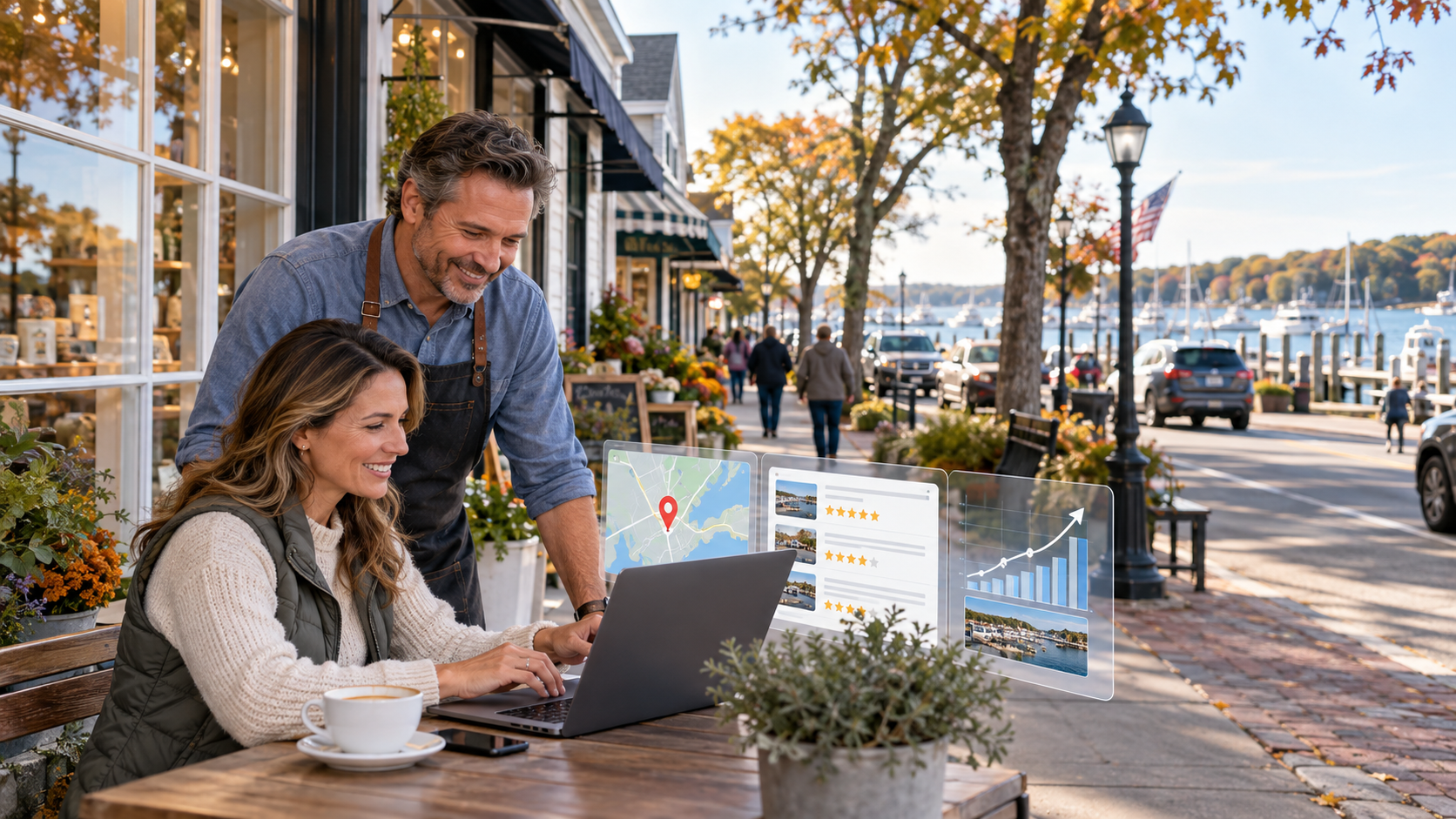
An actionable local-search strategy for businesses that want to reach year-round residents, seasonal homeowners, and visitors—without relying on the summer rush alone.
Hampton Bays has a visibility challenge that is easy to miss if you only look at your busiest months. A business can attract plenty of attention when the weather is warm, boats are moving through the bays, and visitors are planning time on the East End. The harder question is what happens when that seasonal attention falls away.
Who finds your business in February? What happens when someone needs a contractor in November, a wellness appointment in January, or a reliable restaurant for a quiet weekday dinner? If your website, business profile, and content speak almost exclusively to summer visitors, you may be making it harder for year-round customers to understand that you are there for them, too.
That is the opportunity behind Hampton Bays SEO in 2027: building a search presence that accurately reflects how the community functions in every season. It does not require pretending that winter demand equals July demand. It requires being discoverable for the services people actually need, at the times they need them, and making the next step easy.
The Hampton Bays Chamber of Commerce explicitly welcomes people to the hamlet year-round. Its description of the area highlights the waterfront, marinas, beaches, seafood markets, shops, parks, accommodations, and restaurants. The area is more than a summer backdrop. Meanwhile, the Town of Southampton's Hampton Bays Hamlet Center planning materials emphasize locally grown businesses, distinctive shopping, public spaces, pedestrian access, and the character of the hamlet center. These are reminders that local visibility is tied to an actual community, not just a list of vacation keywords.
This guide is written for local business owners, independent operators, and marketing teams who want a practical SEO plan for the coming year. It covers Google Maps, Google Business Profile, useful website content, off-season search intent, reviews, AI-assisted discovery, and measurement. It also explains what not to do: stuffing town names into every page, publishing empty location pages, purchasing reviews, or assuming that a high ranking guarantees paying customers.
A note about 2027: As of October 2026, Google has not published a special set of “Hampton Bays 2027 ranking rules.” The recommendations here are based on current official guidance and sound local marketing practices. Platform features, policies, and individual rankings may change, so business owners should recheck them when putting a plan into action.
Why Year-Round Local SEO Matters in Hampton Bays
Most small businesses understand that Hampton Bays attracts summer interest. But there are several different audiences behind that interest, and the same page rarely answers every audience's questions equally well.
A visitor planning a long weekend may search for a waterfront restaurant, a charter, a shop near the beach, or an activity for the afternoon. A seasonal homeowner might search for landscaping, cleaning, plumbing, HVAC, property care, or home security before arriving or after leaving. A year-round resident may need a dentist, childcare, auto service, home repair, legal support, a fitness class, or a dependable place to eat on a Wednesday in February.
These examples are illustrative search needs, not verified local keyword-volume statistics. Before targeting them, a business should examine its actual services and available search data. The point is that the audience changes with the calendar—even when the business address stays the same.
Search can help connect those needs to the right provider. Google says local results are primarily influenced by relevance, distance, and prominence. Relevance concerns how well a business matches the search; distance concerns location; prominence concerns how well known the business is, informed by signals including links and reviews. Google also explicitly says businesses cannot pay to request a better local ranking. See Google's official local ranking guidance.
A local SEO strategy can improve the information Google and customers can evaluate. It cannot move a storefront closer to every searcher, guarantee a spot in the Map Pack, or create demand where there is none. Good planning is about what the business can control: accurate information, a relevant website, useful content, authentic reputation, and a well-designed path to contact or booking.
For Hampton Bays businesses, a strong approach should account for both seasonal discovery and durable local demand. The two can reinforce each other without requiring identical marketing messages.
Start With the Searcher, Not a List of Keywords
The fastest way to waste time on local SEO is to begin with a spreadsheet of every phrase containing “Hampton Bays” and then force those phrases into website pages. The better starting point is a customer question: Who is looking, what do they need, and what would convince them to choose this business?
Imagine a service business that handles home maintenance. The summer visitor might never need it. A seasonal homeowner may be worried about preparing a property before a holiday weekend. A year-round resident may need an urgent winter repair. Those are different priorities, and the business's website should make the relevant services easy to find without turning each variation into a thin, repetitive page.
Or consider a restaurant. A visitor may prioritize a waterside setting, nearby attractions, or a memorable dinner. A local customer may care more about current winter hours, whether takeout is available, parking, or a menu that is not limited to a special summer event. Good content answers both sets of questions accurately.
For a marina or marine service provider, the calendar may bring questions about spring commissioning, storage, maintenance, and winterization. A shop that only publishes “summer boating in Hampton Bays” content misses opportunities to describe services customers may need at other times. Of course, these pages should only exist if the business genuinely offers the services.
This is search-intent mapping: identifying the reasons a customer searches, then making sure there is a relevant, useful page or business-profile detail that satisfies the need. The objective is not to rank for every possible phrase. It is to be a strong match for the right ones.
1. Audit Your Existing Visibility Before Rebuilding Anything
Before committing to a redesign or a large content package, collect a baseline. Start with your business name and your core service. Search in Google and Maps from appropriate locations, understanding that personalized results and the searcher's actual position can change what appears. Then review what your own reporting says instead of relying on a few manual searches.
Ask the following questions:
Is your Google Business Profile verified and controlled by the business?
Are the business name, address or service area, phone, website, and hours accurate?
Does your website clearly explain what you sell or do and where you operate?
Which service pages receive traffic, and which generate genuine inquiries?
Are important pages indexed and usable on a phone?
Are the search terms reaching your site aligned with your real customers?
Can someone quickly call, request a quote, reserve, or book?
Google Business Profile Performance can show relevant profile searches and actions such as calls, website clicks, and direction requests, depending on the business and available metrics. Google Search Console can help you examine organic search queries, clicks, impressions, and indexing. Analytics can help show what visitors do once they arrive at the site.
Keep these metrics separate. A direction request is not necessarily a store visit. A call-button click is not a completed phone conversation. An impression is not a lead. A credible audit tracks what is known and makes uncertainty explicit.
Most importantly, compare similar periods. A July-to-January traffic decline may reflect seasonal demand, not a broken SEO campaign. Comparing January 2027 with January 2026, where reliable data exists, can reveal more than comparing January with the previous August.
2. Make Google Business Profile Accurate in Every Season
For many local searches, a business profile is one of the first things customers encounter. If it displays outdated hours, an incorrect category, a disconnected number, or old photos, customers may never reach the website to find out more.
Start with a simple accuracy audit. Confirm the real-world business name, primary category, applicable additional categories, address or eligible service area, phone number, website, business description, services, and appropriate photographs. Choose categories that describe what the company is, not what it hopes to rank for. Do not add extra town names or keywords to the business name unless they are genuinely part of the business's real-world name.
Google's business representation guidelines explain these requirements. They also distinguish storefront businesses from eligible service-area businesses. A contractor serving Hampton Bays from an office elsewhere should not invent a Hampton Bays storefront or use a virtual address simply to appear local. The same applies to remote agencies and consultants.
Hours are especially important for seasonal operators. If you operate throughout the winter with shorter hours, show your actual regular hours. If there is a brief holiday change, use special hours. If the business closes for a meaningful off-season period, Google provides guidance on describing seasonal availability and marking a business temporarily closed where appropriate. Do not show “open” simply because you hope to collect inquiries while no one is available.
A practical November task is to review the entire public-facing customer journey: Google Maps hours, website hours, reservation or booking tools, social profile details, and phone greeting. All of them should tell a consistent story.
3. Build a Website That Answers Local Questions Without Keyword Stuffing
A local business website should make three things immediately clear: what the company does, whom it helps, and how someone can take the next step. On a mobile device, those answers should be available without digging through several menus.
A useful core structure often includes a homepage, specific service or product pages, an about page, a contact or booking page, and a small set of helpful supporting resources. For some businesses, a single strong Hampton Bays location page is appropriate. For others, the homepage already serves that purpose. There is no rule that every business needs a page called “Hampton Bays SEO” or “Hampton Bays services” if that language adds no value.
A service page for a genuinely local operation should contain substance: what the service includes, who benefits, relevant timing, service boundaries, what the process looks like, photos of actual work where permitted, common questions, and a direct inquiry option. A page that simply swaps “Hampton Bays” for “Southampton” and “East Quogue” without adding useful detail is a poor substitute for real local expertise.
Google's SEO Starter Guide recommends making content understandable, original, and useful, with clear page organization and links that help people navigate. Its people-first content guidance also encourages accuracy, transparency, and evidence of real experience.
For a Hampton Bays business, that experience might be demonstrated through authentic project examples, an explanation of local delivery or service logistics, clear photographs, and helpful answers from people who actually do the work. Do not invent customer stories or claim projects took place at named locations unless they did.
4. Treat Mobile Speed and Booking Friction as Local SEO Problems
A customer searching while traveling, standing outside a storefront, or deciding where to eat is unlikely to tolerate a confusing mobile website. Even if your business appears in search, your website can lose the inquiry if it loads slowly or hides the next action.
Review the site from a phone rather than only a desktop monitor. Are the phone number and address easy to tap? Can a restaurant visitor find the menu? Can a contractor customer request an estimate without creating an account? Does a booking button lead to a functioning calendar? Are important details visible before an oversized pop-up appears?
Google's page experience documentation recommends considering mobile usability, secure pages, loading experience, and intrusive interruptions. Its Core Web Vitals guidance describes performance measurements for loading, responsiveness, and layout stability. Improving those things can make a site more pleasant for customers; it does not guarantee a number-one ranking.
If your website is old, identify the failure before replacing it. A faster service page with a clear call-to-action might be more useful than an expensive visual redesign. Conversely, a site that cannot support basic mobile navigation, structured content, analytics, or accessible forms may warrant more substantial work. The decision should be based on function, not fashion.
5. Use Local Pages Only When They Represent Real Service
Hampton Bays sits within a broader East End search environment. Depending on the business, customers may also come from nearby communities or search for services using “Southampton,” “Hamptons,” or “East End” language. That does not mean every company should create dozens of near-identical pages for every hamlet.
Start with the actual service area. If the business genuinely serves East Quogue, Southampton, Westhampton Beach, or other nearby communities, it can explain that on the site. Where there is enough substantive information to support a dedicated page—different services, scheduling considerations, a real project portfolio, or unique customer questions—a separate location page may help. Where the only difference is a town name, consolidate the information instead.
For a storefront, the exact physical location is especially important. A business on Montauk Highway should not pretend to have additional walk-in locations. For a service-area operation, explain the eligible coverage area and how scheduling works. Google's business profile rules are clear that fictitious locations and misleading addresses are not acceptable.
There is also an important distinction between search visibility and actual proximity. A well-written page cannot make a distant business physically closer to a customer using Maps. Google's local ranking guidance continues to identify distance as a primary consideration. Local SEO should help explain your real relevance—not disguise your location.
6. Make Reviews Part of Customer Experience, Not a Numbers Game
Reviews can matter for both discovery and decision-making. A prospective customer may read recent feedback to understand whether a business is responsive, reliable, easy to book, and consistent across seasons. A handful of old summer reviews may not answer a January customer's questions as well as recent, genuine feedback.
Build a straightforward system for requesting reviews from customers who have actually used the business. Ask without dictating what they should say. Make it easy for customers to find the appropriate review destination after service, and respond professionally to feedback when it is appropriate to do so.
Avoid schemes that offer discounts, gifts, or special benefits in exchange for positive reviews. Google's review and content policies prohibit incentivized or manipulated reviews and discourage selectively soliciting only positive feedback.
A review strategy should also include what happens when something goes wrong. Respond with care, protect customer privacy, avoid public arguments, and look for recurring service problems. Reputation management is not simply collecting stars; it is maintaining the experience behind those stars.
For year-round businesses, reviews may also reveal questions your website should answer. If customers repeatedly praise easy scheduling, clear estimates, helpful staff, or winter availability, consider whether your pages communicate those strengths accurately. Do not copy private details from reviews or manufacture endorsements.
7. Build Genuine Local Authority Through Community Connections
“Local links” are sometimes sold as a commodity, as though a business can purchase credibility from a bulk directory package. In practice, the more meaningful approach is to participate in the community and make sure authentic relationships are visible online.
The Hampton Bays Chamber of Commerce maintains a member directory and events information. For a business that benefits from involvement, a legitimate membership or listing can serve customers and provide a relevant place to be discovered. The value should be assessed as a real community relationship, not as a guaranteed ranking trick.
Consider opportunities such as supporting an appropriate local event, collaborating with a complementary business, providing a useful resource for residents, or contributing an expert perspective to a relevant publication. If the business is involved with a cause or event, describe what it actually did and link to the organizer when useful. Do not announce invented sponsorships or imply endorsements that do not exist.
Southampton Town's Hamlet Center planning work is also a reminder that local businesses operate within a specific commercial and civic setting. A company that understands its neighborhood, communicates clearly about its services, and maintains accurate public information has more to say than one using generic “best local business” templates.
Local authority is accumulated through real work and trustworthy information. It is not something a company can manufacture in a weekend by submitting its website to hundreds of low-quality directories.
8. Plan Content for Four Seasons, Not Twelve Versions of Summer
A year-round content strategy should reflect the rhythms of customers' needs. It does not need to publish a new post every week, and it should not imply that every business experiences the same cycle. Start with your actual sales, inquiries, and staffing patterns, then consider how to answer the questions that arise at different times.
Winter: Be Useful to the People Who Are Here
Winter content often benefits from clarity. Restaurants and shops can make current hours, reservation policies, gift options, or services easy to confirm. Home-service companies can explain what they genuinely offer during colder months. Wellness and professional-service providers can highlight everyday availability and ways to book. A seasonal operator that is closed should communicate reopening plans rather than suggesting service is available now.
The goal is not to invent winter demand. It is to reduce the effort required for a customer with an existing need to find the answer.
Spring: Prepare for Demand Before It Peaks
Spring can be a useful planning period for businesses tied to outdoor activity, homes, hospitality, or marine services. Publish or update relevant service details before customers begin needing them, including lead times, availability, preparation guidance, and booking instructions. If you serve homeowners preparing properties for a summer arrival, explain timelines and what must be arranged in advance.
Avoid publishing artificial urgency. Real scheduling capacity is more useful than a headline that claims every appointment will disappear tomorrow.
Summer: Make Immediate Decisions Easier
Summer visitors may have little familiarity with a business and may be making decisions quickly. They need accurate hours, useful directions, clear photos, menus or service details, availability, and a mobile-friendly path to action. Keep those essentials current even when staff are busy.
A content calendar can support summer discovery, but operational accuracy may matter more than adding a new blog post. If opening hours, menus, inventory, or reservations change, update the pages and tools people actually use.
Fall: Capture the Transition
Fall content should reflect the business's real operating model. A home-service company may discuss maintenance or preparation. A business serving seasonal homeowners may explain end-of-season arrangements. Retailers and professional services can address relevant year-round needs. Restaurants should communicate any schedule or menu transitions without hiding them on an outdated social post.
This is also a good time to review what summer searches produced. Which landing pages brought inquiries? Which services had demand but weak conversion? What questions did customers keep asking? Those observations can improve the next year's content without turning the website into an endless stream of generic seasonal articles.
9. Use Actual Hampton Bays Details, Not Stock “Local” Language
Local relevance is not created by writing “proudly serving Hampton Bays” twenty times. It is created when the site genuinely helps someone understand the business and its relationship to the area.
For example, a hospitality business might provide useful information about its proximity to Ponquogue Beach or how guests can reach it, provided the directions are accurate. A marine business might explain its actual service offerings in relation to Shinnecock Bay. A downtown shop might give useful parking or pickup information. A service provider might describe appointments across its true coverage area.
These details are worth publishing because they solve practical questions. The Chamber's Hampton Bays overview offers geographic context, including the bays, the Shinnecock Inlet, and access to the ocean. But a commercial website should be grounded primarily in the business's own knowledge and operations, not rewritten tourism copy.
Use authentic photographs where possible. Label services and locations accurately. If you describe a local landmark, verify the relationship and directions. When publishing a case study, get permission to share identifying details and avoid claiming work you did not perform.
An excellent local page should feel as though it was made by a business that knows its customers, not by an automated tool scattering place names across a template.
10. Prepare for AI Search Without Chasing New Myths
In 2027, some customers may discover local businesses through AI-assisted search experiences as well as traditional search results and Maps. A person might ask a conversational tool for help finding a service, comparing options, understanding seasonal availability, or planning a visit. Those interactions can influence discovery, but their reporting and behavior may differ across products.
What should Hampton Bays businesses actually do? Start with the same fundamentals that make the business clear to people: accurate descriptions of products and services, consistent contact and location information, accessible website pages, helpful answers, trustworthy references, and up-to-date hours.
Google's current guidance for AI features in Search says established SEO best practices continue to apply to AI Overviews and AI Mode. It does not prescribe a special file, a magic prompt, or a guaranteed method for appearing in AI answers. A well-maintained business profile and website are useful foundational assets, but no consultant can promise that a particular AI system will recommend a company.
Businesses should also avoid treating all AI referrals as measurable in the same way. Some experiences may send website clicks; others may help customers decide without an easily attributable visit. Make sure staff ask new customers how they found the business, but treat self-reported sources as helpful context rather than perfect attribution.
The right goal is to become easier to identify, verify, and evaluate—not to chase every new AI SEO acronym.
11. Add Structured Data Carefully, Without Expecting Magic
Structured data can help search engines interpret information on a website. Depending on the business, relevant markup might describe the organization, its real location, contact information, opening hours, and applicable services.
Google provides official LocalBusiness structured data documentation. The recommended approach is to use an appropriate schema type, provide accurate information, check that the information also appears visibly on the page, and validate the markup. Seasonal opening periods can be described where supported. Markup should not be used to invent locations, fabricated reviews, or services the business does not offer.
It is important not to oversell this work. Structured data can help search engines understand certain facts and support eligible search features, but Google does not guarantee rich results or improved ranking merely because markup has been added.
For a small local business, a straightforward, accurate implementation often matters more than a complex schema package marketed as an instant visibility shortcut.
12. Measure Leads and Customers, Not Just Rankings
A local business needs reporting that can answer a practical question: Did better visibility create more useful opportunities? Rankings and impressions can be informative, but they are not the same as revenue.
Track meaningful actions based on the business model. A contractor might measure qualified estimate requests and booked jobs. A restaurant might track reservations, direct-order inquiries, or relevant website interactions. A shop might measure directions, calls, product inquiries, and in-store demand where a reliable connection is available. A professional service might track consultation requests and new clients.
Use Business Profile Performance for available Google Search and Maps interactions, Search Console for organic visibility, and website analytics for on-site behavior. Connect the reporting to a simple lead log or customer management process when possible. Note which metrics are directional and which represent verified outcomes.
A useful monthly review asks:
Which services and pages attracted qualified interest?
Which inquiries became appointments, bookings, or sales?
Did an operating-hour or website change affect customer behavior?
Which pages generated traffic without a clear next step?
Are results consistent with seasonality or is there a separate issue?
Are we improving year-over-year performance during comparable months?
Do not claim that one new blog post generated every sale during the following month. Local demand, repeat customers, referrals, paid ads, weather, reputation, and availability can all influence outcomes. Honest measurement creates a better basis for investment.
Industry-Specific SEO Priorities for Hampton Bays Businesses
A single checklist cannot account for every local business. The same fundamentals apply, but the highest-value tasks should reflect how customers choose each type of provider.
Restaurants, Cafés, and Food Businesses
Prioritize a complete business profile, accurate dining and takeout hours, a legible menu, original photos, reservation or ordering links, and clear seasonal changes. If you offer year-round dining, make it visible. If you close or change your service model, say so early and consistently. Helpful content might answer parking, dietary, group, or ordering questions if those services truly apply.
Home Services and Property Care
Make service boundaries explicit. Describe emergency versus scheduled service, contact methods, genuine coverage areas, and what customers should expect after submitting a request. Seasonal homeowners may have different needs from year-round residents, so make scheduling and service details clear without creating duplicate town pages. Useful before-and-after examples can help, with permission and accurate locations.
Marine and Outdoor Recreation Businesses
Align content with actual operating periods. Explain what customers need to know about bookings, cancellations, equipment, instruction, maintenance, or seasonal storage—whichever services you really provide. Avoid targeting winterization or spring commissioning simply because those sound like relevant keywords if they are not services in your business.
Retailers, Boutiques, and Specialty Shops
Help customers understand product selection, store hours, pickup options, availability, and any ecommerce choices. Retailers with products eligible to appear on a Business Profile may benefit from keeping that information current. A storefront that attracts visitors in summer can still communicate reasons for residents to return during slower months.
Wellness, Healthcare, and Professional Services
Focus on trust, clarity, scheduling, credentials where appropriate, and honest descriptions of services. Avoid unsupported health or financial claims. Explain when appointments are available and how to request information securely. For providers serving people beyond Hampton Bays, clearly describe legitimate coverage or office locations without inventing branches.
The shared principle is to optimize the actual customer experience, not merely a search phrase. Good local SEO makes a reliable business easier to recognize and contact.
A Practical 90-Day Hampton Bays SEO Plan
A business does not need to change everything at once. A disciplined first three months can establish reliable information and begin identifying useful opportunities.
Days 1–30: Fix the Foundation
Verify business-profile ownership, name, contact details, categories, photos, hours, and website link. Check the mobile site, contact forms, booking links, and page indexing. Establish a baseline from Search Console, Business Profile Performance, and real inquiries. Identify the three services or customer needs most important to the business during the next quarter.
This month should also include a review of what customers are told when they call or submit a form. An excellent listing will not help if inquiries are never answered.
Days 31–60: Improve the Pages That Matter
Choose high-value pages that already exist or are genuinely missing. Clarify service descriptions, add relevant local context, refresh original photos, improve calls to action, and publish helpful answers to common questions. Fix navigation and slow or confusing mobile experiences. Update seasonal information, and look for legitimate local partnerships or directory opportunities.
Do not automatically commission thirty new pages. Make the most important pages useful first.
Days 61–90: Test, Review, and Refine
Review changes in relevant search queries, calls, booking requests, and qualified leads. Compare with appropriate earlier periods while acknowledging seasonal variation. Look at which pages are performing and which need clearer messaging or better conversion paths. Plan the next set of pages and profile updates based on those observations.
If summer is several months away, this is a sensible time to prepare valuable seasonal content and operational details. If summer is already underway, prioritize accuracy and conversion before attempting a large site overhaul.
This is a planning framework, not a promise that a business will reach the first page or achieve a particular number of leads in 90 days.
How Much Should a Hampton Bays Business Spend on SEO in 2027?
There is no reliable universal number. A single-location shop with a functioning website and a complete Google Business Profile has different needs from a multi-service contractor with a broken site, poor analytics, and several legitimate service areas. Pricing should follow scope, not a generic “Hamptons SEO package.”
A focused engagement might cover a local visibility audit, business-profile cleanup, technical fixes, and a handful of service pages. A more involved project could include website improvements, content production, analytics implementation, and ongoing performance reviews. Some businesses may need a one-time repair and a manageable internal maintenance process rather than a large retainer.
When comparing proposals, ask what the provider actually does, what deliverables you will own, what reporting is included, how results will be assessed, and whether the work can be maintained after the project ends. Beware of guaranteed Map Pack rankings, claims that an invented office address will improve visibility, or vague “AI optimization” add-ons without clear work behind them.
A reasonable budget considers the value of a qualified customer, the business's profit margins, current capacity, and the time available to support new demand. If a restaurant is already fully booked on summer Saturdays, attracting even more Saturday clicks may be less valuable than improving weekday or off-season bookings. If a contractor cannot staff additional jobs, generating extra inquiries without improving operations could produce frustration rather than growth.
Common Hampton Bays SEO Mistakes to Avoid
Writing only for tourists. Tourism is a real part of the local market, but it is not every customer's intent. Publish information for actual year-round services and the people who need them.
Leaving seasonal hours outdated. One closed-door visit can damage trust. Coordinate website, booking, phone, and profile information.
Stuffing location names into the business profile. Google requires the name used in the real world. Keyword additions and fictional addresses can violate policy.
Publishing near-duplicate area pages. A series of pages that differ only by town name offers little to local searchers and may make the site harder to maintain.
Buying or filtering reviews. Genuine customer feedback is more useful than manipulated ratings, and Google prohibits incentivized reviews.
Assuming paid ads automatically strengthen organic rankings. Paid and organic visibility have different mechanisms. Evaluate each by its own outcomes.
Treating AI visibility as guaranteed. A business can improve clarity and public information, but no provider controls every AI answer.
Reporting only impressions. Track inquiries, completed bookings, customers, and useful service demand where possible.
Ignoring the actual customer experience. A clear website cannot compensate for unanswered calls, broken reservation tools, or a service that does not match its description.
Avoiding these errors often provides a more valuable starting point than chasing the newest tactic.
Frequently Asked Questions
1. What is local SEO for a Hampton Bays business?
Local SEO is the process of improving how accurately and usefully a business appears when people search for relevant nearby products or services. It usually includes Google Business Profile, a useful website, location and service information, reputation management, and measurement. It is about being a credible result for real customer needs, not appearing for every possible Hampton Bays search.
2. Can SEO help a Hampton Bays business outside the summer season?
Yes, when there is relevant demand to meet. For example, a year-round service provider can make its winter availability and services easier to find. SEO cannot guarantee that off-season demand matches summer traffic, but it can reduce the chance that an existing customer need goes unanswered because the business is hard to discover.
3. Is Google Business Profile more important than the website?
They serve different purposes. A profile helps customers evaluate the business in Search and Maps. A website can explain services, show detailed information, answer questions, and support conversions. For many businesses, both should be accurate and connected. A strong profile does not compensate for a broken booking flow or a website that misstates services.
4. How does Google decide which local businesses appear first?
Google says local rankings primarily consider relevance, distance, and prominence. Businesses can improve the accuracy and usefulness of their information, but they cannot purchase a higher organic local ranking from Google or control every searcher's physical location. See Google's explanation.
5. Should I put “Hampton Bays” in every page title?
No. Use the location naturally where it clarifies the page, particularly on appropriate location and service pages. Repeating a town name everywhere does not replace a useful description of the actual business. Clear titles that reflect the page's content are more valuable than awkward keyword strings.
6. Should I also target Southampton, East Quogue, and Westhampton Beach?
Only where the business genuinely serves customers or has a meaningful reason to be relevant. Explain real coverage areas. Create separate pages only when they offer distinctive, useful information. Do not create fake physical locations or generic copies of the same page merely to target more place names.
7. What if my business is closed for part of the year?
Show the actual seasonal availability on your business profile and website. Google's guidelines explain using regular hours while operating and appropriate temporary-closure information in the off-season. Make reopening details clear and avoid misleading “open now” information. See Google's seasonal business guidance.
8. Do Google reviews improve local visibility?
Google says reviews and ratings can contribute to local prominence. Reviews also help potential customers evaluate a business. Ask actual customers for genuine feedback without rewards or pressure, and don't selectively request only positive reviews. Read Google's review policies.
9. How long does Hampton Bays SEO take to work?
There is no guaranteed timeline. Correcting a broken link or hours may improve customer experience quickly. Search indexing, rankings, content visibility, and business results can take longer, and seasonality can obscure progress. Evaluate results over appropriate comparable periods rather than expecting every change to produce immediate leads.
10. Do I need to write blog posts every week?
No. A smaller collection of accurate, well-maintained service pages and useful resources may serve customers better than frequent generic posts. Publish when you have something relevant to answer: seasonal service information, a genuine frequently asked question, a useful local guide, or an explanation of what customers can expect.
11. Should I hire a Hampton Bays-based SEO agency?
Local proximity can help with visits, photography, and in-person collaboration. It is not the only valid model. A remote specialist can also provide effective technical SEO, content planning, Business Profile work, and reporting, provided they understand your actual market and do not pretend to operate from a local office. Compare work quality, scope, communication, and results rather than geography alone.
12. Can AI search recommend my local business?
It may, depending on the product, query, and information available. Clear, accurate business details and helpful website content are useful foundations. However, no business or agency can guarantee mentions in ChatGPT, Google AI Overviews, or other AI-generated responses. Google's official AI-search guidance says normal SEO fundamentals still apply to its AI features.
13. Is local structured data required to rank in Maps?
No. Structured data can help describe information on the website and may support eligible search features, but adding markup does not guarantee local ranking or a particular display. Use accurate, validated markup when appropriate. See Google's LocalBusiness documentation.
14. Which metrics should a seasonal business review?
Review relevant search queries, profile interactions, website visits, qualified inquiries, reservations or bookings, and actual sales where trackable. Compare year-over-year periods when possible, and distinguish summer peaks from nonseasonal issues. Do not equate all views, calls, or direction requests with paying customers.
15. What should I fix first if I have almost no SEO budget?
Verify your Google Business Profile, correct your hours and contact information, test your website on a phone, make core services easy to understand, and ensure inquiries reach someone who responds. These foundational repairs often take priority over expensive new content or a website redesign, although the best next step depends on the actual problem.
16. Can Hampton Bays SEO work for contractors without storefronts?
Yes, if the business meets Google's eligibility rules. An eligible service-area business can configure its service area rather than claiming an invented customer-facing address. The website should explain actual services and coverage. Google's service-area business guidance outlines the requirements.
17. Is it worth investing in SEO if summer is already my strongest season?
Possibly. Start by deciding what growth would be valuable: earlier summer bookings, better-quality inquiries, stronger shoulder-season demand, more repeat customers, or better visibility for year-round services. If the business has no capacity to benefit, investing in more traffic alone may not be the right priority. Local SEO works best when it supports a clear business objective.
A Better 2027 Goal: Be the Business People Can Actually Find and Choose
Hampton Bays should not have to be marketed as though the entire hamlet disappears after Labor Day. The local Chamber's year-round invitation, the mix of waterfront and community businesses, and Southampton Town's attention to the hamlet center all point to a place whose commercial identity is broader than a single season.
For individual businesses, the practical goal is straightforward. Show up for the right searches. Represent the business honestly. Keep hours and services current. Offer a useful website experience. Build authentic local relationships. Measure what becomes a real inquiry or customer.
You do not need to win every “Hamptons” keyword to build a more resilient local presence. You need to be discoverable when your particular customers are looking, whether that happens in July, November, or February.
Want a Hampton Bays Local SEO Strategy Built Around Real Business Goals?
Ritner Digital offers local SEO, Google Business Profile optimization, technical site reviews, search-focused content, and visibility strategy. Ritner Digital is a Philadelphia-rooted independent practice, not a Hampton Bays storefront or locally headquartered agency; Hampton Bays businesses can consider it for remote strategy and execution support.
Whether you run a year-round service business, a seasonal operation, or a shop serving both residents and visitors, the first step is identifying what customers need and where your current online presence is falling short.
Contact Ritner Digital to discuss your Hampton Bays SEO and year-round local visibility goals.
Sources and Further Reading
The recommendations above are based on publicly available guidance and local civic resources, reviewed in October 2026. The examples of searches and customer needs are illustrative; no Hampton Bays keyword-volume or business-specific performance figures are claimed.