SEO for Community Banks: A Step-by-Step 2026 Strategy Guide
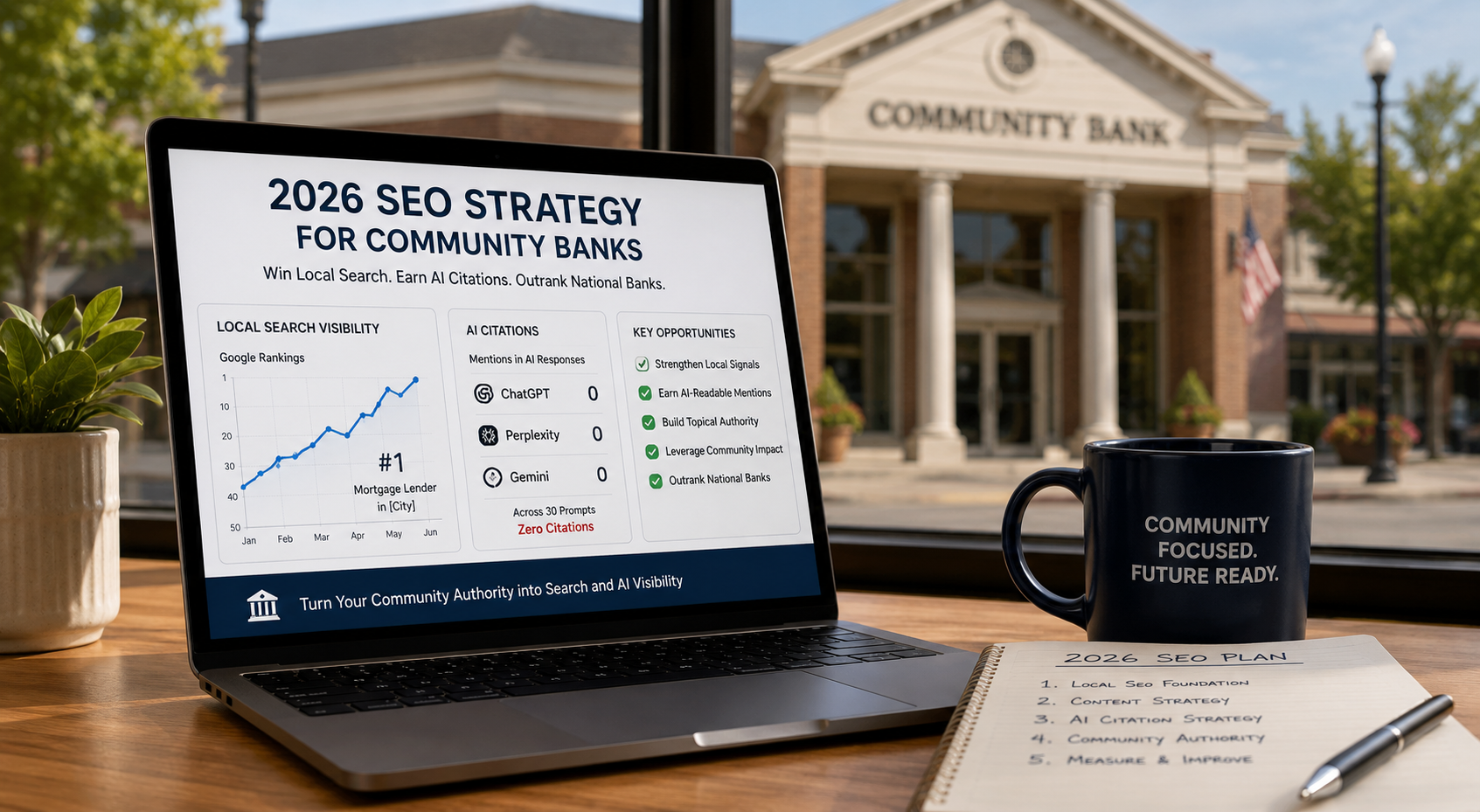
There is a regional bank in the United States that holds the number one organic ranking on Google for a commercially valuable mortgage query. When researchers ran that same query across ChatGPT, Perplexity, and Gemini — 30 test prompts in total — the bank was cited zero times. Its competitors filled every answer.
That single gap captures what has changed for community banks in 2026. Ranking first on Google is no longer the same thing as being found. Search has split into two systems: the index Google ranks, and the answer engines your customers increasingly ask first. Winning deposits and lending leads now means showing up in both — and the good news, which we'll spend this guide proving, is that the local algorithm and the mechanics of AI citation both favor community banks far more than their budgets would suggest.
This is a step-by-step strategy guide built for that reality. It is written for bank marketers, executives, and the teams who have to translate a thirty-year lending relationship into something a search engine can actually read.
Why community banks have the advantage (and don't know it)
Most community bankers assume the deck is stacked against them. National banks have massive websites with thousands of pages, decades of accumulated backlinks, and brand recognition that generates its own search demand. They have entire teams dedicated to SEO. You cannot outspend Chase on television, and you cannot out-publish a bank with a hundred-person content operation.
But the premise is wrong, and here is the part most community bankers miss: national banks are weak in local search. The local algorithm levels the playing field in a way that paid advertising never does. A well-optimized branch page with strong reviews and accurate Google Business Profile data can outrank a national bank with ten times the budget for "near me" queries. At the technical level, a small institution with strong fundamentals consistently outranks a large institution with weak ones.
The real problem is not a lack of advantages — it's that your advantages are invisible to search engines because nobody has translated them into digital signals. A sponsorship of the county fair means nothing to Google unless it generates a backlink from the fair's website. A thirty-year lending relationship with local businesses means nothing to your rankings unless that expertise is reflected in your site content. The entire job of community bank SEO is making your real-world authority visible in the digital spaces where your next customers are searching.
And the demand is genuinely local. Recent industry analysis finds that 45 to 60 percent of banking searches now use "near me" or a specific city qualifier, and that 40 to 60 percent of users still prefer a bank with a local physical presence even when they bank digitally day to day. Customers want to know their money stays in the community and that a human expert is reachable. That hyper-local intent is your structural edge over a national competitor running a one-size-fits-all page.
A note on YMYL before you write a single word
Banking content lives under Google's strictest quality framework: YMYL, or "Your Money or Your Life." These are pages that could affect a person's financial well-being, and Google evaluates them against the highest standard in its algorithm using E-E-A-T — Experience, Expertise, Authoritativeness, and Trustworthiness.
This matters more for banks than for almost any other industry. A blog post about mortgage rates published without clear author credentials, regulatory context, or accurate data won't just underperform — it can cause Google to reduce trust signals across your whole domain. Every tactic that follows assumes you are operating inside this constraint: real author bylines with credentials, accurate and dated figures, compliance disclaimers where rates appear, and no thin, generic filler content. With that foundation set, here is the step-by-step build.
Step 1: Master your Google Business Profile, branch by branch
For a financial institution starting in 2026, the single most critical first move is Google Business Profile (GBP) optimization. Your GBP is your digital storefront and the primary tool for landing in the local "map pack" — the listings that occupy the most valuable real estate on a local results page, often above the organic links entirely.
The non-negotiables for each profile: complete and accurate business information, high-quality images, the correct primary category, targeted local keywords woven into the description, and a steady cadence of posts about community involvement and services. Critically, this is per branch, not one profile for the whole institution. A multi-location bank needs a dedicated local strategy for every location, because each branch competes in its own geographic market.
Review velocity belongs here too. Local rankings draw heavily on the recency and volume of reviews, not just the star average. Collect reviews actively and respond to them — and when a review mentions a specific product like a mortgage or auto loan, that keyword-rich language reinforces your relevance for those searches. When did your team last respond to a review? If you can't answer that, you've found your first project.
One forward-looking note: Google has begun rolling out a conversational "Ask Maps" AI experience, where more answers happen directly inside the map interface. As that expands, traditional GBP click metrics may under-report actual engagement — but the fundamentals that win there are the same ones above: a complete profile, strong reviews, and useful location content.
Step 2: Fix the technical foundation
Strategy and content will not work if the technical base is broken. The highest-leverage technical change most community banks can make is improving structured data — schema markup. Think of schema as the API between your website and the machines reading it: it disambiguates your bank as an entity and tells search engines and AI systems exactly what each page is.
Use the correct schema types. A bank should use BankOrCreditUnion / LocalBusiness markup on the homepage and, importantly, on each individual branch page. Mark up your financial product pages so engines can read and display rates, eligibility, and offerings in enhanced results. A well-formed schema on the homepage and on every branch page measurably improves "bank near me" rankings.
The rest of the technical checklist:
NAP consistency — your Name, Address, and Phone number must match exactly across your site, your GBP, and your top directory listings. Inconsistency here actively suppresses local rankings.
Core Web Vitals and mobile — mobile now accounts for 60 to 75 percent of banking search volume, so a thumb-friendly site that loads fast is not optional. Audit your online application forms on real mobile devices; a form that's painful to complete on a phone is a leak in your funnel.
HTTPS and site health — table stakes, but worth verifying across every page, not just the homepage.
One technical detail that's newly important for AI: many AI crawlers prioritize speed and don't fully render JavaScript. If your rates table or FAQ content is injected via client-side JavaScript, an AI crawler may see an empty page. Make sure your critical text lives in the raw HTML through server-side rendering or static generation.
Step 3: Build the site architecture around customer intent
People arrive with different goals — a checking account, a business loan, a HELOC, fraud help. Your structure should route each visitor to the right product fast, with a clear hierarchy.
Every bank site needs strong product pages and location pages. Each product page should lead with the primary benefit, state eligibility clearly, show current rates where applicable (with proper disclaimers), and offer a direct path to apply or book an appointment. Then add the signal a national bank cannot replicate: a locally relevant section. Even a single paragraph about how this loan has served families or businesses in your specific community adds a relevance signal a generic national page simply doesn't have.
Location pages are how you establish presence in every county, town, or MSA you serve — especially valuable ahead of a branch opening or a rebrand, when you have no other local signals yet. Make each one unique, localized, and schema-tagged. One financial institution saw as much as a 600 percent increase in growth on its location pages after a structured local-search and schema effort. Generic, duplicated location pages, by contrast, do nothing.
Step 4: Earn links the way only a community bank can
Link building for a regulated financial institution is different from every other industry. You cannot pursue aggressive outreach tactics or participate in link schemes — the reputational and regulatory risk makes them non-starters. But community banks hold the single most valuable local-SEO link asset there is: genuine community relationships.
The sponsorships, local events, charity partnerships, and press you already participate in are link opportunities waiting to be captured. The county fair you sponsor should link to you from its website. The local business association, the chamber, the Little League, the press coverage of your community development work — each is a geographically relevant, trustworthy backlink that strengthens your local authority in exactly the market you serve. The work here is mostly translation: turning relationships you already have into links you currently don't.
Step 5: Optimize for AI search — where the next customer already is
This is the step most banks are getting wrong, and it's the one with the widest-open window.
The behavior shift is real and measured. A JD Power survey of 4,000 consumers found that 51 percent of U.S. consumers now use AI to get financial advice or information; of those, 52 percent use ChatGPT, 20 percent use Google Gemini, and 8 percent use Microsoft Copilot. AI tools are used most heavily at the very start of the journey — the research, comparison, and narrowing-down phases. By the time someone reaches the "buy" phase, the shortlist is often already formed. As one analysis put it, customers increasingly arrive at your homepage not with an open mind, but to confirm a view the AI already helped them build.
That makes AI citations disproportionately valuable, and the conversion data backs it up. AI-referred visitors convert at far higher rates than traditional organic — one study put ChatGPT referrals around 15.9 percent and Perplexity at 10.5 percent, against roughly 1.8 percent for Google. These are research-phase users arriving pre-qualified.
So how do you actually get cited? The mechanics are now reasonably well understood:
Brand-managed sources are the lever you control. Yext research published in early 2026 found that 88 percent of AI citations on financial-services queries come from brand-owned or brand-managed sources. The single biggest myth — that you can't influence AI answers — is false. The majority of the signal is within your control.
Fact density beats persuasion. The foundational Princeton-led GEO research found that adding authoritative citations, statistics, and direct quotations can boost a lower-ranked page's visibility in AI answers by up to 40 percent, while old keyword-stuffing tactics had negligible or even negative effects.
Lead with the answer. AI engines favor self-contained answer blocks of roughly 40 to 60 words placed at the top of a page, with a clear question as the heading. Bury the lead in a long narrative and you won't get extracted. Front-loaded content matters: one analysis found 44 percent of AI citations come from the first 30 percent of a page.
Write like an encyclopedia. Objective, declarative sentences get cited more often. Subjective hedges like "we believe" or "in our opinion" raise the model's uncertainty and lower your citation odds.
Build consensus across the open web. AI systems look for agreement across multiple independent sources before confidently recommending a brand. Consistent presence and positioning across your site, reputable directories, review platforms, and third-party publications builds the "consensus signal" that triggers citations. A bank that exists only on its own website gets treated with skepticism.
Keep it fresh. Seer Interactive's analysis of over 5,000 URLs found content updated within 30 days receives 3.2 times more AI citations than stale content, and that 44 percent of AI Overview citations came from content published in the prior year alone. A freshness calendar for rates pages and cornerstone guides is now a ranking input.
There is one publisher dynamic worth understanding. Affiliate and comparison publishers — NerdWallet, Bankrate, and the like — dominate AI financial answers; one study found publisher and affiliate content appears in 60 percent of all AI-generated financial answers. You won't displace them on broad national queries overnight, but two moves help: being present and well-reviewed on those platforms where appropriate, and owning the hyper-local and product-specific queries where a national publisher has nothing specific to say and you have everything.
Step 6: Measure what your CFO actually budgets in
Traditional SEO benchmarks like click-through rate and impressions no longer tell the whole story, in large part because of zero-click search. June 2026 research from SparkToro and SimilarWeb found that 68 percent of Google searches now end without a click — up from about 60.5 percent in 2024. AI Overviews are reducing clicks even as they boost brand visibility, which means a dashboard built only on clicks will increasingly understate the value SEO is producing.
So measure on two levels. Track the traditional signals — local rankings, organic traffic, conversion rates, GBP engagement — and add the new AI layer: your citation rate (how often AI engines cite you), share of model (how often you're recommended versus competitors for a set of prompts), and the sentiment AI uses when it describes your bank. Then tie all of it to the numbers a finance team plans around: leads, pipeline, cost per acquisition, and forecasted return. For reference, banking lead costs typically run $150 to $450 depending on the product, and competitive financial keywords generally take 6 to 12 months to rank — SEO is a compounding program, not a one-time campaign.
The most important first measurement is one you can run this quarter: pick 50 to 100 high-intent prompts a customer might actually type, run them across ChatGPT, Gemini, Perplexity, Claude, and Copilot, and document where you appear, where you don't, and which competitors and publishers fill the gap. That audit is the map for everything above.
The window is open, and it's closing
The institutions investing in visibility, authority, and AI citation now are establishing themselves before most of their competitors realize the game has changed. Authority compounds — but only with consistent investment, and it compounds both ways. Every month you're not building it, a competitor is publishing the content, earning the links, and accumulating the citations that will outrank you for years. The brands that start now own the rankings and the AI recommendations later; the ones that wait spend years clawing back ground they could have held from the beginning.
Community banks have never had a structural advantage in search like the one available right now. The local algorithm favors you. The AI citation mechanics favor brand-managed, locally specific, fact-dense content — which is exactly what a community bank is positioned to produce. The only question is whether your real-world authority gets translated into signals the machines can read before your competitor's does.
Find out where your bank stands. Ritner Digital builds the visibility, authority, and citations that get community banks found and recommended across Google, ChatGPT, Perplexity, and Gemini — and we publish our own data to prove it works. Book a free strategy call → and get a clear read on your search and AI visibility within one business day.
Sources: AJ Creative Studios (2026 local SEO for banks guide); Authority Specialist (2026 community bank benchmarks; bank SEO strategy); SEO Score API (technical local SEO for community banks); Loopex Digital; SEOProfy; New Media Advisors (2026 bank marketer SEO/AI strategies); Bank Marketing Strategies; Geear; American Banker; Yext; Princeton/Georgia Tech/Allen Institute GEO research; Seer Interactive; SparkToro & SimilarWeb; JD Power; Conductor; Gregory FCA; Medium (Rakesh Roshan); Cognito; Mersel AI; Sapt; Yotpo.
Frequently Asked Questions
How is SEO for community banks different from regular SEO?
Banking content falls under Google's YMYL ("Your Money or Your Life") framework, which means your pages are judged against the strictest quality standard in the algorithm using E-E-A-T — Experience, Expertise, Authoritativeness, and Trustworthiness. In practice that means real author credentials, accurate and dated figures, and compliance disclaimers carry far more weight than they would for most industries. Community bank SEO also leans much harder on local signals — branch-level Google Business Profiles, "near me" intent, and geographic relevance — because 45 to 60 percent of banking searches now carry a local qualifier.
Can a community bank really outrank a national bank like Chase?
For local searches, yes. National banks have enormous budgets and domain authority, but they're weak in local search — they run one-size-fits-all pages with little geographic relevance. The local algorithm levels the field in a way paid advertising never does: a well-optimized branch page with strong reviews and accurate Google Business Profile data can outrank a national bank with ten times the budget for "near me" queries. You won't beat them on brand-level national terms, but you can own your own market.
What is the single most important first step?
Google Business Profile optimization, done branch by branch. Your GBP is your digital storefront and the primary path into the local "map pack," which occupies the most valuable real estate on a local results page. Make each profile complete and accurate, add quality images and the right category, post regularly about community involvement, and build review velocity. A multi-location bank needs a dedicated profile and strategy for every branch, not one for the whole institution.
Why isn't my bank showing up in ChatGPT or Perplexity?
Usually because your content isn't structured to be cited and you lack consensus across the open web. AI engines favor self-contained answer blocks of 40 to 60 words, fact-dense content with statistics and citations, and brands that appear consistently across multiple independent sources. A bank that exists only on its own website gets treated with skepticism. The encouraging part: Yext research found 88 percent of AI citations on financial-services queries come from brand-owned or brand-managed sources, so most of the lever is within your control.
Does AI search actually matter for getting customers, or is it hype?
It matters, and the behavior data backs it up. A JD Power survey of 4,000 consumers found 51 percent of U.S. consumers now use AI for financial advice or information, and AI tools are used most heavily at the research and comparison stage — when shortlists get formed. AI-referred visitors also convert at far higher rates than traditional organic traffic, with some studies putting ChatGPT referrals around 15.9 percent versus roughly 1.8 percent for Google. By the time a customer reaches your site, the AI may have already shaped who they're considering.
How do I build backlinks without violating compliance rules?
Through the community relationships you already have. Aggressive outreach and link schemes are non-starters for a regulated institution, but sponsorships, local events, charity partnerships, chamber memberships, and local press are all legitimate, geographically relevant backlink opportunities. The work is mostly translation — making sure the county fair you sponsor or the association you belong to actually links to your site. These are the most valuable local-SEO links available, and only a community bank has natural access to them.
How long does community bank SEO take to show results?
Competitive financial keywords generally take 6 to 12 months to rank, and SEO is a compounding program rather than a one-time campaign. That said, early signals like indexing, rising impressions, and AI citations often appear sooner, especially from technical fixes and Google Business Profile work. Authority builds on itself over time — which is also why waiting is costly, since a competitor investing now compounds an advantage that gets harder to claw back later.
What should I measure beyond rankings and clicks?
Clicks alone now understate SEO's value, because 68 percent of Google searches end without a click as of 2026. Track the traditional layer — local rankings, organic traffic, conversion rates, and Google Business Profile engagement — and add an AI layer: your citation rate, share of model (how often you're recommended versus competitors), and the sentiment AI uses to describe your bank. Then tie all of it to the numbers finance teams plan around: leads, pipeline, cost per acquisition, and forecasted return.
What does community bank SEO cost?
It varies with the number of branches and market competitiveness. Industry figures put a single branch in a mid-sized market in the range of $500 to $2,500 per month for a managed local SEO program, while banks with 10 or more branches in competitive metros often invest $5,000 to $15,000+ per month across the full portfolio. Banking lead costs typically run $150 to $450 depending on the product, which is useful context when modeling return.