The Complete SEO Audit Checklist for Credit Union Websites (2026)
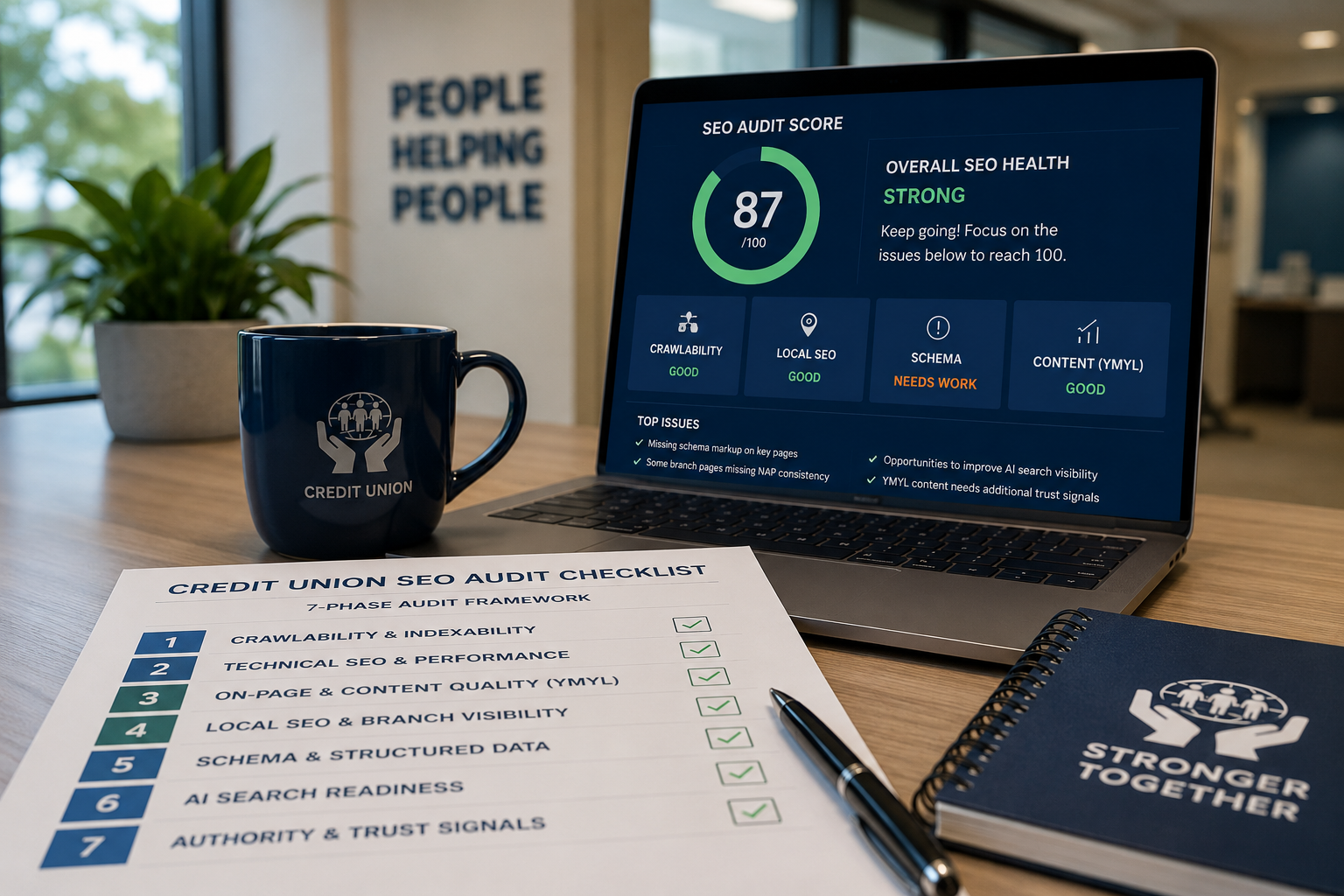
Here is an uncomfortable benchmark to start with. In a May 2026 hyperlocal SEO scorecard of five of the largest credit unions in the country, the top performer — SECU — scored 87 out of 100, and the analysis still flagged gaps in its schema markup and AI-ready content. The others scored lower, with problems as basic as JavaScript-dependent branch locators that AI crawlers can't read and centralized 800 numbers where local phone numbers would reinforce geographic relevance. If the biggest credit unions in America have audit gaps this fundamental, the odds are good that yours does too.
That's the case for auditing before you do anything else. You can't fix what you haven't found, and in 2026 the list of things worth finding has grown — it now spans traditional technical SEO, local search, YMYL compliance, and a new layer of AI-readiness that determines whether ChatGPT and Google's AI Overviews will cite you at all. A live benchmark tracking credit unions across ChatGPT, Perplexity, Google AI Overviews, and Gemini found that credit unions currently appear in only about 14 percent of tracked mentions and earn about 13 percent of citations — third-party aggregators take the rest. The institutions that audit and close those gaps now will be very hard to displace later.
This is the complete checklist, organized into the seven phases we'd actually work through. Run them roughly in order; the early phases unblock the later ones.
Phase 1: Crawlability and indexing — can search engines and AI even read you?
Everything downstream depends on this. If search engines and AI crawlers can't access your pages, no amount of content or authority will help.
Start with the basics. Confirm your most important pages — product pages, branch pages, rate pages — are actually indexed by checking Google Search Console's coverage report and running site:yourcu.org searches. Look for blocked or misconfigured pages in your robots.txt and accidental noindex tags, which quietly remove pages from search entirely. Check your XML sitemap is current and submitted, and that your site structure is clean, with short, descriptive, keyword-focused URLs that improve both crawl efficiency and navigation.
Then add the 2026 layer most audits still skip: AI crawler accessibility. Many AI crawlers prioritize speed and don't fully render JavaScript. If your branch locator, rate tables, or FAQ content is injected client-side, an AI system may see an empty page. This is not hypothetical — in the credit union scorecard, one major institution's JavaScript-dependent locator meant AI systems couldn't access its branch information through standard crawling at all. Audit by viewing your critical pages with JavaScript disabled, or check the raw HTML source. If your key text isn't in the raw HTML, move it to server-side rendering or static generation.
Phase 2: Technical health — speed, mobile, and security
With access confirmed, audit the technical fundamentals that affect both rankings and conversions.
Run your site through Google PageSpeed Insights and Lighthouse for both mobile and desktop. A credit union site should load in under three seconds; if you score below 50, flag it for your host or developer immediately. The usual culprits are uncompressed images, outdated plugins, and missing caching. Speed isn't vanity — even a one-second delay measurably reduces conversions, and slow sites both rank and convert worse.
Mobile is now the main event, not a secondary check. Mobile accounts for roughly 65 to 75 percent of credit union web traffic in 2026, with some research putting it as high as 72 percent. Open your site on an actual phone and confirm pages are readable, buttons are tappable without zooming, and — critically — your loan and account-opening forms are completable with a thumb. Touch targets should be a minimum of 48×48 pixels. Confirm mobile-friendliness with Google's testing tools.
Finish the phase with security and compliance scanning. Verify HTTPS across every page (not just the homepage), and for a regulated financial institution, scan for vulnerabilities and confirm PCI DSS compliance on any payment or application forms, plus appropriate data-handling compliance for member privacy. Security is both a trust signal and a ranking factor.
Phase 3: On-page and YMYL content — the credit union's strictest standard
Credit union content lives under Google's YMYL ("Your Money or Your Life") framework and is judged against the strictest quality bar in the algorithm using E-E-A-T: Experience, Expertise, Authoritativeness, and Trustworthiness. Your audit has to grade content against that standard, not generic SEO best practice.
Work through your core pages and ask:
Does each product have its own optimized landing page? A single generic "Loans" page is not sufficient in 2026. Auto loans, mortgages, HELOCs, checking, and business banking each need a dedicated, optimized page. Each should lead with the primary benefit, state eligibility clearly, show current rates with proper compliance disclaimers, and offer a direct path to apply.
Do staff and author bios establish real credentials? YMYL content without clear author expertise can suppress trust signals across your whole domain. Audit for real bylines and credentials on financial content.
Is rate and term information current and accurate? Stale or inconsistent figures are both a compliance risk and a trust problem for AI systems, which look for consistency across the open web.
Are NCUA membership, certifications, and security standards prominently displayed and properly structured? These are core trustworthiness signals for both members and AI comprehension.
Are you matching search intent, not just keywords? Audit whether each page satisfies what the searcher actually wants — informational, navigational, or transactional — and route them to the next step.
A useful self-test: refreshing existing content with current information often ranks better than publishing brand-new pages, so flag your highest-value stale pages for updating, not just gaps for new content.
Phase 4: Local SEO and branch visibility — your structural advantage
This is where credit unions beat national banks and fintechs, because local relevance can't be bought with a billion-dollar budget. Multi-location SEO, as one 2026 analysis put it, isn't a project — it's an operating system, and every branch should be treated as its own micro-market.
Audit your Google Business Profiles first, one per branch. Confirm every branch has a claimed, complete, and accurate profile with the right category, fresh photos, current hours, and active review management. Claiming a profile makes you eligible for the local "Map Pack" — the listings that dominate local results — and local-search improvements often show up within 4 to 6 weeks, far faster than general organic gains. Where possible, use local branch phone numbers rather than centralized 800 numbers; in the scorecard, that was a distinguishing factor between leaders and laggards.
Then audit NAP consistency — your Name, Address, and Phone number across your site, GBP, and directory listings. Citation errors multiply across multi-branch operations, so run a citation audit (BrightLocal, Whitespark, or Moz Local) to find inconsistencies, duplicate listings needing consolidation, and high-value directories where you're missing. This is ongoing discipline, not a one-time fix; conduct it quarterly.
Audit your branch landing pages for uniqueness. Each should reference local employers, neighborhoods, and community needs — generic, duplicated location pages do nothing. Finally, audit reviews: quantity, velocity, diversity, and sentiment all feed local rankings, and 93 percent of consumers say online reviews influence their decisions. Identify branches with no reviews or largely negative ones and build a generation plan that includes frontline staff, not just marketing.
Phase 5: Schema and structured data — the machine-readable layer
Schema markup is the API between your website and the machines reading it — both Google and AI engines — and it is consistently the biggest missed opportunity in credit union audits. The scorecard found even top performers had schema gaps, and one major institution's branch pages carried only basic image schema, with nothing signaling "this is a financial services branch in this city."
Audit for:
The correct entity type. Credit unions should use CreditUnion (a subtype of BankOrCreditUnion / LocalBusiness) markup — not the generic Bank type — on the homepage and on every branch page.
Complete branch markup including address, hours, phone, and services offered per location.
Product and FAQ schema on rate and product pages so engines can read and display offerings, and so question-and-answer content becomes eligible for rich results and AI extraction.
Validate everything with Google's Rich Results Test and Schema.org's validator. Properly implemented structured data measurably improves "credit union near me" rankings and is now a prerequisite for AI citation.
Phase 6: AI search readiness — the new audit frontier
Traditional SEO isn't being replaced; AI search is layering on top of it. A JD Power survey found 51 percent of U.S. consumers now use AI for financial information, and these visitors convert at far higher rates because they arrive informed and past the awareness stage — which means a smaller number of AI-cited visitors can produce better member-acquisition economics than broad-reach campaigns. As Ritner Digital noted in its credit union CMO guide, the most effective first move is usually restructuring existing content for AI readability rather than producing more of it.
Run an "AI Readiness Audit" of your site:
Do service pages directly answer common member questions? AI engines favor self-contained answer blocks of roughly 40 words placed near the top of a page, under a clear question heading. Audit whether your content leads with the answer or buries it.
Are your top member questions structured as FAQ content with schema? Convert your top 10 member-intent questions into detailed, structured FAQ pages — these are prime citation material.
Is your content written objectively? Declarative, encyclopedia-style sentences get cited more; hedging phrases like "we believe" raise model uncertainty and lower citation odds.
Are rates, terms, and facts consistent across the open web? AI systems look for agreement across multiple independent sources before confidently recommending you. Fragmented or contradictory information pushes engines toward third-party aggregators instead.
Are you present where AI looks for financial authority? Audit your presence in the sources AI trusts for credit union answers — Google and Facebook reviews, local media mentions, community organization citations, and trade publications like The Financial Brand, CUInsight, and America's Credit Unions.
Then run the test that matters most: search your core products in ChatGPT, Perplexity, and Google AI Overviews. Are you cited? If not, you've located your single biggest opportunity — and one that's available right now precisely because most of your competitors haven't done it.
Phase 7: Measurement and tracking — proving it to the board
An audit without a measurement baseline is guesswork. Before you change anything, capture where you stand so you can prove improvement at the 4-to-6-month mark.
Confirm clean analytics: GA4 and Search Console properly configured, conversion tracking live for your priority journeys (account opening, loan application), and rankings baselined for your top member-intent keywords (screenshot them now for later comparison). Then build the attribution layer that connects SEO to outcomes leadership actually cares about — new member acquisition by channel, loan application volume by source, and deposit growth by discovery channel — plus member acquisition cost per channel.
Add AI-specific metrics that didn't exist a few years ago: AI-referred traffic, your owned citation rate, share of voice versus competitors in AI answers, and the sentiment AI uses to describe your institution. Credit unions consistently executing multi-location SEO typically see 15 to 25 percent of new member acquisitions originate from organic local search within 12 to 18 months — the kind of figure that turns an SEO audit from a marketing line item into a growth case.
Quick-win priority matrix
If the full checklist feels like a lot, sequence by impact. The fastest, highest-leverage wins are usually: claiming and completing every branch Google Business Profile, fixing JavaScript-blocked content so AI can read it, adding correct CreditUnion and branch schema, and restructuring your top product pages with answer-first openings. The longer-horizon work — building review velocity, earning local citations and media mentions, and developing localized branch content — compounds over months. Start with the quick wins to show early movement, then build the compounding layer behind it.
The credit unions winning in 2026 aren't the biggest. They're the ones who audited honestly and structured their digital presence for both local and AI search before their competitors did. Every month that gap stays open is a month a competitor spends building the authority that's hard to claw back.
Want to know exactly where your credit union stands? Ritner Digital runs AI visibility and SEO audits built specifically for credit unions — we understand the compliance context, the board expectations, and the community mission behind the work. We'll show you where you're cited, where you're invisible, and what to fix first. Book a free strategy call → and get clear next steps within one business day.
Sources: AuthoritySpecialist (credit union SEO checklist & 2026 statistics); ChatterBuzz Media (multi-location & AI search for credit unions); CUInsight (NextLeft/DuckDive hyperlocal SEO scorecard, May 2026; 2026 data & AI trends); Cited.md (credit union AI citation benchmark); Credit Union Web Solutions; Your Marketing Co.; PixelSpoke; Lemon Head Design; Ritner Digital (Credit Union CMO's Guide to AI Search Optimization, 2026); JD Power; SEOengine.ai; Red Rattler Creative.
Frequently Asked Questions
How often should a credit union audit its website for SEO?
Run a full audit at least once a year, and a lighter technical and local check quarterly. Citation accuracy, schema, and branch-page health drift over time as directories merge, plugins update, and content changes, so quarterly reviews catch problems before they compound. You should also run a complete audit before and after any website redesign — most credit unions should evaluate a redesign every three to five years — and a quick five-minute local search check monthly to track visibility for your priority member-intent queries.
What's the difference between a credit union SEO audit and a regular SEO audit?
A credit union audit adds three layers most generic audits skip. First, YMYL and E-E-A-T compliance — banking content is held to the algorithm's strictest quality standard, so author credentials, accurate rates, and trust signals like NCUA membership get graded. Second, multi-branch local SEO — every branch needs its own Google Business Profile, NAP consistency, and unique location page. Third, the correct CreditUnion schema type rather than the generic Bank markup. Skipping any of these means auditing a credit union site like a generic business and missing what actually drives member acquisition.
How long does it take to see results after fixing audit issues?
Local search improvements — Google Business Profile and branch pages — often show within 4 to 6 weeks. General organic gains from product pages and content typically take 4 to 6 months depending on competition and your starting authority. AI citation improvements usually appear within 60 to 90 days, with substantial member-acquisition impact at the 6-to-12-month mark. Credit unions executing consistently often see 15 to 25 percent of new member acquisitions come from organic local search within 12 to 18 months.
Why isn't my credit union showing up in ChatGPT or Google AI Overviews?
Usually one of three reasons. Your content may be structured as prose rather than the answer-first, 40-word blocks AI engines extract. Your branch or rate information may be locked behind JavaScript that AI crawlers can't read. Or your information may be fragmented and inconsistent across the web, pushing engines to cite third-party aggregators instead — which is why credit unions currently earn only about 13 percent of citations in tracked benchmarks. Fixing content structure, JavaScript rendering, and schema typically closes the gap fastest.
What schema markup should a credit union use?
Use the CreditUnion type — a subtype of BankOrCreditUnion and LocalBusiness — rather than the generic Bank type. Implement it on your homepage and on every branch page, with complete address, hours, phone, and services-offered details per location. Add product schema to rate and loan pages and FAQ schema to question-and-answer content so it becomes eligible for rich results and AI extraction. Validate everything with Google's Rich Results Test and the Schema.org validator. Proper structured data is consistently the biggest missed opportunity in credit union audits.
Can a small credit union outrank big banks and fintechs in search?
In local and AI search, yes. National banks dominate broad, branded national keywords you can't outspend, but they're weak on local relevance — and that's where members actually search. A complete branch profile, strong reviews, unique location content, and correct schema can outrank a national institution with a far larger budget for "credit union near me" queries. AI engines reward the same local specificity and your cooperative, community-focused mission, which megabanks can't authentically replicate. The audit is how you turn that real-world advantage into signals search engines and AI can read.