SEO Translated for the Auto Industry: A Terms Glossary for Dealers, DSOs, and Shop Owners
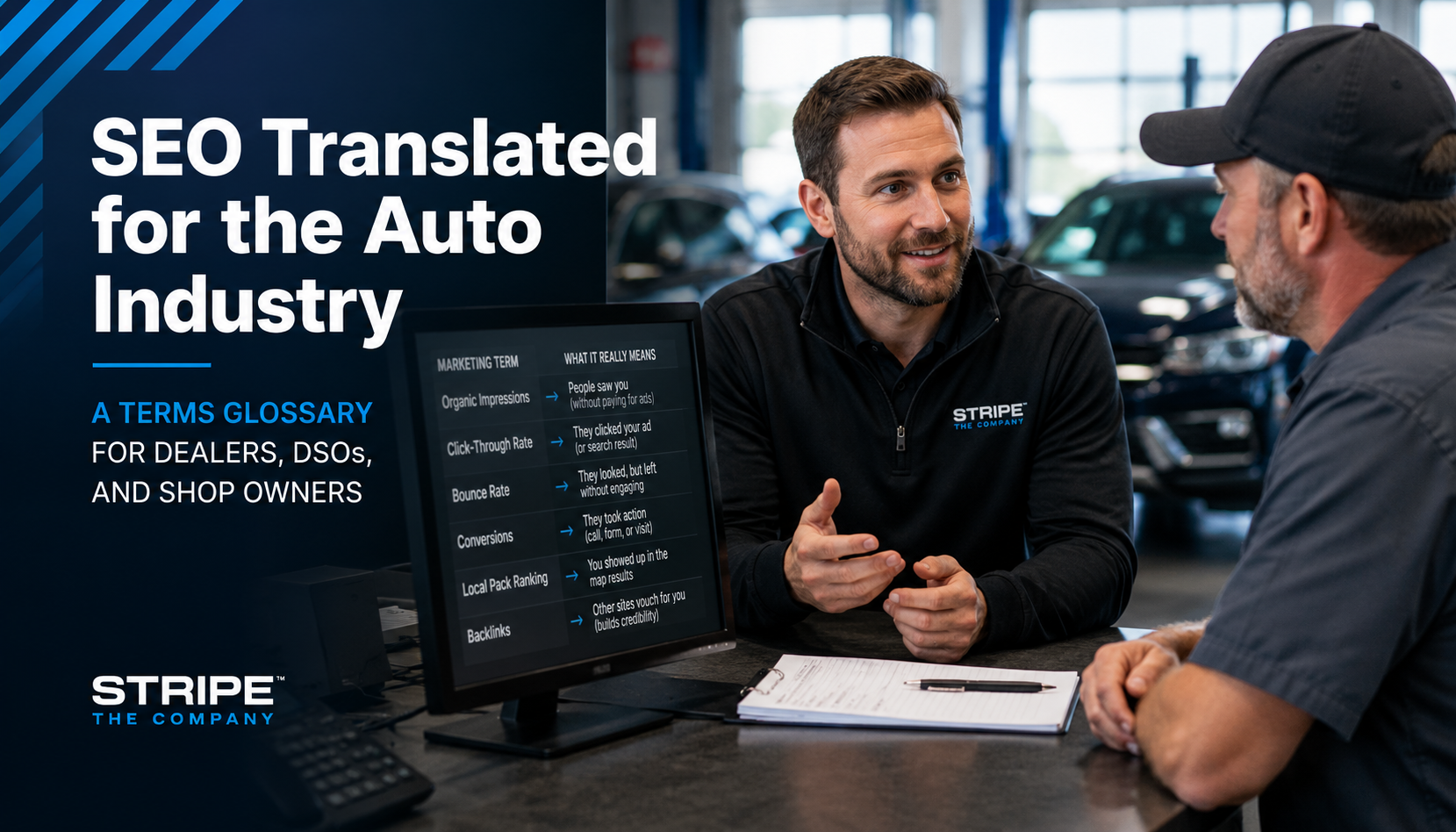
Your marketing agency speaks in impressions, crawl budgets, and domain authority. Your GM speaks in door swings, ROs, and gross per unit. Both of them are trying to grow the same business. Neither of them always understands what the other is saying.
This glossary exists to fix that. Every term below is something your agency will use in a meeting or a monthly report. Next to it is what it actually means in the language your store runs on — and why it matters to your bottom line.
Organic Traffic → Unsolicited Walk-Ins
In SEO, organic traffic is the volume of people who find your website through a search engine without you paying for that specific click. You didn't run an ad. They found you because Google decided you were the right answer to what they typed.
In auto terms, think of it as your unsolicited walk-in traffic. The customer who drove past your lot a hundred times, finally Googled "oil change near me," saw your name at the top, and came in without a coupon, a mailer, or a paid ad pulling them through the door. Organic traffic is the closest thing digital marketing has to word-of-mouth at scale. It compounds over time, it doesn't stop when you cut the budget, and it tends to produce higher-intent customers than paid channels.
Paid Search (PPC) → Spiff-Driven Floor Traffic
Pay-per-click advertising — Google Ads, Bing Ads — is traffic you buy one click at a time. You set a budget, you bid on keywords, and you pay every time someone clicks your ad regardless of whether they convert.
In the dealership context, treat it like a floor spiff. It works while it's running. Turn off the budget and the phone stops ringing. It's a legitimate tool for generating immediate volume, but it's not building anything — the moment you stop paying, the traffic disappears. The dealers who grow sustainably use paid search to bridge gaps while organic and GEO visibility compounds underneath it.
Keyword → What the Customer Actually Types
A keyword is the exact phrase someone searches before they make a decision. "2024 F-150 lease deals near Philadelphia." "Best transmission shop in Scottsdale." "Toyota Camry vs Honda Accord reliability." Every one of those is a keyword, and every one of them represents a customer at a specific point in their buying journey.
In your world, keywords are the equivalent of listening to what customers say when they walk in the door cold. "I saw you do free tire rotations" is a keyword. "My buddy said you guys are honest" is a keyword. SEO is the practice of understanding what your future customers are already typing and making sure your name shows up when they do it.
Search Intent → Buyer Stage
Not all keywords are created equal, and search intent is how SEO professionals categorize the difference. Informational intent means someone is researching. Navigational means they're looking for a specific business. Transactional intent means they're ready to buy or book.
Translating to your sales process: informational intent is the customer in the consideration phase — they're comparing models, reading reviews, not ready to talk numbers. Transactional intent is the be-back who just Googled your name from the parking lot of your competitor. The most valuable keywords for a dealership or shop are high commercial intent — "buy," "near me," "appointment," "price," "deal" — because those customers are already sold on the category and shopping for the vendor.
Domain Authority → Dealership Reputation Score
Domain authority is a score, typically on a scale of 1 to 100, that estimates how much credibility Google assigns to your website based on the quality and quantity of other websites that link to it. A local shop with 12 relevant links from local news sites, business directories, and supplier pages outperforms a national brand's landing page with zero local signal.
Think of it like your dealership's reputation score in the community. It's built slowly through consistent performance, external validation, and showing up in the right places. A high domain authority means Google trusts that your site is a legitimate, relevant authority in your space. You can't fake it and you can't buy it outright — you earn it the same way you earn a five-star reputation on DealerRater.
Backlinks → Third-Party Referrals
A backlink is when another website links to yours. Google interprets each quality backlink as a vote of confidence — another credible source is telling Google that your site is worth sending people to.
In automotive terms, backlinks are third-party referrals. When the local paper covers your community event and links to your website, that's a backlink. When a supplier's dealer locator points to your store, that's a backlink. When a local blogger reviews your detailing service and links to your booking page, that's a backlink. Just like a referral from a trusted source carries more weight than a cold call, a backlink from a credible, relevant site carries more weight than one from a junk directory. Quality over quantity — always.
On-Page SEO → What's on the Window Sticker
On-page SEO is everything on your actual website that you control — the titles, headings, descriptions, page copy, images, and structure that tells Google what each page is about and why it's relevant to a given search.
Think of it as the window sticker on a vehicle. It communicates exactly what you're offering, to whom, and at what specification. A service page that clearly says "oil change service in [City] — starting at $49.99, same-day appointments available" is a well-optimized page. A page that just says "Service" in the title and has three sentences of copy is the equivalent of a blank window sticker. Google can't sell what it doesn't understand.
Technical SEO → Lot Condition and Showroom Maintenance
Technical SEO covers everything underneath the hood of your website — page speed, mobile responsiveness, crawlability, broken links, structured data, SSL certificates, duplicate content. It's the infrastructure that allows Google to efficiently find, read, and index your content.
Your lot analogy: a customer who pulls into a dealership with cracked pavement, burned-out lights, and cars parked at random angles doesn't stay long. Technical SEO is lot condition and showroom maintenance. If your site loads slowly, breaks on mobile, or has hundreds of duplicate pages confusing Google's crawl, the best content in the world won't save your rankings. You have to maintain the foundation before you can merchandise the inventory.
Local SEO → Service Radius Dominance
Local SEO is the set of strategies that determines how prominently your business appears for searches with geographic intent — "near me," city name, zip code, neighborhood. It includes your Google Business Profile, local citations, review volume and velocity, and location-specific page content.
In your terms, local SEO is service radius dominance. It answers the question: when someone within five, ten, or twenty miles of your store searches for what you do, do they find you first or your competitor? For multi-rooftop groups and DSOs, local SEO is how you make sure each individual location is winning its own zip code rather than cannibalizing each other or getting outranked by independents.
Google Business Profile → Your Digital Service Drive
Your Google Business Profile is the listing that appears in Google Maps and in the local results panel when someone searches for your business or a category you operate in. It includes your hours, phone number, address, photos, reviews, and service categories.
For a dealership or shop, treat this as your digital service drive. It's often the first physical impression a customer has of your operation before they ever set foot on your property. Incomplete hours, missing service categories, no photos, and unanswered reviews signal the same thing a dirty waiting room does — that attention to detail isn't a priority here. An optimized, actively managed Google Business Profile is one of the highest-ROI investments in local marketing.
Review Velocity → CSI Score, Publicly Visible
Review velocity is the rate at which you're generating new customer reviews — not just the total count, but how recently and consistently they're coming in. Google's local algorithm favors businesses with active, recent review activity over businesses with a large but stale review pool.
Your CSI score is the closest internal analogue, except review velocity is your CSI score made public and made permanent. A store with 400 reviews and the last one posted eleven months ago looks different to Google — and to a prospective customer — than a store with 180 reviews and three posted this week. The cadence matters as much as the volume.
Content Marketing → Your Fixed Ops Service Menu, Explained
Content marketing is the practice of publishing useful, specific, expert information that attracts customers who are researching before they buy or book. Blog posts, FAQs, comparison guides, how-to articles — content that answers the questions your customers are already asking.
Think of it as explaining your fixed ops menu in plain language for people who don't know what a transfer case flush is or why it matters. A shop that publishes "How to tell if your brake pads need replacing" ranks for that question, earns the trust of the person reading it, and converts a portion of that traffic into appointments. Content marketing is not blogging for the sake of blogging. It's capturing demand that already exists and positioning your shop as the answer.
Impressions → Lot Visibility / Drive-By Traffic
Impressions measure how many times your website or listing appeared in search results, whether or not anyone clicked. High impressions with low clicks indicate that you're showing up but not compelling enough to earn the visit.
In physical terms, impressions are your drive-by traffic. People are seeing your sign, your lot, your location — but not turning in. The gap between impressions and clicks is the equivalent of the gap between drive-bys and door swings. Closing that gap is a function of better titles, stronger offers, and more compelling preview content — the digital equivalent of a clean lot, good signage, and an irresistible balloon sale.
Click-Through Rate (CTR) → Door Swing Conversion
Click-through rate is the percentage of people who saw your listing in search results and actually clicked through to your site. If your page appeared 10,000 times and 300 people clicked, your CTR is 3%. Industry average for automotive varies by position, but anything under 2% for a top-ranking result is leaving serious traffic on the table.
Door swing conversion is the equivalent. Of everyone who drove past your lot, what percentage actually turned in? CTR is that ratio applied to search. A weak CTR tells you that your title tag and meta description — the two lines of text Google shows in a result — aren't doing their job. They're your curb appeal in the search results page.
Bounce Rate → One-and-Done Ups
Bounce rate measures the percentage of visitors who land on a page and leave without taking any further action — no second page, no click, no form submission. A high bounce rate on a service page or VDP typically signals a mismatch between what the customer expected and what they found.
Dealership equivalent: the one-and-done up. They walked in, looked around for ninety seconds, and walked out without talking to anyone. High bounce rate on your site is that same experience happening at scale. The fix is usually alignment — making sure the page delivers exactly what the search result promised, and that the next logical action (schedule service, view inventory, get a quote) is obvious and frictionless.
Conversion Rate → Write-Up Rate
Conversion rate is the percentage of website visitors who take a desired action — submitting a lead form, booking a service appointment, clicking to call, starting a chat. If 1,000 people visit your service scheduling page and 40 book an appointment, your conversion rate is 4%.
Write-up rate is your floor analogy. Of the ups you took, how many did you write up? Conversion rate optimization — CRO — is the discipline of improving that ratio without increasing traffic spend. It's the digital version of improving your sales process, your word-tracks, and your follow-up cadence. More traffic without a better conversion rate is more ups with the same close percentage. The math doesn't improve.
GEO / AI Search Visibility → Being the Dealer the AI Recommends
Generative Engine Optimization is the emerging practice of ensuring your business appears in the AI-generated answers that ChatGPT, Perplexity, and Google AI Overviews produce when someone asks a conversational question. "What's the best Chevy dealer in Columbus?" "Which shop do people trust for transmission work in the suburbs of Dallas?" Those answers are being generated by AI systems pulling from publicly available signals about your brand.
In automotive terms, GEO is being the dealer or shop the AI recommends when a customer asks out loud. It's the digital equivalent of being the first name that comes to mind when someone asks a trusted friend where to buy a car or get their brakes done. The AI is becoming that trusted friend for millions of buyers — and the businesses showing up in those answers are the ones that built the most specific, consistent, well-documented public presence. That's the game now. The dealers who figure it out first own the recommendation layer before their competitors realize it exists.
Ready to build visibility that actually translates to your bottom line? Let's talk. →
Frequently Asked Questions
What's the difference between SEO and just running Google Ads for my dealership?
Google Ads is the spiff — it works while you're paying for it and stops the moment you cut the budget. SEO is the reputation you build over time that keeps generating traffic whether you're running a campaign or not. Both have a place in an automotive marketing strategy, but they do fundamentally different things. Paid search is a volume lever you can pull quickly. SEO is a compounding asset that gets more valuable the longer you invest in it. The dealers who grow sustainably are typically running both — using paid search to generate immediate floor traffic while SEO builds underneath it.
How long does SEO actually take to work for a dealership or auto shop?
The honest answer is three to six months before you see meaningful movement, and six to twelve months before the results are significant enough to impact your RO count or lead volume in a way that's hard to ignore. That timeline is uncomfortable for an industry built around month-end closes, but it's the reality of how search authority compounds. The good news is that the results don't disappear when you stop paying for a click. Every piece of optimized content, every earned backlink, every review that comes in is adding to an asset that keeps working. Dealers who quit SEO at month four because they didn't see instant results are the same ones paying premium CPCs on the same keywords two years later.
Why does my dealership rank fine on Google but not show up when someone asks ChatGPT or Perplexity?
Because AI search and traditional search use different signals to decide who to surface. Google ranks pages. AI search systems cite brands — and the brands they cite are the ones with the most specific, documented, externally validated public presence. You can rank on page one of Google with strong technical SEO and still be invisible in AI-generated responses if your content is generic, your reviews aren't being discussed anywhere beyond your own site, and your brand isn't being mentioned across multiple independent sources. AI visibility and traditional SEO overlap but they are not the same discipline. Both need deliberate investment.
Does my Google Business Profile really matter that much, or is it just a formality?
It is one of the highest-leverage assets in local automotive marketing and most stores are running it at about 30% of its potential. An incomplete or poorly managed Google Business Profile means you're losing door swings to competitors who look more credible in the map pack — before a customer ever visits your website. Hours, photos, service categories, Q&A, review responses, and posting cadence all factor into how prominently Google surfaces your location for near-me searches. For a multi-rooftop group, optimizing each individual profile is the fastest local SEO win available.
What should my dealership actually be blogging about — does anyone read that stuff?
The goal of content marketing for a dealership or shop is not to build a readership. It is to intercept customers at the exact moment they are researching something you can solve. "How often should I rotate my tires?" "Is it worth buying an extended warranty on a used truck?" "What's the difference between a CVT and a traditional automatic?" Every one of those is a question real customers are typing into Google and AI search engines right now. A shop that publishes a clear, specific, expert answer to that question earns the trust of the person reading it and a percentage of them convert into appointments. You're not blogging for blog readers. You're capturing demand that already exists.
How do online reviews actually affect my search rankings?
Review velocity — how recently and consistently new reviews are coming in — is one of the strongest signals in Google's local ranking algorithm. It's not just about volume. A store with 600 reviews and nothing new in eight months looks stale compared to a competitor with 200 reviews and five posted this week. Beyond rankings, reviews directly influence click-through rate from the map pack. A store showing 4.8 stars with recent activity converts more drive-by impressions into door swings than a store showing 4.2 stars with a dead review profile. The operational play is building review generation into your delivery and write-up process the same way you build in the CSI follow-up call.
What does a low click-through rate on my search listings actually mean for my store?
It means people are seeing you in results and choosing someone else before they even get to your website. Your title tag and meta description — the two lines of text that appear in a Google result — are your curb appeal in the search results page. If they're generic, keyword-stuffed, or don't communicate a clear reason to click, you're generating impressions without generating traffic. The fix is treating those two lines of text like ad copy, not an afterthought. Lead with what makes you worth clicking — your offer, your differentiator, your location specificity. A one-point improvement in CTR across your top pages can move your traffic numbers more than a ranking position gain.
We have multiple rooftops across different markets. Does SEO work differently for each location?
Yes, and this is one of the most common mistakes multi-rooftop groups and DSOs make — treating SEO as a single strategy applied across all locations rather than a location-specific program for each one. Each rooftop needs its own Google Business Profile optimized for its specific market, its own location page with city and neighborhood-specific content, its own review generation cadence, and its own local citation presence. A group that manages its digital presence at the brand level and applies a one-size-fits-all approach is leaving local market share on the table in every zip code it operates in. The stores winning local SEO in competitive automotive markets are the ones treating each location like an independent business with its own visibility program.
How do I know if my current SEO agency is actually doing anything?
Ask them for three things: the specific keywords your site has moved on in the last 90 days with before-and-after positions, the organic traffic trend broken down by page, and what new content or technical work was completed last month. If they can answer all three clearly and specifically, they're doing the work. If the answer is a dashboard screenshot with four aggregate numbers and a summary that says "we're making progress," that's not reporting — that's noise. Good SEO agencies show you exactly what moved, exactly why, and exactly what they're doing next. The work should be traceable to outcomes, not hidden behind jargon.
Is SEO even worth it for a smaller independent shop competing against dealer groups with big budgets?
It's where independent shops have their best shot at competing. Large dealer groups with big budgets tend to invest heavily in paid search and brand advertising — channels where budget size is a direct advantage. Local SEO is more of a meritocracy. Google's local algorithm rewards proximity, relevance, and reputation — not ad spend. An independent shop with a well-optimized Google Business Profile, consistent review velocity, location-specific content, and a technically clean website can outrank a regional dealer group for the high-intent local searches that actually drive service appointments. The playing field is not level, but it is more level in local organic search than almost anywhere else in automotive marketing.