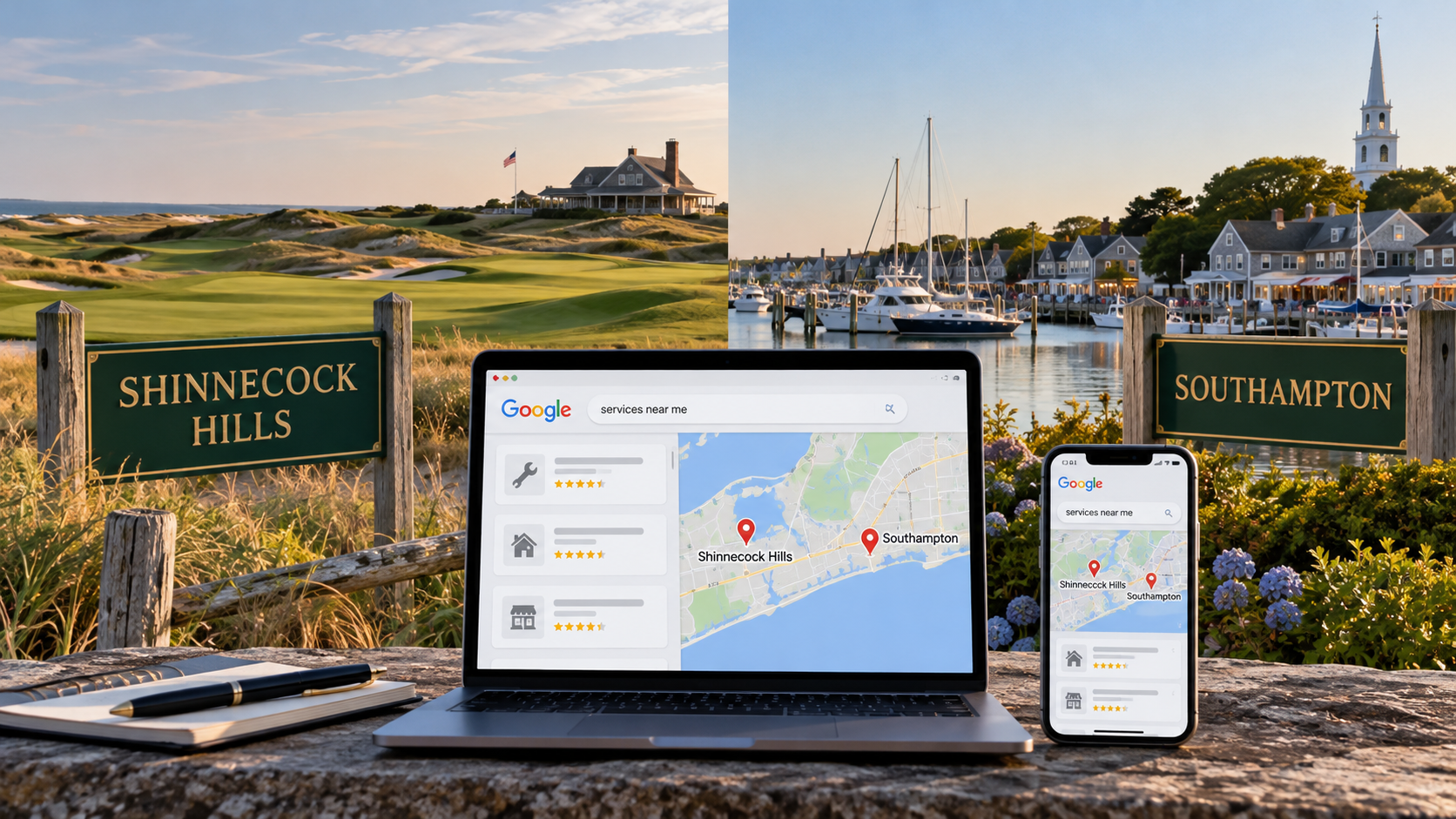
Why two nearby communities can produce different Google Maps results—and how local service companies can build visibility without inventing offices or duplicating pages.
A contractor can finish a job in Shinnecock Hills on Monday, quote a project in Southampton on Tuesday, and serve customers in both places all week. To the business owner, it may feel like one practical service market. To a customer searching on Google, though, “landscaper near me,” “Southampton pool maintenance,” and “Shinnecock Hills home repair” can lead to noticeably different results.
The reason is not that Google secretly assigns more value to one community. It is that local search depends on what the person wants, where the person searches, what the business actually offers, and what Google knows about its real location. Geographic labels matter, but adding town names to a page cannot make physical distance disappear.
For home-service and professional businesses operating across the South Fork, this distinction is easy to overlook. A company may be proud to serve “the Hamptons” yet never explain its work in Shinnecock Hills. Another may repeat “Southampton” on every webpage while leaving the actual services difficult to understand. A third may create unnecessary location pages for neighboring neighborhoods, hoping to capture more Google searches.
All three approaches can miss the point. The better strategy is to give Google and potential customers accurate information about where you are, where you work, what you do, and why someone should contact you.
This guide explains the geography behind Shinnecock Hills and Southampton searches, how Google Maps differs from ordinary website rankings, when location-specific website content makes sense, and how to measure actual inquiries. It is written for contractors, landscapers, estate managers, cleaning companies, pool service providers, specialty trades, and other service businesses seeking customers in and around Southampton.
First, understand what “Southampton” means
Southampton is not one perfectly defined search area. Depending on the conversation, someone saying “Southampton” might mean Southampton Village, the unincorporated Southampton area, or the much larger Town of Southampton. Those distinctions matter when describing a real business location, even if consumers occasionally use the terms loosely.
The Town of Southampton’s own visitor information identifies Southampton as one of Suffolk County’s East End towns and lists Southampton Village as an incorporated village within town boundaries. The town also lists Shinnecock Hills as a separate community on the eastern side of the Shinnecock Canal. The U.S. Census Bureau separately identifies Shinnecock Hills as a census-designated place.
These designations are not interchangeable. A business serving Shinnecock Hills does not automatically have a Southampton Village storefront. A Southampton mailing address does not prove that an office sits within village limits. And a service provider located elsewhere in the town should not describe itself as physically based in the village unless that is true.
There is also a separate, important distinction between the geographic label Shinnecock Hills and the Shinnecock Nation. The town identifies the Shinnecock Nation as a self-governing tribal community with land in the Shinnecock Hills area. Geographic marketing copy should respect those distinct identities rather than treating the tribal community as a generic neighborhood or inventing affiliations.
For SEO purposes, you do not need a lesson in municipal government on every page. You do need an accurate understanding of the area so that business descriptions, service claims, addresses, and directions are not misleading.
Consider a pool maintenance company whose actual base is near Hampton Bays but whose technicians regularly serve homeowners in Shinnecock Hills and Southampton Village. Its website might accurately say, “Pool maintenance for Southampton-area properties, including Shinnecock Hills and Southampton Village.” That is a statement about its service coverage. It should not say “our Southampton Village office” if no such office exists.
The goal is geographic clarity, not geographic keyword saturation.
Why Google Maps can show different businesses a few miles apart
Google explains that local rankings are mainly based on relevance, distance, and prominence. Relevance concerns the match between the business and the search. Distance concerns proximity to the person or location associated with the search. Prominence reflects how well known and established the business appears through information Google can evaluate, including reviews and references elsewhere online.
These are described in Google Business Profile’s official local ranking guidance. Google also says there is no way to request or pay for a better organic local ranking.
That matters because a service provider can be highly qualified, have excellent reviews, and still appear differently depending on where the search happens. A customer physically located in Shinnecock Hills searching “electrician near me” may see a different mix of businesses than someone making the same search inside Southampton Village. A search that explicitly names Southampton can also be interpreted differently from a search using no town name.
Location is not the only factor, and Google does not publish every ranking detail. Still, distance is a real part of the system, and businesses should not confuse location-specific rankings with an absolute score of marketing quality.
Imagine two hypothetical HVAC companies. Company A is based close to Shinnecock Hills and has a complete Google Business Profile, accurate categories, and relevant service pages. Company B is based farther away but has a larger review footprint and a well-established brand. One might perform better for certain nearby searches; the other might perform well for broader, branded, or reputation-driven searches. Without a real search audit, neither outcome can be assumed.
That is why “we don't rank number one in Southampton” is not a sufficient diagnosis. You have to ask: For which service? For which keyword? From which search location? In Google Maps, organic results, or paid ads? On what date? And did the visibility actually produce customer inquiries?
Google Maps rankings and ordinary website SEO are different problems
Business owners often use “Google ranking” to describe several distinct experiences. A map listing may appear above ordinary webpages. Beneath it, Google's standard results may show individual service pages, directories, company homepages, and articles. Paid placements can appear as well.
A complete Google Business Profile helps Google understand a local operation, but it does not replace a useful website. Likewise, a well-written website does not guarantee a top position in the local map results for every neighborhood.
When a Shinnecock Hills homeowner searches for an urgent plumber, they may act directly from the map: read reviews, tap a phone number, or request directions to a staffed storefront. Someone researching a landscape designer for a larger Southampton property may browse project galleries, review credentials, examine service descriptions, and schedule a consultation from the website.
These search journeys overlap, but they are not identical. The first depends heavily on clear, accurate local business details and easy contact. The second may place more emphasis on portfolio depth, website quality, explanatory content, and trust.
Google's SEO Starter Guide emphasizes helpful page organization, descriptive titles, understandable content, and relevant links. Its local ranking guidance emphasizes accurate Business Profile information. Together they suggest a sensible division of labor: maintain a reliable business profile, and build webpages that answer the questions customers actually have.
This also explains why adding the words “Shinnecock Hills” to your homepage cannot solve every local-search problem. It may help clarify your service coverage in a useful context. It cannot manufacture a second verified office or eliminate geographic limitations in Maps.
What should a Shinnecock Hills service business target?
Start with services, not place names. A customer generally needs a problem solved: heating repair, property maintenance, outdoor lighting, roof work, pool servicing, landscaping, cleaning, or another identifiable task. The location modifier adds context, but the service creates commercial intent.
A small service business could build a keyword map around three layers. The first layer contains its core services: “pool opening,” “weekly pool maintenance,” and “pool equipment repair,” for example. The second adds relevant places where it truly operates: “Shinnecock Hills pool service,” “Southampton pool maintenance,” or “pool opening Southampton NY.” The third adds specific questions or problems: “how early to schedule spring pool opening” or “pool pump repair before summer.”
These phrases are illustrative research candidates, not verified search-volume rankings. An owner should validate which terms appear in Google Search Console, which questions customers ask during calls, and which services are profitable enough to prioritize.
It is usually better to have a clear page about a commercially valuable service than a dozen thin pages targeting only slight variations of nearby place names. For example, a real pool service page might explain maintenance frequency, service options, equipment work, seasonal scheduling, coverage area, and the process for requesting an estimate. Local references can be included naturally where they help customers understand coverage.
By contrast, a page that only says “We offer the best pool services in Shinnecock Hills,” then repeats the same text with “Southampton Village” swapped in, contributes little useful information.
The right keyword strategy answers two questions at once: Does the search reflect something we truly provide? And can the customer tell what happens after they contact us?
Should you build separate pages for Shinnecock Hills and Southampton?
Sometimes—but not automatically.
Separate location pages make sense when each can provide genuinely different information. Perhaps your company has a physical staffed location in one community and another legitimate operating location in a second. Perhaps you have substantial experience serving distinct types of properties in each area, unique service logistics, different coverage requirements, or notable project examples you are permitted to share.
The page should then be more than a place-name variation. It should describe the relevant services, who the page is for, accurate coverage boundaries, useful project context, scheduling details, and a clear contact method. It should be accessible through logical website navigation rather than existing only to attract search engines.
If the information would be nearly identical on both pages, consider one strong regional service-area page instead. A contractor can explain that it serves Shinnecock Hills, Southampton Village, Tuckahoe, and other areas when that coverage is accurate, without publishing a near-copy for every locality.
Google's spam policies describe doorway abuse, including substantially similar pages aimed at different geographic searches that funnel users toward the same destination without useful differences. The lesson isn't that location pages are forbidden. It's that location pages should exist to help customers, not merely to multiply keyword targets.
Before creating a second page, ask: Would a customer who lives in that area learn something useful here that is missing from our main service page? Can we support our local claims with genuine experience, details, or examples? Are we able to maintain this page accurately?
If the answer is no, improve the existing page first. A website with fewer, stronger pages is often more useful to prospective customers than a large collection of thin local landing pages.
Your Google Business Profile should reflect where your business really operates
Google Business Profile rules are especially important for contractors and mobile services. According to Google's business representation guidelines, a service-area business that visits customers rather than receiving them at a storefront generally maintains one profile for its actual base of operations, with an appropriate service area. It should hide its address when it does not serve customers there.
A hybrid business that genuinely receives customers at a staffed location and also travels to them can provide both a storefront address and service area. Separate profiles for multiple locations require real locations with separate staffing and operations that satisfy Google's requirements—not rented mailboxes or nominal offices established only for search visibility.
This means a Southampton-area contractor should not create one Google Business Profile for Shinnecock Hills and another for Southampton Village simply because it serves both. Adding a city name to a profile also does not give the business a new physical location.
Google's service-area guidance permits up to 20 service areas and asks businesses to describe their actual coverage accurately. Service areas can be helpful to customers, but selecting more of them does not automatically make a business rank in all of them.
For a business based in Shinnecock Hills that works in Southampton Village, a responsible setup could include its actual base and genuine nearby service areas, appropriate categories, a working phone number, and an accurate website link. The details depend on whether it is a storefront, service-area, or hybrid operation.
If you are unsure whether your profile setup complies, check the rules before changing addresses or creating new profiles. An aggressive shortcut can become a verification or suspension problem, which is much harder to resolve than a normal ranking gap.
Categories and service descriptions matter more than repeating Southampton everywhere
Google asks businesses to choose categories that reflect what they actually are. If you operate a roofing company, your primary category should accurately reflect that business—not whichever category appears easiest to rank for. Related secondary categories can be useful where appropriate, but they must remain truthful.
A business's website should reinforce the same reality. Suppose the company specializes in exterior painting and restoration. Its site should explain the services, the types of jobs it accepts, the properties it works on, and what a customer should expect. The location details should help people decide whether it serves them.
Consider how a homeowner reads a page. “Serving Southampton” may sound broad but leave unanswered whether the company works in Shinnecock Hills. “We provide exterior painting and restoration throughout Southampton Village and nearby Shinnecock Hills, subject to project availability” is more specific—if true. A service-area map or carefully written coverage paragraph may be more helpful than repeating the same places in every heading.
Google's local guidance identifies business relevance as part of ranking. Clear, detailed information supports relevance by making what a business does easier to understand. But relevance is not achieved through repetition alone, and no content change can guarantee a particular map placement.
For service businesses with multiple specialties, a sensible website architecture often looks like one strong page per major service, supported by a helpful service-area page and selective local proof. The structure should follow customer needs, not the number of hamlets in Suffolk County.
Local project proof can be more persuasive than location keywords
If you serve homes and businesses around Southampton, actual completed work can help demonstrate that relationship. A case study about solving an irrigation problem, maintaining a pool through the shoulder season, or restoring exterior finishes can show both your technical capability and the context in which you work.
For higher-value services, the case study should explain the challenge, approach, scope, and result without disclosing client information without permission. A few authentic photographs or a written account can say more than another paragraph of “trusted Southampton contractor” claims.
This is particularly relevant to companies working with private residences, estates, property managers, and design professionals. In these relationships, discretion may be as important as publicity. You do not need to identify an address, client, or property to explain your approach. Obtain permission for photos and testimonials, and use generalized location language when confidentiality calls for it.
The opportunity is not to manufacture local authority. It is to document work you already perform. A portfolio containing actual relevant projects helps a prospective customer decide whether to call, even if they found the website through a broader query such as “landscape lighting company Southampton.”
When local pages are supported by useful proof, they become better sales resources. And that means ranking should be evaluated alongside whether the page encourages qualified conversations.
Reviews support trust, but they don't override distance
A West-of-the-village service provider may have dozens of positive reviews yet still appear below a nearby competitor for a search made from another area. That can be frustrating, but it is not evidence that reviews are being ignored. Google's local ranking guidance includes review signals within prominence while continuing to consider distance and relevance.
The best review strategy is straightforward: ask real customers for honest feedback through permitted channels, make the process easy, and respond professionally when appropriate. Avoid offering incentives in exchange for reviews, filtering out negative customers, or inserting manufactured reviews. Those approaches can violate platform policies and undermine trust.
Specificity is helpful to readers. A real customer describing reliable communication, careful property access, prompt troubleshooting, or a smooth seasonal service experience can help future customers judge fit. Businesses should not script or pressure customers to use particular place names or keywords.
Reviews are one piece of local credibility. Accurate business details, a working phone number, authentic photos, service descriptions, meaningful project information, and timely responses matter to the customer journey too.
Instead of asking only “How do we get more reviews?”, consider “Are we giving people enough confidence to contact us after reading them?” A business with an excellent star rating but a broken contact form can still lose valuable work.
Think about the person searching, not just the town name
Two potential customers can search for similar services but need very different things. A year-round resident may be looking for a repair this week. A seasonal homeowner may be coordinating access and scheduling remotely. A property manager may need consistent documentation and recurring maintenance. A designer or contractor may be screening subcontractors for a larger project.
Those differences can matter more than whether the search contains “Shinnecock Hills” or “Southampton.” A good service page answers the questions that are relevant to the buyer: response area, minimum project size, scheduling, licensing or qualifications where applicable, consultation process, recurring-service options, and how access is handled.
For example, an estate maintenance company may explain how it coordinates with owners who are not on-site, while a plumbing company may emphasize its actual emergency hours and service area. A landscape company could show portfolio examples and a design-to-maintenance process. These details help qualify leads before someone calls.
The geographic goal is to be visible in the places that matter. The business goal is to attract projects you can serve profitably and well. When those goals are separated, the marketing plan becomes easier to evaluate.
This is why copying a large competitor's keyword list is often a poor strategy for a smaller service business. The competitor may cover different services, have more crews, or maintain a legitimate office you do not. Your content should accurately represent your own operating model.
A practical way to audit Shinnecock Hills and Southampton visibility
Do not judge performance by one personal search on your own phone. Google may use location, context, and other signals to tailor what you see. A more useful audit records what was searched, where the search took place, which type of result appeared, and whether it led to business.
Begin by checking your Google Business Profile's verified status, category, address or hidden-address configuration, service areas, hours, phone number, and website link. Then inspect how the profile presents services, photographs, reviews, and contact options.
Next, choose a manageable set of commercial queries, such as your three most valuable services paired with Shinnecock Hills, Southampton, and a neutral “near me” variation. Evaluate Maps visibility across representative locations rather than assuming one point represents the entire region. Record observations over time, and remember that rankings naturally vary.
Then use Google Search Console's Performance report to examine website queries, pages, impressions, clicks, and changes over comparable periods. Search Console is useful for organic website search performance; it is not a precise neighborhood-by-neighborhood Google Maps rank tracker. Its query data also has limitations, including anonymization and filtering effects.
In Google Business Profile Performance, look at available discovery queries and customer actions such as calls, website clicks, and direction requests where applicable. These actions are useful indicators, but a call click is not a completed call, and a website click is not automatically a customer.
Finally, connect the findings to your inquiry records. Which jobs came from Shinnecock Hills? Which from Southampton Village? Which services were requested? Were they viable leads? Was a quote sent, and was the job booked? Even a simple CRM or consistent call log can turn a vague visibility discussion into a business decision.
An audit that ends with “you're ranking seventh” has missed the larger question: what is preventing the right local customers from finding and choosing you?
Five common local geography mistakes
Mistake 1: Treating “Southampton” as a precise synonym for every nearby place
Broad language can be appropriate when discussing general service coverage. It becomes misleading when it implies a physical address or office in a different jurisdiction. Be clear when you mean Southampton Village, the broader town, or nearby communities such as Shinnecock Hills.
Mistake 2: Creating a separate Business Profile for every town served
A service-area business normally needs one profile for its genuine operating base, not a new profile each time it expands coverage into a nearby community. Google's profile representation rules make that distinction explicit. Multiple legitimate staffed locations are a different case, but they must meet Google's criteria.
Mistake 3: Assuming service-area settings guarantee rankings
Choosing Shinnecock Hills and Southampton as covered areas can clarify where your company works. It does not force Google to display the company at the top in both places. Distance, relevance, and prominence continue to matter.
Mistake 4: Publishing nearly identical pages for every locality
Changing only a location name rarely adds meaningful value. Instead, build detailed service information and create geographic pages only when they genuinely help customers. Google's doorway-abuse policy is a useful reminder that more URLs do not necessarily mean more useful coverage.
Mistake 5: Reporting rankings instead of qualified inquiries
A page can rise in impressions while bringing no viable projects. A business can improve its ranking for an irrelevant service while losing visibility for the work it actually wants. Track service-specific leads, source, coverage area, estimates, and bookings so SEO is connected to the business.
How geography changes the strategy by industry
HVAC, plumbing, electrical, and emergency home repair
For urgent services, accurate coverage and contact reliability are essential. Customers may search from a property where help is needed immediately. Prioritize clear service descriptions, actual availability, mobile click-to-call options, and trustworthy operating details. Only advertise emergency or 24-hour service if you genuinely provide it.
A contractor based nearer Shinnecock Hills can still pursue Southampton Village work, but should not assume one set of map rankings will cover the entire route. Website pages describing the services and service boundaries can capture organic demand even where local map placement varies.
Landscaping, pool service, and estate maintenance
These services often involve planned work, maintenance schedules, or recurring relationships. Geographic search matters, but evidence of quality and process may be equally important. Explain the specific types of properties served, seasonal availability, and how quotes or ongoing agreements work.
A portfolio or service page can speak to Southampton-area homeowners while showing real experience across nearby communities. If the work differs substantially between projects, share those differences instead of simply creating a page for each town.
Cleaning, home watch, and property management
Trust, access procedures, communication, and consistency may be decisive. A customer may search using a broader area name because they manage a property remotely. Your website should make the service scope and onboarding process clear, especially for recurring or seasonal arrangements.
Avoid listing areas so broadly that customers assume coverage you cannot deliver. The most profitable lead is not necessarily the most distant or most expensive property; it is the one you can serve reliably.
Design, renovation, and specialty trades
Larger projects often involve longer research journeys. Organic website content, authentic portfolios, appropriate credentials, and a clear consultation process can be important even when the buyer first finds a company through Maps. The website should indicate what project sizes and services are a fit so inquiries are more qualified.
For all of these industries, the underlying lesson is the same: geographic visibility should reinforce your operating reality, not exaggerate it.
A 90-day local search plan for businesses serving both areas
Days 1–30: Establish reality and fix obvious errors. Confirm your actual operating address and legitimate service areas. Check Business Profile categories, verification, hours, services, and contact details. Review your website's top services and current location language. Record an initial baseline of searches, interactions, leads, and booked work. Make sure no duplicate or misleading location profiles have been created.
Days 31–60: Improve useful content and conversion paths. Strengthen the pages for your most valuable services. Add accurate service-area descriptions where they help customers. Improve mobile forms, prominent phone links, portfolio proof, and next-step explanations. If there is a real reason for a separate Shinnecock Hills or Southampton page, build one with distinct useful information rather than copying text.
Days 61–90: Validate, measure, and refine. Review Search Console and Business Profile data against your baseline. Examine which inquiries come from which areas and whether they match the services you want. Ask customers how they found you. Revisit confusing pages or weak contact experiences. Decide whether further local content, website improvements, or broader marketing is justified by the evidence.
Ninety days is a planning framework, not a guarantee of a ranking increase or a complete view of seasonal demand. For home-service companies, comparing results across similar seasons is often important. A landscaping business can have different search behavior in January than in May without anything being technically broken.
The best result of the first quarter may be a clearer diagnosis: perhaps the company already has enough local visibility but needs better conversion; perhaps it serves a second area yet does not explain that service clearly; or perhaps Google Maps performance is constrained by proximity while its website can still reach qualified customers through organic searches.
When it makes sense to hire a local SEO specialist
A professional audit is most useful when a business has already handled the basics but remains uncertain about its visibility, profile setup, or lead quality. It can also help when someone has created many local pages or profiles and the owner does not know which should remain.
Ask a prospective SEO specialist to distinguish Maps visibility from organic website performance, explain location and eligibility rules, and show how they would evaluate service-specific inquiries. They should not promise a number-one ranking in Shinnecock Hills or Southampton Village, or claim that buying an address or adding more city names will solve proximity limitations.
A good proposal should identify what needs to be reviewed: Business Profile configuration, categories, service-area accuracy, website architecture, search intent, local proof, technical issues, customer experience, and measurement. It should also explain what changes the provider recommends first and why.
Local SEO can be a meaningful investment for a service company whose projects justify acquisition costs. But there is no reason to buy a large monthly package if the immediate issue is a wrong category, an unusable mobile form, or a confusing service description. Scope should follow the diagnosed problem.
Frequently Asked Questions
1. Is Shinnecock Hills the same as Southampton Village?
No. Shinnecock Hills is a separately identified community within the Town of Southampton. Southampton Village is an incorporated village. Businesses should use those labels accurately when describing where they are physically located and where they serve customers.
2. Can a Shinnecock Hills business rank in Southampton Village?
Yes, it can appear for relevant searches, but visibility is not guaranteed and will vary by query, competition, relevance, prominence, and distance. A business can work in both places without ranking identically in both.
3. Should I mention both places on my website?
If you genuinely serve both, it can be helpful to say so. Use clear coverage language in service descriptions and service-area content. Do not add location names where they are irrelevant or use them to imply an office that does not exist.
4. Does adding Southampton Village to my Google Business Profile service area help?
An accurate service area helps communicate where you work. It is not a guarantee of increased rankings within that community. Google continues to consider relevance, distance, and prominence.
5. Can I have separate Business Profiles for Shinnecock Hills and Southampton?
Not merely because you serve both. Separate profiles require distinct, eligible real-world operations meeting Google's rules. A mobile service provider operating from one base generally should not create extra profiles for nearby coverage areas.
6. Do I need separate website pages for each area?
Only when each page can provide unique, helpful information. If the content would be almost identical, a strong shared service or regional coverage page may be more appropriate. Avoid location pages built only to repeat keywords.
7. Why does my competitor outrank me if I have better reviews?
Reviews can support prominence but are not the only local ranking consideration. Your competitor might be closer to a particular searcher, have a more relevant category, or be a better match for that search. Investigate the specific query before drawing conclusions.
8. Can I use a virtual office in Southampton to rank there?
A virtual office used only as a mailing address generally does not qualify for a Google Business Profile. Google requires accurate real-world representation. Do not use fake addresses as a local SEO tactic.
9. What should an HVAC company focus on first?
Check profile eligibility, accurate categories, real service coverage, availability, and mobile contact options. Then improve service pages for the specific heating and cooling work the business actually provides. Measure qualified calls and booked jobs, not just appearances.
10. Does one Southampton ZIP code cover all search intent?
No. Postal designations do not erase neighborhood or municipal distinctions, and people may search using a community, a broad area, or “near me.” Use ZIP codes where they help customers understand coverage, not as substitutes for an accurate geographic strategy.
11. Can local pages help when Maps rankings are weaker farther away?
Useful service pages may reach customers through ordinary organic search even when a business's Maps visibility is limited by proximity. That is a reason to invest in helpful content, not a guarantee that any page will rank.
12. What is more important: a Google Business Profile or website SEO?
Both can matter. The profile supports discovery and actions on Google Maps and Search; the website explains services, experience, processes, and reasons to contact the company. The balance depends on the service, customer journey, and current weaknesses.
13. How do I measure whether Shinnecock Hills leads are increasing?
Use search and profile performance as context, then record actual inquiry locations and services in a CRM or call log. Compare qualified inquiries, estimates, and booked work over similar periods. Search Console does not provide a complete street-level map ranking report.
14. Can I optimize for Southampton without being based there?
Yes, if the content honestly reflects services you provide there. Do not falsely claim an office, fabricate local projects, or create misleading Google Business Profiles. Make coverage, service details, and contact expectations accurate.
15. How quickly should local SEO changes work?
There is no universal timeline. Simple corrections may appear sooner than meaningful competitive improvements, and search visibility can fluctuate. Establish a baseline, prioritize the largest verified problems, and assess trends rather than interpreting every daily change as a success or failure.
16. When should I hire an SEO agency?
Consider professional help when the problem is unclear, multiple profiles or pages have become inconsistent, or valuable customer demand is being lost. Ask for a diagnostic scope and a reporting plan tied to meaningful business inquiries before signing a long contract.
Final Takeaway: Target the Customers You Can Actually Serve
Shinnecock Hills and Southampton may sit close together on a service route, but proximity on a road map does not make them identical in Google Search. Searchers can be in different places, use different wording, and need different services. Google's systems also consider real business location alongside relevance and prominence.
That does not mean a service business must choose one place and ignore the other. It means its strategy should make sense geographically and commercially. Keep one truthful business identity, represent real service coverage, build pages that answer customer questions, document relevant work, and measure the inquiries that result.
A business does not need to pretend to be located everywhere to become useful to customers across the Southampton area. It needs to be clear about where it works and why someone should choose it.
Get a Local SEO Review From Ritner Digital
If your business serves Shinnecock Hills, Southampton Village, or surrounding South Fork communities but struggles to turn Google visibility into qualified inquiries, Ritner Digital's local SEO services can help you evaluate your Google Business Profile, service-area strategy, website content, and conversion paths.
Instead of buying more location pages or guessing which town name to target, start with an assessment of where your business operates, how people are finding it, and where potential customers drop off.
Contact Ritner Digital to discuss your local SEO and service-area strategy.