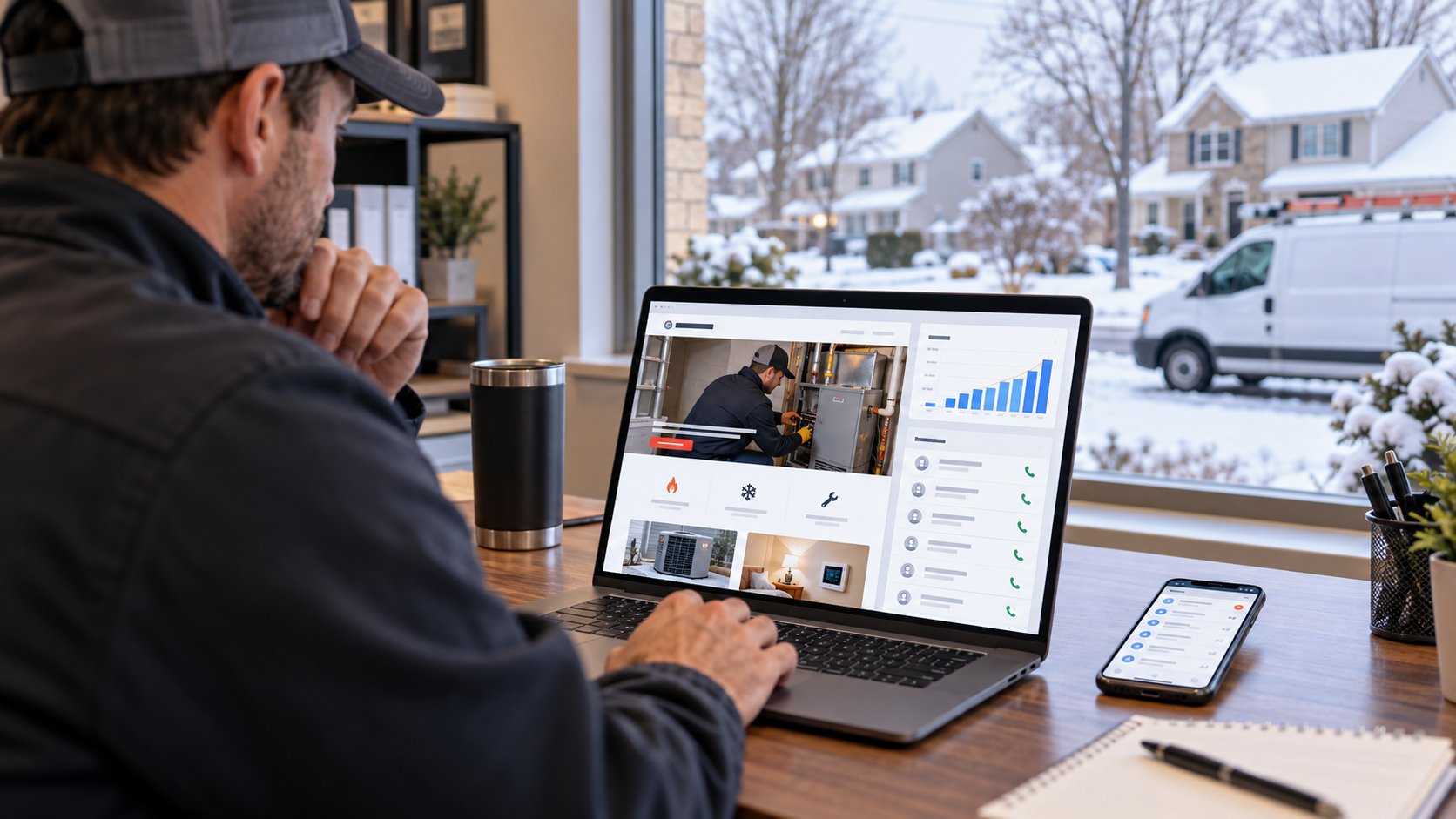
When a homeowner in Cherry Hill wakes up to a freezing house in January, they're probably not interested in reading a company's entire history.
They want to know three things.
Can you fix their heating system?
Do you service their neighborhood?
And how quickly can they contact you?
If your HVAC website doesn't answer those questions immediately, that homeowner may move on to another contractor.
It's a simple scenario, but it exposes a major weakness in how many local service businesses approach digital marketing.
They invest in websites, Google Ads, local SEO, and online business listings. They work hard to generate visibility. But they don't always examine what happens when someone actually needs their services.
And during the winter heating season, that disconnect can become expensive.
For HVAC companies serving Camden, Gloucester, Burlington, Salem, Cumberland, and surrounding South Jersey communities, winter creates important opportunities to connect with homeowners looking for furnace repairs, heat pump service, boiler maintenance, heating system replacements, and emergency assistance.
Some customers plan ahead.
Others don't think about their heating system until something stops working.
Both types of customers may start with an online search.
The question isn't simply whether your HVAC company appears on Google. It's whether your website makes it easy for the right customers to contact you once they find you.
At Ritner Digital, we focus on the connection between search visibility, website experience, and meaningful business inquiries.
For an HVAC contractor, that means looking beyond rankings and website traffic.
It means understanding whether local homeowners can find your heating services, verify that you serve their location, trust your company, and request an appointment without unnecessary friction.
As South Jersey approaches another heating season, now is a good time to examine whether your website is supporting those decisions or creating obstacles.
Here's what HVAC business owners should review before the next cold snap.
Winter Heating Demand Creates a Different Kind of Search Behavior
Heating-related searches often reflect a more immediate problem than general home improvement research.
Someone comparing kitchen renovation styles may spend months gathering ideas.
Someone whose furnace stops producing heat on a cold evening has a different priority.
They need a qualified professional who can evaluate the problem and explain the available options.
That creates a distinctive search environment for HVAC companies.
A homeowner might search for "furnace repair near me," "emergency heating repair South Jersey," or "heat pump not heating Cherry Hill."
Another might look for "boiler repair Gloucester County" or "heating contractor Marlton NJ."
These are examples of relevant search phrases, not claims about verified local keyword volumes.
But they illustrate an important principle: the language customers use changes with the urgency and nature of the problem they're experiencing.
South Jersey Has a Real Heating Season
The seasonal relevance isn't speculative.
The Office of the New Jersey State Climatologist at Rutgers University publishes climate normals based on the 1991–2020 period, including monthly temperature and heating-degree-day data for New Jersey locations.
Heating degree days estimate the demand for heating relative to a standard base temperature.
The Philadelphia/Mount Holly climate normals show how heating requirements increase through the colder months.
That doesn't establish how many HVAC service calls any particular business will receive.
Equipment failures, household needs, local weather conditions, and service demand vary.
But it demonstrates why winter heating services deserve a dedicated place in a South Jersey HVAC company's marketing strategy.
The more important business question is whether the company is positioned to capture relevant demand when it appears.
Your HVAC Website May Be Losing Leads Before You Even Know Someone Visited
One of the challenges with website conversion problems is that lost opportunities aren't always obvious.
A customer who reaches your website, struggles to find your phone number, and leaves without contacting you may never appear in your sales records.
Your team doesn't receive a missed-call notification.
Your scheduling system doesn't show a failed appointment.
You may simply see another website visit.
That makes the problem difficult to recognize without the right measurement tools.
Consider two HVAC contractors serving the same general area.
Both appear in relevant search results.
Both offer furnace repairs.
Both have experienced technicians.
But their websites create very different experiences.
The first website opens with a large generic statement about exceptional service, followed by rotating images, company history, and several sections about different HVAC services.
The visitor has to scroll to determine whether the company offers heating repairs.
The telephone number is difficult to locate on a phone.
The second website clearly explains that the company provides furnace and heating repairs, identifies its service area, and prominently displays a working telephone number and appointment option.
The second website hasn't necessarily offered a better service.
But it has made the next step easier.
And when someone needs heat restored, that difference can influence which contractor receives the inquiry.
1. Your Website Doesn't Make Heating Repair Services Obvious
Many HVAC companies offer both heating and cooling services.
That's normal.
The problem arises when a website treats every service as one undifferentiated category.
A page titled "Our HVAC Solutions" may contain information about air conditioning, furnace repair, ductwork, maintenance, heat pumps, indoor air quality, and system replacements.
But a homeowner looking for a furnace repair may not want to search through all of that information.
They need to know whether the business handles their particular problem.
Separate Heating Services by Customer Need
An HVAC website should make its major services easy to understand and navigate.
A furnace repair page should explain the situations the company handles, the types of systems it services, and how customers can request help.
A heating installation page should address different questions, such as replacement considerations, estimates, and system selection.
A heat pump service page may need to explain both heating and cooling applications.
Boiler service may deserve its own page when it represents an important part of the company's work.
These pages should be created because they answer meaningfully different customer questions, not simply to generate more URLs.
Google's SEO Starter Guide emphasizes useful, organized content that helps search engines and people understand a website.
For HVAC contractors, clear service organization supports both goals.
Don't Make Customers Guess What You Offer
A homeowner shouldn't have to call just to find out whether your company services gas furnaces or residential boilers.
Explain your actual capabilities.
If you specialize in particular systems or manufacturers, communicate that accurately.
If your technicians service both residential and commercial properties, make those distinctions clear.
If certain services are not available, avoid suggesting otherwise.
This is especially important for emergency heating searches, where people may be comparing several providers quickly.
The easier it is to establish relevance, the easier it becomes for a qualified customer to move toward an inquiry.
2. Your Phone Number Is Hard to Find on Mobile
This is one of the most practical website issues HVAC contractors can investigate.
A customer experiencing a heating problem may search from a smartphone, open a contractor's website, and attempt to call.
If the telephone number is buried in the footer, displayed as an image, or difficult to interact with, the website creates an unnecessary obstacle.
A mobile-friendly heating service page should offer a clear way to call.
That doesn't mean covering the entire screen with oversized buttons.
It means making the primary action visible, understandable, and functional.
Make Contact Information Easy to Use
A phone number should be readable and linked so mobile visitors can initiate a call.
An appointment request option should be easy to locate for customers who prefer not to call immediately.
If the business offers emergency service, those details should be accurate and prominently explained.
Importantly, don't advertise 24-hour emergency availability unless the company genuinely provides that service.
A customer whose heating system fails at midnight may reasonably interpret a "24/7 emergency repairs" message as a promise of immediate access to assistance.
If the company offers after-hours voicemail, next-day scheduling, or an emergency answering service with limited availability, communicate that honestly.
Test the Experience Like a Customer
Don't evaluate your website exclusively from a desktop computer in the office.
Open it on a phone.
Visit your furnace repair page directly from a search result if possible.
Try calling the displayed number.
Check the appointment form.
See how easy it is to return to the heating service information.
Then repeat the process on another mobile device or browser.
You may discover problems that aren't visible during routine office use.
A website can look professional and still be inconvenient for someone trying to contact a contractor quickly.
3. Your Website Is Too Slow When Customers Need Answers
Website speed matters because customers shouldn't have to wait through unnecessary delays to access essential information.
Large images, complicated page builders, excessive scripts, third-party widgets, and poorly optimized design elements can affect performance.
For an HVAC company, the issue is especially relevant when visitors are arriving with immediate service needs.
A homeowner shouldn't have to wait for a full-screen video or animation before seeing the heating repair phone number.
Google's Core Web Vitals documentation identifies three primary measurements of real-world page experience.
Largest Contentful Paint evaluates loading performance.
Interaction to Next Paint measures responsiveness.
Cumulative Layout Shift measures visual stability.
Google recommends good performance across these metrics and provides guidance for evaluating them.
Speed Is Part of the Customer Experience
A website doesn't need elaborate animations to convince someone to request heating service.
It needs to present relevant information clearly.
Large homepage images can be optimized.
Unnecessary scripts can be removed or deferred where appropriate.
Layouts can be simplified.
Contact buttons can appear without waiting for unrelated elements to finish loading.
Google's page experience guidance also makes an important distinction: strong technical scores alone don't guarantee higher search rankings.
Page experience is one consideration within a much larger search system.
For a local service company, the practical goal should be straightforward.
Make the website fast enough and easy enough that potential customers can use it without frustration.
4. You're Not Showing Up for the Heating Searches That Matter
Not every search visitor has the same value to an HVAC business.
Someone researching how heating systems work may be gathering general information.
Someone looking for a licensed furnace repair contractor in a specific town may have a more immediate service requirement.
A useful SEO strategy recognizes that difference.
Focus on Actual Service Intent
South Jersey HVAC companies should evaluate their visibility for searches related to the services they provide and the areas they genuinely serve.
For example, a contractor operating in Camden County may want to understand its search visibility for heating repair in Cherry Hill, Voorhees, or nearby communities.
A Gloucester County business might evaluate searches involving Washington Township, Deptford, Glassboro, or Sewell.
A contractor serving Burlington County could consider searches associated with Marlton, Mount Laurel, and surrounding communities.
These are examples of geographically relevant targeting. They aren't a recommendation to build separate pages for every town automatically.
The goal is to match real services and genuine geographic coverage.
Use Search Console to Find Gaps
Google Search Console allows website owners to review search queries, impressions, clicks, and landing-page performance.
This can help an HVAC contractor answer important questions.
Is the website receiving visibility for furnace repair searches?
Are heating service pages being discovered?
Which search phrases bring visitors to the website?
Are most search clicks branded, or is the business also being discovered through non-branded service searches?
Which pages are attracting relevant search activity?
These questions can reveal opportunities that ordinary website traffic reports may miss.
However, Search Console doesn't provide a complete record of every query or a verified count of customer inquiries.
It should be used alongside website analytics and actual lead records.
5. Your Google Business Profile May Be Sending the Wrong Message
For local HVAC contractors, your website isn't the only place customers evaluate your business.
Your Google Business Profile can appear in Google Search and Maps, helping nearby customers assess relevant service companies.
That makes profile accuracy important.
Google explains that its local ranking systems mainly consider relevance, distance, and prominence.
In its guidance on improving local rankings, Google emphasizes complete business information, accurate details, and helpful customer reviews.
For an HVAC business, basic information matters.
A customer needs to know whether the company services their area, how to contact it, and what services it offers.
Verify Your Services and Service Area
Google allows eligible service businesses to specify service areas and list services.
An HVAC company can use this information to clarify the types of work it performs.
For example, heating repair, furnace installation, heat pump service, or air conditioning maintenance may be appropriate services if they accurately reflect the business.
Google's service management documentation explains how certain service businesses can display offerings through their profiles.
But avoid adding irrelevant services simply to increase keyword coverage.
Accuracy helps customers understand whether the company is a suitable provider.
Be Careful With Service-Area Listings
Some HVAC contractors operate from offices or facilities where customers don't visit.
Others have staffed commercial locations.
Google has different rules for storefront and service-area businesses.
Its Business Profile representation guidelines explain when businesses should display or hide their addresses.
The rules also restrict the use of virtual offices that don't meet the required staffing conditions.
Creating artificial business locations around South Jersey is not a reliable substitute for legitimate local presence.
A contractor should accurately represent its business and actual service coverage.
Check Holiday and After-Hours Information
Winter includes holidays, unusual schedules, and periods when staffing availability may differ.
Google provides options for updating business hours and special hours.
Those details should match the company's real availability.
A profile showing the business as open when no one can respond may create a poor customer experience.
And a website advertising emergency service should be consistent with the business's actual ability to provide it.
6. Your Website Doesn't Establish Trust Quickly Enough
Heating systems involve safety, comfort, and significant household expenses.
Homeowners want to know that a contractor is qualified, reliable, and appropriate for the work.
That makes trust particularly important in HVAC marketing.
A company can offer excellent technical service and still fail to communicate its credibility online.
Display Accurate Licensing Information
New Jersey has specific requirements for master HVACR contractors.
The New Jersey State Board of Examiners of HVACR Contractors explains the licensing framework for HVACR contracting work.
New Jersey's administrative rule on contractor identification and advertising also sets requirements for how master HVACR contractors identify themselves in advertising.
For example, the rule requires covered advertising to include the master HVACR contractor's name and designated license-number information.
Contractors should review the current requirements and ensure their websites and other advertising comply where applicable.
This isn't simply an SEO tactic.
Accurate credentials help customers understand who they're hiring.
Show Real Evidence of Your Work
A strong HVAC website can include genuine customer reviews, photographs of actual work where appropriate, information about the company's service process, and verified professional qualifications.
If the business has specialized training or manufacturer certifications, explain them accurately.
If technicians routinely work with particular heating systems, those capabilities can be useful to communicate.
Don't invent awards, customer counts, service guarantees, or years of experience.
Specific, truthful information is more useful than unsupported claims about being the best contractor in South Jersey.
Make Reviews Part of Your Reputation Strategy
Reviews can help homeowners compare providers.
Google's review guidance for businesses encourages businesses to request genuine feedback and respond appropriately to customer reviews.
Google prohibits incentives in exchange for reviews and other forms of review manipulation.
A South Jersey HVAC company can establish a consistent process for inviting customers to share honest feedback after service.
That process should not depend on whether the customer is expected to leave a positive rating.
Authentic feedback supports a more credible online presence.
7. Your Contact Form May Be Creating More Problems Than It Solves
Contact forms are useful because not every customer wants to call immediately.
Someone planning a furnace replacement may prefer to submit information and request an estimate.
A homeowner scheduling routine maintenance may want an appointment request option.
But forms can create friction when they ask for too much information too early.
Consider what a homeowner needs to provide to request initial contact.
Usually, the company needs enough information to identify the customer, determine the general service requirement, and respond appropriately.
An excessively complicated form may discourage completion.
Match Forms to the Type of Inquiry
An emergency heating service request and a planned system replacement inquiry may need different workflows.
An urgent service form might focus on contact information, location, problem description, and service availability.
A replacement estimate form could ask for additional details that help the company prepare for the discussion.
Don't require unnecessary technical information that homeowners may not know.
A customer shouldn't have to identify a furnace's exact model number just to request assistance.
Test Whether Forms Actually Work
Google's guide to measuring lead forms discusses how form placement, required fields, and completion behavior affect lead-generation measurement.
But tracking only helps if the form itself functions correctly.
Submit a test inquiry.
Verify that the business receives it.
Confirm that it routes to the appropriate person.
Check whether the customer receives a confirmation.
And determine what happens when the form is submitted outside normal working hours.
A form that looks functional but fails to deliver inquiries can create a serious business problem.
8. Your Heating Services Are Buried Under Summer Air Conditioning Content
HVAC companies often have strong seasonal patterns in the subjects customers research.
Air conditioning may receive greater emphasis during warmer months.
Heating repair becomes more relevant during colder periods.
But many HVAC websites don't adjust their content strategy to reflect those changes.
A website may continue promoting summer AC maintenance throughout November, even while customers are beginning to research heating problems.
That doesn't mean a company should remove air conditioning content during winter.
Year-round services should remain accessible.
But the website can give greater prominence to seasonally relevant information.
Update Content Before Winter Arrives
A heating-season content review might include improving furnace repair pages, updating heat pump service information, adding relevant maintenance guidance, and confirming that emergency service information is accurate.
The homepage can also direct visitors toward winter heating services when appropriate.
These changes should support real customer needs rather than simply add seasonal keywords.
Build Content Around Questions Technicians Actually Hear
Your technicians and customer service team can be valuable sources of content ideas.
They know which questions homeowners repeatedly ask.
For example, customers may want to understand why a heating system is blowing cold air, when a furnace might require replacement, why a heat pump behaves differently during cold weather, or what factors affect the cost of a heating repair.
These subjects can support useful educational articles.
The content should help readers recognize when professional assessment is appropriate.
It shouldn't encourage unsafe attempts to repair gas, electrical, or combustion equipment.
The U.S. Department of Energy's Energy Saver resource on furnaces and boilers provides background on heating system efficiency and maintenance considerations.
Reliable technical references can support useful content, but advice involving safety-critical equipment should be reviewed by qualified HVAC professionals.
9. You're Targeting South Jersey Too Broadly
"South Jersey HVAC" can be a useful general phrase.
But South Jersey covers many communities with different service markets.
A homeowner searching for furnace repair in Cherry Hill may not approach the search the same way as a homeowner in Williamstown, Vineland, or Woodstown.
For local businesses, geographic relevance matters.
Build a Service Area Strategy Based on Real Operations
A contractor should start with the communities it actually serves.
That may include selected towns in Camden, Gloucester, Burlington, or nearby counties, depending on staffing and travel capabilities.
Then evaluate which locations justify dedicated website content.
A strong local service page should provide useful information specific to the area.
That might involve actual service coverage, scheduling considerations, relevant customer questions, or examples of completed work when available and appropriate to share.
A page shouldn't exist only because a town name has been inserted into a generic template.
Avoid Dozens of Nearly Identical Town Pages
One of the common weaknesses in local SEO is creating large numbers of pages that say essentially the same thing.
The only noticeable difference is the location name.
Google's spam policies warn against doorway abuse and other practices designed primarily to manipulate rankings.
For a local HVAC contractor, the better strategy is to create genuinely helpful content that accurately represents the service area.
Some companies may benefit from a small number of strong regional pages.
Others may have enough meaningful local information to justify more specific pages.
The right approach depends on the actual business, not a fixed number of city names.
10. You're Not Measuring the Heating Leads Your Website Generates
This may be the most important issue of all.
A South Jersey HVAC company could have strong Google visibility, helpful service pages, and a well-designed website.
But if it can't distinguish website visits from real customer inquiries, evaluating marketing performance becomes difficult.
A business owner needs to know more than how many people visited the website.
They need to understand whether those visits contributed to actual work.
Track Meaningful Actions
Google Analytics 4 allows businesses to measure important website events.
Google's key event documentation explains how specific form submissions can be tracked as meaningful actions.
For an HVAC business, useful measurements may include successfully submitted contact forms, requested appointments, and supported call interactions.
But a telephone-number click isn't the same as a completed phone call.
And a form submission isn't automatically a qualified service request.
The measurement process should distinguish these outcomes.
Connect Leads to Scheduled Work
When possible, a contractor should connect marketing inquiries with its scheduling or customer management system.
That creates opportunities to evaluate:
Which sources generate genuine heating service requests.
How many inquiries become booked appointments.
Which service types attract qualified customers.
Whether inquiries fall within the company's actual service area.
How marketing spending relates to completed jobs and relevant gross profit.
The goal isn't to collect every possible metric.
It's to understand which marketing activities are supporting the business.
Don't Confuse Traffic Growth With Business Growth
An HVAC website might receive more visitors after publishing a popular article about thermostat settings.
That could be useful for awareness.
But it doesn't automatically mean the website produced more heating repair appointments.
Similarly, a service page with relatively modest traffic may generate valuable inquiries.
Those differences matter when deciding where to invest.
At Ritner Digital, we've discussed the distinction in Your 2026 SEO Report Says Traffic Is Up. But Did It Actually Produce Business?.
For heating contractors, that distinction should be central to winter marketing reporting.
The Real Cost of a Lost Heating Lead
Not every website visitor will become a customer.
Some people are comparing providers.
Some are gathering information.
Others may be outside your service area or looking for work you don't perform.
But qualified inquiries have real business value.
Consider a hypothetical HVAC company that receives 100 relevant heating-service website visits.
If two visitors become leads, that's two inquiries.
If improvements to the website increased that figure to four, the business would receive two additional inquiries from the same traffic.
That's an illustrative scenario, not a prediction or a benchmark for HVAC websites.
The outcome depends on search intent, service availability, competition, website quality, pricing, and many other factors.
The important principle is that improving conversion can create more opportunities from visitors you're already attracting.
That matters when advertising costs are rising or a contractor has limited resources for generating additional traffic.
Before purchasing more clicks, make sure existing visitors can reach you.
Emergency Heating Leads and Planned Replacement Leads Need Different Experiences
One reason HVAC websites struggle with lead generation is that they treat every customer inquiry the same way.
But emergency heating service and planned system replacement are different purchasing situations.
Someone without heat may prioritize availability and immediate contact.
Someone considering replacing an aging furnace may need information about system options, efficiency, financing availability, warranty coverage, and the estimate process.
A single generic page may not address both situations equally well.
Emergency Service Pages Should Prioritize Clarity
If your company offers emergency heating assistance, the page should explain which services are available and how customers can request help.
Don't imply guaranteed arrival times unless the business can consistently support those claims.
State any meaningful limitations.
If after-hours service is available only within part of your territory, communicate that accurately.
Customers should understand what happens when they contact the company.
Replacement Pages Should Support Research
A furnace installation or heating replacement page can address a more considered decision.
Homeowners may want to understand what affects the price of a replacement, how equipment options differ, whether the company provides estimates, and what the installation process involves.
Useful content can help them prepare for a conversation.
Avoid presenting one universal installation price as though every home and system has identical requirements.
Explain the variables that affect the work.
This builds credibility while supporting qualified inquiries.
Should South Jersey HVAC Companies Use Google Ads During Winter?
Paid search can be useful for contractors trying to reach people actively looking for heating services.
Google Ads allows businesses to target relevant search terms and geographic markets, subject to campaign settings and platform requirements.
But advertising should not be treated as a substitute for a functioning website.
If a contractor pays for a click and sends the visitor to a confusing page, the business may still lose the opportunity.
Before increasing winter advertising spending, review landing-page relevance, call handling, scheduling capacity, geographic targeting, and actual lead results.
Local Services Ads Are Another Option
Google also offers Local Services Ads for eligible service categories and locations.
These advertisements can let potential customers contact participating businesses directly.
Google requires screening and verification, and availability depends on the service category and geographic market.
The platform uses a lead-based charging approach rather than the traditional pay-per-click structure of standard search advertisements.
That doesn't automatically make Local Services Ads more profitable than other channels.
An HVAC contractor should evaluate qualified leads, service capacity, actual costs, and completed jobs.
Paid advertising can complement a strong organic and local presence.
But no advertising product eliminates the need for accurate information and reliable customer communication.
Don't Overlook the People Who Find You Through AI Search
Homeowners are increasingly able to discover service information through traditional search engines and AI-powered tools.
Someone might ask an AI assistant what to consider when hiring a furnace repair company or how to compare heating replacement options.
Those tools may help people evaluate qualifications, services, and local providers.
For HVAC contractors, the practical response is not to abandon traditional SEO.
It's to make business information clear, accurate, and accessible.
A company website should explain the services offered, geographic coverage, qualifications, and how to make contact.
That information is useful to people regardless of how they discover the website.
Google's people-first content guidance reinforces the value of useful information created for a real audience.
AI search visibility is not guaranteed, and a website cannot force an AI system to recommend a particular contractor.
But maintaining a strong, credible online presence supports the broader goal of being understandable and discoverable across different research environments.
A 30-Day Winter Website Audit for South Jersey HVAC Companies
Contractors don't need to rebuild their entire websites to begin identifying problems.
A focused audit can reveal issues worth addressing before heating demand intensifies.
Week 1: Review the Customer Experience
Open the website on several mobile devices.
Check the homepage and major heating service pages.
Confirm that phone numbers work.
Test contact forms.
Review whether the business's service area, hours, and heating capabilities are clearly communicated.
Identify where a visitor might become confused or abandon the process.
Week 2: Review Local Search Visibility
Examine the Google Business Profile for accurate hours, services, contact information, and service areas.
Review Google Search Console for relevant heating searches and landing-page performance.
Check whether the business is visible for important non-branded service terms.
Identify whether major heating services need stronger pages or better internal links.
Week 3: Improve Heating Content and Trust Signals
Update outdated service information.
Add genuine customer questions and useful answers.
Review contractor licensing information and any applicable advertising requirements.
Make actual qualifications and service capabilities easy to understand.
Ensure that relevant pages clearly explain how customers can request assistance.
Week 4: Verify Tracking and Lead Follow-Up
Confirm that completed contact forms reach the intended destination.
Review call handling and appointment processes.
Check how website inquiries are recorded in the company's management system.
Evaluate whether marketing reports distinguish leads from visits and clicks.
Use the findings to prioritize the next improvements.
A small contractor may complete some of these tasks internally.
A more complex website or competitive service area may benefit from specialized technical and marketing support.
Ritner Digital explores that decision in SEO Agency vs. Doing It Yourself: What Actually Makes Sense for a Small South Jersey Business.
What Should You Fix First?
Not every website problem has the same urgency.
A contractor with a broken contact form should fix that before developing a new blog series.
A business whose heating service pages are difficult to find may need navigation improvements before investing in more advertising.
A company with strong website traffic but few verified inquiries may need a conversion and lead-handling audit.
And a contractor with almost no visibility for relevant heating searches may need to prioritize local SEO and service content.
A practical order of operations is to fix broken contact pathways first, clarify services and geographic coverage second, address major mobile usability and technical issues third, and then expand search visibility through content and appropriate advertising.
Those priorities can vary depending on the evidence.
The important thing is not to assume that every HVAC company needs the same solution.
Build a Heating Marketing Strategy That Works Beyond the First Cold Snap
Winter marketing shouldn't begin when the first major heating problem sends homeowners searching for repair companies.
By that point, the business should already have accurate service pages, functional contact options, and a reliable process for handling inquiries.
Search optimization also isn't guaranteed to produce immediate results.
Google needs to discover and process changes, and actual search performance depends on competition, relevance, and other factors.
A contractor that waits until peak demand to begin working on basic SEO may have less time to benefit from those improvements.
But that doesn't mean the website should become irrelevant when temperatures rise.
The strongest HVAC websites support a full year of customer needs.
Heating content can remain available throughout the year.
Air conditioning pages can serve warmer-season searches.
Maintenance resources can support planned appointments.
Replacement content can help homeowners evaluating long-term equipment decisions.
A consistent content and website strategy builds a stronger foundation than simply changing the homepage banner every few months.
Frequently Asked Questions
1. Why isn't my HVAC website generating heating repair leads?
Several issues can prevent an HVAC website from generating meaningful inquiries.
The website may not appear for relevant local heating searches, or its service pages may not clearly explain what the company offers.
Mobile usability, slow loading, weak trust signals, confusing navigation, broken contact forms, and inconsistent follow-up can also contribute.
The best starting point is a review of search visibility, actual customer behavior, and verified lead records rather than assuming one specific problem.
2. What are the best SEO keywords for HVAC companies in South Jersey?
Useful keywords depend on the services offered and the geographic area the contractor actually serves.
Potential topics include furnace repair, heating repair, boiler service, heat pump repair, heating installation, and emergency heating assistance combined with relevant local terms.
For example, a company serving Cherry Hill might evaluate search interest for furnace repair in that area.
A Gloucester County contractor may focus on the communities where its technicians regularly work.
Keyword selection should be guided by real service capabilities and search intent.
3. How can an HVAC company get more furnace repair calls from Google?
Start by making furnace repair services clearly discoverable.
Create a useful service page, verify Google Business Profile information, make the telephone number easy to use on mobile, and accurately describe the service area.
Review search performance and customer inquiry data to understand where opportunities exist.
Paid advertising may also help reach relevant searches, but it should be evaluated using qualified leads and completed business outcomes.
4. Does my HVAC company need a separate furnace repair page?
A dedicated furnace repair page can be useful when furnace repair is an important service and the page can provide meaningful information beyond what appears on a general HVAC page.
It should explain the service, customer questions, relevant qualifications, and how to request assistance.
Avoid creating repetitive pages solely to target slightly different keywords.
Useful content should help customers make decisions.
5. How important is Google Business Profile for South Jersey HVAC contractors?
Google Business Profile is an important part of local discovery because customers may encounter eligible businesses through Google Search and Maps.
Accurate service information, business hours, contact details, and appropriate service-area settings help people evaluate a contractor.
However, a Business Profile doesn't guarantee local search rankings or inquiries.
It should work alongside the company's website and broader local marketing strategy.
6. Should HVAC companies advertise emergency heating repair online?
Yes, when emergency heating service is genuinely available and the company can accurately communicate its capabilities.
Emergency-related pages should explain how customers can request assistance and what they can expect.
Contractors should avoid promising immediate service, 24-hour availability, or specific response times unless those claims are accurate.
Clear expectations help both customers and scheduling teams.
7. Can a slow HVAC website cost my company customers?
A slow or difficult-to-use website can create obstacles that cause visitors to leave before making contact.
Poor performance may also affect the broader page experience.
Businesses should evaluate loading speed, responsiveness, visual stability, and mobile usability.
Speed alone doesn't guarantee leads or rankings, but improving usability can reduce unnecessary friction.
8. Should I create a separate HVAC landing page for every South Jersey town?
Not necessarily.
Separate local pages should provide meaningful value and accurately reflect the company's services and geographic coverage.
Creating dozens of nearly identical pages that only change the town name can produce a poor user experience and may raise search quality concerns.
A well-developed regional service page may be more appropriate when a business lacks distinct information for individual towns.
9. How do I know whether my HVAC SEO is producing actual jobs?
Connect website analytics and search performance information to verified customer inquiries, appointment records, and completed jobs where practical.
Google Search Console can show search clicks and impressions.
Google Analytics can measure configured website actions.
Your scheduling or customer management system can provide evidence about actual work.
Together, these sources create a more useful picture than keyword rankings alone.
10. Is winter the best time to invest in HVAC SEO?
Winter is an important period for heating-related customer needs, but SEO work can benefit from beginning earlier.
Updating service pages and fixing technical issues before the season gives businesses more preparation time.
Because search performance is not immediate or guaranteed, HVAC companies should treat SEO as an ongoing effort that supports both heating and cooling services throughout the year.
11. What's the difference between HVAC SEO and Google Ads?
SEO focuses on improving a website's visibility in unpaid search results through relevant content, technical improvements, site structure, and other practices.
Google Ads allows businesses to purchase advertising exposure through eligible campaign formats.
Both can support customer acquisition, but they involve different costs and timelines.
Businesses should evaluate performance based on qualified inquiries and actual business outcomes rather than assuming one channel is always better.
12. Do customer reviews affect local HVAC marketing?
Reviews can help potential customers evaluate a business and may contribute to local search prominence.
Google encourages businesses to request authentic feedback and respond appropriately.
However, paying for reviews, offering incentives for positive ratings, or manipulating feedback violates Google's policies.
A consistent and ethical review process can strengthen the company's online reputation.
13. How much should a South Jersey HVAC company spend on SEO?
There is no universal SEO budget appropriate for every HVAC contractor.
The investment depends on the size of the service area, existing website condition, competition, business goals, and work required.
A small company serving a limited area may have different needs from a multi-location contractor competing across several counties.
Ritner Digital provides additional context in its South Jersey SEO Pricing Guide.
14. Can an HVAC website generate leads without paid advertising?
Yes, an HVAC website can receive relevant inquiries through organic search, local discovery, referrals, direct visits, and other unpaid sources.
However, that outcome isn't automatic.
The website must be discoverable, relevant, credible, and easy to use.
Organic visibility may require ongoing work, and results depend on market conditions and competition.
Paid advertising can complement these efforts when it supports the business's goals.
15. What is the first thing an HVAC company should check before winter?
Start with the experience of someone trying to contact the company.
Open the website on a phone, find the heating repair service page, click the telephone number, and test the inquiry form.
Confirm that service areas, hours, and contact details are accurate.
Then review local search visibility and lead tracking.
If the website can't reliably turn customer interest into a received inquiry, attracting more traffic may not solve the underlying problem.
South Jersey Homeowners Need Heat. Your Website Needs to Make Finding You Easy.
Winter heating demand creates important opportunities for HVAC contractors.
But simply operating in a market where homeowners need heating repairs doesn't guarantee that your company will receive the inquiries.
Potential customers still need to discover your business.
They need to recognize that you provide the service they're looking for.
They need to trust your qualifications.
And they need a clear way to contact you.
When any of those steps becomes unnecessarily difficult, your website may lose opportunities that never appear in your scheduling system.
That's why HVAC marketing should be evaluated as more than a collection of rankings, website visits, and advertising clicks.
It should be a connected system.
Local search visibility introduces potential customers to your business.
Useful service content answers their questions.
A fast, mobile-friendly website helps them navigate.
Accurate credentials and genuine reviews support trust.
Working contact options allow them to request service.
And meaningful lead tracking helps the business understand the results.
Your next heating customer might already be searching for the service you provide. The question is whether your website makes it easy for that customer to choose the next step.
For South Jersey HVAC companies preparing for winter, that's a question worth answering before the temperature drops.
Make Your HVAC Website Work Harder This Winter With Ritner Digital
If your HVAC company is serving customers across South Jersey, your website should do more than explain what your business does.
It should help homeowners find your services, understand where you work, and contact you when they need assistance.
At Ritner Digital, we help local service businesses connect SEO, AI search visibility, website strategy, and conversion-focused improvements to real business goals.
Whether your HVAC company needs stronger local search visibility, more useful heating service pages, improved mobile performance, or better insight into where inquiries originate, the first step is understanding what's working and what may be holding your website back.
You don't necessarily need more clicks.
You need a better opportunity to turn relevant searches into meaningful service inquiries.
Don't wait until the middle of heating season to discover that your website is making it difficult for customers to reach you.
Let's talk about strengthening your South Jersey HVAC marketing strategy. Contact Ritner Digital →