To the Family-Owned Wildwood Motel Paying Expedia More Than Your Winter Payroll: There's a Better Way
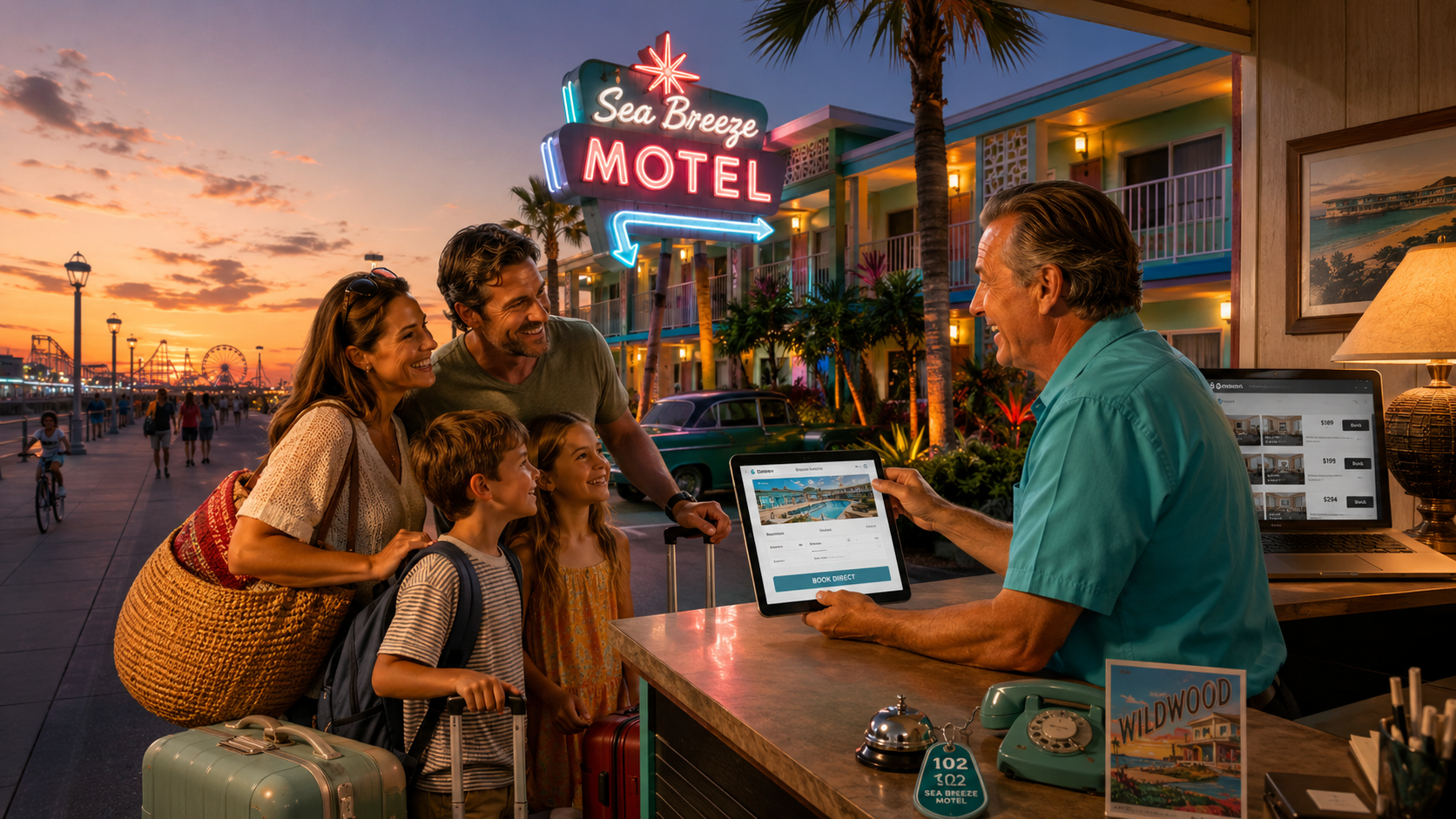
Your grandfather put that neon sign up when Chubby Checker was still playing the Rainbow Club, and it's been pulling families off the boardwalk ever since. Three generations later, the sign still works. The plastic palm trees still work. The kidney-shaped pool still works.
What stopped working — quietly, one booking at a time — is the economics underneath it all.
Somewhere between the 1960s and now, a middleman moved in between your motel and the families who love it. Today, when the Hendersons from Cherry Hill book their same two rooms for their same July week — the family that's stayed with you eleven summers running — there's a decent chance the reservation routes through Booking.com or Expedia. And when it does, you pay a commission for the privilege of hosting people who were always coming back anyway.
Here's the number nobody puts on a sign: across the industry, OTA commissions now run 15–25% of room revenue, up from an average near 10% a decade ago — and the effective rate is worse. When contracts and invoices are actually reconstructed, the all-in cost lands at 18–30% on Booking.com once Genius discounts and Visibility Booster fees stack on, and 17–23% at Expedia with its Accelerator program. For most independent properties, OTA commission is the single largest marketing expense in the business — larger than the website, the ads, and the photographer combined — taken quietly at source, every night.
This letter is about taking a meaningful share of that money back — not by fighting the OTAs (you'll lose, and you shouldn't fight them anyway), but by winning the bookings that never should have been theirs in the first place. And it's about why a Doo Wop motel in Wildwood, of all businesses on Earth, is uniquely built to do it.
First, Run Your Own Math
Let's make the invoice visible, using a modest example. A 30-room Wildwood motel, a 14-week core season, 75% occupancy, $190 average nightly rate — call it roughly $420,000 in seasonal room revenue. Industry data says OTAs drive around 63–70% of independent-property bookings; at the middle of that range and a conservative 18% effective commission, that motel hands the platforms about $50,000 a season. At the all-in rates many independents actually pay, it's $60,000–$75,000 — a manager's salary, a roof, a full off-season of payroll, gone without anyone ever writing a check.
And the product you're buying with that money is getting worse. The Cloudbeds analysis of 90 million bookings found OTA reservations cancel at 21.8% — more than double the 10.6% rate for direct bookings — meaning the commissions come attached to your flakiest demand. Compare the channels honestly: a direct booking costs roughly 4.5% all-in (payment processing plus booking engine), versus 15–25%+ through an OTA — on a $200 room, that's about $9 versus $36–$50, per night, per room.
Now the crucial honesty, because it's what separates a real strategy from a rant: you should not leave the OTAs. They deliver first-time discovery — the Ohio family who's never heard of Wildwood — that no independent motel can replace, and commission on a room you'd never have sold is a fair acquisition cost. The strategy is surgical, not scorched-earth: keep OTAs for discovery, and move the bookings that should never pay commission — repeat guests, referrals, and people already searching your name — to direct. For a shore motel whose entire business model is families returning every summer for decades, that "should-be-direct" segment isn't a sliver. It's the heart of the ledger.
The Second Tab: Where Wildwood Motels Bleed the Most
Here's the behavior pattern that decides everything, and it happens thousands of times per season: a traveler finds your motel on an OTA, gets curious, and opens a second browser tab to Google your name. Most guests who book direct found the property on an OTA first — the second tab is the entire battlefield.
What do they find in that tab? For too many Wildwood motels: a dated website that doesn't work on a phone, no clear way to book, no reason to believe booking direct is better — and, frequently, the OTA's own ad sitting on top of the motel's name. So the traveler shrugs, goes back to Expedia, and you pay 20% to acquire a guest who was actively trying to give you the booking for free.
Closing the second-tab leak is the highest-ROI marketing work available to any independent lodging property, and it has three parts: owning your brand search results outright, a mobile site that converts like the OTAs do with a real booking engine, and a visible, concrete reason to book direct — best-rate guarantee plus the perks only you can give (the parking spot, early check-in, the room they had last year, the beach-cart loan). None of this is exotic. It's simply never been anyone's job at a family motel where everyone already works sixteen-hour summer days. That's the job we do.
The New Front: Families Are Asking ChatGPT to Plan Wildwood
While the second tab was leaking, the front door moved again. Trip planning is migrating to AI: consumer use of tools like ChatGPT for recommendations jumped from 6% to 45% in a single year, and the prompt your next decade of guests is typing looks like this: "Planning a week in Wildwood NJ with two kids in July — recommend a family motel near the boardwalk with a pool."
Somebody's motels come back in that answer. The engines assemble it from whatever the internet says clearly and credibly — reviews, structured details, and above all content that actually answers the question. This is the discipline of AI search optimization, and here's why the window matters: the platforms see it too. Major hotel-distribution tech has already announced AI distribution partnerships with ChatGPT and Claude, which means the OTA ecosystem is racing to become the default answer inside AI conversations the way it became the default answer inside Google. Right now — and only right now — the AI answer box for "best family motel in Wildwood" is genuinely up for grabs by whoever earns it. In two years it will be defended territory.
Your Unfair Advantage: The OTAs Flatten You. Your Story Un-Flattens You.
Here's the thing an Expedia listing structurally cannot show: what you actually are.
On the OTA grid, a 1962 Doo Wop landmark with a hand-painted sign, a third-generation family at the desk, and sixty years of the same families' beach photos renders identically to an anonymous two-star box: thumbnail, price, review score. The platform's entire design flattens difference into comparability — because comparability is what makes them the brand and you the inventory.
But Wildwood motels are sitting on the least flat story in American lodging. This town holds the largest surviving collection of mid-century Doo Wop motel architecture in the world — more than 90 remaining from a peak of over 300, the neon-and-plastic-palm optimism that once lined six miles of Cape May County before nearly a hundred motels fell to condo developers in a single five-year stretch. Every surviving motel is a piece of that history with a family attached — and that's not nostalgia, it's search demand: people plan entire trips around Doo Wop, photographers pilgrimage for the signs, and journalists write about the era every summer. It is also precisely the kind of distinctive, verifiable, richly documented story that AI engines cite by name — because in a sea of interchangeable listings, the property with a real history is the one worth naming.
This is the core of what we do at Ritner Digital, and why we've built our practice around family businesses: we find the heart of a business and make it tangible where decisions happen. For a Wildwood motel, the heart was never hidden — it's forty feet tall and glows. It's just never been translated into the content, structure, and signals that Google ranks and ChatGPT quotes.
The Direct-Booking Engine, Wildwood Edition
Here's what the build looks like — one system, the same compounding architecture we publish about, tuned to a seasonal shore motel:
1. Seal the brand leak. Own page one for your motel's name completely; a converting, mobile-first site with a real booking engine and a stated best-rate-plus-perks guarantee; Google Business Profile treated as the storefront it is, with current photos of the sign, the pool, the rooms, and answers to the questions families actually ask (parking? pool hours? distance to the boardwalk? dogs?).
2. Win the planning searches. The content families use to choose: best Doo Wop motels in Wildwood, Wildwood with kids — where to stay, motels walkable to the boardwalk and Convention Center, pet-friendly Wildwood motels, which week to visit (and what each week is like), Wildwood on a budget vs. splurge. Written with real local fluency — the kind that knows what Morey's Piers night feels like and which end of the island the wind comes off — because that fluency is what both trip-planners and AI engines reward.
3. Publish the story. Your motel's history as a genuine asset: the year it rose, the family that built it, the sign's story, the restoration, the guests who've returned for forty summers. This is copywriting as un-flattening — the material no OTA grid can display and no competitor can copy, structured so the engines can verify and cite it.
4. Lock in the repeat guests. The single most profitable project on this list: your returning families should never book through an OTA again. Past guests re-book at 3–5x the rate of cold audiences, at zero acquisition cost — a simple email program (season-opening note, "your week is filling," a January photo of the sign in the snow) plus a returning-guest perk converts your most loyal revenue from 20%-commission to commission-free. For a motel with decades of guest books, this is found money.
5. Feed the review flywheel. Reviews power the map pack, the OTA rankings you're keeping, and the AI answers — recency and volume both matter, and a light QR-plus-follow-up system at checkout captures the goodwill of families who just had their best week of the year.
6. Measure it in commission dollars. Reporting in the only metric that matters here: direct-booking share, and OTA commission avoided — a running total of what the engine has kept out of the platforms' pockets. We forecast it before we build, and we hold ourselves to the same standard we ask of the work: our own performance data, published monthly, in public.
And one piece of shore-specific advice that costs nothing: the time to do this is now — in the off-season. The families booking next July are researching between September and March. An engine built in the quiet months meets them at decision time; one started in June meets them at check-in.
Frequently Asked Questions
How much do OTAs really cost a small Wildwood motel per season?
More than the headline rate suggests. Base commissions run 15–25%, but effective all-in costs reach 18–30% on Booking.com and 17–23% on Expedia once visibility programs stack on. For a 30-room motel doing roughly $420,000 in seasonal room revenue with a typical ~65% OTA booking share, that's on the order of $50,000–$75,000 per season — and those bookings cancel at double the rate of direct reservations. Every point of booking share shifted to direct drops most of that spread straight to the bottom line.
Should a motel just leave Booking.com and Expedia entirely?
No — and any marketer who says otherwise is selling bravado, not strategy. OTAs deliver first-time discovery demand independents can't replace, and commission on a guest you'd never have found is a legitimate acquisition cost. The correct move is segmentation: keep the platforms for new-guest discovery while systematically moving repeat guests, referrals, and brand-name searchers — the bookings that were always yours — onto your commission-free direct channel. For a shore motel with generational repeat business, that segment alone typically justifies the entire program.
What actually convinces a guest to book direct instead of on an OTA?
Three things, together: findability (when they Google your name, your site — not an OTA ad — must win), a booking experience as easy as the OTA's on a phone, and a concrete stated reason: best-rate guarantee plus perks only the property can give — guaranteed parking, early check-in, the specific room they love, flexible cancellation. Price parity clauses have loosened structurally in recent years, and the guests most likely to convert are the ones already researching you in a second tab; the job is making sure that tab closes with a reservation instead of a shrug.
Do AI tools like ChatGPT really influence where people stay in Wildwood?
Increasingly, yes. Consumer use of AI tools for recommendations grew from 6% to 45% in one year, trip planning is one of the heaviest use cases, and distribution platforms are already striking AI partnerships to put inventory inside those conversations. When someone asks an AI for "a family-friendly Doo Wop motel near the Wildwood boardwalk," the answer is assembled from published, credible, well-structured content — which means the motels investing in that content now are claiming positions that will be very hard to dislodge once the channel matures.
Why does the Doo Wop story matter for bookings and not just nostalgia?
Because differentiation is the entire counter to the OTA model. The platforms profit by flattening properties into comparable grids of price and stars; a documented history — part of the largest surviving mid-century motel collection in the world — is the one asset that can't be flattened, copied, or undercut. It drives its own search demand (travelers plan trips around Doo Wop), it earns press and links, and it gives AI engines a verifiable reason to name your motel rather than generically describing "several options." Story isn't the soft side of the strategy. In this market, it's the moat.
When should a seasonal motel invest in this — and how fast does it pay back?
Build in the off-season, harvest in the booking window: families planning next summer research heaviest from September through March, so an engine launched in fall meets peak decision-making, while one launched in June misses the year. Payback math is unusually clean in this vertical because the ROI target is a known cost — commission avoided. Shifting even 15–20 bookings a month from OTA to direct during the season covers a typical engagement on commission savings alone, before counting the incremental guests won from planning searches and AI answers. We model the specific number for your motel before any work begins.
The Sign Still Pulls Them In. Let's Make Sure the Booking Comes to You.
Three generations of your family built something the platforms can list but never replicate — and every summer, thousands of families feel it the moment the neon comes on. The only broken part is the routing: too much of that love passes through a middleman's checkout page on its way to your front desk.
We'll show you exactly where it's leaking and what it's worth. Bring last season's OTA statements to the call if you want the math done live.
Book a free 30-minute strategy call → An honest read on your brand searches, your AI visibility, and your commission math — with a clear next step within one business day. Best done before the season does your planning for you.
Sources
Tribii — OTA Commission Rates Explained: Booking.com, Expedia & Airbnb (industry commission ranges; second-tab behavior)
ProStay — Hotel Direct Booking Conversion 2026 (all-in effective commission reconstruction; Cloudbeds 90M-booking data; cancellation-rate gap)
ProStay — How to Reduce OTA Commissions: A 2026 Hotel Guide (commission as largest marketing expense; keep-the-OTAs strategy)
RevPARGenius — Direct Bookings vs OTA Commission: The 2026 Math (per-booking channel cost comparison; segmentation strategy; OTA booking share)
BeyondBooking — Hotel Direct Booking Strategy: Complete 2026 Guide (repeat-guest rebooking rates; AI distribution partnerships)
CCC — Local Consumer Review Survey 2026 Insights (AI recommendation usage growth)
Grokipedia — Wildwood, New Jersey (Doo Wop architecture counts; visitor spending)
NJ 101.5 — Wildwood Motels Through the Years: The Rise and Fall of Doo Wop (peak motel counts; demolition wave; ~100 surviving)