AI Search Strategy for Law Firms
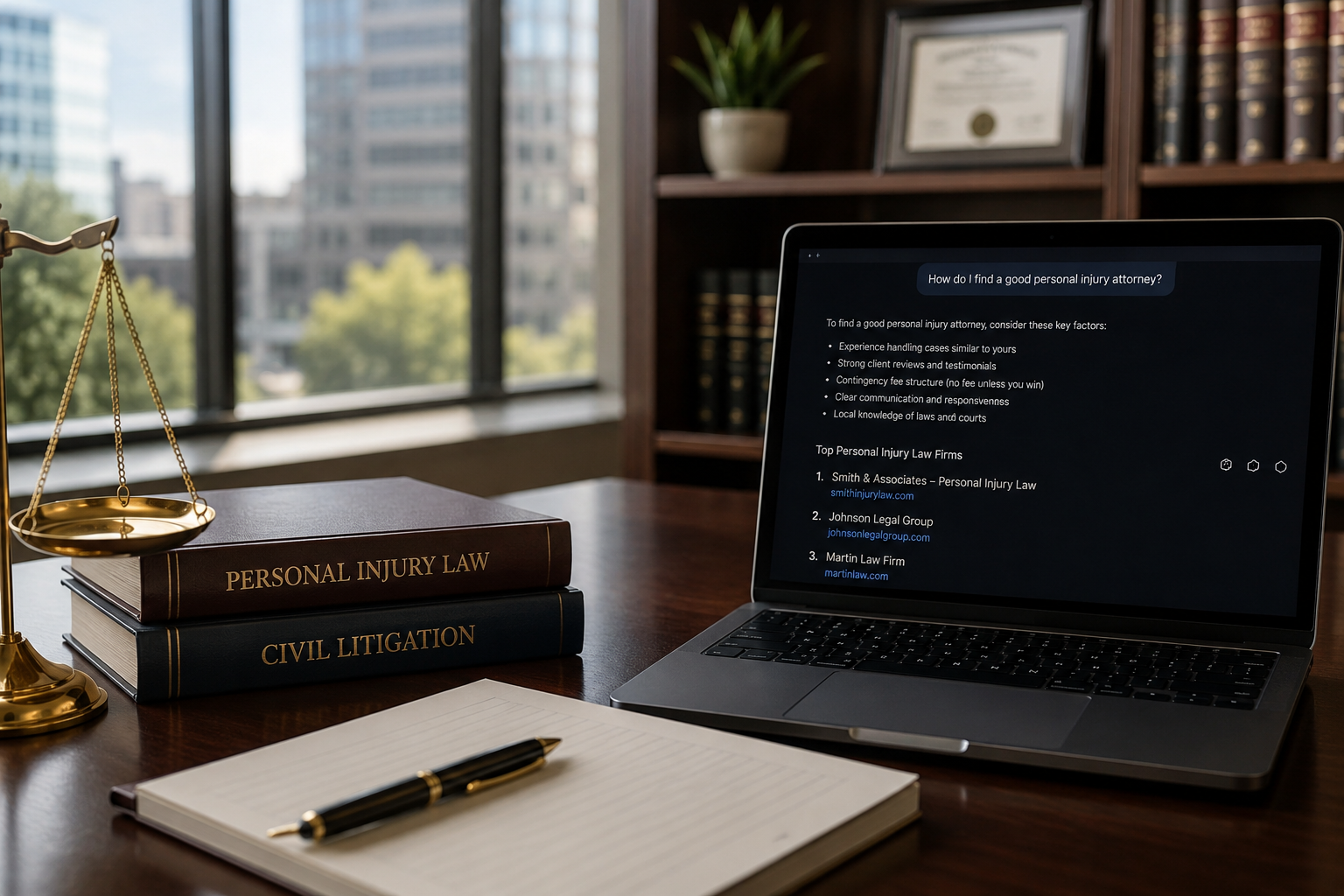
Law is one of the categories where AI search is already reshaping how potential clients find and evaluate attorneys — faster, and with higher stakes, than most firms have recognized.
When someone faces a legal problem, their first move is increasingly an AI system. Not a Google search returning a list of law firm websites. A direct question to ChatGPT, Perplexity, or Google AI Overviews: "what type of lawyer do I need for X," "how do I find a good employment attorney in Philadelphia," "what should I look for when hiring a personal injury lawyer," "is it worth getting an attorney for Y situation." These are high-intent, high-anxiety queries from people who need help and are forming a shortlist in real time.
The firms that appear in those AI-generated answers are being considered. The firms that don't are being eliminated from a process they didn't know they were in.
Why Law Firms Face a Unique AI Search Challenge
The legal category sits at an interesting intersection of AI search dynamics that makes it simultaneously one of the highest-opportunity and highest-complexity categories for AI visibility optimization.
YMYL classification and elevated credibility standards. Legal content falls squarely within Google's Your Money or Your Life classification — content where inaccurate information could cause serious harm to the reader. AI systems apply elevated credibility standards to legal content as a result. The bar for being cited in AI-generated answers about legal topics is higher than in most other professional service categories. A generic marketing agency blog post about personal injury law is unlikely to be cited by an AI system advising someone on whether to pursue a claim. Content from a verifiable attorney with demonstrated expertise in the relevant practice area is significantly more likely to be retrieved and cited.
This elevated standard is actually an opportunity for firms willing to produce genuinely authoritative content — because most law firm content doesn't meet it, creating a wide gap between the credibility bar and the current quality of content most firms are publishing.
Geographic specificity of legal services. Law is licensed by jurisdiction. A client in New Jersey needs a New Jersey attorney. A business dispute in Philadelphia needs Pennsylvania counsel. This geographic specificity means AI search strategy for law firms has to operate at two levels simultaneously: building general topical authority in practice area content, and building local relevance signals that connect that authority to specific geographic markets.
High-value, low-frequency purchase decisions. Legal services are expensive and infrequent. The client who hires a firm for a serious matter will conduct significant research before making contact. That research increasingly runs through AI systems — and the firm that appears consistently and credibly across that research process has a substantial conversion advantage over firms that appear only when someone types the firm name directly into a search bar.
Competitive density in major markets. Law is one of the most competitive categories in traditional SEO — firms have been spending aggressively on search for decades. That competitive density is partially replicated in AI search but with different dynamics. Firms with the highest advertising spend don't automatically translate their paid search dominance into AI citation frequency. The AI search landscape in legal is being shaped by content quality, authority signals, and external credibility — not ad budget. This creates an opportunity for firms with genuine expertise and a willingness to invest in content and authority building to outperform larger competitors in AI-generated answers.
The Queries That Matter Most
Before building an AI search strategy, the query landscape needs to be mapped. For law firms, the queries with the highest commercial value in AI search fall into several distinct categories.
Problem identification queries. "Do I have a case for X," "is Y situation worth hiring a lawyer for," "what are my rights when Z happens." These are the earliest-stage queries — potential clients trying to understand whether they have a legal problem worth pursuing. Firms that appear in these answers are inserted into the consideration process before the client has formed a view of which firms exist, let alone which one to call.
Attorney selection queries. "What should I look for in a personal injury lawyer," "how do I choose a family law attorney," "what questions should I ask before hiring an employment lawyer." These queries are explicitly about how to evaluate attorneys — and the firms whose content answers these questions are simultaneously educating the prospective client and positioning themselves as knowledgeable, trustworthy, and client-focused.
Practice area definition queries. "What does a civil litigation attorney do," "how does the workers compensation process work," "what is the difference between Chapter 7 and Chapter 13 bankruptcy." These informational queries build topical authority and create the foundational content cluster that makes practice area expertise legible to AI systems.
Geographic and jurisdictional queries. "Best employment lawyer in Philadelphia," "top personal injury firms in New Jersey," "how to find a criminal defense attorney in [city]." These local queries are where geographic signals matter most and where Google Business Profile optimization and local citation building have the most direct impact.
Process and timeline queries. "How long does a personal injury case take," "what happens after I file for divorce," "how does the discovery process work in a civil lawsuit." These queries serve clients who are already in process or actively considering initiating one — high-intent, specific, and perfectly suited to the kind of detailed, authoritative content that earns AI citations.
Content Strategy for Law Firm AI Search
The Authority Threshold for Legal Content
AI systems apply a higher credibility standard to legal content than to most other categories. Meeting that standard requires content that is demonstrably produced by or in close collaboration with practicing attorneys — not content that reads like it was written by a marketing team that researched the topic online.
The specific signals that establish legal content authority include named attorney authorship with verifiable credentials, bar admission information, jurisdictional specificity that demonstrates real practice knowledge, citations to relevant statutes and case law where appropriate, and the kind of nuanced treatment of legal questions that reflects genuine professional experience rather than surface-level research.
Content that meets this standard gets cited. Content that doesn't — generic, attorney-free, jurisdiction-agnostic — contributes almost nothing to AI search visibility regardless of how well it's optimized by traditional SEO standards.
Practice Area Content Clusters
The most effective content structure for law firm AI search is the content cluster model applied at the practice area level. Each major practice area the firm handles deserves its own comprehensive content ecosystem — not a single practice area page, but a pillar page supported by multiple supporting pieces that go deep on the specific questions, scenarios, and processes within that practice area.
A personal injury practice area cluster, for example, might include the pillar overview of personal injury law, supported by pieces specifically addressing car accidents, slip and fall cases, medical malpractice, wrongful death, the statute of limitations by jurisdiction, how damages are calculated, what to do immediately after an injury, how to evaluate a settlement offer, and the litigation process from filing through trial. Each piece is its own asset — answering a specific question completely — while the cluster as a whole signals comprehensive topical authority to AI systems.
This cluster approach produces the kind of topical depth that AI systems reward. A firm with one practice area page will rarely be cited for practice area queries. A firm with a comprehensive content ecosystem demonstrating genuine expertise across every dimension of a practice area will be cited consistently.
Question-and-Answer Formatting
Legal questions are exactly the kind of specific, answerable questions that AI systems are built to respond to. Structuring legal content around the explicit questions clients ask — stated clearly at the top of each section, answered directly before elaborating — makes content significantly more citable than content that addresses legal topics in essay format without clear question-answer structure.
FAQ pages built around the specific questions clients ask most frequently in initial consultations are particularly effective AI search assets for law firms. They're directly answerable, they demonstrate client-facing expertise, and they match the question-based query patterns that AI systems receive from potential legal clients.
Jurisdictional Content
AI systems can only recommend attorneys licensed to practice where the client is located. Content that is explicitly jurisdiction-specific — that names the state or local jurisdiction, references relevant state law, and demonstrates familiarity with local courts and procedures — signals geographic relevance that generic legal content doesn't.
This means each major geographic market a firm serves should have dedicated content that is specifically relevant to that jurisdiction. A firm licensed in both Pennsylvania and New Jersey serving the Philadelphia metro area should have content that addresses Pennsylvania law, New Jersey law, and the specific differences between the two for practice areas where those differences matter to clients.
Technical and Authority Signals
Attorney Profiles as Entity Anchors
Individual attorney profiles are among the highest-value pages on a law firm website for AI search purposes — and most firms dramatically underinvest in them. A comprehensive attorney profile that includes bar admission information, practice areas with jurisdictional specificity, educational credentials, notable cases or results, published articles or speaking appearances, and direct quotes demonstrating the attorney's perspective and approach creates a rich entity signal that AI systems can use to represent that attorney as a credible legal expert.
Attorney profiles should be connected to the firm's content through authorship markup — each piece of content authored by a specific attorney should be schema-marked to attribute that content to the attorney's profile entity. This creates the author-content connection that Google's E-E-A-T framework values and that AI systems use to assess the credibility of legal content.
Google Business Profile for Each Office Location
Law firms with multiple office locations need optimized Google Business Profiles for each location — not just a single profile for the main office. Each location's GBP should have accurate practice area categories, complete service descriptions, location-specific photos, and an active review management practice that generates consistent review volume.
The Google Business Profile is particularly important for the geographic and local recommendation queries that make up a significant portion of high-value legal AI search traffic. A well-optimized GBP is one of the primary signals that connects a firm's general topical authority to its local geographic relevance in AI-generated answers.
Reviews on Legal-Specific Platforms
For law firms, the review platforms that carry most weight in AI search include Google reviews, Avvo, Martindale-Hubbell, and Justia — in addition to general business review platforms. AI systems retrieving information about law firms will draw from these legal-specific platforms because they have editorial standards and verification processes that make their reviews more credible signals than unverified general platforms.
A systematic review generation program that encourages satisfied clients to leave reviews on both Google and the most relevant legal-specific platform for each practice area is one of the fastest-moving AI search signals a firm can build.
Bar Association and Legal Directory Listings
Authoritative legal directories — state bar websites, Avvo, Martindale-Hubbell, Super Lawyers, Best Lawyers, Justia, FindLaw — are among the sources that AI systems draw from heavily when generating answers about attorneys and law firms. Complete, accurate, and detailed listings in these directories are a direct input to AI search visibility for law firms in a way that general business directories are not for most other categories.
Every attorney at the firm should have complete profiles on the major legal directories, with consistent information across all of them and practice area descriptions that match the firm's primary content themes.
Local AI Search Strategy
Multi-Location Firms
Law firms serving multiple geographic markets need to build local relevance signals for each market independently, not just at the firm level. This means location-specific content that addresses local court procedures, local legal resources, and jurisdictionally-specific legal questions. It means location-specific GBP profiles with dedicated review streams. And it means building local citations and mentions in each market through involvement with local bar associations, local business organizations, and local press.
The firm that appears in AI-generated answers for "best employment lawyer in Cherry Hill" and "best employment lawyer in Center City" are often different firms — because local relevance is geographically granular enough that the signals that work in one market don't automatically transfer to another.
Community and Association Presence
Law firms that are visibly present in their local legal communities — participating in bar association events, contributing to local legal aid organizations, speaking at community events, being quoted in local press on legal topics — build the kind of community presence that generates the local mentions and citations that feed AI search local relevance signals.
This community presence is both a genuine business development activity and an AI search signal — which means it doesn't require treating it as purely a marketing exercise. Showing up authentically in the local legal community produces the external mention profile that makes a firm more citable in local AI search results.
The Compliance Consideration
Any AI search strategy for a law firm has to account for the professional responsibility rules governing attorney advertising in the relevant jurisdiction. State bar rules around attorney advertising vary — some are more permissive, some are more restrictive — and content produced for AI search purposes is subject to the same rules as any other attorney marketing material.
The specific compliance considerations most relevant to AI search content include: accuracy of any claims about results or outcomes, appropriate use of disclaimers where required, avoiding the creation of attorney-client relationships through online content, and ensuring that any content that could be construed as legal advice includes appropriate disclaimers. Working with a marketing partner familiar with legal advertising compliance rules — or reviewing AI search content with the firm's general counsel or ethics counsel — is advisable before publishing content at scale.
This compliance consideration is actually an advantage for law firms that take it seriously. The elevated content quality required for genuine compliance with professional responsibility standards produces exactly the kind of authoritative, accurate, appropriately caveated content that AI systems favor for legal queries. Compliance and citation worthiness are aligned, not in tension.
What a 12-Month AI Search Program Looks Like for a Law Firm
Months one and two. Baseline citation audit across ChatGPT, Perplexity, and Google AI Overviews for priority practice area and geographic queries. Competitive citation mapping — which firms are appearing and for which queries. Attorney profile audit and enhancement. Google Business Profile audit and optimization for all locations. Legal directory listing audit and completion. Technical crawl audit with focus on crawl accessibility for AI systems.
Months three through six. Practice area content cluster development — beginning with the two or three highest-priority practice areas. FAQ content development based on actual client intake questions. Schema markup implementation across attorney profiles and content. Review generation program implementation on Google and primary legal directories. Initial citation frequency measurement against baseline.
Months seven through twelve. Geographic content development for each major market served. Earned media and local press outreach program. Bar association and community presence documentation and amplification. Content cluster expansion into secondary practice areas. Quarterly citation frequency reporting with competitive benchmarking. Program refinement based on which content and authority signals are producing measurable citation improvements.
Ritner Digital works with law firms and professional service firms to build the kind of AI search visibility that puts them in front of potential clients at the moment those clients are deciding who to consider. If you want to understand where your firm currently stands in AI-generated answers for your practice areas and markets, start here.
Frequently Asked Questions
Do potential legal clients actually use ChatGPT and Perplexity to find attorneys?
Increasingly yes — and the behavior is accelerating. The pattern is consistent with how AI search adoption has spread across high-consideration purchase decisions: people facing an unfamiliar, high-stakes situation turn to AI systems for guidance before they've formed a view of which specific providers to evaluate. Someone who has just been injured in a car accident, received a termination letter, or been served with divorce papers is likely to ask an AI system what their options are before they search for specific attorneys. The firms that appear credibly in those early-stage AI answers are shaping the consideration set before traditional search or referral processes even begin. Law firms that dismiss AI search because their current clients come primarily from referrals are not accounting for how the next generation of clients will find them.
Isn't legal content too complex and jurisdiction-specific for AI systems to handle accurately?
The complexity and jurisdictional specificity of legal content is exactly why AI systems favor authoritative, attorney-produced content over generic legal information — and why law firms that produce genuinely expert content have a significant advantage over content farms and legal information aggregators in AI citation. AI systems are generally cautious about specific legal advice and tend to recommend consulting an attorney rather than substituting for one. But they do synthesize and cite authoritative information about legal processes, attorney selection criteria, general legal concepts, and jurisdictional differences — which is precisely the category of content that well-resourced law firms are positioned to produce better than anyone else in the space.
How do attorney advertising rules affect what we can publish for AI search purposes?
The same professional responsibility rules that govern any attorney advertising in your jurisdiction apply to content produced for AI search. The specific rules vary by state but generally include requirements around accuracy of outcome claims, appropriate disclaimers, and avoiding the creation of implied attorney-client relationships through online content. The practical implication for AI search content is that disclaimers should be consistent and appropriate, outcome references should be carefully worded, and any content that could be construed as specific legal advice should be clearly framed as general information. Working with ethics counsel or a marketing partner familiar with legal advertising compliance before publishing content at scale is advisable. The compliance requirements actually align well with AI citation standards — the accuracy, appropriate caveating, and substantive depth required for compliance produce exactly the kind of content AI systems favor for legal queries.
We're a small firm without a large marketing budget. Is AI search optimization realistic for us?
Yes — and small firms may actually have structural advantages in AI search that they don't have in traditional paid search. AI search optimization rewards genuine expertise and content depth over advertising budget. A two-attorney boutique firm with deep expertise in a specific practice area that produces genuinely authoritative content about that area can outperform a large regional firm with a superficial content program across many practice areas. The investment required is primarily time and content quality rather than media spend. The practical starting point for a small firm is narrow and deep — pick the one or two practice areas where the firm has the strongest expertise and build the most comprehensive, authoritative content available in those areas for the specific geographic markets served. That concentrated investment produces more AI search impact than a thin program spread across many practice areas and markets.
How important are reviews specifically for law firm AI search visibility?
Extremely important — and more specifically important than for most other professional service categories. Potential legal clients are making high-stakes, high-anxiety decisions where social proof from other clients carries disproportionate weight. AI systems reflect this in how they incorporate review signals into legal recommendations — a firm with substantial positive review volume on Google and legal-specific platforms like Avvo and Martindale-Hubbell is significantly more likely to be cited in AI-generated attorney recommendation responses than a firm with comparable expertise but minimal review presence. The review generation challenge for law firms is real — professional responsibility rules in some jurisdictions restrict how actively attorneys can solicit reviews, and many satisfied clients are reluctant to post publicly about legal matters. A systematic but compliant review outreach process — following up with satisfied clients at matter close and making the process frictionless — produces meaningful review volume over time without running afoul of bar rules.
Should each practice area have its own dedicated landing page or is one comprehensive page better?
Each major practice area should have its own dedicated page at minimum — and ideally a content cluster of multiple pages rather than a single page. The comprehensive single-page approach produces lower AI citation rates than the cluster approach because a single page can't go deep enough on every relevant sub-topic and question within a practice area to build the topical authority that AI systems recognize. A personal injury practice area page is a starting point, not a destination. The full cluster — car accidents, slip and fall, medical malpractice, wrongful death, damages calculation, statute of limitations, the litigation process — is what produces the comprehensive topical signal that makes a firm the go-to AI citation for personal injury queries in their market. The single page approach serves navigation. The cluster approach builds authority.
How do we handle AI search for practice areas where we want more cases but don't currently rank well in traditional search?
AI search creates an opportunity to build visibility in practice areas where traditional search competition is too entrenched or too expensive to penetrate quickly through paid or organic means. The strategy is to produce the most authoritative, comprehensive content available for the target practice area — content that meets the elevated credibility standard AI systems apply to legal queries — while simultaneously building the external signals that establish genuine expertise in that area. Earned media placements, speaking at relevant events, participation in bar association committees focused on that practice area, and building relationships with referral sources who cover that area all contribute to the external credibility signal that makes the content more citable. The AI search timeline for building visibility in a new practice area is typically six to twelve months of consistent effort — faster than building meaningful organic rankings in a competitive traditional SEO environment.
What's the most common AI search mistake law firms make?
Publishing content that's written for search engines rather than for the potential client asking the question. Most law firm content — including content ostensibly written for SEO — is structured around keyword placement rather than around genuinely answering the specific questions clients ask before, during, and after a legal matter. AI systems are extremely good at distinguishing between content that directly answers a question and content that mentions the right keywords without actually serving the information need. Law firms that produce the former get cited. Firms that produce the latter don't — regardless of how well optimized that content is by traditional SEO standards. The audit question is direct: take the five questions a potential client in your primary practice area is most likely to ask an AI system before calling anyone, and check whether your content directly, completely, and clearly answers each of them. Most firms will find that it doesn't — and that gap is both the diagnosis and the starting point.
Ritner Digital works with law firms on AI search strategy built around the specific dynamics of the legal category — content that meets the elevated credibility standard, technical signals that establish attorney authority, and local relevance signals that connect expertise to the markets you serve. If you want to know where your firm currently stands, start here.