Aloha State of Mind: The Biggest Brands Born in Hawaii and What the Islands Are Actually Buying
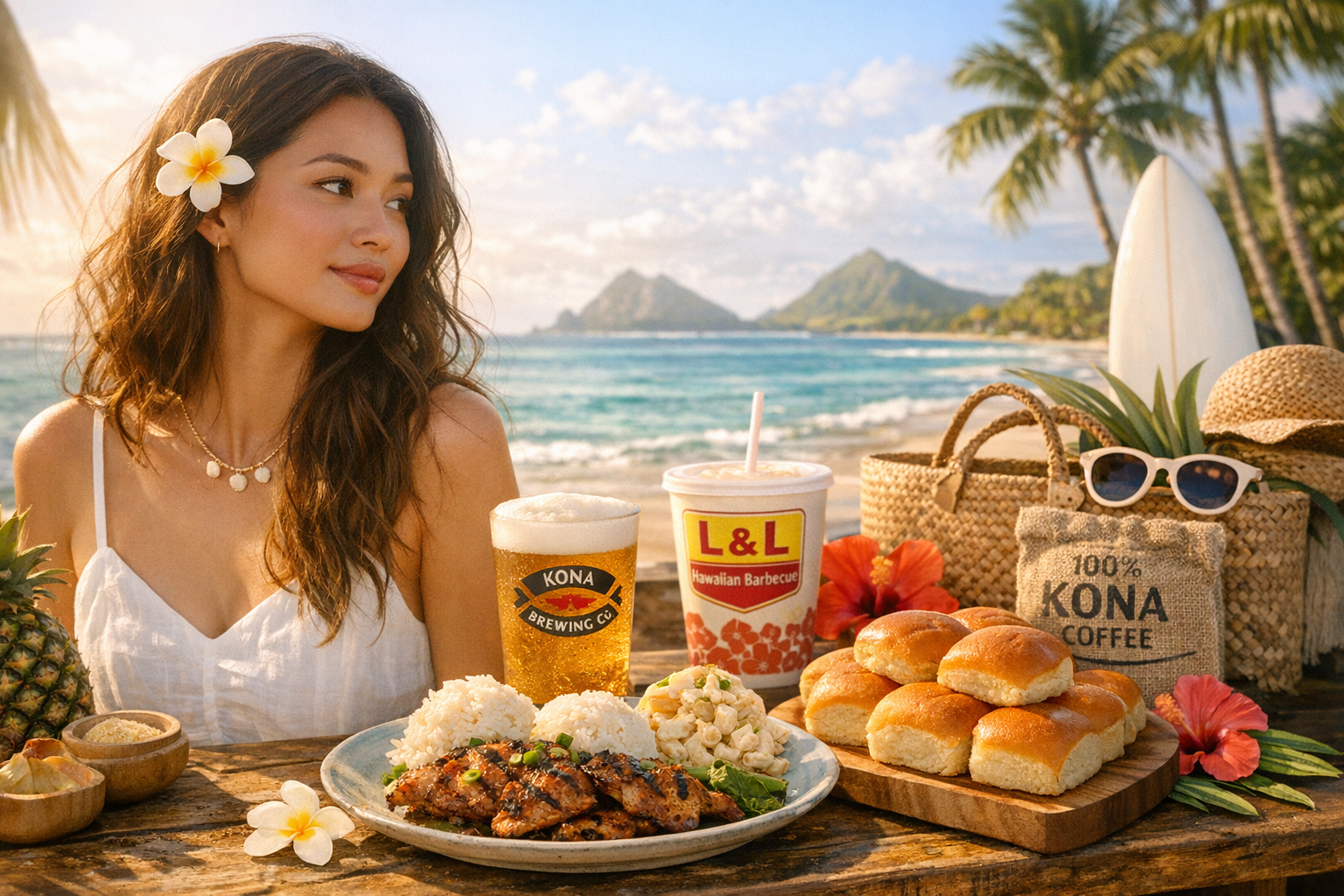
Hawaii does not export brands the way other states do.
It exports an idea — and the idea is so powerful, so globally recognized, so deeply loaded with emotional associations that companies from the mainland have been appropriating it for decades without permission. Hawaiian Punch contains no Hawaiian fruit. Hawaiian Sweet Maui Onion Potato Chips contain no ingredients from the state. The most famous mai tai recipe comes from a bar in Oakland. And there are coffee blends labeled "Kona" that contain as little as 10% beans from the region, a situation that a former state senator described plainly: "There's no other place in the world that doesn't protect its brand like Hawaii. We have a powerful brand name that has an image for the best quality. We should be protecting that."
That tension — between the extraordinary power of the Hawaii brand and the degree to which that power is exploited, diluted, and exported by people who have nothing to do with the islands — is the central marketing story of the fiftieth state. Understanding it is essential to understanding both the brands that Hawaii has genuinely produced and the consumer economy that exists within the islands themselves.
This is the latest entry in Ritner Digital's State by State Brand Series. Welcome to Hawaii — where the brand is priceless, the geography is unparalleled, and the plate lunch will make you want to move there.
The Brands That Made Hawaii
King's Hawaiian — Hilo, HI (Est. 1950)
The origin story of King's Hawaiian is one of the most purely American brand stories in this series. Robert R. Taira was born in Hilo in 1923, the ninth of eleven children of Okinawan immigrants. He served as an Army translator during the occupation of Japan after World War II, studied baking in Hilo and Chicago with the intention of opening a Western-style bakery in postwar Tokyo, and was blocked from returning to Japan when the Korean War closed the borders. So he opened Robert's Bakery in his hometown of Hilo in 1950 instead.
The product that made him famous was a variation on Portuguese sweet bread — pão doce — that Portuguese immigrant workers had brought to Hawaii in the late 1800s. The bread had always been beloved but it had a fatal flaw: it turned rock-hard within a day, earning the nickname "stone bread," which meant it had to be bought and eaten fresh from the oven or not at all. Taira figured out how to extend its shelf life while preserving the cake-like texture and flavor, transforming it into a product that could be produced at scale and distributed through supermarkets. Once he solved that problem, the rest was almost inevitable.
The bread became a local institution. In 1963 the bakery moved to King Street in Honolulu and was renamed King's Bakery, where locals lined up around the block. Tourists and departing residents began carrying loaves home to the mainland as gifts — the ultimate proof of product-market fit, when people voluntarily become your distribution channel. In 1977 Taira opened a 24,000-square-foot facility in Torrance, California and renamed the operation King's Hawaiian Bakery. In 1983 he introduced the 12-pack of Original Hawaiian Sweet Dinner Rolls that became one of the most recognizable products in American grocery stores.
Today King's Hawaiian is a family-owned company that produces millions of rolls a day from facilities in California and Georgia, has expanded into BBQ sauces, buns, sliced bread, and baking mixes, and has run marketing partnerships with Arby's, NASCAR, Universal Pictures, and Guy Fieri. The brand is on the Macy's Thanksgiving Day Parade. It is everywhere. The production is entirely on the mainland — the Honolulu bakery closed in 1992 — and the product that started as a Hawaiian appropriation of a Portuguese immigrant recipe is now as American as Thanksgiving itself.
The lesson is the same one Longaberger taught: a genuinely great product made with genuine care by a genuinely committed founder can travel from the most remote geography in the United States to every grocery store in the country. King's Hawaiian rolls are on tables in Mississippi and Maine because Robert Taira solved a real problem and refused to compromise on quality. The origin is Hawaiian. The reach is universal. That is what a real brand does.
Matson Navigation Company — Honolulu, HI (Est. 1882)
Matson is not a consumer brand in the conventional sense. Most Americans have never heard of it. But no single company did more to shape Hawaii's modern economy, identity, and cultural relationship with the mainland than Matson Navigation, and its history is one of the most remarkable in American business.
William Matson was born in Sweden in 1849, orphaned in childhood, and arrived in San Francisco in 1867 at the age of sixteen. In 1882, he sailed his three-masted schooner Emma Claudina into Hilo Bay carrying 300 tons of food, plantation supplies, and general merchandise, and a company was born. For the next century, Matson Navigation was the primary economic lifeline connecting the Hawaiian Islands to the United States mainland — carrying freight going in, sugar and pineapple coming out, and eventually passengers in the grand luxury liners that defined the golden age of Hawaii tourism.
Matson's "white ships" — the Malolo, Lurline, Mariposa, Monterey — were the vessels that carried wealthy Americans to Waikiki before the age of commercial aviation, and Matson's hotels accompanied them: the company built the Royal Hawaiian Hotel in 1927, the SurfRider in 1951, the Princess Kaiulani in 1955. To fill these ships and hotels, Matson ran one of the most sophisticated destination marketing campaigns in American history — commissioning artists like Eugene Savage and Frank McIntosh to create the iconic Hawaiian travel posters that defined the visual language of Hawaii as an American romantic ideal for generations. Those images — of surf and orchids and graceful women in the warm Pacific light — did not just sell tickets. They built the cultural association between Hawaii and paradise that every brand selling "Hawaiian" anything has been borrowing against ever since.
Today Matson is a publicly traded company headquartered in Honolulu with a fleet of U.S.-flagged container ships serving Hawaii, Alaska, Guam, Micronesia, and Asia. It is the dominant ocean carrier for Hawaii cargo. The passenger ships are long gone. But the physical and cultural infrastructure of the Hawaii that the world knows — the tourism economy, the Waikiki skyline, the very idea of Hawaii as a place Americans dream about — was substantially built by a Swedish immigrant in a schooner who recognized that islands needed ships.
Hawaiian Airlines — Honolulu, HI (Est. 1929)
Hawaiian Airlines was founded in 1929 and spent 96 years as an independent carrier before being acquired by Alaska Air Group in 2025, ending its run as the oldest American airline that had never had a fatal accident or a hull loss. That safety record — unbroken for nearly a century — was itself a brand statement of remarkable consistency.
For most of its history, Hawaiian Airlines was the airline that connected the Hawaiian Islands to each other and to the mainland, and its brand identity was inseparable from the identity of the state it served. The carrier embedded local culture into every aspect of the passenger experience — local artists in the inflight magazine, amenity kits designed by local designers using exclusive patterns, Maui Brewing beer and Koloa Rum in first class, dishes by local chefs. The aircraft, in the brand's own words, was the stage — a sensory delivery mechanism for the Hawaiian experience at 35,000 feet. That approach, executed consistently over decades, built a customer loyalty that many much larger carriers never achieved.
The Alaska Air acquisition in 2025 raised immediate questions about brand continuity. The Hawaiian Airlines name is being maintained for now, but the independent carrier that was genuinely, operationally, culturally Hawaiian is no longer independent. What that means for the brand over the long term is one of the more interesting open questions in American airline marketing.
Kona Brewing Company — Kailua-Kona, HI (Est. 1994)
Kona Brewing was founded by father-and-son duo Cameron Healy and Spoon Khalsa in an old newspaper pressroom in Kailua-Kona on the Big Island in 1994 — the first craft brewery in the state in years. The vision was simple and it proved to be exactly right: make beers that reflected the spirit, culture, and natural beauty of Hawaii, and serve them with the same aloha that defines every aspect of island life.
The first kegs and bottles of Pacific Golden Ale and Fire Rock Pale Ale were poured on Valentine's Day 1995. Within a decade, Kona was one of the ten largest craft breweries in the United States. The brand's flagship Big Wave Golden Ale and Longboard Island Lager became two of the most widely distributed craft beers in the country, available in all 50 states and more than 30 countries.
The Kona story has a structural complication worth understanding: what is called Kona Brewing Company in mainland markets is now owned by AB InBev and has its beer produced primarily on the mainland. The actual brewing operation in Kailua-Kona — Kona Brewing Hawaii — is an independent company operating under separate ownership, brewing exclusively for the local Hawaii market. The split happened when the Department of Justice required AB InBev to divest the Hawaii operations as a condition of its acquisition of Craft Brew Alliance in 2020. In 2023, the mainland brand rebranded to Kona Big Wave to differentiate from its Hawaiian counterpart.
The implication for the brand is genuinely interesting. The Kona beer that mainland Americans drink is not brewed in Hawaii. The Kona beer brewed in Hawaii is available only in Hawaii. The name is genuinely Hawaiian. The beer in most American hands is not. It is, in miniature, the same authenticity question that haunts every brand carrying the Hawaii identity into national distribution.
L&L Hawaiian Barbecue — Honolulu, HI (Est. 1952/1976)
The L&L story is one of the great immigrant entrepreneur narratives in American food history. Eddie Flores Jr. arrived in Hawaii from Hong Kong, studied at the University of Hawaii, built a career in real estate, and in 1976 bought a small walk-up restaurant on Liliha Street in Honolulu as a gift for his mother. He knew nothing about restaurants. His mother knew nothing about cooking. They learned fast.
The original location had been L&L Dairy, an outlet of a local dairy company whose owners' last name was Lee — hence the L&L. Flores kept the name. He and his partner Johnson Kam franchised the concept in 1988, built it to 40 locations across Hawaii, and then in 1999 did something that required genuine nerve: they opened the first mainland location in California, in the Puente Hills Mall in West Covina, and renamed the concept L&L Hawaiian Barbecue to give mainland consumers a frame of reference for what they were offering.
The product was the Hawaiian plate lunch — two scoops of rice, one scoop of macaroni salad, and a generous protein entrée of barbecue chicken, kalua pork, chicken katsu, loco moco, or kalbi short ribs. It was the food of Hawaii's multicultural working class — Japanese, Chinese, Filipino, Portuguese, Korean, and Native Hawaiian culinary traditions combined into a single meal that was uniquely, unmistakably Hawaiian. Flores's insight was that "Hawaiian" was the draw. He told every interviewer: "The word Hawaiian, to me, is the key, is the biggest draw. Everyone just fantasized. Everyone wants to come to Hawaii."
Today L&L has over 235 locations across 15 states and Japan, and the brand is now led by Flores's daughter Elisia, who brought a General Electric finance background to the operation and has focused on digital marketing, franchise systems, and an expansion target of 500 locations by 2032. The company also has the distinction of having established National SPAM Musubi Day — a cultural achievement that says everything necessary about the relationship between Hawaii and its most beloved canned meat.
Mauna Loa Macadamia Nut Corporation — Hilo, HI (Est. 1949)
Mauna Loa is the world's largest macadamia nut producer and one of the most recognizable food brands in Hawaii tourism. Founded in 1949 on the slopes of Mauna Loa volcano on the Big Island, the company pioneered the commercial cultivation and processing of macadamia nuts in Hawaii — a crop that has since become one of the state's most valuable agricultural exports.
The macadamia nut is not native to Hawaii. It was introduced from Australia in the late 19th century and the first commercial orchards were planted in the 1920s. Mauna Loa was the company that scaled it into an industry — developing the farming techniques, the processing technology, and the marketing machinery that turned a niche tropical nut into one of the most globally recognized premium snack foods. The distinctive macadamia nut chocolate sold in the bright yellow tin has been carried home from Hawaii in tourist luggage for over half a century, making it one of the most successful souvenir products in American tourism history.
What Hawaii Consumers Are Actually Buying
Tourism as the Economy and Its Complications
Tourism is not a sector of Hawaii's economy. It is the economy. Before the pandemic, tourism accounted for approximately 23% of Hawaii's GDP. The hospitality industry — hotels, restaurants, activity operators, retail — employs a significant portion of the state's workforce. Every major consumer brand decision in Hawaii is made in the shadow of the question: what does this mean for the visitors?
That dependence creates a consumer market with unusual characteristics. Retail in Waikiki is oriented toward the tourist with discretionary income and limited time — a very different customer than the Honolulu resident doing weekly grocery shopping at Costco or Times Supermarkets. The brands that succeed in Hawaii's retail environment tend to be those that can serve both: authentic enough to satisfy the tourist looking for a genuine Hawaiian experience, practical and affordable enough to maintain the loyalty of residents who interact with the brand year-round.
The pandemic taught Hawaii an expensive lesson about the risks of tourism concentration. When visitors stopped coming, the economy did not bend — it broke. The experience has accelerated conversations about economic diversification that have been ongoing for decades without resolution, and has given new urgency to the question of how Hawaii builds brands that can generate value independent of the visitor economy.
Local Food as Cultural Identity
No aspect of Hawaii's consumer culture is more deeply felt or more carefully protected than its food identity. The plate lunch, the spam musubi, the shave ice, the malasada, the poke bowl, the loco moco — these are not just menu items. They are cultural artifacts that reflect the extraordinary multicultural history of the islands, where Native Hawaiian, Japanese, Chinese, Filipino, Portuguese, Korean, and Okinawan food traditions collided and fused into something that exists nowhere else in the world.
The plate lunch in particular is the most complete expression of Hawaii's culinary identity — a working-class meal born in the plantation fields where laborers from a dozen different cultures shared food, combined their traditions, and created something new. Two scoops of Japanese rice. A scoop of Portuguese macaroni salad. A protein drawn from whichever tradition was most abundant that day. It is the food of Hawaii's actual history rather than its tourism mythology, and its export by L&L Hawaiian Barbecue to 235 locations across the mainland is one of the more culturally significant food brand stories in America.
The Kona coffee economy is another defining food identity — and another arena for the authenticity battles that define Hawaii's brand landscape. Kona coffee, grown on the slopes of Mauna Loa and Hualalai on the Big Island, is among the most expensive and sought-after coffees in the world. The 10% blending loophole — which allows a coffee product to be labeled "Kona blend" with as little as 10% Kona beans — has been a source of industry outrage for years. The genuine producers, who maintain meticulous growing standards at significant cost, compete against cheaper products that appropriate their geographic name without earning it.
The Power and Peril of the Hawaii Brand Name
The most important thing to understand about Hawaii's consumer landscape is the extraordinary economic value of the state's name — and the degree to which that value is both leveraged and abused. Brands that genuinely earn the Hawaii identity by making authentic products from the islands, by employing island residents, by honoring the culture and the land, have access to one of the most powerful brand positions in the world. The word "Hawaiian" carries associations of beauty, quality, hospitality, and paradise that no amount of advertising spend can manufacture.
Brands that appropriate the identity without earning it — Hawaiian Punch, generic "Kona" blends, mainland food products with Hawaiian in the name and nothing Hawaiian in the bottle — are extracting value from an identity they did not create and are not maintaining. State Senator Ruderman's complaint stands: no other major geographic identity in the United States is appropriated with this degree of impunity and this little legal protection.
For businesses entering Hawaii's market or seeking to build on its identity, the lesson is the same one that runs through this entire series: the geographic identity is a brand asset that has to be earned through the actual product, the actual culture, the actual people and place. Hawaii's brand is not a label. It is a living thing, and the brands that treat it as a living thing — that build their products from the ingredients of the islands, their culture from the people of the islands, their stories from the history of the islands — have access to the most powerful single-word brand in American consumer culture. Aloha is not a slogan. It is a standard.
Ritner Digital works with brands across the country — including those in and around tourism-driven markets like Hawaii — helping them build the marketing infrastructure that reflects what they've actually built. Let's talk.
Frequently Asked Questions
What is Hawaii's most famous brand?
King's Hawaiian is the most widely recognized consumer brand born in Hawaii — a family-owned bakery started in Hilo in 1950 by Robert Taira, the son of Okinawan immigrants, that grew from a single bakeshop into a national staple found in virtually every American grocery store. The 12-pack of Original Hawaiian Sweet Dinner Rolls is one of the most recognizable products in the bread aisle in the country. Beyond consumer products, Hawaiian Airlines was the state's most iconic institutional brand for nearly a century — the oldest American carrier with a perfect safety record — until its 2025 acquisition by Alaska Air Group ended its run as an independent carrier. For food culture, the plate lunch and the spam musubi are Hawaii's most defining culinary exports, carried to the mainland most visibly through the 235-location L&L Hawaiian Barbecue franchise.
Why do so many brands use the word "Hawaiian" when they have nothing to do with Hawaii?
Because it works. The word Hawaiian carries associations of beauty, quality, warmth, and paradise that are among the most powerful in American consumer culture — associations built over more than a century through Matson's luxury ocean liners, Hollywood films, tourism marketing, and the genuine allure of a place most Americans have dreamed about visiting. That emotional equity makes the name enormously valuable as a marketing asset, and because Hawaii's geographic identity has historically lacked the same legal protections that places like Champagne and Parmigiano-Reggiano enjoy in Europe, brands have appropriated it freely. Hawaiian Punch contains no Hawaiian fruit. Many products labeled "Kona coffee" contain as little as 10% beans from the Kona region. State legislators have tried for years to strengthen protections for Hawaiian geographic names, with limited success. The situation is a genuine brand crisis for authentic Hawaiian producers who compete against cheaper products carrying the same identity without earning it.
What is the plate lunch and why does it matter as a brand story?
The plate lunch — two scoops of rice, one scoop of macaroni salad, and a generous protein entrée — is the defining food of Hawaii's multicultural working-class history. It was born in the plantation fields of the late 19th and early 20th centuries, where laborers from Japan, China, the Philippines, Portugal, Korea, and Native Hawaii shared food and combined their culinary traditions into something that exists nowhere else. The rice is Japanese. The macaroni salad is Portuguese-influenced. The proteins range from Japanese chicken katsu to Korean kalbi short ribs to local loco moco. The plate lunch is Hawaii's food identity compressed into a single meal — and L&L Hawaiian Barbecue's expansion of it to 235 mainland locations is one of the most genuinely culturally significant food franchise stories in American history, carrying a working-class immigrant food tradition from the Pacific into strip malls across fifteen states.
What happened to Hawaiian Airlines and does it still operate as a Hawaiian brand?
Hawaiian Airlines was founded in 1929 and operated as an independent carrier for 96 years before being acquired by Alaska Air Group in 2025. During its independent run it was the oldest American airline with a perfect safety record — no fatal accidents, no hull losses — and consistently ranked as the most punctual airline in the country. The carrier embedded local culture throughout its passenger experience, from local artists in its inflight magazine to Maui Brewing beer and dishes by local chefs in first class. The Hawaiian Airlines name is being maintained under Alaska Air Group ownership, but the independent, locally operated carrier that was genuinely embedded in Hawaiian culture is no longer independent. Whether the brand's cultural authenticity survives the acquisition over the long term is one of the more consequential open questions in Hawaiian branding.
What should a brand know before entering the Hawaii market?
Several things. First, Hawaii is not one market — tourist-facing Waikiki and residential Honolulu operate on completely different consumer logics, and a brand strategy built for one will fail in the other. Second, the word Hawaiian is both the most powerful tool and the most dangerous trap available. Brands that earn the identity through genuine product quality, authentic local sourcing, community investment, and cultural respect have access to one of the strongest brand positions in the world. Brands that appropriate the name without earning it will be seen through immediately by residents who have spent their entire lives watching outsiders do exactly that. Third, Hawaii's food culture is extraordinarily specific and deeply felt — the plate lunch, the shave ice, the malasada, the spam musubi are not generic menu items but cultural artifacts with real history behind them. Brands entering the food and beverage space in Hawaii should understand that history before they try to serve it. And fourth, the tourism economy that dominates the islands creates pricing structures, real estate costs, and competitive dynamics unlike any other state market in the country. Prepare accordingly.