An Open Letter to the Fourth-Generation Funeral Firm That's Been Serving Massachusetts Since the Civil War
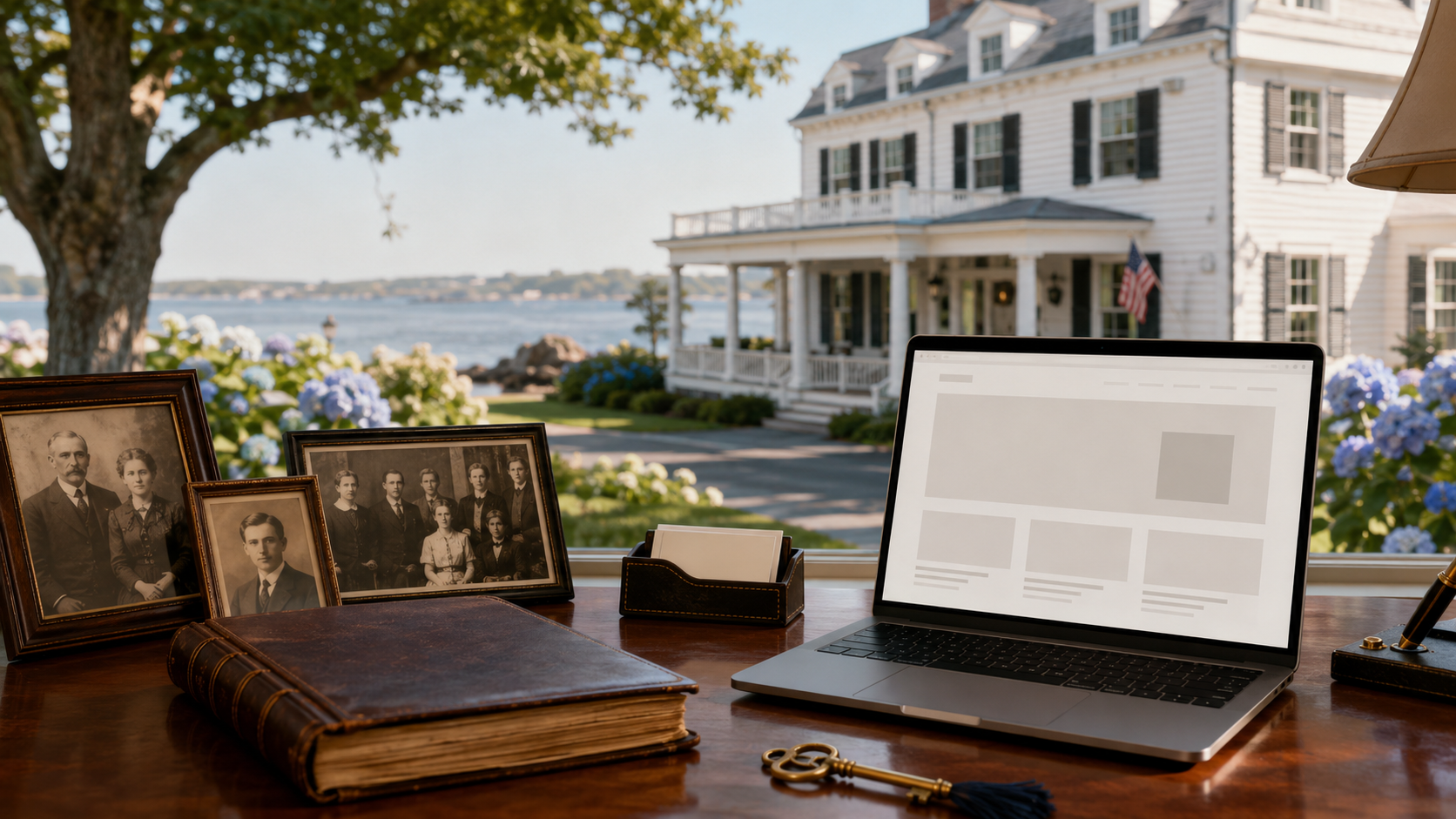
This one is written to a specific kind of firm. If it's you, you'll know by the second paragraph.
You're a family funeral firm in Massachusetts — really a family firm, not a corporate brand wearing one. The founding generation opened its doors when Lincoln was president. The fourth generation runs it now. Over a century and a half, you've grown from one funeral home to eight, nine, ten locations — a footprint that stretches from the South Shore over the bridges, across the Cape, and out onto the Islands, where you're one of the only firms a ferry-bound family can call at all. Your towns have voted you their best. Your directors have buried the grandparents, then the parents, of the families who call you now.
By every measure that matters, you are the strongest funeral service story in the Commonwealth: the scale of a group, the soul of a family, and a name that predates the telephone you answer at 2 a.m.
And here's the reason we're writing: almost none of that story survives the trip to a screen. Search your own towns tonight — better yet, ask ChatGPT to recommend a family-owned funeral home in one of them — and watch what a hundred and sixty years compresses into: a template listing, a phone number, a map pin, indistinguishable at a glance from a two-year-old cremation startup or a corporate consolidator wearing somebody's family name. The gap between who you are and what the internet says you are is the widest we've seen in this industry. This letter is about closing it.
The Strange Problem of Being Big and Family at the Same Time
Most funeral homes have one of two stories. The single-location family firm has soul but limited reach. The corporate group has reach but rented soul. You have the rare third thing — real scale and real family — and it should be an unfair advantage.
Online, though, it creates a problem nobody warns you about: at ten locations, scale without storytelling reads as corporate. A family searching "funeral homes near me" in one of your towns sees a multi-location operation with a consistent brand and standardized pages — which is, pixel for pixel, exactly what SCI's Dignity Memorial network looks like. The visual grammar of "we're everywhere" is the visual grammar of the consolidators. Without deliberate, provable, location-by-location evidence of family ownership and local presence, your greatest strength quietly costumes you as the thing you've spent four generations not being.
And the audience that most needs the difference proven is growing every year. You serve the oldest county in Massachusetts — median age 53.9, deaths outnumbering births more than two to one — but a huge share of that population moved there, with no inherited knowledge of which names are real. Nationally, selection of a funeral home based on a prior relationship has collapsed from 27% to 16% since 2012, with price rising to the top factor, and 40% of consumers now use a funeral home they found on Facebook — nearly double two years prior. The families who already know your story are, actuarially speaking, the families you're burying. The families deciding your next fifty years are the ones reading a screen.
What the Screen Currently Can't See
Run the audit we'd run, and a familiar pattern emerges — not because anyone did anything wrong, but because the funeral profession's digital infrastructure was built by nobody's marketing department. In rough order of cost:
The story is asserted, not proven. "Family owned since [the 1860s]" appears somewhere on an About page — a sentence any acquirer would happily keep. What's missing is the evidence architecture: the generations by name and face, the "never sold, never franchised" declaration, the history told town by town, and the structured entity signals that let Google and AI engines verify family ownership rather than skim past a claim every competitor also makes. When a family asks an AI engine for a genuinely family-owned firm — and AI tools have jumped from 6% to 45% usage for local recommendations in a single year — the engine can only cite what's been made machine-readably true.
The template is the ceiling. Like most of the profession, the site likely runs on an industry platform — obituary hosting, tribute walls, flower integration — shared with thousands of funeral homes nationwide. Those platforms are competent at logistics and structurally incapable of differentiation: your 160-year story renders in the same wrapper as a firm founded in 2019. The highest-traffic pages you own — the obituaries, where your whole community visits weekly — pour that attention into a vendor's template and hand almost none of it back to your story, your preneed pipeline, or your local authority.
Ten locations, three different markets, one strategy. The South Shore homes, the mid- and outer-Cape homes, and the Island homes serve populations that differ in age, transience, seasonality, and search behavior — and each location's Google Business Profile is a front door that 76% of local searchers act on within 24 hours. Managed as one undifferentiated brand, ten profiles become ten thin listings. Managed deliberately, they become the most defensible local search position in southeastern Massachusetts — because no competitor, corporate or independent, can match the footprint and the authenticity at once.
The Island lane is wide open. A firm that serves Martha's Vineyard and the Nantucket ferry corridor sits on content nobody in America is writing: what happens when a death occurs on-island, how transport across the water works, island burial and cemetery realities, the summer death in a rental cottage, the year-rounder's winter arrangements when half the family is on the mainland. Every one of those is a real search made by a panicked family with no alternative provider — the same uncontested-lane dynamic we've described for second-home Cape families, amplified by geography. Owning it isn't just case volume; it's the kind of singular, citable expertise that makes AI engines treat a firm as the authority rather than an option.
The reviews are an unharvested archive. Four generations of service means thousands of families walking around with the sentence "they've taken care of us for fifty years" in their hearts and no easy way to say it where it counts. With 73% of consumers trusting only reviews from the last month, a century of goodwill earns nothing without recency — and a respectful QR-and-SMS workflow across ten locations would compound faster here than at any single-site firm in the region.
None of this is a criticism of how the firm is run. It's the normal state of a profession whose excellence has always lived in rooms, not on screens. But the decision-making moved to the screens, and the screens are currently neutral about the least neutral firm in the market.
What We'd Build (Because We've Already Published the Blueprint)
Here's the part where most agency letters get vague. We'll do the opposite, because the plan for a firm like this is one we've been publishing in public, piece by piece:
First, the proof layer. Ownership and lineage made explicit, verifiable, and machine-readable across every location — the entity and authority work that turns "family owned" from a slogan every consolidator also uses into a fact engines can check and cite. In a market where corporate and PE-backed firms have been documented charging more than independents across every basic price category studied in Massachusetts, provable independence is both a values statement and a price-transparency advantage — and we'd pair it with published pricing, the radical honesty that wins the direct-cremation comparison rather than hiding from it.
Second, the three-market engine. A content system built town-by-town with genuine local fluency — South Shore, Cape, Islands — anchored by the assets each market is missing: the "what to do in the first 24 hours in [county]" guides, the off-Cape-family and off-island logistics content, the preneed pipeline tuned to the oldest demographics in the state and the 19.4% preplanning penetration that leaves four of five households unserved.
Third, the operational flywheel. Ten Google Business Profiles run as a portfolio; the review workflow installed at every location with the timing and restraint the profession requires; obituary traffic — the community's weekly visit — finally connected, gently, to the story and services around it.
Fourth, the measurement a fourth-generation business deserves. A 12-month forecast per market, reporting in cases and preneed contracts rather than impressions, and the standard we hold ourselves to publicly: our own Search Console data, published monthly, uncomfortable parts included. A firm that has answered to its community since 1862 should never have to take a marketing vendor on faith.
And underneath all four: the thing that can't be listed as a deliverable. The team doing this work has to believe funeral service matters and know the Cape isn't a ZIP code — we've told every funeral home to interrogate exactly that before hiring anyone, including us. We're a small Massachusetts-area firm ourselves, family-scale on purpose, principals on every call. The match matters; we've written about what happens when it's ignored.
Frequently Asked Questions
Why would a well-established, multi-location funeral firm need SEO at all?
Because the referral mechanism that built it is aging out. Prior-relationship selection has fallen from 27% to 16% since 2012, the Cape's population increasingly consists of transplants with no local funeral history, and consumers now find and choose firms through search, social, and AI recommendations. An established firm doesn't need SEO to invent a reputation — it needs it to transfer an existing one to the places decisions are now made, before competitors with weaker stories and stronger visibility intercept them.
Doesn't having many locations already guarantee strong local search presence?
No — and unmanaged, it can hurt. Each location's Google Business Profile competes independently in its own map pack on completeness, reviews, recency, and engagement; ten thin profiles lose, one by one, to single-location competitors who work theirs hard. Worse, a uniform multi-location web presence visually mimics corporate chains, undercutting the family-ownership differentiation. The footprint only becomes an advantage when each profile and town page is run with local specificity — at which point it becomes nearly impossible for anyone to outflank.
How does a family firm prove it's family-owned online, rather than just saying so?
Through an evidence architecture: named generations with real photographs and history; an explicit "independently owned, never sold" statement; ownership consistent across every directory, profile, and page; structured data that identifies the organization, its founders, and its lineage; and third-party corroboration — press, community involvement, reviews that reference the family by name. This matters because AI engines increasingly answer "family-owned funeral home near me" from machine-verifiable signals, and because in a market where acquirers keep family names on signs, the claim alone has been devalued for everyone.
What's the biggest untapped digital asset most funeral firms already own?
Their obituary pages — reliably the highest-traffic pages on any funeral home's website, visited weekly by the whole community, and typically rendered inside a third-party template that captures none of that attention for the firm. Thoughtfully handled (with restraint — these are grief pages first), obituary traffic becomes the top of every funnel the firm has: awareness for preplanning, familiarity for at-need, and the largest local audience the brand will ever assemble for free.
Can one agency serve locations across the Cape, the Islands, and the South Shore?
Only with a deliberately three-market strategy, because the markets genuinely differ: the South Shore behaves like suburban Massachusetts, the Cape is the oldest, most transplant-heavy county in the state, and the Islands add ferry logistics, extreme seasonality, and near-monopoly service dynamics no mainland playbook addresses. The wrong approach is one template stamped ten times; the right one is shared infrastructure — brand, proof layer, review operations — with market-specific content and local signals per town.
What should a 160-year-old firm expect from marketing measurement?
The same accountability it has always given its own community: a forecast before the work (projected visibility, cases, and preneed activity by market), reporting in business terms rather than vanity metrics, and full ownership of every account and asset. And a partner willing to be audited the way it asks to be trusted — we publish our own monthly performance data precisely so a firm built on generational accountability never has to extend a vendor blind faith.
If This Letter Described You, It Wasn't an Accident
We've spent months publishing the playbook for exactly one kind of client: the genuinely family-owned Massachusetts funeral firm whose story deserves better than a template. If you recognized your firm in these paragraphs — the generations, the bridges, the ferry, the name that's older than the Commonwealth's telephone lines — then the research phase is already done. Ours, anyway.
The next step is small: thirty minutes, principals on both sides, and an honest audit of what your towns, your profiles, and the AI engines currently say about a firm that's been proving itself since 1862. We'll show you the gaps, the forecast, and exactly what we'd build — and if we're not the right match, we'll be the first to say so.
Book a strategy call → One business day, a real reply, from people who know which side of the bridge every one of your towns is on.
Sources
The Provincetown Independent — As State Shrinks, Cape Cod Has Its Own Odd Crisis (Cape demographics, deaths vs. births, transplant migration)
Johnson Consulting Group — Inside the NFDA Consumer Awareness and Preferences Survey (decline of relationship-based selection)
Connecting Directors — NFDA 2025 Consumer Awareness & Preferences Study (digital adoption, Facebook-driven selection)
US Funerals Online — The US Funeral Industry Today (SCI/Dignity Memorial structure)
The Shoestring — Funeral Home Consolidation Hits Western Mass (corporate vs. independent pricing analysis)
CCC — Local Consumer Review Survey 2026 Insights (AI recommendation usage growth)
Digital Applied — Local SEO Statistics 2026 (local search behavior)
BizIQ — Online Reviews Statistics 2026 (review recency and trust)