Rolling Out Dog Cremation at Your Cape Cod Funeral Home: How to Honor Every Grief Without Losing Your Gravity
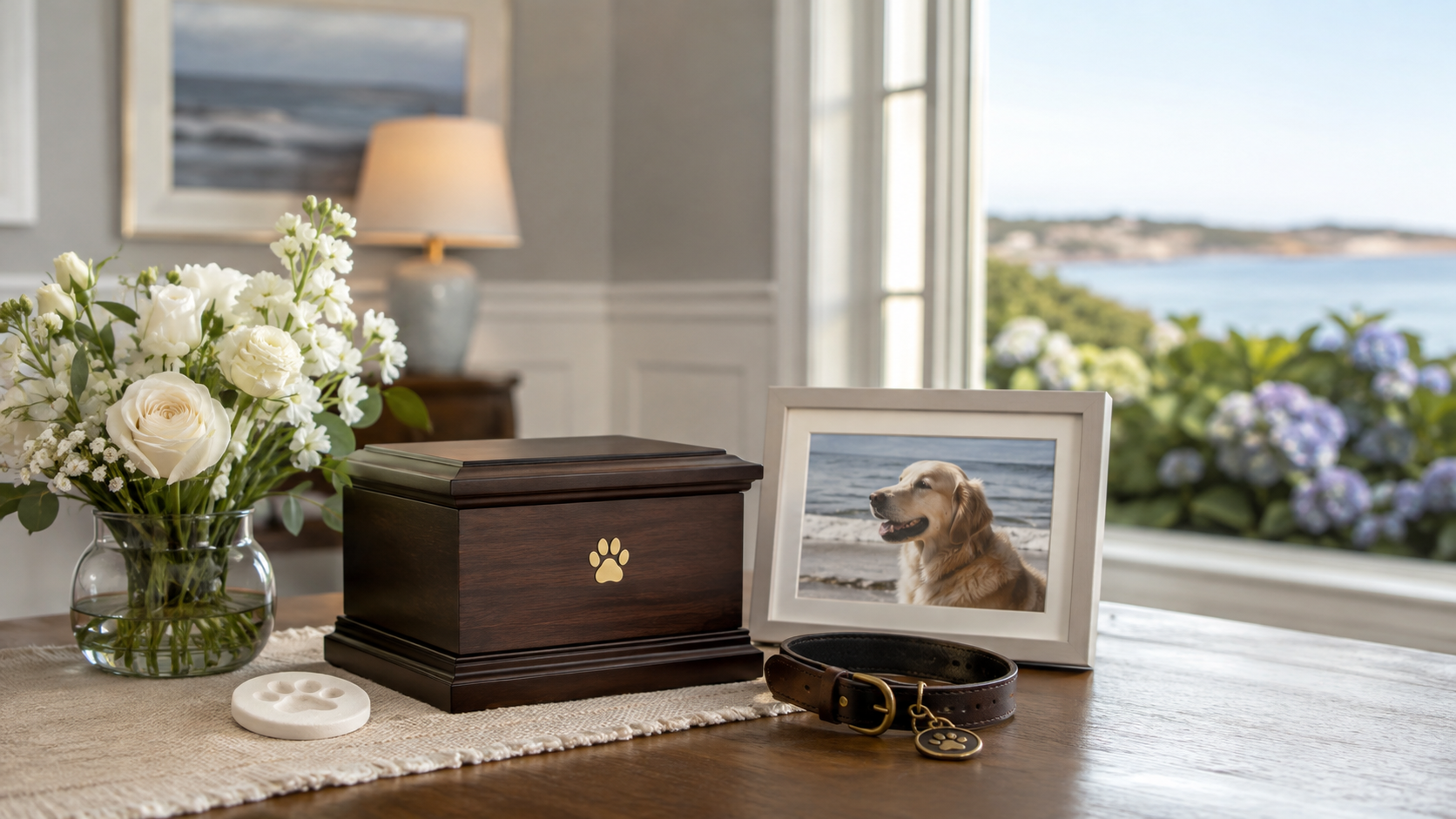
The idea usually comes up quietly, at the end of a staff meeting.
Maybe a director mentions the third call this month from a family asking if you handle pets. Maybe someone read that the vet clinic two towns over ships every cremation an hour off-Cape. Maybe it's more personal than that — someone on your own staff just lost a fourteen-year-old lab and discovered, firsthand, how thin the options are.
And then comes the hesitation, spoken or not: We bury people. We've buried this town's people for three generations. Does offering dog cremation... cheapen that?
It's the right instinct to pause on — your gravity is your brand, and nothing should be added to a funeral home casually. But we'd argue the question is backwards. The real question isn't whether pet loss is serious enough for your firm. The research below makes that answer embarrassingly clear. The real question is whether the families in your towns deserve to have this grief handled by people who treat all grief seriously — or left to a drop-box service an hour over the bridge.
This is a guide to rolling it out right: the grief case, the business case, the marketing tightrope that decides whether the launch elevates your brand or dents it, and how Ritner Digital partners with funeral homes to launch a new service line the same way we do everything — by finding the heart of it and making it tangible.
The Grief Case: Pet Loss Is Real Grief With No Infrastructure
Start with what the bereavement research actually says, because it dismantles the "it's just a dog" framing more thoroughly than most funeral professionals realize.
A recent study published in PLOS One found that 21% of people who had experienced both types of loss said their pet's death was harder to bear than the human loss — and roughly 7.5% of bereaved pet owners met clinical criteria for prolonged grief disorder, comparable to rates following many human deaths. Quantitative work in the human-animal bond literature reaches the same conclusion from another direction: grief over the loss of a pet is comparable to grief over a human loved one, driven by attachment and the family-member status owners genuinely assign their animals — which is nearly universal now, with 99% of owners in one large survey describing pets as part of the family rather than "just a pet". Some studies find the grieving period can last as long as, or longer than, mourning a person, with recently bereaved owners three times more likely to report depressive symptoms.
Now the part that should sound familiar to anyone who has read what we've written about the value of funerals: researchers have a name for grief that society refuses to recognize — disenfranchised grief — and pet loss is its textbook case. No bereavement leave. No casseroles. No receiving line. Studies find pet grief is perceived as less legitimate than human grief, and empathy for it measurably fades within three months — right when the griever needs it most. The result, documented across cultures: intense loss, little validation, and mourning that goes underground.
Read that as a funeral director and something should click into place. Your profession exists to give grief structure, witness, and dignity. Here is an entire category of documented, clinically significant grief that our culture hands nothing— no ritual, no professional, no room to stand in. Even the market analysts see it plainly: Grand View Research notes that pet memorialization helps grieving owners precisely because it validates their emotions and counters disenfranchised grief. Offering pet cremation doesn't dilute what a funeral home is. Done right, it's the purest possible extension of it: we are the people in this town who take grief seriously — all of it.
That sentence, incidentally, is your entire marketing position. We'll come back to it.
The Business Case: A Growing Market With a Cape-Shaped Hole in It
The numbers support what the calls to your front desk already suggested. The global pet funeral services market was an estimated $1.7 billion in 2025 and is projected to reach $3.6 billion by 2033, growing at 9.6% annually — with North America holding the largest share at 42% and cremation as both the largest and fastest-growing segment. Dogs alone account for roughly half of market revenue. And the professional infrastructure is thin: a decade ago there were very few dedicated pet aftercare facilities in the U.S.; today there are only around 700 funeral homes, crematories, and cemeteries serving the entire country's pet population.
Layer the Cape on top of that and the fit sharpens. This is the oldest county in Massachusetts — 30% of residents are 65+— which describes, demographically, the empty-nest and retiree households where a dog isn't an accessory to family life; the dog is the household. It's a place where dog beaches have their own off-season rules and half the town knows your golden by name before they know yours. And it's a seasonal economy — which creates a case type almost nobody serves: the family whose dog dies mid-vacation or at the summer house, three hundred miles from their vet, googling in a panic from a rental in Wellfleet. You already know this exact family from the human side of your work; we've written about the second-home and split-life families that define Cape funeral service. Their dogs travel with them.
Strategically, a pet line also does quiet work for the core business: it introduces your firm to households years before an at-need human call, it builds a referral bridge to every veterinary practice in your service area, and it puts your name in the phone of exactly the preneed-age families your pre-planning pipeline depends on. Handled with your standards, the family who experiences how you treated their dog has learned everything they need to know about how you'd treat their mother.
Handled with your standards. Which brings us to the tightrope.
The Marketing Balance: Serious, Warm, and Never Silly
Here is where pet aftercare launches succeed or fail — not in the crematory, but in the register of the language. There's a failure mode on each side of the wire, and a funeral home has more to lose than a standalone pet crematory on both.
Fail cute, and you dent the mothership. Paw-print clip art, rainbow-bridge kitsch, "furever friends" wordplay — the standard vocabulary of the pet-loss industry — sits catastrophically next to a brand that buried this town's veterans. Families planning a human service who encounter cartoonish pet marketing under your name will quietly recalibrate what your name means. The gravity you've built over generations is load-bearing; nothing cutesy can hang on it.
Fail cold, and you miss the entire point. The opposite error is transplanting human-funeral solemnity wholesale — organ-music gravity applied to a beagle — which reads as either parody or pressure. Pet grief is real, but its texture is different: it's tangled with guilt about euthanasia decisions, it's often carried alone, and the mourner has usually been told by half the people in their life to get over it. What that mourner needs isn't performance of solemnity. It's permission — the first institutional voice that says plainly: this loss is real, and we will treat it that way.
The balance point, then, isn't a compromise between silly and somber. It's a third register entirely — the one your best directors already use across the arrangement table: plain, warm, unembarrassed dignity. In practice:
Lead with the validation, not the product. The disenfranchised-grief insight is the positioning: "All grief deserves care." A launch page that opens by acknowledging what the research says — that losing a companion animal is real bereavement, that it's okay for it to hurt this much — will outconvert any package grid, because it gives families the thing nobody else has offered them.
Use family language, not category language. "Your companion," "a member of your family," their name — never "pet disposal," never inventory nouns. The same discipline you already apply to human services, adjusted in warmth, never in respect.
Get the brand architecture deliberate. Most firms should launch as a clearly framed service line — "[Family Name] Pet Aftercare, from the family that has cared for [town]'s families since 19XX" — distinct enough to hold its own register, connected enough that your century of trust transfers. Full sub-branding makes sense mainly at volume; what matters at launch is that neither audience ever feels the other's page was written for them.
Be transparently honest about the process. Private versus communal cremation, exactly what happens, exactly what it costs. The pet aftercare industry has trust problems your industry solved decades ago under the Funeral Rule; importing that transparency voluntarily is an instant differentiator — and it's the same radical-honesty positioning that wins on the human side.
How Ritner Digital Launches a Service Line Like This
A new offering is where an agency's real method shows. Here's ours, applied:
Positioning before pixels. We start where this article started — in the research and in your arrangement room — to define the register, the brand architecture, and the one-sentence position ("the family that takes all grief seriously") before a single page is built. This is the find-the-heart work that generic agencies skip, and it's precisely why pet-service launches by generic agencies come out clip-art cute.
A dedicated content engine, built for how this grief searches. Pet loss has its own query universe, almost uncontested locally: dog cremation Cape Cod. What to do when your dog dies at home. Pet euthanasia at home [town] — what happens after. How does private pet cremation work. Our dog died on vacation — what do we do. Each becomes a genuinely excellent, compassionate page in our content-systems architecture — ranking in Google, and structured to be the answer AI engines give when a heartbroken owner asks ChatGPT at midnight. That last scenario isn't hypothetical; it's the modern version of the 2 a.m. phone call, and the same AI search optimization discipline applies.
The local and referral layer. Local SEO treatment for the new service — profile strategy, service pages by town, and the content that makes you the easy answer for every veterinary practice, mobile euthanasia vet, and shelter in your area to recommend. Vets are the channel in this market; giving them a partner they're proud to hand a grieving client is most of the distribution strategy.
A review stream with the same restraint. The dignified QR-and-SMS review workflow we've detailed for human services adapts naturally here — with pet families often more eager to speak, because you were the first institution that took their loss seriously. Those reviews compound both lines: "they treated our dog's passing with the same care as a family member" is third-party proof of your soul that no competitor category can match.
Forecast, then proof. A new service line deserves a business case, not a hope: a 12-month model of search volume, expected cases, and revenue, then open measurement against it — the same standard we hold ourselves to by publishing our own Search Console data every month. If the line works, you'll see it. If a piece of it doesn't, you'll see that too, early, from us first.
Frequently Asked Questions
Will offering pet cremation hurt a funeral home's reputation for human services?
Only if the execution is careless — the risk lives entirely in tone and brand architecture, not in the service itself. Pet grief is clinically real and comparable to human bereavement, so extending genuine care to it is consistent with, not contrary to, a funeral home's mission. The rule: same dignity, adjusted warmth, deliberate separation of pages and materials so each audience meets the right register. Done that way, the pet line typically strengthens the core brand, because it demonstrates the firm's care is a value, not a price tier.
Is pet cremation actually a growing business opportunity?
Yes — the pet funeral services market is projected to more than double from roughly $1.7 billion to $3.6 billion by 2033, with cremation the fastest-growing segment and dogs about half of revenue. Supply hasn't kept pace: only about 700 dedicated pet aftercare facilities serve the entire U.S. For an established funeral home, much of the infrastructure, licensure familiarity, and — most importantly — community trust already exists, making it one of the lowest-friction adjacent lines available.
Why is pet grief called "disenfranchised grief"?
Because it's mourning that society doesn't formally recognize: no bereavement leave, no ritual, no social script — often just "it was only a dog." Research shows pet grief is perceived as less legitimate than human grief and draws measurably less empathy within months, even though its intensity is comparable and about one in five people who've experienced both found the pet loss harder. That validation gap is exactly what a funeral home is built to fill — which is why "all grief deserves care" is both the ethical frame and the strongest marketing position for the service.
Should the pet service use the funeral home's name or a separate brand?
For most independent firms: the family name, framed as a distinct service line ("[Name] Pet Aftercare"), with its own pages, materials, and voice. Your name carries generations of earned trust that a new brand would have to rebuild from zero — and on the Cape especially, provable family ownership is the moat. Full sub-branding becomes worth considering mainly at high volume or when adding a physical pet-dedicated facility. The non-negotiable either way is register separation: no family should land on the wrong tone for their loss.
How should a funeral home market pet cremation without being cutesy or exploitative?
Anchor everything in validation and transparency. Open with the honest truth families rarely hear — this grief is real, the research says so, and it's okay that it hurts — then be plainly clear about options, process, and pricing (private vs. communal cremation especially). Avoid both the clip-art vocabulary of the pet-loss industry and imported human-funeral solemnity; the target register is the one a good director already uses in the arrangement room: warm, direct, unembarrassed. Content that informs and permits will always outperform content that decorates or pressures.
How long does it take for a new pet cremation service to generate cases?
Faster than most service launches, because local competition for the search terms is unusually thin: pet aftercare queries in most Cape and Massachusetts towns have no strong, trustworthy local answer today. Expect early signals — rankings, calls, first vet referrals — inside the first 90 days, with volume compounding as content, reviews, and referral relationships build. We model it before we build it: every launch gets a 12-month forecast of search volume, cases, and revenue, then openly measured results against that forecast.
Every Family in Your Town Has Two Kinds of Loss Coming. Be There for Both.
Somewhere in your service area this week, a family is driving home from the vet with an empty leash on the passenger seat, being told by everyone around them that it wasn't a real loss. You know better — knowing better about grief is your family's whole trade. The firms that extend that knowing to every member of the family, with the dignity already on their sign, will earn something no discount pet service or off-Cape drop box ever can: a relationship with the household, for everything that's coming.
If you're weighing the rollout, let's pressure-test it together — the positioning, the brand architecture, the forecast, and exactly what the launch engine would look like for your firm.
Book a free 30-minute strategy call → An honest read, a clear next step, and a straight answer on whether the numbers work in your towns — within one business day.
Sources
Grand View Research — Pet Funeral Services Market Size To Reach $3.6Bn By 2033 (market size, cremation segment growth, dog share, disenfranchised-grief note, U.S. facility count)
Medical Xpress — 1 in 5 People Say Losing Their Pet Was Worse Than Losing a Person (PLOS One study; prolonged grief disorder rates)
The Conversation — One in Five Britons Say Losing Their Pet Was Worse Than Losing a Person (99% pets-as-family survey)
"We Lost a Member of the Family": Predictors of the Grief Experience Surrounding the Loss of a Pet, Human-Animal Interaction Bulletin
Pet Loss and Disenfranchised Grief: Implications for Mental Health Counseling Practice (legitimacy and empathy findings)
Online Survey as Empathic Bridging for the Disenfranchised Grief of Pet Loss, PubMed (cross-cultural themes: lack of validation, intensity of loss)
Pet Humanisation and Related Grief: Development and Validation of a Structured Questionnaire Instrument, PMC (grief duration and depression findings)