Before You Hire a Marketing Agency for Your Cape Cod Funeral Home, Ask Them One Question: "Have You Been to a Funeral?"
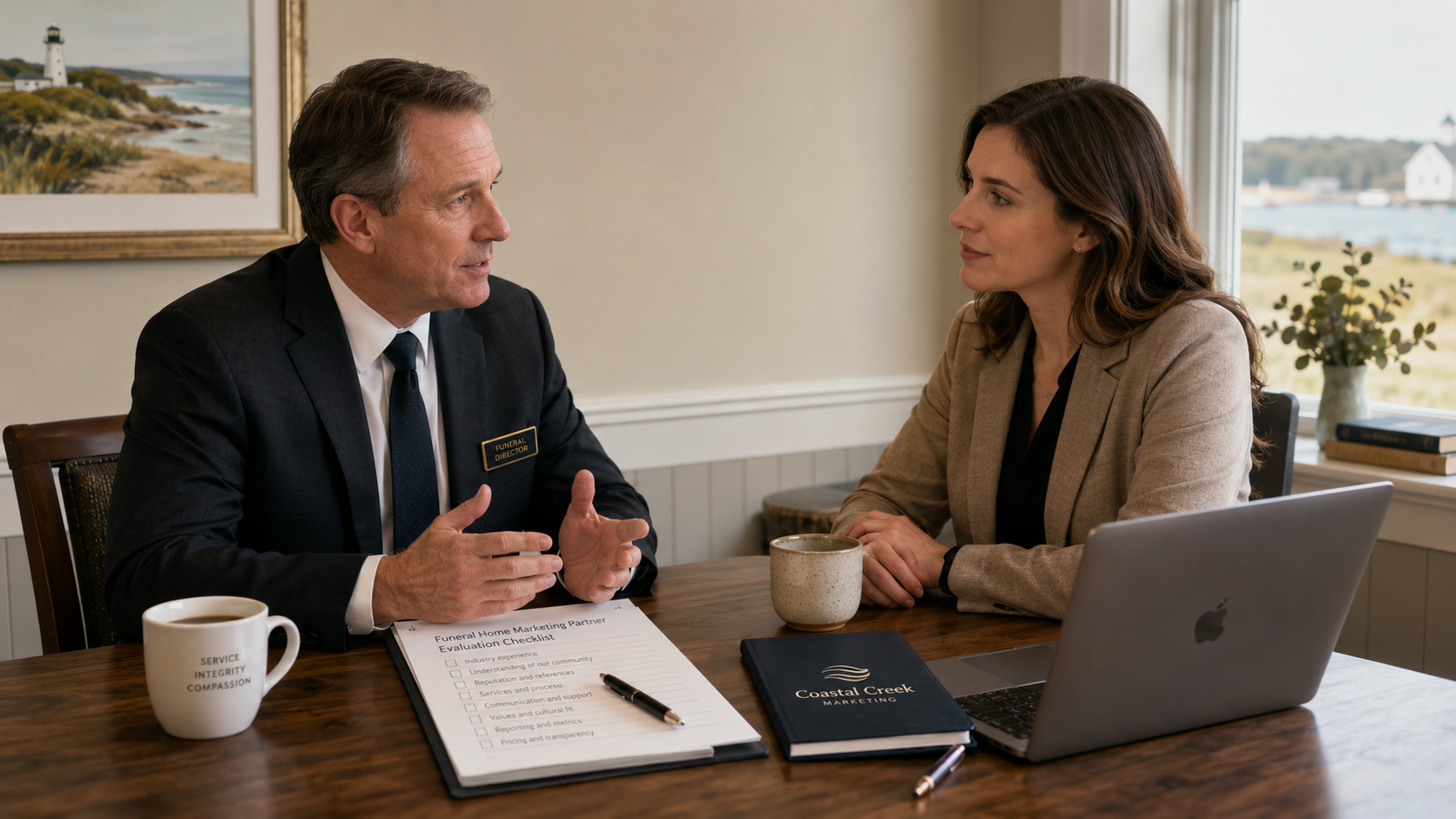
Imagine interviewing a marketing agency for your funeral home and asking the room a simple question:
"What's your personal experience with funerals? Have you been to one that mattered to you? Have you ever helped plan one? What do you believe a funeral is actually for?"
Watch what happens. Some teams will light up — someone will talk about their grandmother's wake, the director who handled everything when their father died, the strange comfort of a receiving line. And some teams will go quiet, glance at each other, and offer something like, "Well, we approach every vertical with the same proven framework."
Hire the first team. Every time. And if you run a funeral home on Cape Cod — where we've argued local context is everything — this single filter will tell you more than any portfolio, case study, or pitch deck. Here's why the question works, what it exposes, and the full vetting checklist to bring into your next agency conversation.
The Problem Nobody Names: Most Marketers Are Quietly Anti-Funeral
Here's an uncomfortable truth about hiring writers and strategists to represent your profession: the cultural water they swim in has been subtly hostile to funeral service for sixty years.
The modern script was written in 1963, when Jessica Mitford published The American Way of Death — the exposé that cast funeral directors as salesmen exploiting grief and profoundly transformed public perception of the industry. The book drove real, needed reforms — the FTC Funeral Rule exists in its shadow, and its influence on the profession continues six decades later. But it also planted a frame that never left the culture: that ceremony is upsell, that viewing is salesmanship, that the whole enterprise is, as even Mitford's sympathetic modern readers still put it, "selling the idea" that ritual helps grief. Critics of the book noted at the time what critics note now: that this framing overlooks the intrinsic value funeral ceremonies carry in helping survivors through grief — value the bereavement research literature takes seriously, documenting how funerals facilitate expression, solace, support, and meaning-making.
Now consider who staffs a typical marketing agency: smart, young, digitally native writers who grew up on "funeral industry rip-off" listicles, watched direct-cremation startups build entire brands on the premise that funeral directors are middlemen to be disrupted, and — statistically — may have attended very few funerals at all. Nobody at that agency decided to be skeptical of your profession. They inherited the skepticism the way everyone inherits cultural defaults: invisibly.
And inherited skepticism leaks. Not as open hostility — as hedging. The copy that says "if you choose to have a service" with an almost apologetic shrug. The pricing page written with the defensive crouch of someone who half-believes the Mitford critique. The blog post about cremation options that reads like it was written by the discount startup's marketing team, because in a sense it was — the writer absorbed their framing from the same internet. Your agency doesn't have to believe funerals are a racket to hurt you. They just have to not believe funerals matter, and the absence of conviction will be legible in every paragraph they produce on your behalf.
You cannot fix this with a style guide. Conviction isn't a tone setting. Which is why the vetting question isn't "can you write sensitively?" — everyone says yes. It's "what do you believe a funeral is for?" — because that answer can't be faked by anyone who's never thought about it.
Why Lived Experience Shows Up in the Work (and in the Rankings)
"Have you been to a funeral?" isn't a gotcha or a hazing ritual. It's a proxy for a set of capabilities that directly determine whether your marketing performs.
Experience is now literally a ranking framework. Google's quality standards lead with E-E-A-T — and the first E stands for Experience: content demonstrably informed by firsthand involvement with the topic. This isn't abstract for you; it's the difference between a "what to expect at a wake" page written from search-result paraphrase and one written by someone who remembers the smell of the flowers and the awkward mercy of not knowing what to say. Readers feel the difference in seconds. So, increasingly, do the systems deciding what ranks and what gets cited by AI engines — because in a world drowning in generated text, verifiable human experience is the scarcest signal left. We've written about what actually separates converting copy from filler, and the answer keeps coming back to the same thing: specificity that only proximity to the real thing produces.
Grief content has a failure mode on each side, and only experience steers between them. Writers uncomfortable with death fail in one of two directions: euphemistic mush ("your loved one's celebration journey") or clinical detachment that reads like an insurance form. The narrow path between — plain, warm, unflinching, useful — is walked almost exclusively by people who have been the family in the arrangement room and remember what actually helped. One wrong-registered sentence in front of a grieving family doesn't just fail to convert; it tells them you don't understand them, at the exact moment understanding is the product.
Someone has to catch what's wrong. Every agency now uses AI in production — we've been open about how and where— which makes the humans on your account more decisive, not less. An AI draft about "affordable cremation options" will faithfully reproduce the internet's median framing of your profession, Mitford residue and all. A reviewer who has lived a good funeral catches it instantly. A reviewer who hasn't doesn't even see it. The question "have you been to a funeral?" is really the question "is there anyone on my account capable of noticing when the machine subtly argues against my existence?"
The stakes are asymmetric on the Cape. Your market is the oldest in Massachusetts, full of transplants with no inherited loyalty deciding by search, and the NFDA finds 44.4% of consumers wouldn't feel confident planning a funeral without a director's help — a number that's rising. Those families are reachable, persuadable, and actively looking for someone to trust. Content with genuine conviction wins them. Content with hedged, secondhand conviction loses them to whoever — including the discount checkout pages — sounds most sure of itself.
The Vetting Checklist: What to Ask Any Agency Before You Sign
Bring these into the room. The answers — and the speed and texture of the answers — will sort your candidates fast.
1. "What's your team's personal experience with funerals?" The open door. You're not scoring trauma; you're listening for whether anyone has stood in the rooms you work in. Vague professional answers ("we've done sensitive verticals") are a soft no.
2. "Who exactly will work on my account — and what's their answer to question one?" The oldest agency trick is pitching with partners and producing with juniors. Names, roles, and the actual writers. If the person drafting your grief-support content has never been to a wake, you deserve to know before the contract, not after the first draft.
3. "What do you believe funerals are for?" The conviction question. A strong answer engages honestly — ritual, gathering, the research on grief, maybe even wrestling with the industry's real historical sins. A weak answer pivots immediately to deliverables. You're hiring the belief as much as the skillset, because the belief is what writes the copy.
4. "Would you feel comfortable telling a family that a simple direct cremation is the right choice for them?" The integrity check, from the other direction. "Pro-funeral" doesn't mean "anti-simplicity" — an agency that would pressure-market ceremony to every family is as dangerous to your reputation as one that believes in nothing. You want people who believe in the value of what you do and in telling the truth about when less is enough. (That honesty, it turns out, is also what converts.)
5. "Show me funeral or deathcare content you've produced — and tell me what you'd do differently now." Portfolio plus self-criticism. If they've never touched the vertical, the follow-up: "Write me 200 words on what to expect at a graveside service, by Friday, by the actual person who'd write mine." Twenty minutes of reading will tell you everything.
6. "How will you learn our families?" The right answer involves your arrangement room: interviewing your directors, reading your reviews, understanding your towns — on-Cape context specifically. The wrong answer involves the word "framework" doing all the work.
7. "Where does AI sit in your process, and who reviews what it produces for this account?" You're not disqualifying AI use — you're disqualifying evasiveness about it, and confirming that the human safety net has the lived experience from questions one and two.
8. "What would make you push back on us?" A partner who believes in funeral service will sometimes tell you your website's obituary page is failing families, or your pricing opacity is costing you trust. A vendor will tell you everything is great. Vendors are cheaper and worth less.
Our Answer to Our Own Question
It would be strange to hand you a vetting checklist and duck it ourselves, so: ask us. These questions are ones we ask internally when we staff funeral home accounts, because our whole model — finding the heart of a business and making it tangible — collapses if the people doing the finding don't believe the heart is real. You can't excavate a value you privately suspect is a sales tactic. The team on a funeral account has to be able to sit with your directors, hear the 2 a.m. stories, and recognize them as the point rather than the pitch.
We're also comfortable being tested the way we've told you to test everyone: put us in a room, ask the questions above, and read our published funeral service work with your director's eye before you believe a word of our sales conversation. Conviction should be checkable. Ours is on the page.
Frequently Asked Questions
Why does it matter if a marketing agency's staff has attended funerals?
Because firsthand experience is both a quality mechanism and a ranking signal. Google's E-E-A-T standards explicitly prioritize content informed by lived experience, and in practice, writers who have stood in receiving lines and arrangement rooms produce the specific, emotionally accurate content that grieving families trust — while inexperienced writers default to euphemism, detachment, or the culture's inherited skepticism of funeral service. The difference is visible to families in seconds and to search systems over time.
What does "pro-funeral" mean when hiring a marketing agency?
It means the team genuinely believes funeral service creates value — grounded in the research showing ritual and gathering support the bereaved — rather than privately viewing the profession through the "upsell" frame popularized by decades of industry criticism. It does not mean pressure-marketing ceremony to every family; the strongest partners believe in your value and in honest guidance, including when a simple option genuinely fits. Conviction plus honesty is the combination; either one alone fails.
What questions should a funeral home ask before hiring a marketing agency?
The core eight: the team's personal experience with funerals; exactly who will work the account (not who pitched it); what they believe funerals are for; whether they'd honestly recommend a simple option when it fits; samples of deathcare content with self-critique; how they'll learn your specific families and towns; where AI sits in their process and who reviews it; and what would make them push back on you. The pattern across all eight: you're vetting people and beliefs, not logos and frameworks.
Should a funeral home avoid agencies that use AI?
No — in 2026 that would exclude essentially every agency, and AI genuinely accelerates research and drafting. The real requirement is disclosure and review: the agency should explain exactly where AI sits in its process, and the humans reviewing output for your account must have the lived experience to catch the subtle anti-funeral framing that AI models reproduce from the broader internet. Unreviewed AI content is where inherited skepticism about your profession sneaks into your own website.
How is this different for Cape Cod funeral homes than funeral homes elsewhere?
The stakes compound on the Cape: the oldest population in Massachusetts, deaths outnumbering births two to one, and a large transplant population with no generational loyalty means more of your future case volume is decided by strangers reading your content than almost anywhere else. An agency team needs two kinds of fluency at once — genuine conviction about funeral service and genuine on-Cape context — because Cape families detect the absence of either one immediately.
What are red flags that an agency is wrong for a funeral home?
The pitch team won't name the delivery team. Personal-experience questions get deflected to "proven frameworks." Their sample content hedges about the value of services or reads like a direct-cremation startup wrote it. They promise unconditional agreement instead of honest pushback. And the largest one: nothing they show you could only have been written about your firm — because content that could belong to any funeral home in America will perform like it belongs to none.
The People on the Account Are the Product
Every agency will show you a deck. Every deck will say "compassionate," "trusted," and "results." The decks are interchangeable — the people are not. Before you sign anything, sit the actual team in front of you and ask the question this whole article is built on: Have you been to a funeral? Tell me about it.
If you'd like to ask us, we're easy to find — and we'll answer before we ever ask you a single question about budget.
Book a free 30-minute strategy call → Bring the checklist. Test us against it. You'll get an honest read on your visibility and a clear next step within one business day — whether or not we're the right fit.
Sources
Overnight Caskets — The Book That Turned the American Funeral Industry on Its Head (Mitford's influence and the criticisms of her stance on ceremony)
San Francisco Examiner — How The American Way of Death Reshaped the Funeral Industry
SevenPonds — Revisiting The American Way of Death (the critique's persistence in current commentary)
Utilizing the Spirituality of Funeral Rituals for Post-Pandemic Grief Recovery, PMC (expression, solace, support, meaning-making)
How Do Funeral Practices Impact Bereaved Relatives' Mental Health, Grief and Bereavement?, PubMed (mixed-methods review)
Connecting Directors — NFDA 2025 Consumer Awareness & Preferences Study (rising reliance on funeral director expertise)
Johnson Consulting Group — Inside the NFDA Consumer Survey (decline of relationship-based selection)