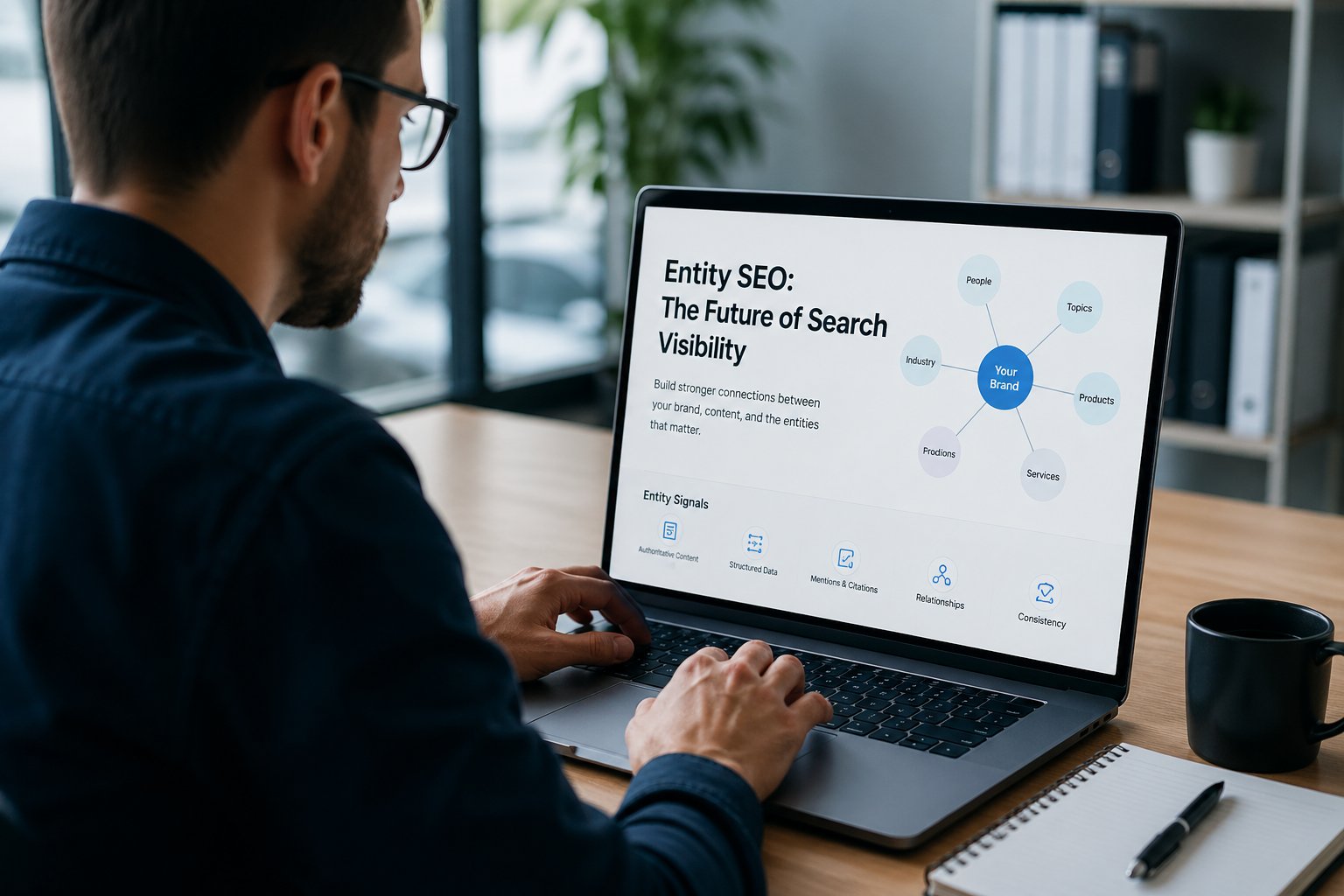
The Word You Keep Seeing but Nobody Fully Explains
If you've spent any time recently reading about AI search, Google's evolving algorithm, or why some brands seem to show up everywhere while others with strong content don't, you've probably encountered the term "entity SEO." It gets mentioned in passing in conference talks, dropped into agency proposals, and referenced in technical SEO threads — often without a clear explanation of what it actually means or why it matters for your specific business.
This post fixes that.
Entity SEO is not a tactic. It's not a plugin setting or a checklist item you hand to your web developer. It is a fundamental shift in how search engines — and increasingly AI models — understand the web. Understanding it changes how you think about your brand's online presence, your content strategy, your social profiles, and the relationship between all of them.
We're going to explain it from the ground up: what an entity is, how Google and AI models use entities to evaluate credibility, what entity SEO looks like in practice for a B2B brand, and how to audit and improve your own entity signals starting today. We'll go deep where depth is warranted, keep it practical throughout, and cite the research that backs up every major claim.
By the end of this post, you will understand entity SEO better than most people who use the term.
Part One: What Is an Entity?
In the context of search and AI, an entity is any distinct, well-defined thing that can be uniquely identified and distinguished from other things.
That definition sounds abstract, so let's make it concrete.
Google's documentation defines an entity as "a thing or concept that is singular, unique, well-defined, and distinguishable." ¹ Entities include:
People — Elon Musk, your company's CEO, a named industry analyst
Organizations — Google, Ritner Digital, the American Marketing Association
Places — New York City, a specific office building, a country
Products — the iPhone 15, Salesforce CRM, a specific software platform
Concepts — machine learning, content marketing, supply chain management
Events — the Super Bowl, a specific industry conference, a product launch
What makes something an entity is not that it exists, but that it is knowable and distinguishable. Google can tell the difference between Apple the technology company and apple the fruit because it understands them as distinct entities with different attributes, relationships, and contexts — not just as the same keyword string.
This distinction — between keywords as strings of characters and entities as meaningful, knowable things — is the foundational concept behind entity SEO.
Part Two: How Google Moved from Keywords to Entities
For most of Google's history, search was fundamentally a keyword matching exercise. You typed words into a search box, Google looked for pages that contained those words, and it ranked them based on a combination of relevance and authority signals — primarily links.
This worked reasonably well until it didn't. Keyword matching is brittle. It treats "Apple" the company and "apple" the fruit as the same string. It can't understand that "the president" in one query means the U.S. president and in another means the president of a local school board. It can't grasp that a search for "best CRM for small business" is really a search for help with a decision, not just a request for pages containing those six words.
Google began its formal shift toward entity-based understanding with the Hummingbird algorithm update in 2013, which introduced semantic search — the ability to understand the meaning and intent behind a query rather than just matching its keywords. ²
This accelerated significantly with the development of the Knowledge Graph, Google's massive structured database of entities and the relationships between them. The Knowledge Graph currently contains hundreds of billions of facts about entities — who founded which company, which person wrote which book, which organization is headquartered in which city, and so on. When you search for a person or organization and see a panel on the right side of Google's results page summarizing key facts, you are seeing the Knowledge Graph in action. ³
The BERT update in 2019 and the MUM update in 2021 further extended Google's ability to understand natural language queries in entity terms — recognizing context, relationships, and meaning rather than surface-level keyword patterns. ⁴
By 2025, Google's search system is not primarily a keyword index with entity awareness bolted on. It is fundamentally an entity understanding system that uses keywords as one input signal among many. The question Google is constantly trying to answer is not "which pages contain these words?" but "which entities are most relevant and credible for this query, and which content from those entities best answers the intent?"
Part Three: What Is Entity SEO?
Entity SEO is the practice of optimizing your brand, your people, and your content to be clearly understood, accurately represented, and positively evaluated within Google's Knowledge Graph and AI entity recognition systems.
Where traditional SEO focused on signals like keyword density, backlink count, and page speed, entity SEO focuses on signals like:
Entity clarity — Is your brand clearly defined as a distinct, knowable thing? Does Google understand what you are, what you do, who you serve, and how you relate to other entities in your industry?
Entity consistency — Does your brand's name, description, location, and attributes appear consistently across every platform where you have a presence?
Entity authority — Is your brand recognized and referenced by other credible entities? Do authoritative third parties — publications, organizations, platforms — mention and link to you in ways that confirm your expertise and existence?
Entity relationships — Is your brand connected in Google's understanding to the right topics, people, organizations, and concepts? When Google thinks about B2B content marketing, does it associate your brand with that topic?
The goal of entity SEO is to become what SEO researchers call a trusted entity in your subject area — a brand that Google and AI models recognize as a credible, established, well-defined source of information on specific topics, worthy of surfacing in response to relevant queries.
Part Four: Why Entity SEO Matters More Than Ever in the AI Era
Entity SEO has been a legitimate SEO discipline for years. But its importance has increased dramatically with the rise of AI-generated search answers, and here is exactly why.
When ChatGPT, Perplexity, or Google's AI Overviews generate a response to a query, they are not just fetching the highest-ranked web page. They are making a judgment about which sources are credible enough to cite in an answer that users will rely on. That credibility judgment is heavily influenced by entity signals.
An AI model encountering a query about B2B demand generation will look for sources it has reason to believe are authoritative on that topic. It draws on its training data — which reflects the broader web's entity relationships — and on real-time retrieval of current content. In both cases, brands with strong entity signals have a significant advantage.
Researchers at the Allen Institute for AI found that entity recognition and cross-source corroboration were among the strongest predictors of AI citation selection, outperforming single-source signals like page length or keyword relevance in controlled testing. ⁵ Put simply: AI models are more likely to cite sources they recognize as established entities than sources that are technically relevant but entity-weak.
This creates a direct line from entity SEO investment to AI citation frequency — which, as our AI Citation Gap research established, is increasingly the mechanism through which B2B buyers discover and evaluate vendors. ⁶
Part Five: The Core Components of Entity SEO
Entity SEO is not a single tactic. It is a system of interconnected signals that collectively tell search engines and AI models who you are, what you stand for, and why you should be trusted. Here are the core components.
1. Knowledge Panel and Knowledge Graph Presence
A Google Knowledge Panel is the information box that appears on the right side of Google search results when you search for a well-defined entity — a person, brand, or organization that Google has sufficient information about to summarize confidently.
Having a Knowledge Panel is not a vanity metric. It is a concrete indicator that Google has recognized your brand as a distinct entity in its Knowledge Graph — which means it has enough corroborating information from enough credible sources to represent you as a knowable thing rather than just a collection of web pages.
Brands with Knowledge Panels are cited in AI-generated answers at meaningfully higher rates than brands without them, because the Knowledge Panel itself is evidence of entity recognition — the prerequisite for AI citation confidence. BrightEdge's 2024 research found that brands with active Google Knowledge Panels appeared in AI Overviews at 2.4x the rate of brands without them, controlling for content quality and domain authority. ⁷
You cannot directly create your own Knowledge Panel — Google generates them based on its own assessment of available information. But you can build the signals that make Knowledge Panel generation more likely, which we will cover in the practical section below.
2. Structured Data and Schema Markup
Schema markup is code you add to your website that explicitly tells search engines what type of entity your content represents and what its key attributes are. Rather than leaving Google to infer that your about page describes an organization, schema markup states it unambiguously: "This is an Organization. Its name is Ritner Digital. Its URL is ritnerdigital.com. Its founding date is X. Its areas of expertise are Y and Z."
Schema.org, the collaborative vocabulary developed by Google, Microsoft, Yahoo, and Yandex, provides standardized entity types and attributes that search engines universally understand. ⁸ Key schema types for B2B entity SEO include:
Organization — defines your company as a distinct entity with name, URL, logo, social profiles, and contact information
Person — defines named authors and team members as distinct entities with credentials and affiliations
Article — defines each piece of content with its author, publication date, and topic associations
BreadcrumbList — helps search engines understand your site's topical structure
FAQPage — explicitly marks FAQ content for AI retrieval systems
LocalBusiness — for businesses with physical locations, ties your entity to geographic data
Search Engine Journal's 2025 analysis found that structured data markup was present in 73% of content cited by AI Overviews but only 47% of non-cited content at equivalent ranking positions — one of the clearest available signals that schema implementation directly influences AI surfacing probability. ⁹
3. NAP Consistency
NAP stands for Name, Address, and Phone number. NAP consistency — having identical business information across every platform where your brand appears — is one of the most foundational entity signals available, and one of the most commonly neglected.
Here's why it matters at an entity level. Google's Knowledge Graph builds its understanding of an entity by aggregating information about it from multiple sources. If your brand appears as "Ritner Digital" on your website, "Ritner Digital LLC" on your Google Business Profile, "RitnerDigital" on LinkedIn, and "Ritner Digital Marketing" on a directory listing, these variations create ambiguity. Google's entity resolution system — the process by which it determines whether two mentions refer to the same entity — has to work harder, and inconsistent signals reduce the confidence with which it can represent your brand as a well-defined entity.
A 2024 Whitespark local search ranking factors study found that NAP consistency across citations remains one of the top five local entity signals used by Google to evaluate business credibility. ¹⁰ For B2B brands targeting national or global markets, the same principle applies — consistent brand name representation across all platforms strengthens entity recognition even without geographic specificity.
4. Author Entities and E-E-A-T
In 2022, Google updated its quality evaluator guidelines to expand E-A-T (Expertise, Authoritativeness, Trustworthiness) to E-E-A-T, adding a second E for Experience. ¹¹ This update formalized something entity SEO practitioners had observed for years: Google evaluates not just content quality in the abstract, but the credibility of the specific entity who created it.
Author entities — the people who write your content — are distinct entities in Google's Knowledge Graph with their own authority signals. A named author with a verifiable professional history, consistent online presence, published work across multiple platforms, and clear topical expertise is a stronger entity than an anonymous byline or a generic "staff writer."
Gartner's 2024 research found that named authors with verifiable LinkedIn profiles and prior published work were cited by AI models at 1.8x the rate of anonymously authored content at equivalent content depth. ¹² Building author entities — ensuring your named contributors have complete, consistent, cross-referenced online presences — is one of the highest-leverage entity SEO investments available to B2B content teams.
5. Topical Authority
Topical authority is the degree to which Google and AI systems recognize your brand as an established, credible source specifically on a defined set of topics. It is closely related to entity SEO because it represents the relationship between your brand entity and specific subject matter entities.
A brand that has published 50 well-researched pieces on B2B demand generation, had those pieces cited by trade publications, referenced in Reddit discussions, and discussed on LinkedIn, has strong topical authority in demand generation. Google's systems recognize the relationship: Ritner Digital entity → highly associated with → demand generation entity.
When a buyer queries an AI model about demand generation, that entity relationship increases the probability that Ritner Digital's content will be retrieved and cited — even if a given piece of content is newer or has fewer backlinks than a competitor's.
Semrush's 2024 content analysis found that domains with concentrated topical authority in a defined subject area earned featured snippet and AI Overview placements at 3.2x the rate of domains with equivalent domain authority but diffuse topical coverage. ¹³
6. Third-Party Entity Corroboration
Perhaps the most important entity signal of all is third-party corroboration — mentions, citations, and references to your brand from other credible entities.
This is the entity-level equivalent of backlinks, but broader. It includes:
Mentions in trade publications and industry media
Citations in other brands' research and content
Guest authorship in established publications
Podcast appearances with transcripts
Conference speaker listings
Industry association memberships and listings
Community discussion on platforms like Reddit
Each of these represents an independent entity — a publication, a platform, a community — confirming that your brand exists, is active, and is associated with specific topics. The aggregate of these confirmations is what gives Google and AI models the confidence to recognize your brand as a trusted entity rather than an unknown source.
The Content Marketing Institute's 2024 B2B Benchmarks Report found that brands cited in three or more industry publications earned Knowledge Panel generation at 4.1x the rate of brands with equivalent website authority but no third-party publication presence. ¹⁴
Part Six: How to Audit Your Entity SEO
Before building new entity signals, you need to understand where you currently stand. Here is a practical audit framework.
Step 1: Google Your Own Brand
Search your brand name on Google and observe:
Does a Knowledge Panel appear? If yes, is the information accurate and complete?
What does Google show as your primary description?
Which social profiles and platforms appear in results?
Are there any incorrect or outdated facts Google is surfacing?
If no Knowledge Panel appears, note this as a gap. If one does appear but contains inaccurate information, correcting it is a priority — inaccurate entity data actively undermines AI citation confidence.
Step 2: Audit Your Schema Markup
Use Google's Rich Results Test tool at search.google.com/test/rich-results to check whether your website's key pages have valid schema markup. Specifically check your homepage for Organization schema, your blog posts for Article and Person schema, and your about page for any team member Person schema.
Note every page that lacks schema markup — these are entity signal gaps that are relatively straightforward to close with developer implementation or a schema plugin.
Step 3: Audit Your NAP Consistency
Search your brand name across the major platforms where you have a presence — Google Business Profile, LinkedIn, Facebook, industry directories, data aggregators like Manta, Yellow Pages, and Yelp. Document every variation in how your brand name, address, and phone number appear.
Any inconsistency is an entity ambiguity signal. Create a master NAP document with your exact, canonical brand information and use it as the standard for every platform correction.
Step 4: Audit Your Author Entities
For each named author who contributes to your content, check:
Do they have a complete, accurate LinkedIn profile with consistent professional history?
Do they have an author bio page on your website with schema markup?
Is their name spelled and formatted consistently across all their published work?
Do they have bylined work on any third-party publications?
Is their affiliation with your organization clearly stated in every context?
Any author producing content for your brand without a strong, consistent entity presence is a missed credibility signal for everything they write.
Step 5: Audit Your Topical Footprint
List the five to ten topics most central to your business. For each topic, search it on Google, ChatGPT, and Perplexity and note:
Does your brand appear in any results or citations?
Which competitors appear consistently?
What types of content — format, depth, data — are being cited?
This audit tells you where your topical authority gaps are relative to competitors who are already being recognized as entities in your core subject areas.
Part Seven: How to Build Entity SEO — The Practical Playbook
Auditing reveals your gaps. Here is how to close them.
Establish Your Organization Entity
Start with your website. Implement Organization schema on your homepage and About page. Include your official brand name exactly as it appears everywhere else, your canonical URL, your logo URL, your founding date, your social profile URLs, and your areas of service or expertise.
Then ensure your Google Business Profile is fully complete — every field, accurate and consistent with your website. Claim your Wikidata entry if your brand is established enough to warrant one — Wikidata is a direct input into Google's Knowledge Graph. ³ If your brand warrants a Wikipedia page, creating or improving it is one of the highest-authority entity signals available, though Wikipedia's notability standards mean this is only appropriate for brands with substantial third-party coverage.
Build Your Author Entities
For every named contributor to your content, create a dedicated author bio page on your website with Person schema markup. Ensure their LinkedIn profile is complete, consistent, and cross-references your organization. Where possible, secure bylined placements in trade publications — even one or two third-party bylines significantly strengthen an author's entity signals.
Establish a consistent author signature: the same name spelling, professional title, and organizational affiliation across every piece of content, every platform, and every publication. Inconsistency here creates entity ambiguity that AI models resolve by reducing citation confidence.
Build Topical Authority Systematically
Choose three to five topics you want to own and build content depth systematically. For each topic, publish a comprehensive pillar piece — a long-form, thoroughly cited, deeply researched guide. Then publish supporting content that covers adjacent subtopics, all internally linked to the pillar. This content architecture creates a clear topical cluster that Google's systems can map to your entity. ¹³
Crucially, include original data in at least one piece per topic cluster. A benchmark report, a survey, or a proprietary analysis is the highest-value entity signal available for topical authority — because it creates a piece of content that AI models can cite as a primary source, not a secondary one.
Pursue Third-Party Entity Corroboration
Identify the five most authoritative publications in your industry and develop a relationship strategy for each. This means contributing guest articles, pitching original data for coverage, offering expert quotes for their reporting, and participating in any industry roundups or research they publish.
Each byline, each citation, each mention in a credible third-party publication strengthens your brand's entity corroboration signals. There is no shortcut here — this is relationship work that compounds over time, but it is also the work that most directly builds the trust signals AI models use to select citation sources.
Maintain Cross-Platform Consistency
Every platform where your brand appears — LinkedIn, Google Business Profile, Facebook, industry directories, association listings, speaker bios — should reflect your canonical NAP and brand description. Build a brand consistency document that specifies your exact official name, tagline, description, and contact information, and audit every platform against it at least annually.
Want to know how strong your brand's entity signals are — and exactly where the gaps are?
Book a free Entity SEO Audit → ritnerdigital.com/#contact
Frequently Asked Questions
Is entity SEO the same as local SEO?
They overlap significantly but are not identical. Local SEO focuses specifically on optimizing for geographically relevant queries — "B2B marketing agency near me" or "SEO consultant in Philadelphia." Entity SEO is broader — it applies to any brand, regardless of geographic focus, that wants to be recognized as a credible, distinct entity by search engines and AI models. Local SEO is essentially entity SEO with a geographic dimension added.
Do I need a Wikipedia page for entity SEO?
Not necessarily, but it helps significantly if your brand meets Wikipedia's notability standards — meaning you have substantial, independent third-party coverage in reliable sources. Wikipedia is one of the most direct inputs into Google's Knowledge Graph. If your brand doesn't yet qualify for Wikipedia, Wikidata is a lower-barrier alternative that still feeds directly into the Knowledge Graph.
How is entity SEO different from traditional link building?
Traditional link building focuses on acquiring backlinks to improve domain authority and page ranking. Entity SEO includes link acquisition as one signal but is broader — it encompasses brand mentions without links, social profile consistency, schema markup, author credibility, and cross-platform corroboration. A brand mention in a trade publication that doesn't include a hyperlink still contributes to entity corroboration signals. Entity SEO recognizes that the web's signals of credibility extend beyond hyperlinks.
How long does entity SEO take to show results?
Entity signals build cumulatively and are not subject to the same rapid fluctuations as keyword rankings. Most brands see meaningful improvement in Knowledge Panel generation and AI citation rates within 3 to 6 months of consistent entity SEO investment. Full topical authority development — being consistently recognized as a trusted entity in a defined subject area — typically requires 12 to 18 months of sustained effort.
Can a small B2B brand compete with large brands on entity SEO?
Yes — and entity SEO is one of the areas where smaller brands have the most opportunity to outperform larger competitors. Large brands often have diffuse topical coverage and inconsistent entity signals across their many properties. A smaller brand that concentrates its entity signals on a defined niche — with consistent NAP, strong author entities, and deep topical authority in a specific subject area — can achieve AI citation rates that rival much larger competitors in that niche.
Does social media follower count matter for entity SEO?
Follower count itself is not a direct entity signal. What matters is the presence and consistency of your social profiles — that they exist, that they are actively maintained, that they consistently represent your brand's canonical information, and that they are cross-referenced with your website through schema markup. An active LinkedIn company page with 500 followers contributes more to entity signals than an abandoned page with 5,000 followers.
What is the single most important entity SEO action for a brand starting from scratch?
Implement Organization schema markup on your website homepage and ensure complete, consistent information on your Google Business Profile. These two actions — one on your own domain, one on Google's platform — establish the foundational entity recognition signals everything else builds on. From there, the next highest-priority action is publishing one piece of original proprietary research that gives AI models a citable primary source to associate with your entity.
How does entity SEO relate to E-E-A-T?
E-E-A-T (Experience, Expertise, Authoritativeness, Trustworthiness) is Google's quality evaluation framework, and entity SEO is the primary mechanism through which E-E-A-T signals are built and communicated. Expertise is demonstrated through topical authority content. Authoritativeness is built through third-party entity corroboration. Trustworthiness is established through NAP consistency, schema markup, and Knowledge Graph accuracy. Entity SEO is, in practice, the operational discipline of building E-E-A-T signals systematically.
References
<a name="ref1">1.</a> Google Search Central. (2024). How Google Search Works: Understanding Entities. Google. https://developers.google.com/search/docs
<a name="ref2">2.</a> Search Engine Land. (2023). "Google Hummingbird: Ten Years of Semantic Search." Search Engine Land.https://searchengineland.com
<a name="ref3">3.</a> Google. (2024). The Knowledge Graph: Understand the World with Google. Google Blog. https://blog.google/products/search/introducing-knowledge-graph-things-not
<a name="ref4">4.</a> Google Search Central. (2021). MUM: A New AI Milestone for Understanding Information.Google Blog. https://blog.google/products/search/mum
<a name="ref5">5.</a> Allen Institute for AI. (2024). Entity Recognition and Citation Selection in Large Language Model Retrieval Systems. AI2 Research. https://allenai.org/research
<a name="ref6">6.</a> Ritner Digital. (2025). The AI Citation Gap: Analysis of 1,000 B2B Search Queries. Ritner Digital Research. https://www.ritnerdigital.com
<a name="ref7">7.</a> BrightEdge. (2024). AI Search Behavior and Content Performance Report. BrightEdge Research. https://www.brightedge.com/resources
<a name="ref8">8.</a> Schema.org. (2024). Schema.org Full Hierarchy. Schema.org. https://schema.org/docs/full.html
<a name="ref9">9.</a> Search Engine Journal. (2025, January). "Structured Data and AI Overview Citation Rates: A 2025 Analysis." Search Engine Journal.https://www.searchenginejournal.com
<a name="ref10">10.</a> Whitespark. (2024). Local Search Ranking Factors 2024. Whitespark Research. https://whitespark.ca/local-search-ranking-factors
<a name="ref11">11.</a> Google Search Central. (2022). Google Search Quality Evaluator Guidelines: E-E-A-T Update.Google. https://developers.google.com/search/blog/2022/12/google-raters-guidelines-e-e-a-t
<a name="ref12">12.</a> Gartner. (2024). Emerging Technology: The Impact of Generative AI on Search and Content Discovery. Gartner Research. https://www.gartner.com
<a name="ref13">13.</a> Semrush. (2024). Topical Authority and Search Performance: A Content Analysis. Semrush Research. https://www.semrush.com/blog
<a name="ref14">14.</a> Content Marketing Institute. (2024). B2B Content Marketing Benchmarks, Budgets, and Trends. CMI Annual Report. https://contentmarketinginstitute.com/research
Ritner Digital is a B2B digital marketing agency specializing in entity SEO, AI-era content strategy, and search visibility for B2B brands.