Claude Opus 4.7 vs. Claude Sonnet 4.6 for Marketing Operations: Which Model Should Actually Run Your Marketing Stack
There's a quiet question that's started showing up in marketing leadership conversations in the last twelve months. As marketing teams have moved from experimenting with AI to actually building AI into their core operations — content production, campaign analysis, customer segmentation, ad copy generation, SEO research, email personalization, reporting, you name it — the question of which model to actually use has become a real budget and performance decision. Not a theoretical one. A line item on the marketing technology stack that has measurable cost and quality implications every single month.
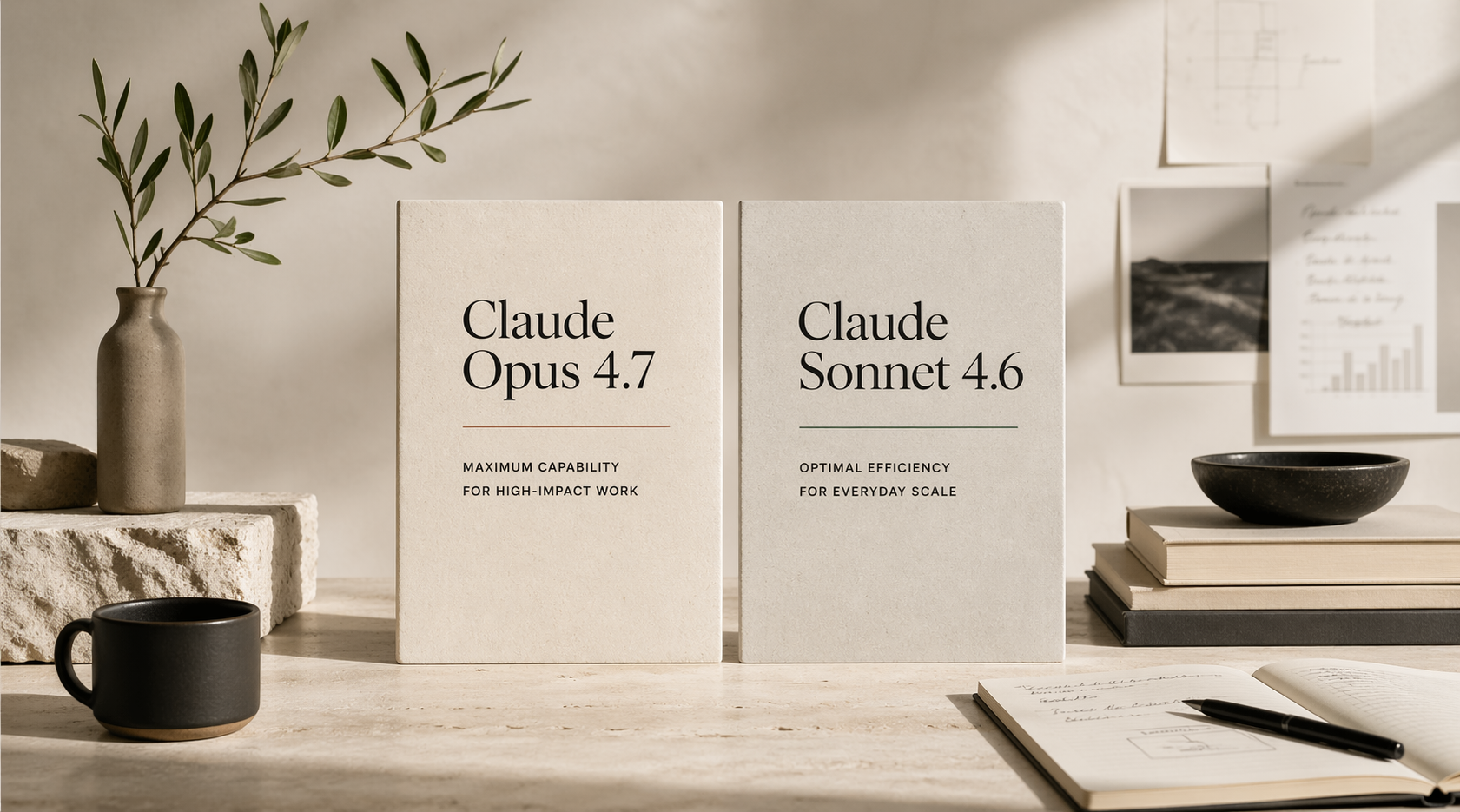
For teams using Claude as part of that stack, the choice in April 2026 has narrowed to two production models that matter: Claude Opus 4.7, released April 16, 2026, and Claude Sonnet 4.6, the established mid-tier workhorse that's been in production since late 2025. Both are capable. Both are widely deployed. Both have legitimate use cases. And the price difference between them — Opus 4.7 at $5 per million input tokens and $25 per million output tokens versus Sonnet 4.6 at $3 per million input tokens and $15 per million output tokens — adds up to something material when you're running them across thousands of marketing tasks per month.
This post is about how to actually think through that choice for marketing operations specifically. Not for software engineering, not for general-purpose use, not for the benchmark-chasing that dominates most AI model coverage. For the marketers and marketing operations leaders who are trying to figure out where each model belongs in their stack, what each one is actually best at, and where the cost-performance tradeoff lands for the work that actually gets done in modern marketing teams.
The Actual Differences Between the Two Models
Before getting into which one to use where, the practical differences matter. There are five that actually affect marketing operations work.
Pricing. Sonnet 4.6 is roughly 1.7x cheaper per token than Opus 4.7. Opus 4.7 runs at $5 per million input tokens and $25 per million output tokens. Sonnet 4.6 runs at $3 per million input tokens and $15 per million output tokens. For high-volume marketing workloads — generating thousands of product descriptions, processing thousands of customer reviews, drafting hundreds of email variants — that 40% cost difference compounds quickly. There's also a less-discussed wrinkle: Opus 4.7 ships with a new tokenizer that can use up to 35% more tokens to encode the same input text compared to Opus 4.6, which means the effective cost difference between Opus 4.7 and Sonnet 4.6 in real workloads is sometimes closer to 2x than 1.7x. Marketing teams that benchmarked their workloads on older Opus models and budgeted accordingly should re-measure before assuming the published per-token price tells the whole story.
Context window. Opus 4.7 supports a 1 million token context window. Sonnet 4.6 supports a 200,000 token context window. For most day-to-day marketing tasks — drafting an email, writing a landing page, summarizing a meeting — the 200K window is more than enough. Where the difference matters is when you're working with large reference material in a single call: analyzing an entire competitor's content library, processing a year of customer support transcripts, working through a complete brand guidelines document plus historical campaigns plus current creative, or running marketing intelligence work that requires the model to see a lot of source material at once.
Raw capability and reasoning depth. Opus 4.7 outperforms Sonnet 4.6 across most benchmarks, with the gap most pronounced in complex reasoning, coding, and agentic tasks. On SWE-Bench Verified (a coding benchmark), Opus 4.7 scores 87.6% versus Sonnet 4.6's 79.6%. On GPQA (graduate-level scientific reasoning), Opus 4.7 scores 94.2% versus 89.9%. On Terminal-Bench 2.0 (autonomous task execution), the gap is larger. For marketing operations, the raw benchmark gap matters less than the qualitative difference in how each model handles ambiguity, multi-step reasoning, and novel problems — which is where Opus 4.7's reasoning premium shows up.
Behavioral changes. Opus 4.7 follows instructions more literally than Sonnet 4.6 or any prior Claude model. Anthropic itself flags this explicitly as a migration consideration: prompts that depended on loose interpretation may now produce unexpected results because Opus 4.7 takes the wording at face value. Opus 4.7 also has a "more direct, opinionated tone with less validation-forward phrasing and fewer emoji than Claude Opus 4.6's warmer style," according to Anthropic's own migration documentation. For marketing teams, this means prompt libraries built for older models may need to be re-tuned — and brand voice guidelines that worked with one model may produce different output on another.
Vision capability. Opus 4.7 ships with three times the image resolution support of any prior Claude model, accepting images up to 2,576 pixels on the long edge (~3.75 megapixels). For most marketing tasks this isn't relevant, but if your workflow involves analyzing screenshots of competitor websites, parsing high-resolution mockups, reading dense data visualizations, or doing visual quality control on creative assets, the resolution upgrade is a meaningful capability difference.
Those are the actual differences. The question is how they map to the work your marketing operation actually does.
Where Sonnet 4.6 Is Genuinely the Right Choice
For most marketing operations, Sonnet 4.6 is the right default. This isn't a hedge or a value-tier consolation. It's the honest answer based on the work most marketing teams actually do.
The vast majority of marketing operations work falls into a category we can call high-volume, well-defined production tasks. Writing product descriptions from spec sheets. Generating ad copy variants for A/B testing. Drafting email subject lines. Summarizing meeting notes into briefs. Tagging and categorizing customer feedback. Translating campaign assets into multiple languages. Repurposing long-form content into social posts. Cleaning up data. Writing first drafts of standard marketing collateral. Categorizing inbound leads based on form responses. Generating SEO meta descriptions. Drafting standard responses to common customer service queries.
For all of this work, Sonnet 4.6 produces output that's qualitatively indistinguishable from Opus 4.7 in the eyes of the humans who actually consume the output. The 1.2 to 8 point benchmark gaps that show up in technical evaluations don't translate to noticeably different ad copy, product descriptions, or email drafts. The work is well-defined, the patterns are well-understood, the reasoning required is bounded, and Sonnet handles all of it at near-Opus quality. Paying a 67% per-token premium to use Opus on this work isn't buying you better output — it's buying you a higher cloud bill.
The math here matters, especially at scale. A marketing team that runs 10 million tokens of marketing content production per month (a moderate but realistic volume for a mid-sized team) is looking at roughly $180 per month on Sonnet 4.6 versus roughly $300 per month on Opus 4.7 for the same work, holding token volume constant. Over a year, that's a $1,440 difference for one workflow at one volume — and most marketing operations have multiple workflows running multiple volumes. Once you're routing the wrong tasks to Opus across an entire stack, the marketing AI bill can be 50-100% higher than it needs to be without any improvement in output quality that anyone actually notices.
Beyond cost, Sonnet 4.6 has real operational advantages that matter for production marketing workflows. It tends to respond faster on average. It handles long sequences of similar tasks reliably without degrading. It works well in batch processing workflows where you're running thousands of similar operations in sequence. And it's been in production long enough that the prompt patterns, tooling integrations, and edge case handling are well-understood across the AI tooling ecosystem, which means fewer surprises when you're integrating it into existing marketing automation platforms.
For a marketing team starting fresh or reassessing their AI stack, the right default position is: route everything to Sonnet 4.6 first, and only escalate to Opus 4.7 the specific tasks where Sonnet's output isn't meeting the quality bar. Most teams that run this exercise honestly discover that 80% or more of their workflows belong on Sonnet — and the bills they were running before were the result of defaulting to Opus rather than the result of Opus actually producing better marketing output.
Where Opus 4.7 Earns Its Premium
That said, there's a meaningful set of marketing operations work where Opus 4.7 produces genuinely better output, and where the premium is worth paying.
The clearest case is complex strategic and analytical work. Building a brand positioning framework from a discovery interview transcript, customer research, competitive intelligence, and historical creative — the kind of work where the model needs to synthesize substantial input, hold multiple constraints in mind, and produce a coherent strategic output that integrates all of it. Analyzing a year of campaign performance data and producing a synthesized insights report with strategic recommendations. Working through complex customer journey mapping with multiple personas, channels, and touchpoints. The reasoning depth that shows up on Opus 4.7's benchmark advantages is real, and it shows up most clearly on this kind of multi-input, multi-constraint, synthesis-heavy work.
The second clear case is long-context marketing intelligence work. Anything where you need the model to ingest a substantial body of source material in a single call — competitive teardowns of an entire competitor's content library, full-funnel analysis across years of campaign data, comprehensive content audits of a large website, long-form research synthesis that pulls from dozens of source documents at once. Sonnet 4.6's 200K context window is enough for most marketing tasks, but it constrains workflows that genuinely need the model to see and reason across hundreds of pages of input at once. Opus 4.7's 1M token window is built for exactly this kind of work.
The third case is agentic marketing workflows where the model is autonomously executing multi-step processes with tools. Setting up automated content briefing systems that pull from multiple data sources, draft content, check brand guidelines, and prepare deliverables for human review. Marketing intelligence agents that monitor competitor activity, analyze changes, and produce synthesized reports without step-by-step prompting. Autonomous SEO workflows that audit content, identify gaps, draft updates, and produce reports. Opus 4.7 was built specifically with improvements in agentic reliability — particularly the model's tendency to verify its own outputs before reporting back, which Anthropic added as an explicit behavioral change in the new release. For workflows where the model is operating with minimal human supervision across many steps, this verification behavior measurably reduces the rate of confident-but-wrong output that has historically plagued long agentic runs.
The fourth case is high-stakes creative and brand work. Writing the actual launch copy for a major campaign, not just brainstorming variants. Drafting executive communications that will go out under a CEO's name. Producing the strategic narrative for a brand refresh. Crafting the messaging that will anchor a new product launch. For work where the cost of mediocre output is high — because the work is going to be public, expensive to produce, and consequential to the business — paying the Opus premium for the quality difference is straightforwardly the right call. The cost differential per task at this end of the workflow is small, and the quality difference is meaningful.
The fifth case, more niche but worth flagging, is visual analysis work that depends on the high-resolution image support. Marketing teams doing competitive UI/UX analysis, parsing high-resolution mockups, reading dense data visualizations, or analyzing detailed creative assets all benefit from Opus 4.7's resolution upgrade. For most marketing teams this is occasional work, but for teams whose workflows involve significant visual analysis, it's a real capability gap.
How to Actually Build a Two-Model Marketing Stack
The right approach for most marketing operations is not to choose between Opus 4.7 and Sonnet 4.6 — it's to use both, route work intentionally, and treat model selection as an active operational decision rather than a default.
The framework that works in practice has three layers. The first layer is task classification. Every marketing workflow gets categorized by complexity: routine production work (the bulk of operations), strategic synthesis work (less frequent but higher-leverage), and high-stakes deliverable work (occasional but important). The classification is mostly intuitive once you've worked with both models for a few weeks — the boundary between "Sonnet handles this fine" and "this needs Opus" becomes obvious through observation.
The second layer is routing logic. Some marketing teams build this into their tooling explicitly, with model routing handled at the application or middleware level. Other teams handle it through team conventions and documentation, with prompt libraries that specify which model to use for which workflow. Either approach works as long as the routing is intentional. The failure mode is treating model choice as a developer preference and ending up with everything routed to whichever model was the team's default at setup time.
The third layer is measurement. Marketing teams running mature AI operations track cost per task and quality per task by workflow, not just overall AI spend. The goal is to be able to answer: "We spent $X on AI for the email campaign workflow last month, producing Y outputs at Z quality level." Once you can see those numbers per workflow, the optimization decisions become clear. Workflows where Opus is producing 5% better output for 70% more cost get downgraded to Sonnet. Workflows where Sonnet is producing visibly worse output get upgraded to Opus. The continuous optimization compounds over time into a stack that's both better and cheaper than what most teams default to.
A quick sketch of what this looks like for a typical mid-sized marketing operation: Sonnet 4.6 handles the volume work — content production, ad copy variants, email drafts, social repurposing, customer feedback analysis, SEO meta descriptions, translation, data cleaning, basic reporting. Opus 4.7 handles the leverage work — campaign strategy synthesis, competitive intelligence reports, brand positioning work, executive communications drafting, complex agentic workflows, and high-resolution visual analysis when needed. The volume work runs at scale on the cheaper model. The leverage work runs at full quality on the more capable model. Total cost is meaningfully lower than defaulting everything to Opus. Total output quality is meaningfully higher than defaulting everything to Sonnet.
What to Watch For When Migrating or Setting This Up
A few practical notes for marketing teams either standing this up for the first time or migrating from older models.
The Opus 4.7 tokenizer change is real and matters for budgeting. If you're moving from Opus 4.6 to Opus 4.7 (or budgeting fresh against Opus 4.7), assume that your token consumption per request can be up to 35% higher than equivalent work on Opus 4.6. The per-token price is the same, but the effective bill can be meaningfully higher. Re-measure on actual workloads before assuming the published price tells the full story.
Opus 4.7's tighter instruction-following can break old prompts. If you have a prompt library that was built for Opus 4.6 or earlier models, expect some prompts to behave differently on 4.7. Anthropic has flagged this explicitly. Words like "consider," "you might," and bulleted "suggestions" are now read closer to hard requirements than they were before. Audit prompts that depended on loose interpretation. Marketing teams that have invested in carefully tuned brand voice prompts should test those prompts against Opus 4.7 before flipping the switch in production.
Sonnet 4.6 is the more predictable model for production deployment. It's been in production longer, the integration patterns are more mature, and the edge cases are better understood across the tooling ecosystem. For mission-critical marketing workflows, this predictability matters. Opus 4.7 is the more capable model, but capability isn't the only consideration when you're running thousands of tasks per day in production.
Don't conflate what's best for engineering with what's best for marketing. Most of the AI model coverage in technical media is written for software engineering use cases — coding benchmarks, agentic development, technical reasoning. Those benchmarks don't always translate cleanly to marketing operations work. A model that wins a coding benchmark may not produce noticeably better email copy. A model that's slightly behind on technical reasoning may be perfectly suited to high-volume content production. Evaluate the models on the actual marketing work your team does, not on the benchmarks the developer community focuses on.
The Right Mental Model
The right way to think about Opus 4.7 versus Sonnet 4.6 for marketing operations is this: they're not competing models, they're complementary tools that solve different parts of the same problem. Sonnet 4.6 is the production engine — fast, reliable, cost-efficient, and more than capable enough for the majority of marketing operations work. Opus 4.7 is the leverage engine — more expensive per task but capable of work that genuinely benefits from deeper reasoning, longer context, and more reliable agentic execution.
Marketing operations that get this right route most of their volume to Sonnet, escalate the strategic and high-stakes work to Opus, measure the cost and quality outcomes per workflow, and continuously optimize the routing as their understanding of where each model excels gets sharper. The result is a stack that costs less than defaulting everything to Opus and produces better output than defaulting everything to Sonnet — and that scales gracefully as the team's AI footprint grows.
The wrong way to think about it is to pick one model and commit. Marketing operations that route everything to Opus end up overspending by 40-60% relative to what their workflows actually require. Marketing operations that route everything to Sonnet to save money end up with strategic and high-leverage work that's noticeably worse than it should be, costing the team more in human rework and missed quality than they saved on the AI bill. Neither extreme is the right answer. The thoughtful split is.
For marketing leaders trying to figure out the right configuration for their team, the practical starting point is to audit what your operation actually produces, classify the workflows by complexity and stakes, set the default to Sonnet 4.6, identify the specific workflows where Opus 4.7 is worth the premium, and build the routing into your tooling and conventions. Then measure, iterate, and adjust. The teams running this loop are getting more value out of their AI stack than the teams treating model selection as a one-time setup decision — and the gap is widening as the volume of AI-mediated marketing work grows.
Ritner Digital helps marketing teams build AI-integrated operations that actually work — from selecting the right models for the right workflows, to building the prompt libraries and routing logic that turn AI into a reliable production engine, to measuring and optimizing cost and quality across the stack. Whether you're standing up your team's AI marketing operations for the first time, migrating from older models, or trying to figure out why your AI bill keeps climbing without a corresponding lift in output quality, we'll help you build the stack that actually delivers. Let's talk.
Sources: Anthropic Claude API Documentation, "Models Overview" and "What's new in Claude Opus 4.7" (April 2026); Vellum AI, "Claude Opus 4.7 Benchmarks Explained" (April 2026); NxCode, "Claude Opus 4.7 vs 4.6 vs Mythos: Which Model Should You Use?" (April 2026); NxCode, "Claude Sonnet 4.6 vs Opus 4.6: Complete Comparison Guide" (March 2026); Finout, "Claude Opus 4.7 Pricing: The Real Cost Story Behind the 'Unchanged' Price Tag" (April 2026); LLM-Stats, "Claude Opus 4.7 vs Opus 4.6" (April 2026); LLM-Stats, "Claude Sonnet 4.6 vs Claude Opus 4.7 Comparison"; BenchLM.ai, "Claude Opus 4.7 vs Claude Sonnet 4.6: AI Benchmark Comparison 2026."
Frequently Asked Questions
If I Can Only Pick One Model for My Marketing Stack, Which One Should It Be?
Sonnet 4.6, almost without exception. The honest answer for marketing operations is that single-model deployments are usually a setup mistake rather than a strategic choice — but if budget, tooling, or team bandwidth genuinely forces a single-model decision, Sonnet 4.6 covers more of the actual marketing work most teams do than Opus 4.7 does. The 40% per-token savings on every workflow add up faster than the quality lift Opus would provide on the small percentage of work that genuinely benefits from it. The exception is marketing teams whose primary AI workload is strategic synthesis, agentic intelligence work, or high-stakes brand and executive communications — for those teams, Opus 4.7 is the right single-model choice. For everyone else, default to Sonnet and revisit the question once your AI usage has matured enough to justify a two-model stack.
How Do I Know When My Sonnet 4.6 Output Isn't Good Enough and I Should Escalate to Opus 4.7?
The signal is consistent human rework. If your team is using Sonnet 4.6 output as a first draft and the humans downstream are doing meaningful editing, restructuring, or substantive revision before the work ships, that's a flag that the model isn't producing output at the quality bar your workflow needs. Track this informally for a few weeks per workflow — how much human time is being spent fixing the AI's output? When the rework time is high enough that the cost of the human editing exceeds the savings from using Sonnet over Opus, escalate that specific workflow to Opus and re-measure. The other clear signal is when Sonnet output is consistently missing nuances that Opus catches — strategic implications, second-order effects, brand voice subtleties — and your team can demonstrate the difference qualitatively. If you can't articulate a concrete quality difference, you're probably not getting one, and Sonnet is the right choice.
What About Haiku 4.5? Should That Be Part of the Marketing Stack Too?
Yes, for the right workloads. Haiku 4.5 sits below Sonnet 4.6 in the Claude lineup and is built for high-volume, low-complexity tasks where speed and cost matter more than reasoning depth. For marketing operations, the workflows where Haiku belongs include things like simple content classification, basic data tagging, routine customer service response drafting, simple data extraction, and any work where the model is essentially doing pattern-matching rather than reasoning. The mature marketing AI stack often has all three models running in parallel: Haiku for the highest-volume mechanical work, Sonnet for production content and standard operations, and Opus for strategic and high-stakes work. The cost optimization from properly tiering across all three is significant — often more than 50% lower total spend than running everything on a single mid-tier model.
How Should We Handle Brand Voice Consistency When Different Models Are Producing Output?
This is one of the more underappreciated operational challenges of a multi-model stack. Different models produce subtly different output even given identical prompts, and Opus 4.7 in particular has been documented to have a "more direct, opinionated tone" than older models or Sonnet. The practical solution is to invest in a strong brand voice prompt library that's tested and tuned for each model you're deploying. The same brand voice instructions that produce on-brand output from Sonnet may need slight adjustment to produce equivalent output from Opus, and vice versa. Sophisticated marketing teams maintain model-specific prompt versions for their core brand voice instructions and audit output samples from each model regularly to catch drift. The alternative — assuming brand voice will hold consistent across models without active management — produces output that's subtly inconsistent in ways that erode brand cohesion over time without anyone being able to point to exactly what changed.
Does the New Tokenizer in Opus 4.7 Mean We Should Stay on Opus 4.6 to Save Money?
No, but it does mean you should re-measure your costs after migrating. The Opus 4.7 tokenizer can use up to 35% more tokens to encode the same input compared to Opus 4.6, which means your effective bill on the same workload can be meaningfully higher even though the per-token rate is unchanged. For most workloads the actual increase is in the 10-20% range rather than the 35% ceiling, but it's enough that budgeting based on Opus 4.6 token consumption will under-estimate your Opus 4.7 spend. The right move is to migrate to 4.7 (the capability improvements are real and worth having), then measure your actual token consumption on representative workloads and re-budget accordingly. Staying on 4.6 to dodge the tokenizer change leaves the capability improvements on the table — and Anthropic will eventually deprecate older models, so the migration is coming either way.
What If Our Marketing Workflows Are Mostly Run Through Tools Like HubSpot, Salesforce Marketing Cloud, or Klaviyo Rather Than Direct API Calls?
Then your model selection is largely determined by what those platforms support and how they expose model choice. Most major marketing automation platforms have integrated AI features that run on specific models chosen by the platform vendor — you don't always have direct control over which Claude model is doing the work behind the scenes. Where this matters is in the parts of your stack where you do have direct control: custom integrations, internal tooling, agency partnerships, and bespoke workflows your team has built. For those parts of the stack, the routing logic in this post applies directly. For the platform-mediated parts, the relevant question is whether the platform's choice of model is producing output that meets your quality bar — and if not, what custom workflows might need to be built outside the platform to get the leverage you need.
How Often Should We Re-Evaluate Our Model Routing as New Versions Get Released?
At least quarterly, with a more comprehensive review whenever a major new release comes out. The Claude model landscape has been moving fast — Sonnet 4.6 was released in late 2025, Opus 4.6 in early 2026, Opus 4.7 in April 2026 — and the relative cost-performance positioning of each model shifts with every release. A routing decision that was optimal six months ago may not be optimal today. The practical cadence for most marketing operations is a quarterly review of cost and quality metrics per workflow, plus a deeper re-evaluation whenever a new model release affects the lineup. This doesn't have to be a heavy lift — for most teams it's a one-hour conversation between marketing operations and whoever owns the AI tooling, looking at the data and deciding whether any workflows should be re-routed. The teams that skip this end up with stacks that drift further out of optimization over time.
Are There Marketing Workflows Where We Shouldn't Be Using AI at All — Where Both Sonnet and Opus Are the Wrong Answer?
Yes, and being honest about this matters. AI models are extraordinarily good at certain marketing tasks and unreliable or inappropriate for others. Tasks that require genuine human creative judgment, strategic intuition built on hard-won experience, deep brand stewardship, sensitive customer communications during crises, work that involves significant legal or compliance exposure, and content where authenticity is the entire value proposition (founder voice, customer testimonials, executive thought leadership in raw form) are all places where AI assistance can be helpful but where pure AI generation tends to produce work that's subtly off in ways that damage rather than build the brand. The right framing isn't "AI versus human" — it's "where does AI add leverage to humans, and where does it replace the very thing that makes the work valuable?" Marketing operations that get this right use AI aggressively in the leverage-amplifying zone and resist the temptation to push it into the human-judgment zone just because it's technically possible.