What Is Answer Engine Optimization (AEO) and Why Your Business Needs It Now
You've spent years building your SEO strategy — fine-tuning keywords, earning backlinks, climbing the rankings. And it's worked. But something is shifting beneath your feet, and if you haven't noticed it yet, your competitors probably have.
Search is no longer just search. It's answers.
When someone types a question into ChatGPT, Perplexity, or Google's AI Overviews, they're not getting a list of ten blue links. They're getting a synthesized, authoritative response — sourced from a small handful of trusted websites. One of those websites should be yours. That's the entire premise of Answer Engine Optimization, or AEO.
This post explains what AEO is, why it matters more urgently than most businesses realize, and what you can start doing right now to make sure your brand shows up when AI gives the answer.
The Search Landscape Has Fundamentally Changed
Here's a number that should stop you in your tracks: zero-click searches rose from 56% of all Google searches in 2024 to 69% in 2025. CXL More than two-thirds of people who search Google never visit a website. That's not a blip. That's a structural shift.
Meanwhile, ChatGPT serves 800 million users weekly. CXL Google has rolled out AI Overviews broadly, Perplexity is growing fast, and Microsoft Copilot is embedded across the entire Office ecosystem. These aren't search engines — they're answer engines. They don't return links; they return conclusions.
Gartner predicts that by 2026, 25% of organic search traffic will shift to AI chatbots and virtual assistants instead of traditional search clicks. O8 If your business depends on organic search for leads, customers, or revenue, that projection isn't something you can afford to ignore.
So What Exactly Is AEO?
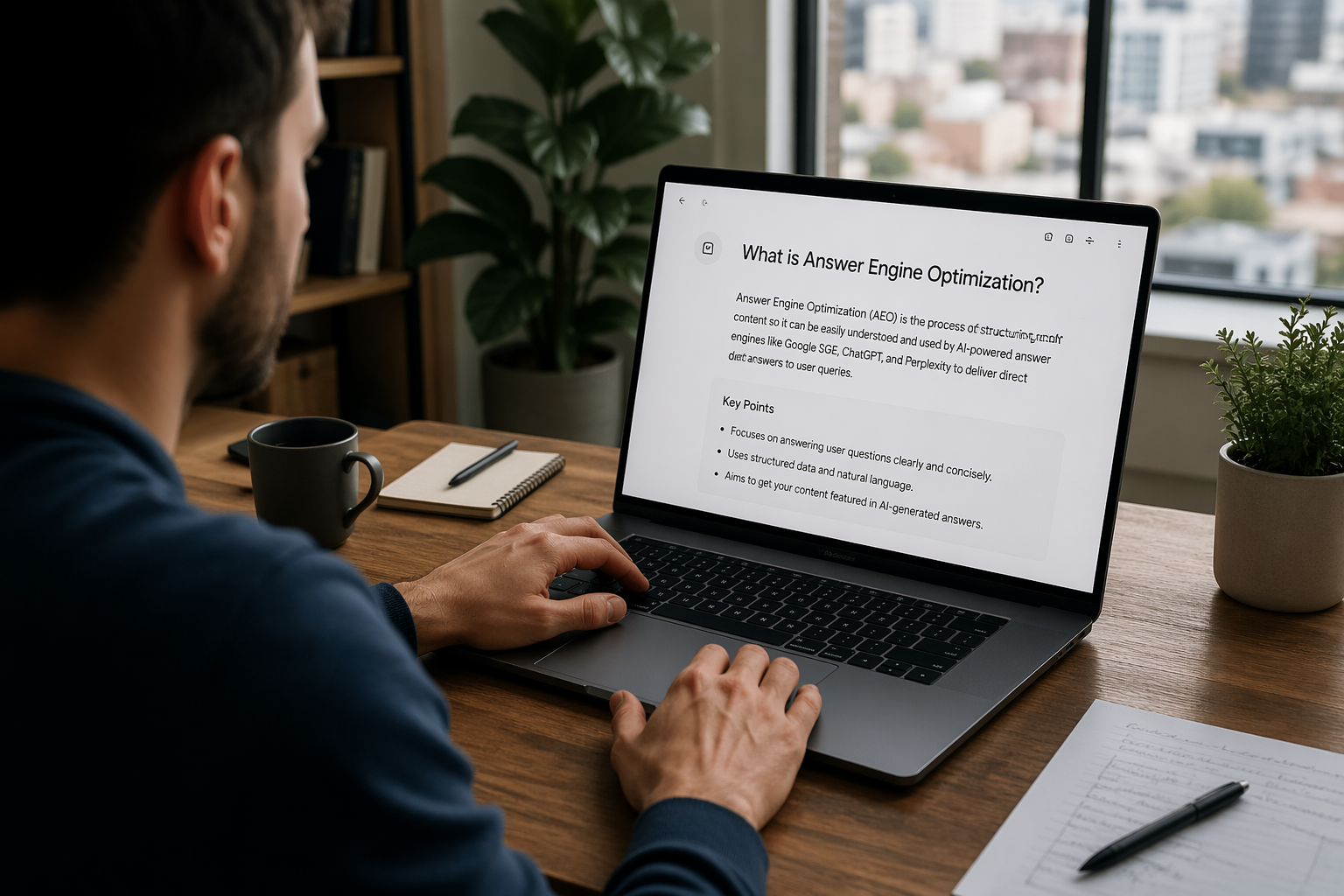
Answer Engine Optimization is the practice of structuring and enhancing your content so that AI-powered platforms — ChatGPT, Google AI Overviews, Perplexity, Microsoft Copilot, and others — select it as a cited source when generating answers to user queries.
The distinction from traditional SEO is important. SEO is about ranking. You optimize to appear in a list of results and earn a click. AEO is about being cited. You optimize to be the source an AI model draws from when it synthesizes an answer — whether or not that answer ever leads to a click.
That might sound like a consolation prize, but it's actually the opposite. Brands that are cited in AI answers are establishing authority at exactly the moment a user is forming an opinion, making a comparison, or deciding to buy. That's enormously valuable real estate — and right now, most businesses aren't competing for it.
Why AEO Matters for Your Bottom Line
Let's move past the theory and talk about what's actually at stake.
Traffic quality is getting better, not worse. Studies show that AI-driven visitors convert at 4.4x the rate of standard organic visitors and spend 68% more time on site. Frase These users aren't browsing — they've already done their research with the AI's help. They arrive qualified.
Traditional rankings are losing their click value fast. Ahrefs' December 2025 study of 300,000 keywords found that the #1 position click-through rate drops 58% when an AI Overview is present. Frase You can rank first and still lose the majority of your clicks to an AI summary that doesn't cite you.
The adoption gap is a real first-mover opportunity. 70% of organizations believe AEO will significantly impact their digital strategy within 1–3 years, but only 20% have begun implementing it. Frase That gap is your window. Brands that establish citation authority now will be increasingly difficult to displace later.
B2B buyers are already living in AI. According to Forrester, 89% of B2B buyers have adopted generative AI as a central source for self-directed information throughout their entire buying process. Evergreen If you sell to businesses and you're not appearing in AI answers, you're invisible to a growing majority of your prospects before they ever reach your website.
Your questions are getting longer — and so are your customers'. The average query length in traditional search is 3.37 words. The average prompt length in ChatGPT is 23 words, with some prompts reaching over 2,700 words. HubSpotLonger, more specific prompts produce more qualified intent — and the brands whose content answers those detailed questions are the ones getting cited.
How Answer Engines Actually Work
To optimize for something, you need to understand how it functions. When someone asks an AI a question, here's what happens under the hood:
Retrieval. The AI searches for relevant documents across the web and its indexed sources. Crawlability and basic technical SEO still matter here — if your site can't be reached, you can't be cited.
Ranking. The AI weighs source authority, content freshness, structural clarity, and E-E-A-T signals (Experience, Expertise, Authoritativeness, Trustworthiness). There is a 0.65 linear correlation between a website's domain authority and its frequency in AI citations Jacklimebear — strong enough to confirm that foundational credibility still matters enormously.
Extraction. The AI doesn't copy your content. It pulls key facts, statistics, and explanations. Content buried in dense, unstructured paragraphs is harder to extract. Content formatted specifically for LLM extraction is 3 times more likely to be cited. Jacklimebear
Synthesis. The AI rewrites what it found in natural language. Your phrasing may not survive, but your facts and authority will — as long as your content was clear and structured enough to extract in the first place.
Citation. The engine attributes specific claims to their sources. This is where AEO pays off. Clear, citable facts with supporting data get credited. Vague marketing copy does not.
AEO vs. SEO: Not Either/Or
A common misconception is that AEO replaces SEO. It doesn't. SEO drives the organic traffic that pays the bills today. AEO builds the brand authority that protects your visibility as AI search grows. Frase You need both.
Data from 2025 suggests that most high-performing brands are now practicing hybrid optimization — using traditional SEO to build the infrastructure (site speed, crawlability, backlinks, content) and AEO for interpretation (structured data, entity clarity). Jacklimebear
Think of it this way: SEO gets you on the field. AEO gets you quoted.
What AEO Actually Looks Like in Practice
Here are the concrete tactics that move the needle:
Answer-first content structure. Lead every page with a direct, concise answer to the question it targets — 50 to 100 words, plainly written. Then expand. AI models scan for the clearest, most extractable answer, and burying your point in paragraph three means getting skipped.
Schema markup. Adding structured data — FAQ, HowTo, Product schema — feeds AI engines explicit signals about what your content contains and how it should be interpreted. Semai It's one of the highest-leverage technical moves you can make for AEO right now.
Topic clusters and topical authority. AI systems favor clearly structured, extractable content with concise answers and a logical flow. Evergreen Building interconnected content around a topic signals that your site is a genuine authority, not a collection of isolated posts.
E-E-A-T signals. Demonstrate expertise through author credentials, original research, cited sources, and regular updates. Brands leading in AEO update their content quarterly at minimum. Evergreen Freshness signals that your information is trustworthy and current.
Entity consistency. Make sure your brand, products, people, and locations are described consistently across your website, social profiles, directories, and third-party mentions. AI models build knowledge graphs, and consistency strengthens your entity's presence in those graphs.
Third-party citations and digital PR. Being cited by authority platforms in your industry is one of the best ways to gain visibility in large language models. Jacklimebear Getting mentioned in industry publications, earning expert quotes, and building relationships with high-authority sites feeds the trust signals that AI models prioritize.
Measuring AEO Success
AEO requires a different measurement mindset than traditional SEO. You're not just tracking rankings and clicks anymore.
Watch for high impressions but low clicks on question-type queries in Google Search Console — that's your content appearing in snippets without earning the visit. Track conversions by source so you can see when AI platforms like ChatGPT start sending traffic. Manually test relevant questions across ChatGPT, Perplexity, and Google's AI Overviews periodically to see if your brand is being cited. Emerging tools like OmniSEO and HubSpot's AEO Search Grader can help systematize that monitoring.
The metric that matters most isn't rankings or even traffic alone — it's whether your brand is present in the conversation at the moment of intent.
The Window Is Open — But Not Forever
The businesses winning in AEO right now are the early movers. They're the ones being cited by default, building citation authority that compounds over time, and showing up in AI answers while their competitors are still debating whether AEO is worth the investment.
Early adopters often establish citation advantages that become increasingly difficult for competitors to overcome. O8That's not hype — it mirrors exactly what happened with SEO a decade ago. The brands that invested early built structural advantages that took years for others to close.
The question isn't whether AI search will reshape how your customers find you. It already is. The question is whether you'll be cited when it happens — or invisible.
Ready to Get Found in AI Search?
At Ritner Digital, we help businesses build the content authority, technical structure, and digital presence they need to show up where their customers are actually looking — including in AI-generated answers.
Whether you're starting from scratch or looking to evolve an existing SEO strategy into one built for 2026 and beyond, we're ready to help.
Contact Ritner Digital today to schedule a free strategy session and find out where your brand stands in the AI search landscape.
Sources: HubSpot Marketing Blog, Frase.io AEO Guide, CXL AEO Guide, O8 Agency, Acquia AEO Survey, Evergreen Media, JackLimebear State of AEO 2026, SEMAI.ai
Frequently Asked Questions
What is Answer Engine Optimization (AEO)?
Answer Engine Optimization is the practice of structuring and enhancing your content so that AI-powered platforms — ChatGPT, Google AI Overviews, Perplexity, and Microsoft Copilot — select it as a cited source when generating answers to user queries. Unlike traditional SEO, which optimizes for rankings and clicks, AEO optimizes for being the source an AI draws from when it synthesizes a response.
How is AEO different from SEO?
SEO focuses on ranking in traditional search results and earning clicks. AEO focuses on being cited in AI-generated answers, which may or may not result in a click to your website. The two are complementary, not competing — SEO builds the infrastructure (crawlability, backlinks, site speed) while AEO layers on the interpretation signals (structured data, entity clarity, answer-first formatting) that AI models need to trust and cite your content.
Why does AEO matter if AI answers don't always send traffic to my site?
Because the citation itself has value. Users who arrive via AI citation convert at 4.4x the rate of standard organic visitors. More importantly, being cited shapes brand perception at the moment of decision — when someone is comparing options, evaluating a purchase, or forming an opinion. That influence happens whether or not they ever click through to your website.
Which platforms does AEO target?
AEO targets any AI-powered answer engine, including Google AI Overviews, ChatGPT, Perplexity, Microsoft Copilot, and voice assistants like Siri and Alexa. Each platform has slightly different preferences for source selection, but the foundational signals — domain authority, structured content, E-E-A-T, and freshness — apply across all of them.
Do I need to abandon my existing SEO strategy to pursue AEO?
No. AEO builds on top of your existing SEO foundation, not in place of it. Answer engines favor content from authoritative domains with strong technical SEO fundamentals. A well-optimized site is the prerequisite, and AEO is the next layer. The biggest shift is in how you structure and format content — leading with direct answers, using schema markup, and building topical authority through interconnected content clusters.
How do I know if my content is being cited by AI platforms?
You can monitor this manually by periodically searching relevant questions on ChatGPT, Perplexity, and Google AI Overviews and noting whether your brand appears. In Google Search Console, watch for pages with high impressions but low click-through rates on question-type queries — a strong signal your content is surfacing in AI summaries. Tools like OmniSEO and HubSpot's AEO Search Grader can help automate and scale that tracking over time.
How long does AEO take to show results?
AEO timelines vary depending on your current domain authority, content quality, and how competitive your niche is. That said, well-structured content with strong E-E-A-T signals can begin appearing in AI citations faster than traditional SEO rankings, particularly for long-tail, conversational queries where fewer authoritative sources exist. The brands investing now are building citation authority that compounds — and becomes harder for late movers to displace.
What kind of businesses benefit most from AEO?
Any business that depends on organic search visibility benefits from AEO, but the impact is especially significant for B2B companies (since 89% of B2B buyers now use generative AI for research), service businesses that compete on expertise, and local or niche brands that can establish authority in a specific topic area. If your customers are asking questions before they buy — and they are — AEO is how you make sure your answers are the ones they hear.