
You Started Publishing SEO Content and Your Leads Dipped. Here's Why That's Normal — and When It Recovers.
You had a five-page site and a phone that rang. Then you started a content engine and the leads slowed down. Before you panic, here's what's actually happening: Google re-reads your whole site, new pages drag your averages down, and your traffic shifts from buyers to researchers — the same turbulence a new site launch causes. This post breaks down all five mechanisms, the month-by-month recovery timeline, and how to tell a normal dip from a broken one.

The Proposal Happens at Sunset on Your Beach. The Venue Decision Happens in a Group Chat in Philadelphia. (The Final Letter in Our Shore Series)
The proposal happens at sunset on your beach; the venue decision happens over fourteen months in a Philadelphia group chat. It's the longest, richest funnel in local commerce — first decision made, 27% of a $34,000 budget — and a two-platform duopoly now charges venues up to $1,000+/month while claiming 73% of AI wedding answers, leaving 84% of vendors invisible in their own market. The final letter in our Shore series covers the escape route, the radical-transparency pricing play, the guest guide that markets to a hundred future visitors per wedding, and the one thesis all eight letters share.

Your Next Wildwood Buyer Is on a Couch in Doylestown, Three Years From Closing. Zillow Plans to Sell Them to You for 35%.
Tonight, your next closing is on a couch in Doylestown typing "is a Wildwood Crest condo a good investment" — three winters from a wire transfer with six zeros. The national data describes this buyer perfectly: 62 years old, repeat purchaser, 30% chance of paying cash, living entirely on screens. This letter maps the multi-year dreaming phase almost no agent farms, runs the Zillow Flex math ($6–7K per closing at 35%), and lays out the content, AI visibility, and remote-buyer proof that make you the family's advisor years before the toll booth can introduce you at the door.

Before You Hire a Marketing Agency for Your Cape Cod Funeral Home, Ask Them One Question: "Have You Been to a Funeral?"
Every agency deck says "compassionate" and "trusted." The decks are interchangeable — the people aren't. Sixty years of cultural skepticism about funeral service quietly shapes how most marketers write about your profession, and that inherited doubt leaks into copy in ways a style guide can't fix. This guide explains why you should vet the actual humans on your account — have they stood in a receiving line, planned a service, thought about what funerals are for? — and gives you the eight questions that sort real partners from vendors in one meeting.

Funeral Home Marketing in the Direct Cremation Era: How SEO and AI Search Make Your Value Tangible
Cremation is heading toward 82% of dispositions, and the fastest-growing slice is direct cremation — chosen online, at midnight, on price alone. Families aren't rejecting funeral directors; they're deciding without ever seeing what you do. This guide breaks down the revenue math, what the grief research actually says, and the four-layer content engine that makes a family-owned funeral home's heart tangible in Google results and AI answers alike.

"Do You Use AI to Write?" — How Agencies Should Answer the Question Every Client Is Now Asking
Every agency is getting asked the same question in 2026: "Do you use AI to write our content?" Most fumble it. This guide breaks down what clients are really asking, why denial is the worst possible strategy (87% of marketers use AI — and clients know it), and gives you a word-for-word answer framework plus responses to every follow-up. Handled right, the industry's most awkward question becomes your sharpest differentiator.

The Phrases That Give Away AI Writing (and How to Edit Them Out Before They Cost You Trust)
AI writing has tells — and your readers can spot them on sight. Backed by a Science Advances study of 14 million abstracts and Wikipedia's editor-built field guide, this post breaks down every word, phrase, and structural pattern that gives away AI-generated content, why they cost you rankings and AI citations, and the six-step editing pass that fixes them without killing your voice.

The "Normal Photo With Text On It" LinkedIn Trend: Why It Works, Why It's Dying, and What to Post Instead
A candid photo, a bold one-liner, zero design — and for two years it beat every polished graphic on LinkedIn. Now single-image posts underperform text by 30% and the parody phase has begun. Here's the full breakdown: the four mechanics behind the trend, the data on its decline, and how to steal what still works without becoming the meme.

Aura, Mogging, and FRFR: The 2026 Gen Z Slang Glossary for Marketers (And How to Use It Without Getting Roasted)
Gen Z built an entire language around one idea: prove it, or we don't believe you. This glossary breaks down aura, mogging, frfr, brainrot, and the rest of 2026's vocabulary — what each term actually means, which ones are safe for brands to touch, and why the generation's demand for receipts mirrors exactly how AI search engines decide who gets cited.

Evergreen vs. Timely Content: What Works Best for Bank Blogs
Every bank marketing team faces the same question: write durable guides that rank for years, or timely posts about rate changes that fade fast? It's a false choice. Here's how bank blogs balance evergreen and timely content — the right ratio, which timely topics are worth writing, how to link the two so short-term attention feeds long-term authority, and why quarterly refreshes aren't optional in a YMYL category.

How to Use Financial Education Content to Win SEO and Member Trust
There's a quiet irony in financial marketing: the same content that builds a member's trust is the content Google rewards with rankings. That's not a coincidence — it's the mechanism. Here's how to use financial education content to win SEO authority and member trust at once, why the E-E-A-T signals that convince a human are the same ones that convince Google, and how to structure it all for AI answer engines.
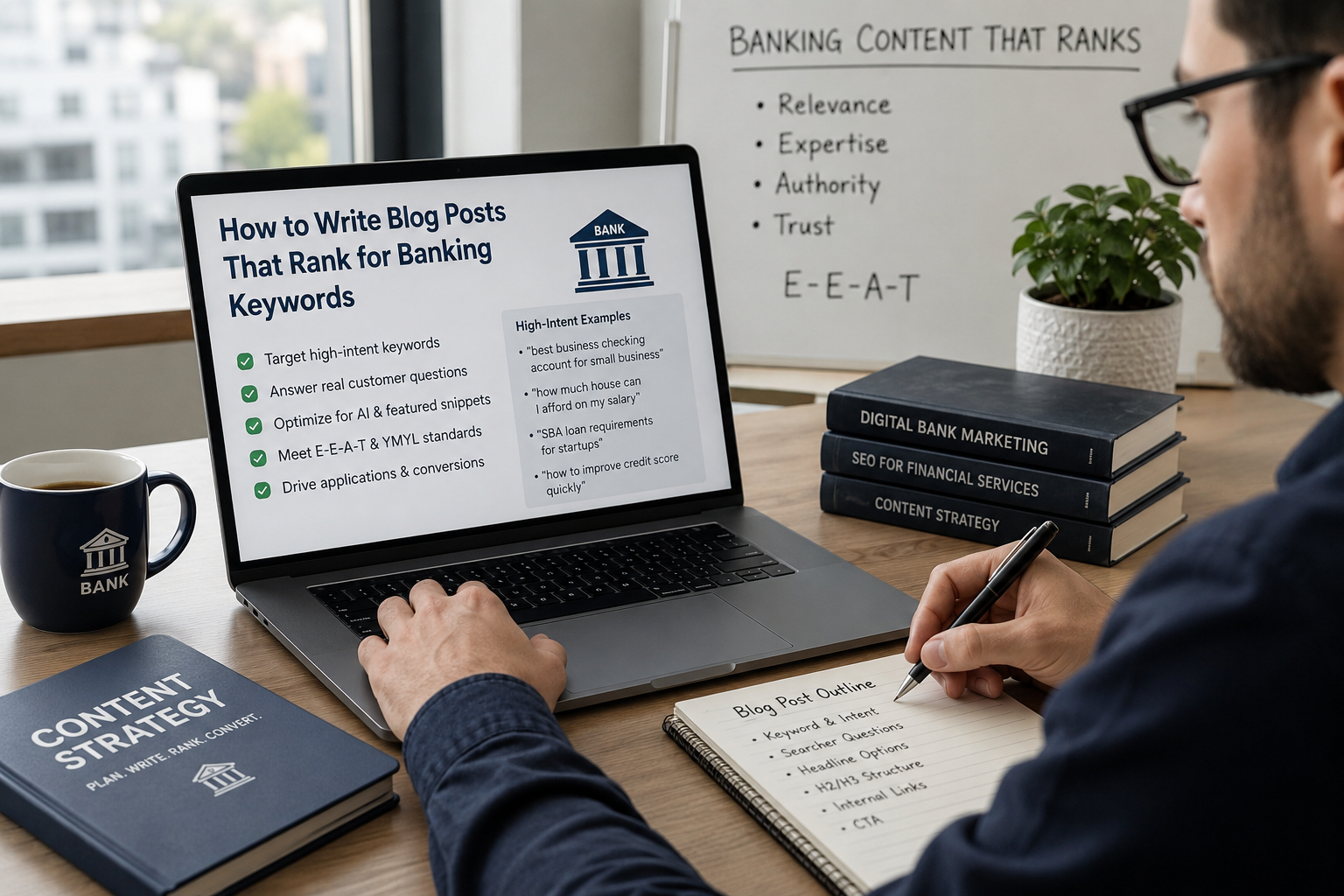
How to Write Blog Posts That Rank for High-Intent Banking Keywords
Most banking blogs are written backwards — chasing high-volume keywords that never convert. Here's how to write posts that actually produce applications: start from high-intent queries, target the terms you can realistically win against national banks, structure for AI answers, and clear the E-E-A-T trust bar Google sets for financial content. Five disciplined choices that turn each post into a compounding asset.

Financial Literacy Content That Ranks — And Converts Readers Into Members
Most credit unions treat financial literacy as community service — and leave growth on the table. Here's how to build financial literacy content that does two jobs at once: ranks in Google and gets cited by AI engines, then converts readers into funded members. From the questions people actually search to the low-bar CTAs that turn an article into a member relationship.
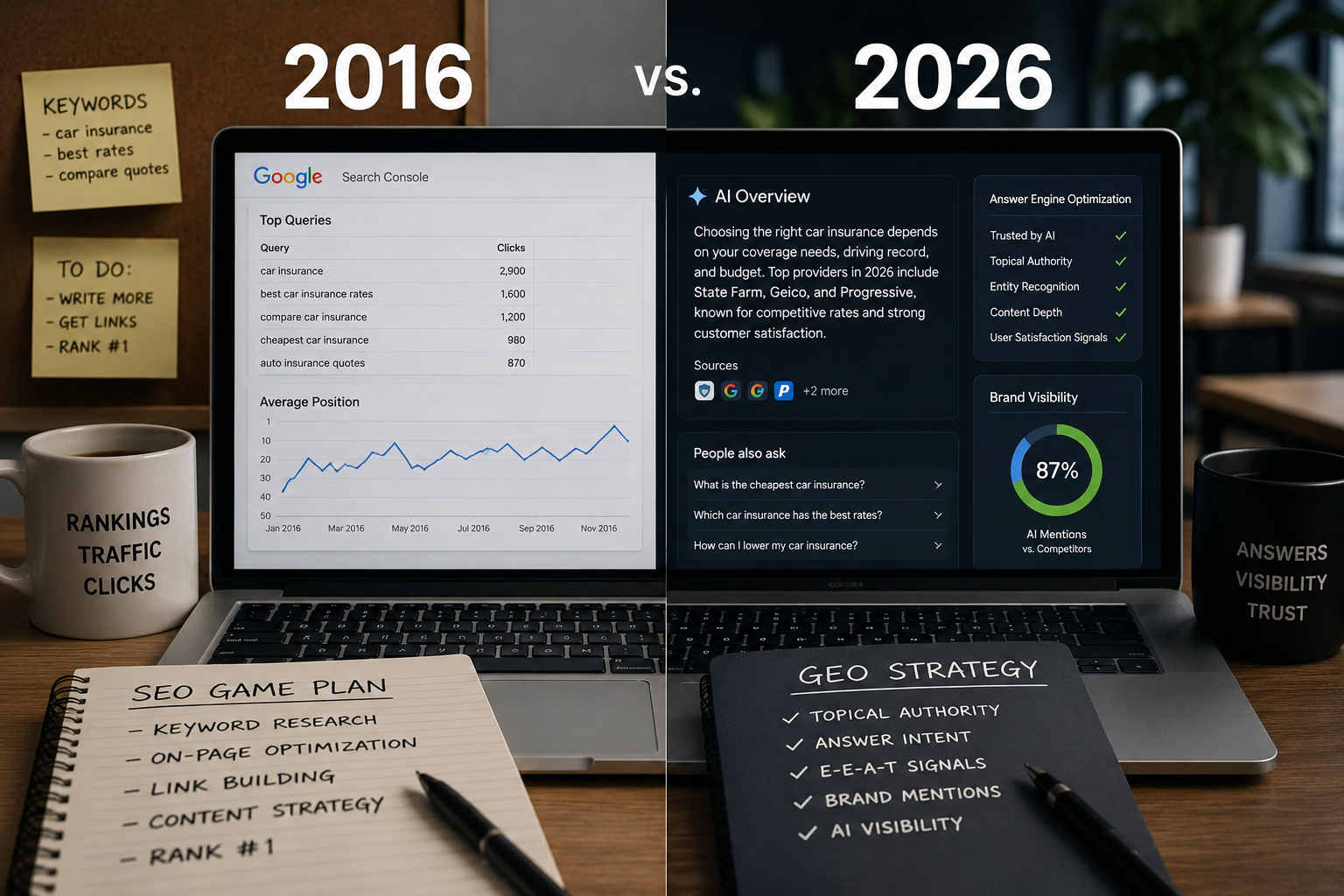
Is Your SEO Strategy Built for 2016 or 2026?
Would your SEO playbook look out of place in 2016? If it still revolves around keywords, word counts, and chasing position one, you're running a decade-old strategy in a search world that no longer rewards it. Here's what actually died, what didn't, and how to make the shift.
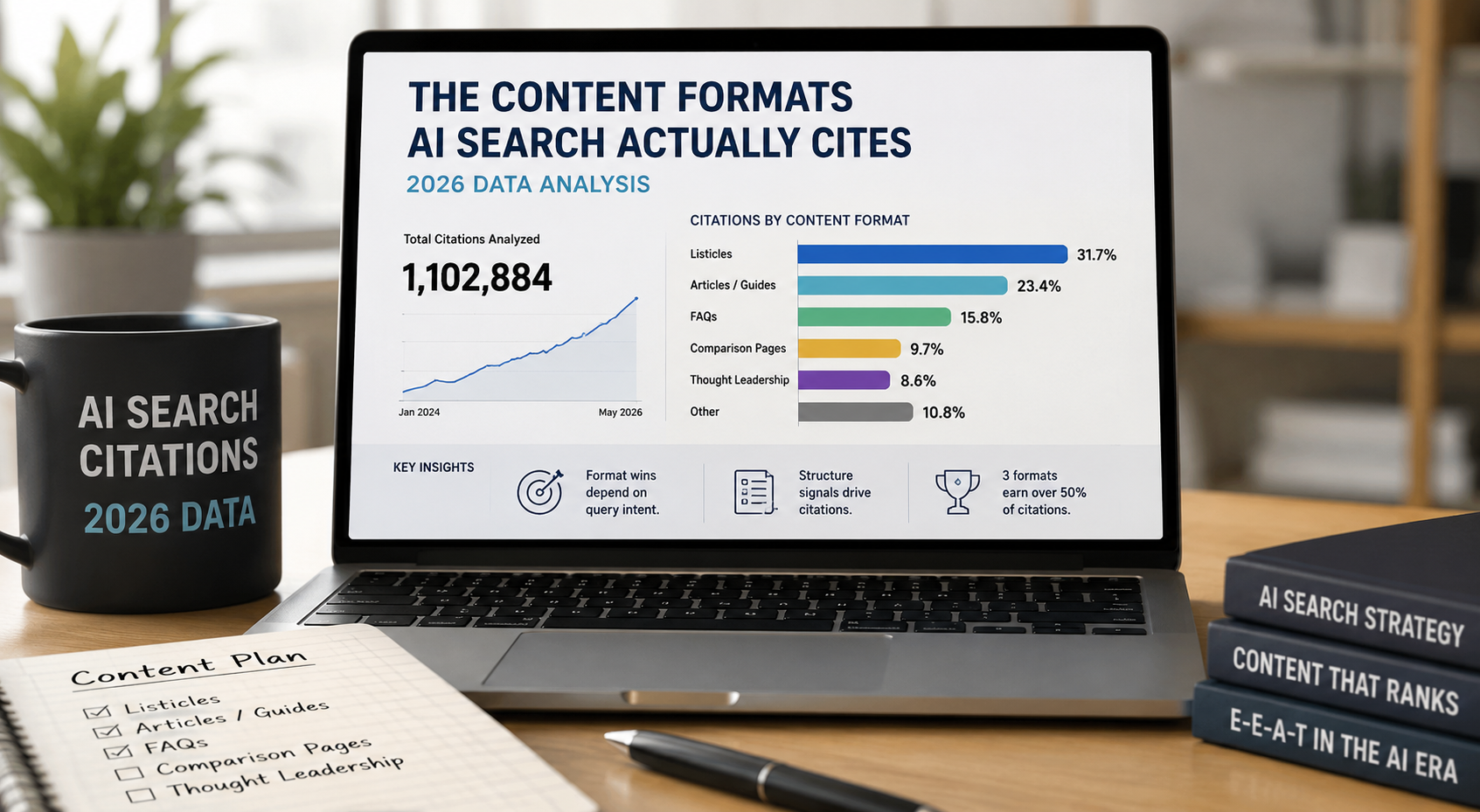
The Content Formats AI Search Actually Cites (Based on What We're Seeing Across Clients)
Most advice about "writing for AI search" is vibes: be helpful, be authoritative, answer questions. True, but useless as a content plan — none of it tells you which formats actually earn the citation. The 2026 citation studies finally do. Across more than a million analyzed citations, three formats earn over half of them, the winning format depends almost entirely on query intent, and a specific set of structural signals separates the cited from the ignored. Here's what the data shows about listicles, articles, FAQs, comparison pages, and thought leadership — and how to build a content plan around what AI actually rewards.
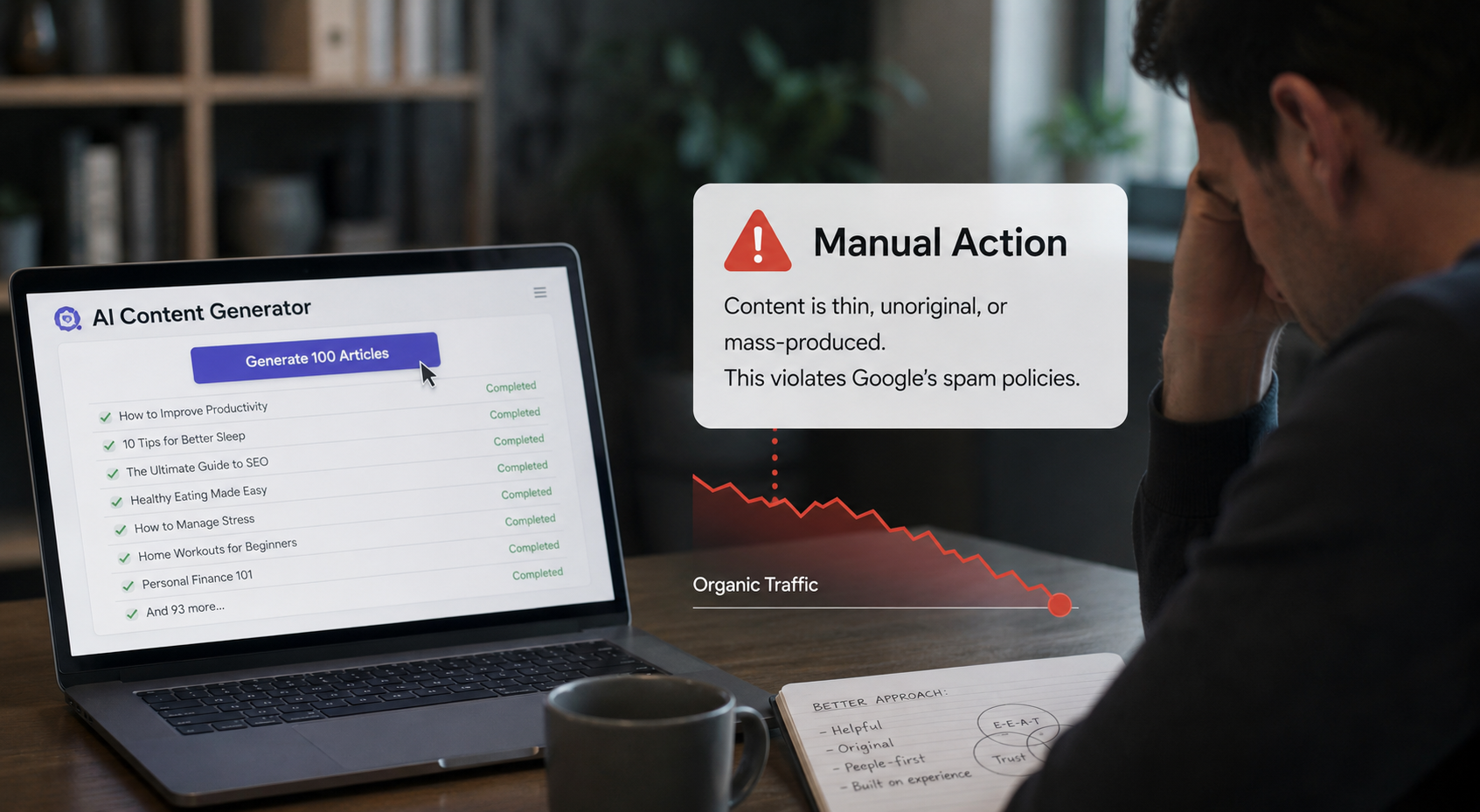
The Case Against Push-Button Content: Why "AI at Scale" Is the Riskiest Bet in Marketing Right Now
Push-button tools promise hundreds of AI-generated, "prompt-optimized" articles with a single click. It sounds like leverage — but it's colliding with how search and answer engines actually reward content. We break down why mass-produced content gets penalized, why it won't earn AI citations, and what the smarter alternative looks like.

What Today's Headlines Mean for Your Search Rankings
Every morning, millions of people open Google and search for something they just read in the news. The stories dominating today's headlines aren't just business news — they're live windows into shifting search behavior, emerging keyword clusters, and where brands with the right content strategy can show up at exactly the right moment. From AI Overview citations to local SEO survival tactics, here's what May 27th's biggest stories mean for your rankings.

If AI Is Eating Your Content Marketing Career, Consider This Pivot
A significant portion of what content marketers have been paid to do can now be done faster and cheaper by AI — and the market is adjusting accordingly. But the displacement isn't uniform. There's a pivot available right now that AI genuinely cannot replicate, that the market is undervaluing, and that's sitting largely untapped inside most of the businesses you've worked for. That pivot is data journalism — and if you're a content marketer looking for ground worth standing on, this is it.

Your Semrush Competitor List Is Humbling — Here's What It Actually Means
There's a specific kind of quiet that falls over a room when someone opens Semrush, pulls up their organic competitors report, and sees the list for the first time. Not the competitors they expected. Not the agencies they benchmark against. Just a handful of domains they've never heard of. Here's what that list is actually telling you — and what to do about it.
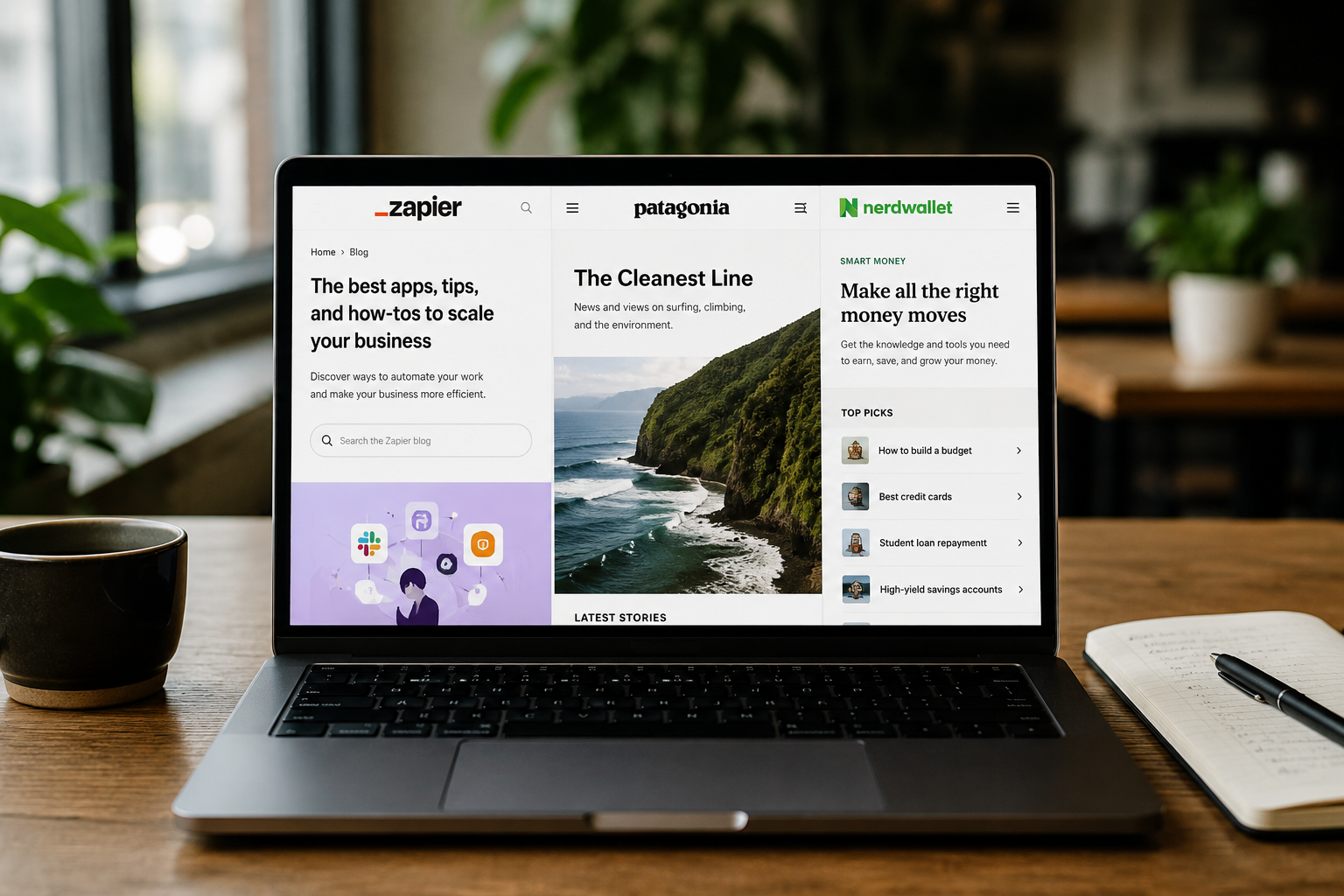
When Going Off-Topic Works: Real Companies That Built Massive SEO Traffic by Not Writing About Their Products
The conventional SEO wisdom says stay in your lane, build topical authority within your niche, and don't dilute your signal by wandering into unrelated territory. It's good advice. It's also advice that some of the most successful content programs in the world have systematically broken — and won because of it. Zapier, Patagonia, and NerdWallet didn't build their traffic by writing exclusively about what they sell. Here's how they did it and what the pattern means for your content strategy.