The Hidden Cost of a Long Sales Cycle
Every day a deal sits in the pipeline is a day it could close or die. Sales cycles that drag on consume sales team time, drain marketing resources, erode deal momentum, and give competitors more opportunity to intervene. Shortening the sales cycle — even modestly — compounds across every deal in your pipeline, making it one of the highest-leverage improvements any revenue-focused business can pursue.
The good news is that there's a substantial body of research showing that specific marketing investments have a measurable and often dramatic effect on how quickly buyers move from first contact to closed deal. The research spans lead nurturing, content marketing, thought leadership, marketing automation, inbound channels, and account-based marketing — and across all of it, a consistent pattern emerges: companies that invest in pre-sale buyer education close faster, at lower cost, and at higher deal values than those that rely on sales alone.
This guide synthesizes what the research actually shows — with specific percentages where the data supports them, honest caveats where it doesn't, and practical implications for how to deploy marketing investment to accelerate your pipeline.
Part 1: The Structural Problem — Where Sales Cycles Get Stuck
Before examining what reduces sales cycle length, it's worth understanding why sales cycles are long in the first place.
Lingering economic uncertainty is extending sales cycles, with nearly 90% of global buyers indicating their purchase process became more drawn-out in the previous year. B2B buyers now prefer a self-directed journey of digital discovery over a sales call. Edelman
The self-directed buyer is the defining dynamic. B2B buyers now conduct extensive independent research before engaging vendors. By the time they speak to sales, they are often already 60 to 70% through the decision process. If your organization isn't influencing that research phase, you're competing late. CMO Alliance
This is the core insight that runs through virtually all of the sales cycle reduction research: the sales cycle doesn't start when your sales team makes first contact. It starts when the buyer begins their research. Marketing that influences that research phase — before any sales conversation — is the most powerful lever for compressing the overall cycle.
Inbound channels drastically cut the sales cycle length, whereas outbound channels extend it, requiring a greater degree of rapport to be built before true selling could occur. Focus Digital
Part 2: Lead Nurturing — The Most Extensively Studied Sales Cycle Reducer
Lead nurturing — the practice of providing systematic, relevant content to prospects across their buying journey — has the most robust research body of any marketing investment in terms of its effect on sales cycle duration.
The 23% Shorter Sales Cycle Finding
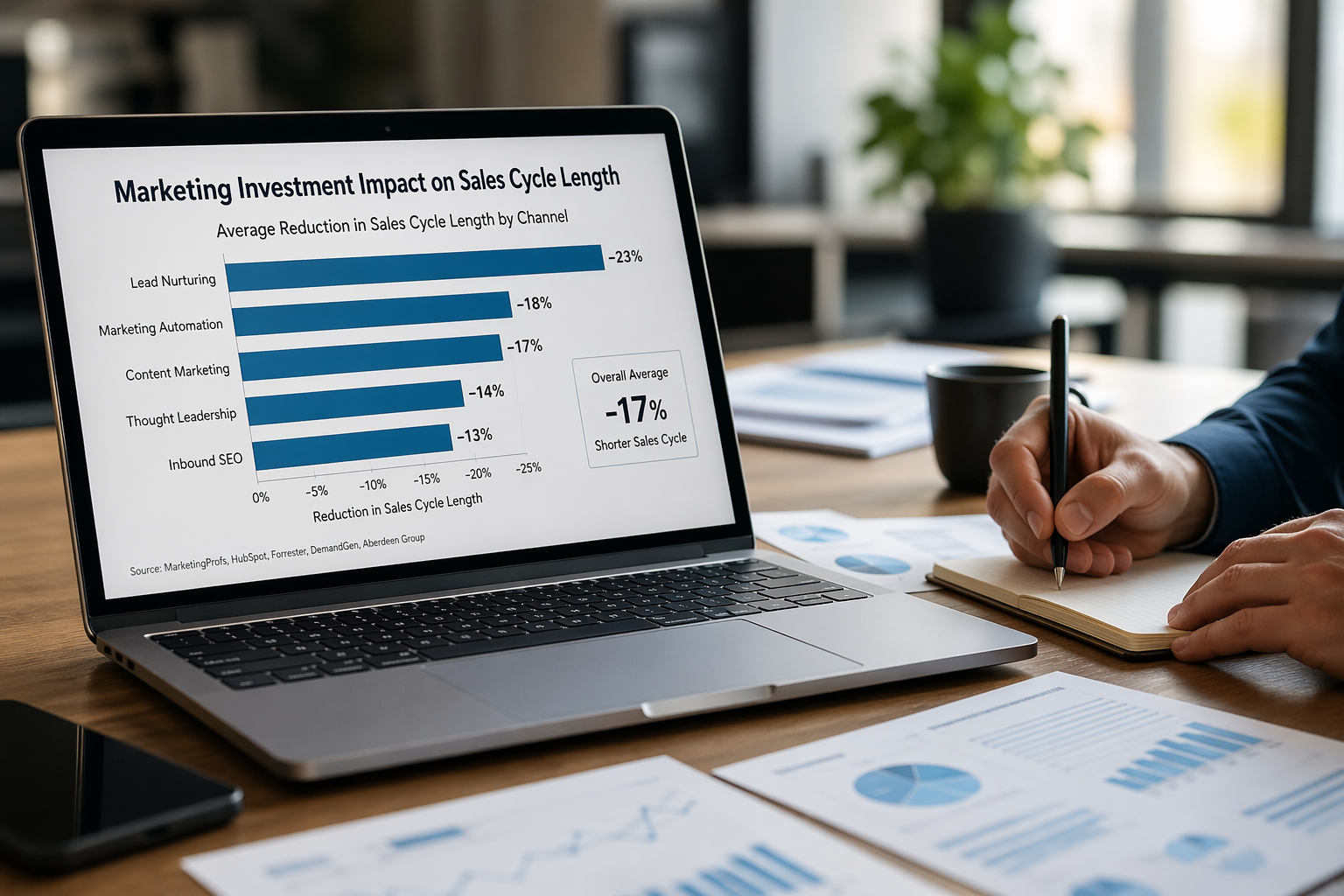
Nurtured leads have a 23% shorter sales cycle. Companies that have expertise in lead nurturing generate 50% more sales-ready leads at 33% lower cost. Salesmate
This 23% reduction is one of the most frequently cited figures in marketing research. To put it in practical terms: if your average sales cycle is 90 days, a 23% reduction means closing in roughly 69 days — shaving three weeks off every deal in your pipeline. At scale, that compression is transformative.
Why Nurturing Works: The Mechanism
The mechanism behind nurturing's impact on sales cycle length is straightforward. Marketers who align content to specific stages of the buyer's journey see 73% higher average conversion rates compared to those who don't. A multi-channel lead nurturing strategy ensures you're delivering the right content at every stage of the buying journey. Madison Logic
When a prospect receives relevant content addressing their specific questions and objections before they ever speak to sales, the sales conversation starts at a more advanced stage. Instead of a salesperson spending the first several meetings educating a prospect on basic concepts and building fundamental trust, they're engaging with a buyer who already understands the category, has seen proof of outcomes, and is further along in their own evaluation.
Nurtured leads make 47% larger purchases and produce a 20% increase in sales opportunities versus non-nurtured leads. Prospeo
That combination — shorter sales cycles and larger deal sizes from nurtured leads — represents a compounding return. You're not just closing faster; you're closing more valuable deals faster.
The 50% More Sales-Ready Leads at 33% Lower Cost Finding
Nurtured leads make 50% more sales at 33% less cost, according to Forrester Research. Entrepreneurs HQ
This finding from Forrester is significant because it reframes nurturing as a cost efficiency lever, not just a sales acceleration tool. The same marketing budget, deployed through a systematic nurturing program, generates both more opportunities and cheaper opportunities.
Part 3: Marketing Automation — Speed and Consistency at Scale
Marketing automation is the infrastructure that allows lead nurturing to operate systematically across hundreds or thousands of prospects simultaneously. The research on its impact on sales cycle length is consistent across multiple studies.
The 67% Shortened Sales Cycle Finding
67% of sales teams using automation say it has shortened their sales cycle. Businesses that use automation for lead nurturing see a 20% increase in sales opportunities. Companies using marketing automation to nurture leads see a 451% increase in qualified leads. Firework
The 451% increase in qualified leads is a striking number that requires context: it reflects the difference between manually managing lead nurturing (which most organizations do poorly or inconsistently) versus automated, behavior-triggered nurturing that fires the right content at the right moment based on actual prospect behavior.
Why Timing Matters More Than Volume
One of the most important findings in marketing automation research concerns response timing. Leads contacted within 5 minutes are 100 times more likely to qualify. If your first nurture email fires "within 24 hours," you've already lost the moment. Configure instant triggers — not batch sends. Prospeo
The sales cycle doesn't just shorten because prospects are better educated — it shortens because automation ensures that no prospect goes cold while waiting for a manual follow-up. Every behavior signal (downloading a white paper, visiting a pricing page, watching a demo video) can trigger an immediate, relevant response that advances the relationship in real time.
Personalized emails triggered by automation drive a 10x higher conversion rate than mass emails. Firework
Part 4: Content Marketing and Thought Leadership — The Pre-Sale Trust Builder
Content marketing's effect on sales cycle length operates through a different mechanism than nurturing. Where nurturing accelerates existing prospects, content marketing creates a state of pre-existing familiarity and trust that compresses the cycle from its very beginning.
The Buyer Who Already Knows You
75% of global B2B buyers and C-suite leaders say that a particular piece of thought leadership content has led them to research a product or service they were not previously considering. Among this group, 60% said the content made them realize their organization was missing out on a significant business opportunity. Edelman
A striking 73% of B2B buyers consider thought leadership to be a more trustworthy basis for judging a company's competencies than traditional marketing materials. 54% say that organizations which consistently produce thought leadership content have prompted them to research their offers and capabilities. 86% said they would be moderately or very likely to invite these organizations to participate in an RFP process. Edelman
When a prospect discovers your company through thought leadership they've been consuming for months — not through a cold email or paid ad — they arrive at the sales conversation with a substantial base of trust already built. The initial education phase of the sales cycle has already happened. The proof-of-credibility phase has already happened. What remains is qualification and commercial negotiation, which are shorter phases by nature.
Authentic authority reduces the trust gap in the B2B sales cycle. When prospects already recognize your perspective and credibility, they move from awareness to decision significantly faster — often eliminating weeks of repetitive vendor education. CMO Alliance
Content Marketing's Quantified Lead Impact
Content creation leads to six times more conversions. Nurtured leads spend 47% more (The Annuitas Group). Lead magnets increase conversions of internet users by 30% (Forrester Research). Entrepreneurs HQ
While direct "days saved in the sales cycle" measurements for content marketing are harder to isolate than for nurturing programs, the conversion multiplier effect (six times more conversions) is equivalent to cycle compression in its revenue impact — you're moving significantly more prospects to closed-won status per unit of time.
Part 5: Inbound Marketing and SEO — The Channel That Starts the Cycle Stronger
The channel through which a lead originates has a profound effect on how quickly they convert. Leads who find you through organic search or inbound content enter the sales cycle at a fundamentally different starting point than leads who receive an outbound cold contact.
The Close Rate Differential
Leads gained through SEO have a close rate of 14.6% as opposed to just 1.7% with outbound. Responsify
This nearly nine-fold difference in close rate between inbound and outbound leads is one of the most striking figures in marketing research. A prospect who searched for your solution and clicked through to your content has demonstrated active intent and taken a self-directed action. That differs fundamentally from a prospect who received an unsolicited email and agreed to a call.
The close rate differential also implies a cycle length differential: higher close rates from the same pipeline volume means either more prospects closing in a given time period (effectively a shorter average cycle) or less time spent on prospects who ultimately don't convert.
The Cost Efficiency of Inbound Channels
Inbound marketing methods cost 62% less per lead than outbound methods. Inbound tactics generate 54% more leads than paid marketing. Inbound leads cost 39% less than outbound leads. Entrepreneurs HQ
These cost advantages compound with the cycle reduction benefits. Not only are inbound leads closing faster and at higher rates, they cost less to acquire. The total economics of inbound marketing — accounting for lead cost, close rate, and sales cycle length — are consistently more favorable than outbound at scale.
Part 6: Account-Based Marketing (ABM) — Precision That Directly Compresses Cycles
Account-based marketing — coordinating marketing and sales around a defined set of target accounts rather than broad lead generation — has produced some of the most specific research on sales cycle reduction.
ABM's Effect on Cycle Length
Marketers who align content to specific stages of the buyer's journey see 73% higher average conversion rates. Multi-channel lead nurturing ensures delivery of the right content at every stage of the buying journey. Madison Logic
The ABM cycle compression mechanism is more targeted than general nurturing: because ABM programs coordinate content, advertising, and outreach specifically toward known stakeholders at specific accounts, every interaction is more relevant and more likely to advance the buyer's decision-making process. There are fewer "educational" touchpoints that don't move the deal forward.
Among buyers who say a piece of thought leadership content led them to research a product or service they weren't actively considering, 23% said they ultimately began buying from or working with the organization that published the content. Edelman
In an ABM context, this finding is particularly powerful — content targeted to specific accounts can move organizations from not-in-market to actively buying over a compressed timeline.
The Multi-Stakeholder Dimension
B2B buying committees are getting larger, which traditionally extends sales cycles. Thought leadership isn't just content marketing — it's a strategic tool for building trust, driving alignment, and opening doors where ads and traditional sales methods fall short. It guides reaching deeper into the buying group and turning silent influencers into powerful advocates. Edelman
Marketing that reaches multiple stakeholders simultaneously — rather than relying on a single champion to evangelize internally — compresses the time required for internal consensus-building, which is often one of the most significant hidden extensions of the B2B sales cycle.
Part 7: Email Nurturing Specifically — The Performance Data
While email is one component of a broader marketing program, its specific contribution to sales cycle compression is well-documented.
Lead nurturing emails generate an 8% CTR compared to general email sends, which generate a 3% CTR. Madison Logic
Behavioral triggers alone achieve 42% open rates and 10x higher ROI than batch-and-blast sends, while stage-targeted content drives 72% higher conversion rates compared to generic messaging. Sender
The behavioral trigger finding is important for understanding sales cycle dynamics. When a prospect visits your pricing page, a triggered email that sends a relevant case study within minutes keeps momentum alive in a way that a scheduled weekly newsletter cannot. The prospect's buying intent is highest at the moment of their behavior — capturing that moment shrinks the gap between interest and action.
Lead nurturing emails have 4 to 10 times more response rates compared to email blasts. 50% of leads are qualified but not yet ready to buy. Salesmate
That last statistic — 50% of leads are qualified but not yet ready — defines the exact problem that nurturing addresses. A nurturing program that keeps qualified-but-not-ready leads engaged and advancing ensures that when they do become ready, your organization is the first call rather than one of several options they research from scratch.
Part 8: Brand Awareness and Marketing Spend — The Long-Term Compounding Effect
Beyond the tactical channels examined above, there's a body of research on the relationship between sustained marketing investment — particularly brand-building — and the long-term reduction of sales friction.
Salesforce's 2025 State of Sales report puts the average B2B financial services sales cycle at 6 to 18 months. When a prospect already knows your brand, that cycle compresses. Research from the LinkedIn B2B Institute found that brands with strong awareness convert leads at 2 to 3 times the rate of unknown competitors, even when Wolf the product and pricing are comparable.
The mechanism here is trust-at-scale. A brand that has built consistent visibility through content, events, PR, and thought leadership over a sustained period compresses the sales cycle for every individual deal because prospects arrive with less skepticism, require less education, and need fewer proof points before committing.
This is the compounding argument for sustained marketing investment: the sales cycle reduction from year three of a content program is larger than the reduction from year one, because brand familiarity compounds while the investment level remains relatively stable.
Part 9: What the Research Doesn't Show — Honest Caveats
The research on marketing investment and sales cycle reduction is compelling, but it deserves honest qualification before being applied to any specific situation.
Most figures come from aggregated averages. A 23% shorter sales cycle for nurtured leads represents an average across industries, deal sizes, and competitive environments. Your specific reduction will depend on your category, your content quality, your implementation discipline, and how well your nurturing program maps to your actual buyer journey.
Channel and content quality matter as much as presence. Marketing automation running generic, poorly-segmented content will not replicate the results of behavior-triggered, highly relevant nurturing. The "23% shorter" finding assumes nurturing that is actually good — relevant to the buyer's stage, matched to their role, and timed appropriately.
Attribution remains an unsolved problem. Directly measuring a sales cycle's length and attributing a specific percentage of its compression to a specific marketing investment requires sophisticated multi-touch attribution modeling that most organizations haven't built. The research figures cited in this guide come primarily from large-scale surveys and studies — not from controlled experiments with single-variable manipulation.
Longer-term investments take time to show results. SEO and content marketing require three to six months to generate measurable traffic, and the brand familiarity effect takes longer still. These are not short-term levers.
Conclusion: The Research Points in a Consistent Direction
Across lead nurturing, marketing automation, content marketing, thought leadership, inbound SEO, and ABM, the research consistently points toward the same conclusion: organizations that invest in systematic buyer education and engagement before and during the sales process close faster, at higher rates, and at higher deal values than those that don't.
The specific figures — 23% shorter sales cycles from nurturing, 67% of sales teams reporting cycle shortening from automation, a 14.6% versus 1.7% close rate differential between inbound and outbound leads — should be treated as directional benchmarks rather than guaranteed outcomes. But the direction they point is unambiguous.
Marketing is not just a demand generation function. It is a sales cycle compression function. Every piece of content that answers a buyer's question before they have to ask a salesperson, every nurturing email that keeps a qualified prospect engaged between sales touchpoints, every thought leadership piece that builds credibility before a first call — all of it shortens the distance between first contact and closed deal.
The question for any revenue-focused organization is not whether marketing investment reduces sales cycles. The research is clear that it does. The question is whether the investment is structured to deliver that reduction as efficiently as possible.
Ready to Build a Marketing Program That Accelerates Your Pipeline?
At Ritner Digital, we help businesses build the content, nurturing, and digital presence infrastructure that moves buyers faster — not by pressuring them, but by being genuinely useful at every stage of their journey.
Book a free strategy call today and let's talk about where your current marketing investment is leaving sales cycle compression on the table.
👉🏼 Schedule your call at ritnerdigital.com
Sources: Madison Logic Lead Nurturing Statistics | Sender Lead Nurturing Statistics 2026 | Firework Marketing Automation Statistics | Salesmate Lead Nurturing Data | Forrester Research B2B Nurturing Studies | Edelman-LinkedIn B2B Thought Leadership Impact Report 2024 | TopRank Marketing State of B2B Thought Leadership 2026 | CMO Alliance B2B Thought Leadership Strategy 2026 | Responsify Inbound Marketing Statistics | Entrepreneur HQ Inbound Marketing Statistics | Focus Digital Average Sales Cycle Length by Industry | HubSpot Marketing Statistics 2026
Frequently Asked Questions
Is the 23% shorter sales cycle figure for lead nurturing reliable, or is it marketing hype?
It's a real finding from Forrester Research that has been widely replicated in subsequent studies, but it's an average across many organizations, industries, and deal types — not a guaranteed outcome. The figure assumes nurturing that is actually well-executed: content matched to buyer stage, relevant to the prospect's role and industry, and delivered at the right cadence. A generic drip campaign sending the same newsletter to every lead in your CRM will not produce 23% compression. A behavior-triggered, segmented program that answers the specific questions a buyer has at each stage of their journey will. Treat the 23% as a directional benchmark, not a forecast, and measure your own results starting from your baseline.
What's the most impactful single marketing investment for reducing sales cycle length?
Based on the research, lead nurturing implemented through marketing automation has the most direct and documented effect on sales cycle duration. The combination of systematic buyer education, behavior-triggered relevance, and consistent multi-touchpoint engagement addresses the three most common reasons sales cycles drag: buyers who aren't ready yet, buyers who have unanswered objections, and buyers who go quiet between sales calls. That said, the highest-leverage investment depends on where your specific cycle is losing time. If prospects arrive at your sales team with no familiarity with your solution, thought leadership and content marketing are the upstream fix. If qualified leads are sitting dormant between calls, automation and nurturing are the downstream fix.
How does inbound marketing reduce sales cycle length compared to outbound?
Inbound leads — people who find you through organic search, content, or referrals — enter your sales cycle at a fundamentally different starting point than outbound leads who received a cold email or ad. An inbound lead has already demonstrated active intent, done some degree of self-education, and self-selected into your funnel. That means the early stages of the sales cycle — building basic awareness, establishing fundamental credibility, overcoming initial skepticism — are already partially complete before the first sales conversation. Outbound leads require that trust-building work to happen during the sales process itself, which extends it. The close rate differential of 14.6% for SEO leads versus 1.7% for outbound reflects how much further down the buying journey inbound leads already are.
We have long B2B sales cycles with multiple stakeholders. Which marketing investment helps most?
The multi-stakeholder dynamic is one of the biggest hidden extensions of B2B sales cycles — a single champion can be sold, but if the other five people in the buying committee have questions that haven't been answered, the deal stalls during internal review. Marketing that reaches and educates multiple stakeholders simultaneously is the most direct solution. Account-based marketing with content tailored to different buying roles — technical evaluators, financial decision-makers, end users — ensures that your champion has the internal assets they need to build consensus rather than doing all the education work themselves. Thought leadership content published broadly through LinkedIn also reaches hidden stakeholders who may never speak to your sales team but significantly influence the outcome.
How quickly can we expect to see sales cycle reduction after implementing a nurturing program?
Most organizations see measurable impact in the three to six month range after implementing a well-structured nurturing program, but this depends heavily on your starting point and your sales cycle's baseline length. If your cycle is currently 12 months, you'll likely see meaningful shortening within two quarters. If it's 30 days, the absolute reduction will be smaller even if the percentage is similar. The most important factor is implementation quality — nurturing programs that launch with generic content and minimal segmentation will take longer to show results than programs launched with content carefully mapped to buyer stage and role. Start measuring baseline cycle length by lead source immediately so you have a clear before-and-after comparison.
Does brand awareness investment reduce sales cycle length, or is that harder to measure?
Brand awareness investment does reduce sales cycle length, but the mechanism is different and the measurement is harder. The direct effect — prospects who arrive at your sales team already familiar with your brand require less foundational education and establish trust faster — is real but takes longer to materialize than the effects of tactical nurturing or automation. The research from the LinkedIn B2B Institute showing that brands with strong awareness convert leads at two to three times the rate of unknown competitors illustrates the scale of the effect, but attributing a specific number of days saved to a brand investment made 18 months ago is legitimately difficult. The practical implication is that brand investment and tactical nurturing should be treated as complementary — brand reduces the baseline cycle length for all future leads, while nurturing compresses the cycle for leads currently in your pipeline.
What's the relationship between marketing spend and deal size, beyond just cycle length?
The research shows that nurtured leads not only close faster but make 47% larger purchases than non-nurtured leads. This means marketing investment affects deal economics in two directions simultaneously: it compresses the time it takes to close while increasing the value of what closes. The likely mechanism is that a prospect who has been systematically educated about the full scope of a solution's value — through content, case studies, and nurturing that addresses their specific use cases — arrives at the sales conversation with a broader understanding of what they need, rather than purchasing the minimum viable version they originally had in mind. This expansion effect compounds the ROI of marketing investment significantly beyond just the cycle reduction benefit.
How do we measure whether our marketing investment is actually shortening our sales cycle?
Start by tracking sales cycle length by lead source in your CRM — separate inbound from outbound leads, and segment further by which specific channels or content assets influenced each deal. Your baseline is the average days from first contact to closed-won for each segment. Once you implement nurturing or automation, measure the same metric for the same lead source segments over the following two quarters. The comparison will tell you whether the investment is working. Also track: what percentage of deals stall at each stage, how often leads go cold between touchpoints, and close rates by channel. These give you diagnostic insight into where in the cycle marketing is and isn't reducing friction, so you can optimize investment toward the highest-leverage stages.
Is there a point of diminishing returns where more marketing spend stops shortening the sales cycle?
Yes, and it's worth being honest about this. Marketing investment reduces sales cycle length by educating buyers and building trust before and during the sales process. Once a buyer has received all the information they need to make a confident decision, additional marketing touches don't materially advance the timeline — and over-nurturing can actually signal noise rather than value. The research finding that over-frequent emails drive unsubscribe rates above 0.5% per email is a useful signal of that threshold. The highest-leverage marketing investment is precise rather than voluminous: the right content, for the right person, at the right moment in their decision process. Beyond that point, additional spend produces diminishing returns on cycle compression even if it continues generating brand impressions.
How does the buyer's self-directed research journey change how we should think about marketing's role in the sales cycle?
The fact that buyers are 60 to 70% through their decision process before engaging a sales team fundamentally reframes marketing's role. Marketing is no longer just demand generation — it is the early-stage sales process for most buyers. Every piece of content your organization publishes, every thought leadership piece, every case study, every FAQ on your website is participating in a sales conversation that your sales team doesn't even know is happening. This means marketing investment that succeeds in influencing that pre-contact research phase doesn't just shorten the sales cycle from first contact to close — it effectively starts the sales cycle earlier, giving your organization more influence over the buyer's evaluation criteria before your competitors are even in the room. That upstream influence is where the largest sales cycle compression gains are available.