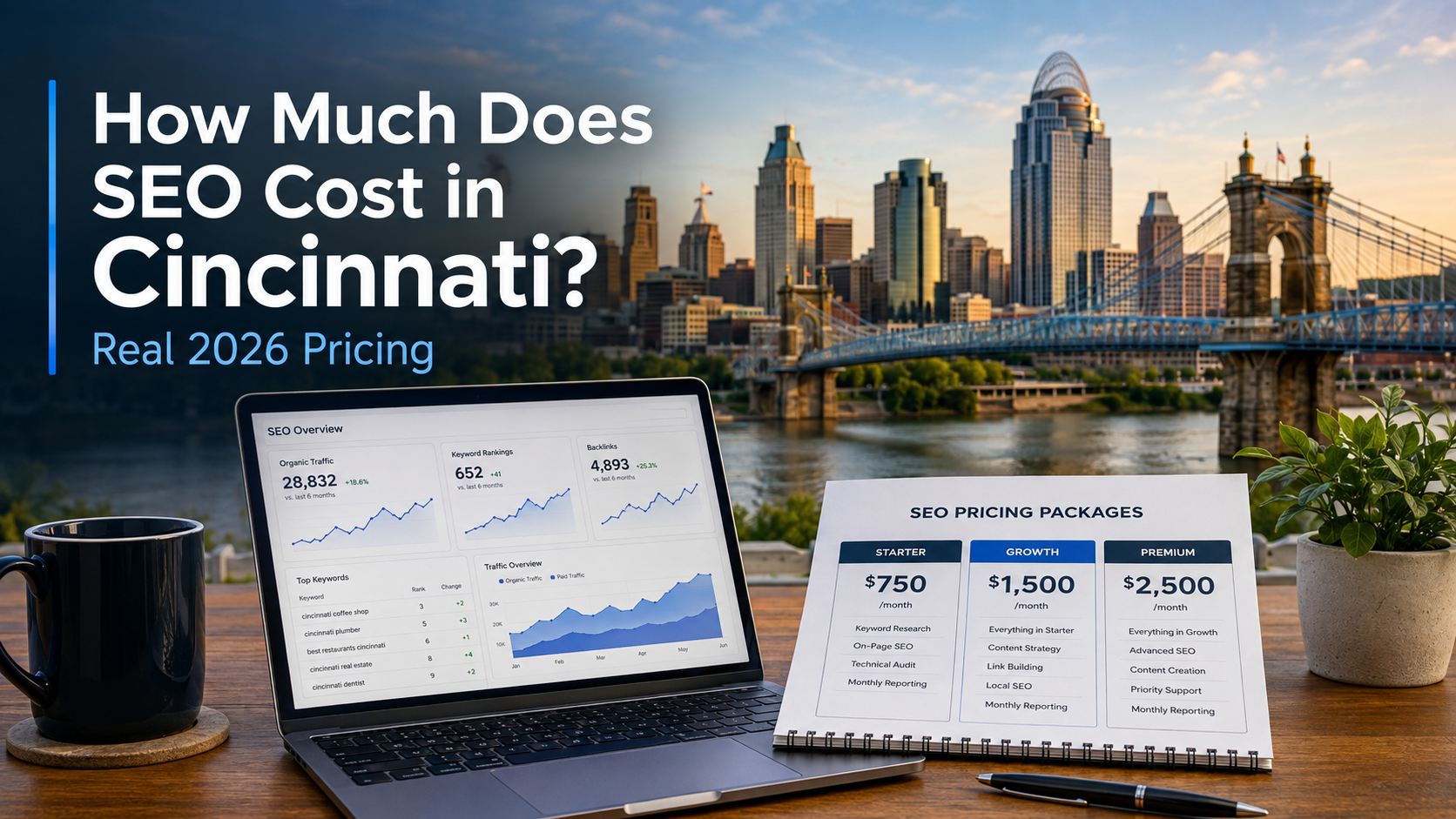
How Much Does SEO Cost in Cincinnati? A Real Pricing Breakdown (2026)
Ask five Cincinnati agencies what SEO costs and you'll get four "book a call"s. This is the pricing page the market doesn't have: what national surveys of 439+ providers actually say, what Cincinnati retainers run tier by tier, the six factors that move a quote, the red flags at any price, and the customer-value math that tells you whether a retainer will ever pay for itself. Our own pricing is public, so we went first.

100 Clicks a Day: The Organic Search Sweet Spot Where Leads Become a Daily Habit
There's a number where organic search stops being a marketing line-item and starts behaving like a salesperson who shows up every morning: 100 clicks a day. That's 3,000 a month — one lead a day at a deliberately conservative 1% conversion, six to eight customers a month at normal close rates, and about $16,000 a month in equivalent ad spend at 2026 prices. Most business sites run at a twentieth of that, which is exactly why organic feels like it doesn't work. Here's the full math — including where we sit on our own curve.

From Search to Pipeline: How to Attribute Revenue from AI Citations
"AI traffic is untrackable, so how do we know it makes money?" is the objection that kills budgets. It's half right—and far more bridgeable than skeptics think. Here's how to connect AI citations to real pipeline, and how to present it to a CFO in terms that survive scrutiny.

The Cost of a Face: Why Tracking Patient Lifetime Value Rewrites Your Paid and Organic Strategy
Ask most med spa owners what it costs to acquire a patient, and you'll get an answer. Ask what that patient is worth, and you'll usually get a pause — and that pause is the most expensive gap in aesthetic practice economics. A retained patient can easily be worth $3,000 to $6,000 over a few years, while acquisition costs around $132. Once you internalize that number, spending $150 to acquire a high-intent organic patient stops looking like an expense and starts looking like a predictable investment. Here's the math that rewrites everything.

Marketing Built for the CFO: How to Treat SEO Like a Predictable Acquisition Channel
Picture the quarterly review: traffic's up, engagement looks healthy — then the CFO asks, "If we cut this 20%, what happens to revenue?" Silence, and the budget loses ground. Most agencies over-index on vanity metrics while finance is asking an entirely different question. Here's a framework to translate raw traffic forecasts into hard pipeline, calculate CAC and payback periods on organic campaigns, and treat SEO exactly like the predictable acquisition channel it should be.
The ECB Just Raised Rates. Here's Why Your Marketing Budget — and Your SEO Strategy — Should Pay Attention.
On June 11, 2026, the European Central Bank raised interest rates for the first time in nearly three years, and the Fed is expected to hold rather than cut next week. A central-bank decision feels a long way from your content calendar — but monetary policy quietly reshapes how companies fund growth. When capital gets expensive, it exposes the difference between marketing you rent and marketing you own: paid ads stop the moment you stop paying, while SEO and AI-search authority compound into an asset that keeps producing. Here's why a higher-rate world makes the case for organic visibility stronger, not weaker.
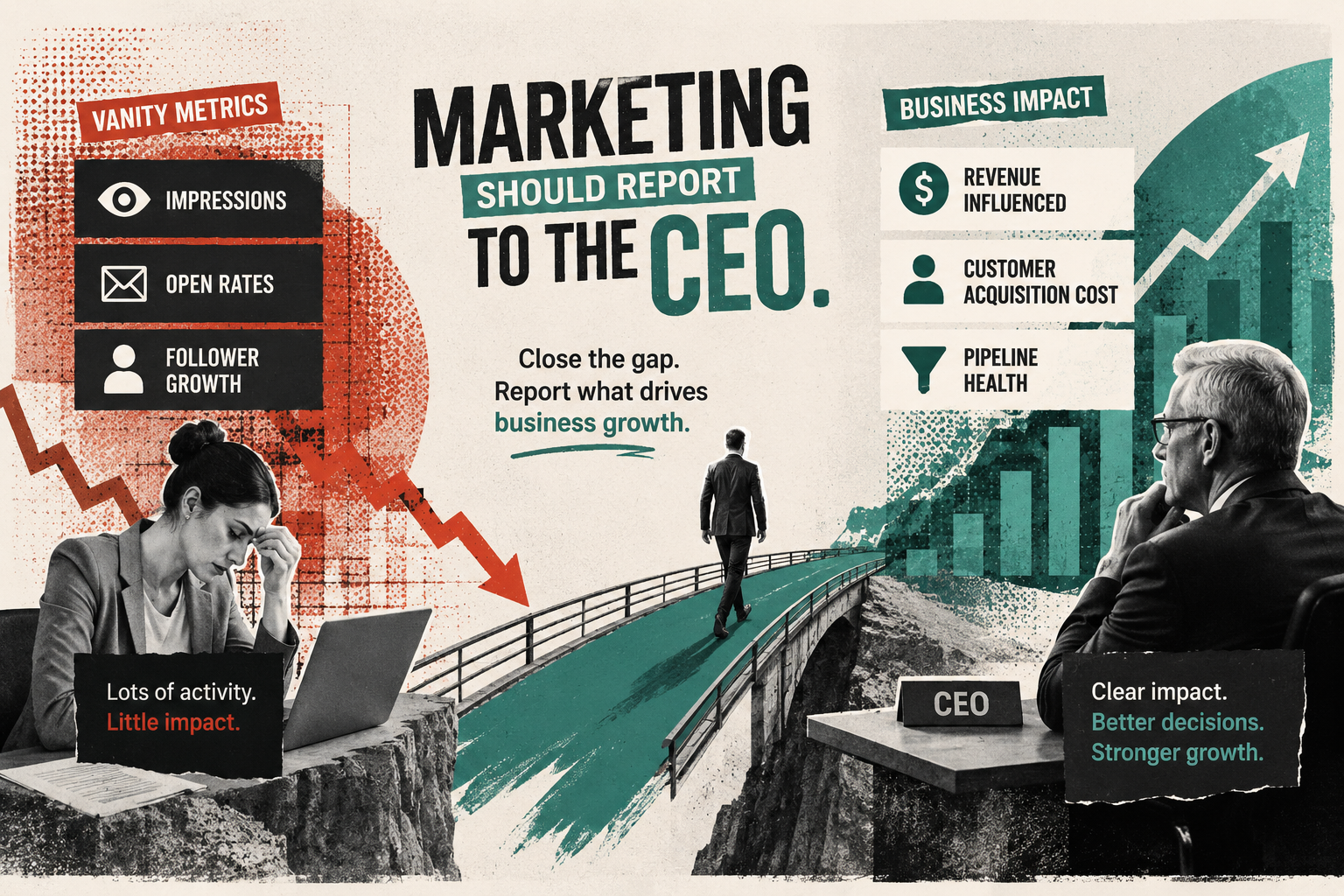
What Should Marketing Actually Report to the CEO?
Most marketing teams report impressions, open rates, and follower growth. CEOs make decisions based on revenue, acquisition cost, and pipeline health. That gap is why marketing budgets keep getting cut — and why marketing keeps losing credibility at the executive table. Here's how to fix the reporting.

Why Marketing Attribution Is Broken — And How AI Fixes It
Ask any marketing team where their best customers come from and you'll get a confident answer backed by data. In most cases, that answer is wrong. Traditional attribution models — last-click, first-click, even rules-based multi-touch — were built for a buyer journey that no longer exists. They credit what's trackable, ignore what's influential, and systematically misdirect budgets at scale. AI attribution doesn't just offer a better version of the same approach. It changes the methodology entirely — from counting touches to understanding influence. Here's what's broken, why it matters, and how AI fixes it.

What the Research Actually Says: How Marketing Investment Reduces Sales Cycle Duration
Every day a deal sits in your pipeline is a day it could close or die. The research is clear that specific marketing investments — lead nurturing, marketing automation, content marketing, thought leadership, and inbound SEO — have a measurable and often dramatic effect on how quickly buyers move from first contact to closed deal. This guide compiles the most credible data across every major marketing channel, explains the mechanisms behind each finding, and gives you an honest assessment of what the numbers actually mean before you apply them to your own pipeline.

What Does a Marketing Agency Actually Do Day-to-Day? What Am I Paying For?
You're paying a marketing agency every month and you're not entirely sure what's happening on the other end of that invoice. Reports come in. Calls happen. Things seem to be moving. But what exactly are they doing all day? This is the most honest answer you'll find — a real account of what agency work looks like week by week, what your retainer actually pays for, and how to tell the difference between an agency that's genuinely moving the needle and one that's just staying busy with your money.
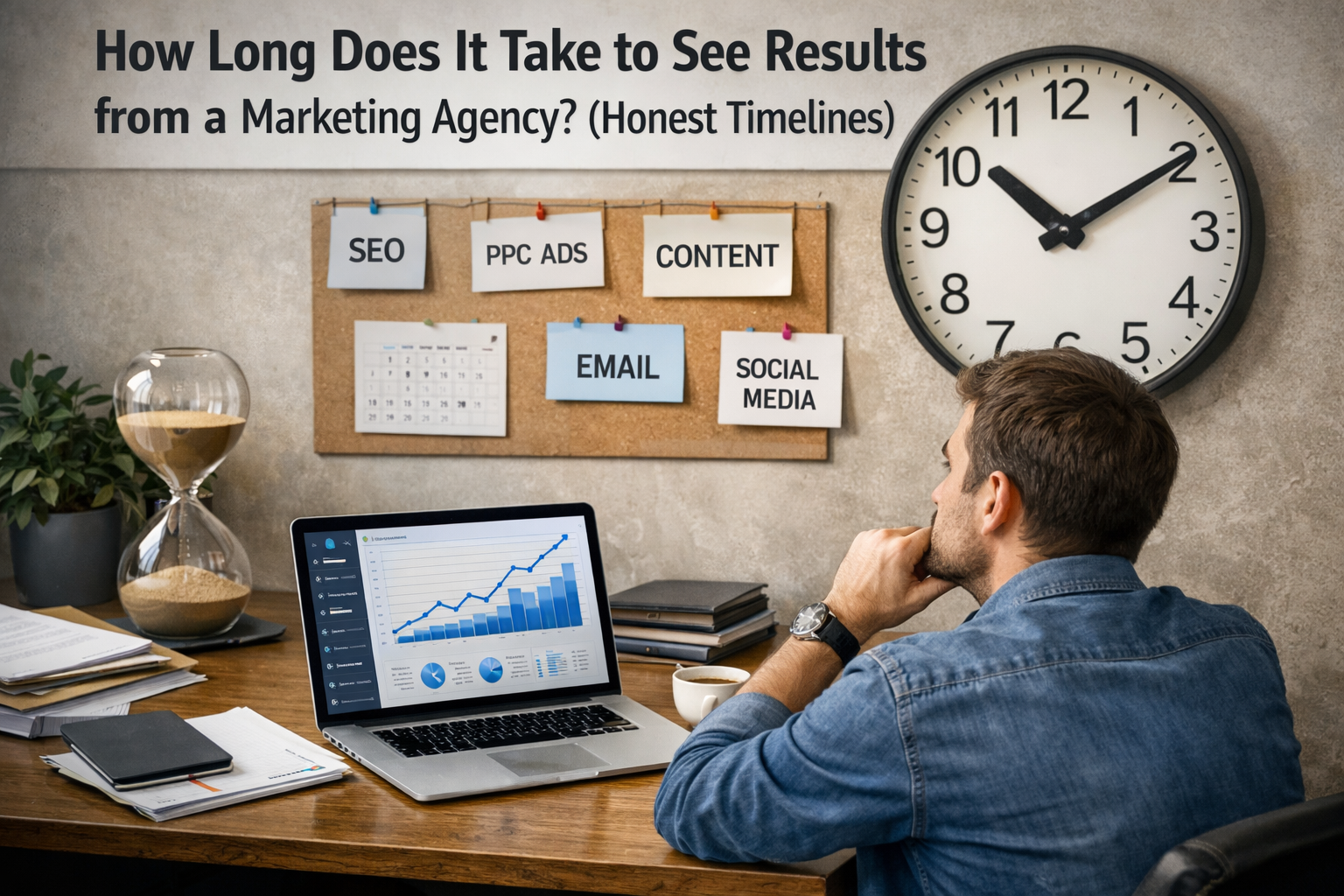
How Long Does It Take to See Results from a New Marketing Agency?
You signed the contract. You sat through the kickoff call. Now you're waiting — and wondering how long this is actually going to take. Most agencies give vague answers designed to manage expectations without committing to anything. This guide gives you the real answer: channel-by-channel timelines for paid ads, SEO, content, email, and social, plus a clear framework for knowing when to wait and when to worry.

How Do I Know If My Current Marketing Agency Is Actually Working?
You're months into your contract, the invoices keep coming, and the reports look busy — but something feels off. If you've been wondering whether your marketing agency is actually moving the needle or just staying busy with your money, you're not alone. This guide gives you a concrete framework to evaluate your agency's performance using real benchmarks, behavioral red flags, and a simple scorecard you can run through today.

The Clearest Sign Your Marketing Agency Is Actually Doing Its Job
There's a sentence that changes how business owners think about their marketing agency. It doesn't show up in a dashboard or a monthly report. It comes out naturally, almost offhand — "we're seeing more leads come in, and a lot of them are mentioning our content." That sentence means everything is working. Here's what has to happen behind the scenes to get there.
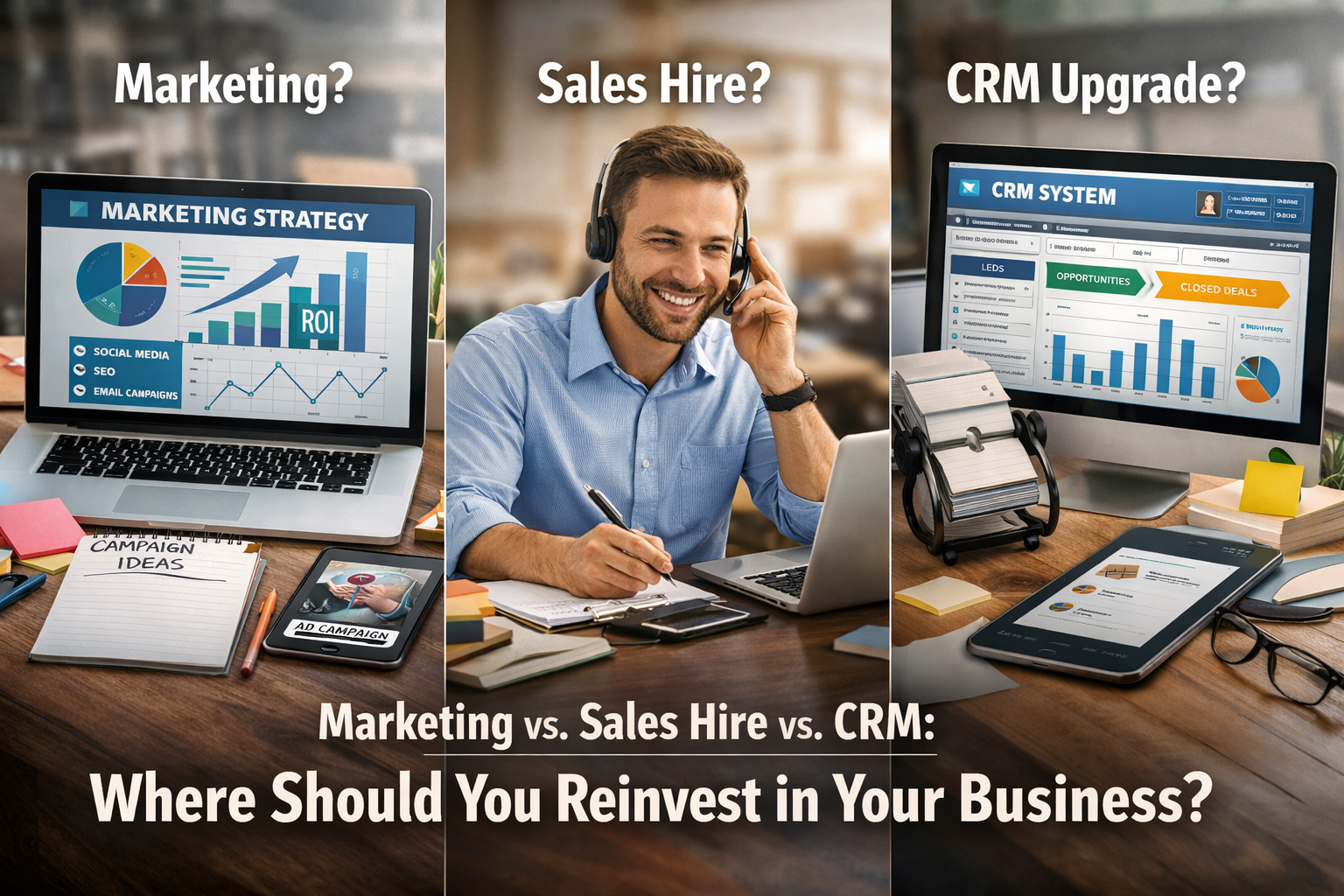
The Best Investment You Can Make in Your Business Right Now Isn't Another Sales Rep
Every growing business eventually hits the same wall: you have money to reinvest and a list of competing priorities. Another sales rep. A CRM upgrade. A marketing push. Most business owners default to the first two because marketing feels uncertain and hard to attribute. This post makes the case — with real numbers — for why that instinct is costing you, and why marketing investment compounds in ways that a sales hire simply can't.

How to Tie Marketing Spend to Revenue
Marketing teams spend money. Finance wants proof. This guide breaks down how to tie marketing spend to real revenue using clean tracking, attribution models, and data your leadership team will actually trust.