The Best Investment You Can Make in Your Business Right Now Isn't Another Sales Rep
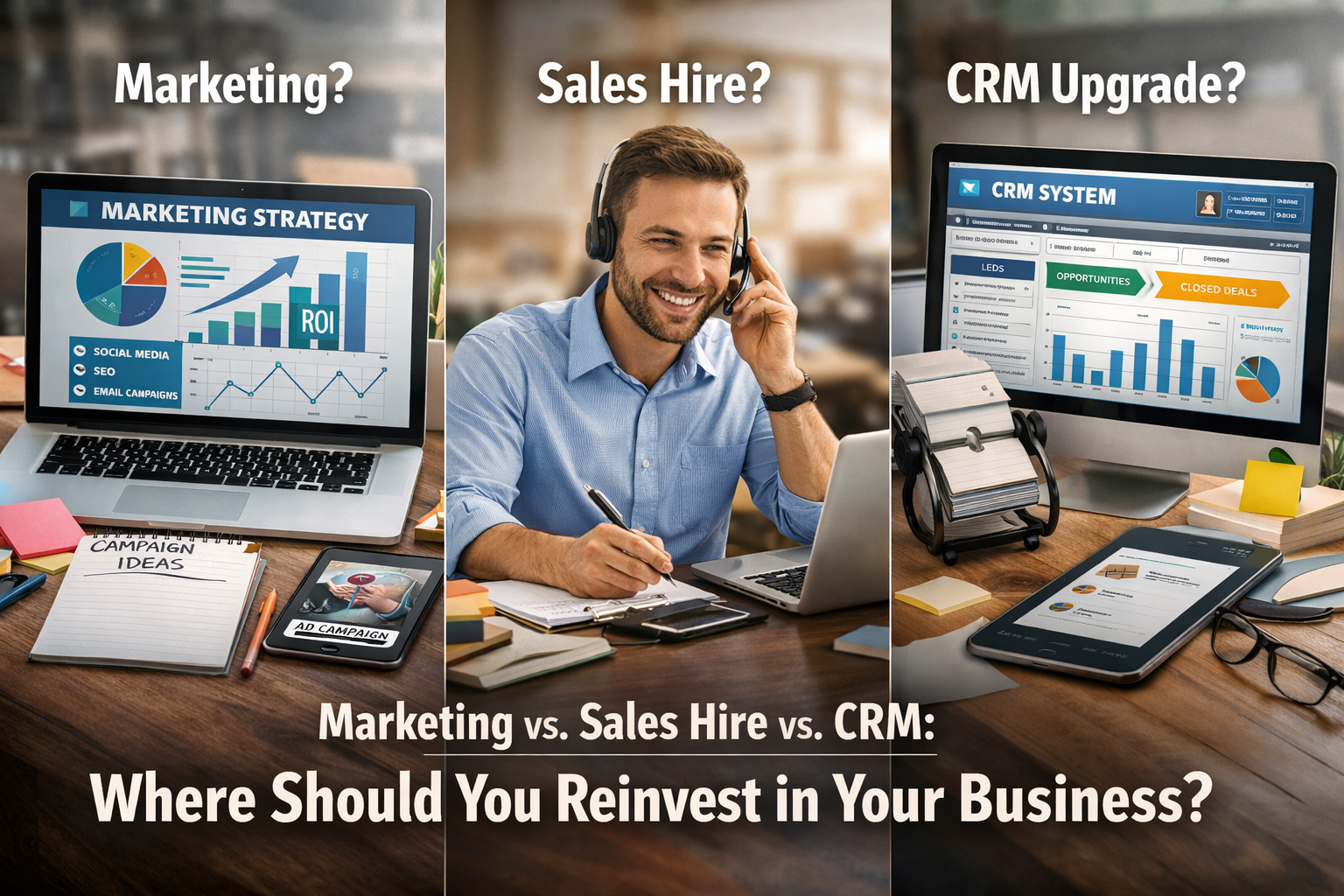
Every growing business eventually hits the same wall. Revenue is decent. The team is stretched. You've got some cash to reinvest, and the question lands on the table in every leadership meeting: where does this money go?
Do you hire another salesperson to chase more deals? Upgrade the CRM so the team stops losing leads in spreadsheets? Bring on an operations hire to clean up the back end? Or do you finally invest in marketing — either building an internal function or partnering with an agency?
Most business owners default to the first three. Marketing feels soft. Uncertain. Hard to attribute. A new sales rep, on the other hand, feels like a direct line to new revenue. A CRM upgrade feels like infrastructure. Marketing feels like a bet.
This post is going to make the case that this instinct is wrong — and cost you real money if you keep following it.
The Problem With the "Just Hire a Sales Rep" Instinct
The logic is intuitive: more salespeople equals more sales. If you need more revenue, hire someone to go get it.
The problem is the actual math.
The average cost of hiring and training a new sales representative — accounting for recruitment, onboarding, salary, benefits, and ramp time — is estimated at more than $150,000. CulverCareers That's before the rep has closed a single deal. That's before you account for the six to nine months most new hires need before they're operating at full capacity. That's before you factor in the management time required to onboard, coach, and support them.
And here's the structural problem with a sales-first investment: a sales rep can only work a pipeline that exists. They can call on leads. They can follow up on prospects. They can close deals that are already in motion. But they cannot manufacture demand from nothing. They cannot make your phone ring from people who have never heard of you. They cannot create the inbound flow of qualified, pre-educated prospects that makes a sales process efficient instead of exhausting.
What fills that pipeline? Marketing does.
A sales hire without a marketing engine behind it is an expensive outbound machine working against a cold market. The rep grinds. The close rate is low. The cost per acquired customer is high. And the moment that rep leaves — which, on average, happens within 18 months — you've lost the relationships they built and you're starting over.
The Problem With the "Just Upgrade the CRM" Instinct
CRM upgrades are seductive because they feel like they'll fix the problem of lost leads and disorganized follow-up. And sometimes they do. If your team is genuinely losing deals because of a broken process, better tooling can help.
But a CRM is a management tool for leads you already have. It doesn't generate leads. It doesn't make your business more findable. It doesn't build the kind of digital presence that makes a prospect choose you over the competitor they found first.
The math here is less dramatic than the sales hire comparison, but the opportunity cost is real. A mid-tier CRM implementation — software, setup, integrations, training, ongoing fees — runs $10,000 to $30,000 or more in the first year, depending on the platform and the complexity of your business. If your pipeline is thin, the world's best CRM will be an expensive way to organize a small number of leads.
The better investment is one that makes the pipeline fuller. Then the CRM earns its keep.
What Marketing Investment Actually Buys You
Here's the honest comparison. A four-person in-house marketing team — manager, content creator, data analyst, and ad specialist — costs between $450,000 and $550,000 annually. Chariot A full-service agency partnership that delivers equivalent capabilities typically costs a fraction of that — and comes without the recruitment cost, the benefits overhead, the management burden, or the risk of turnover.
Agencies reduce risk through proven processes and immediate implementation. Market conditions change rapidly, and agencies provide flexibility to scale efforts up or down without HR complications, while in-house teams create fixed costs that persist regardless of market conditions. Chariot
But the more important comparison isn't agency vs. in-house — it's marketing investment vs. no marketing investment. The ROI data on this is stark.
Businesses on average earn $22 in revenue for every $1 spent on SEO. Thought leadership content campaigns can deliver 748% ROI with roughly a nine-month breakeven. Martal Group Email marketing ROI averages $36 to $40 for every $1 spent. Martal Group These aren't edge cases. These are averages across industries and company sizes.
Businesses employing both in-house efforts and external agency support are 2.5 times more likely to report marketing success compared to those relying solely on in-house teams. SimpleTexting And critically: 75% of businesses with 10 or more dedicated marketing staff are confident in their positive marketing ROI, in stark contrast to only 6% of businesses with no dedicated marketing staff at all. SimpleTexting
The gap between marketing-invested businesses and non-invested ones isn't marginal. It's structural. The longer you delay the investment, the further behind you fall — because marketing compounds, while the absence of it compounds equally in the wrong direction.
The Compounding Advantage That Most Business Owners Miss
Here's the critical insight that tips the calculus in marketing's favor: a sales hire produces linear returns. One rep, working at full capacity, can manage a finite number of relationships and close a finite number of deals. Add a second rep, you roughly double the output. The math scales linearly with headcount.
Marketing produces compounding returns. A blog post that ranks on page one in month six keeps generating traffic in month 24. A strong domain authority built over two years makes every new piece of content rank faster and higher. A brand that earns genuine awareness in a market means that when a prospect's contract comes up for renewal and they start looking for alternatives, your name is already on the list — before a sales rep has made a single call.
Website, blog, and SEO efforts ranked as the top ROI-generating channel for B2B brands in 2024 according to HubSpot's State of Marketing Report. Small businesses are 23% more likely than average to see ROI from blog posts specifically. HubSpot These aren't vanity metrics. They're leads. They're pipeline. They're the conversations your sales team didn't have to go find because the marketing brought the prospect to them.
The sales rep produces this month's revenue. Marketing builds next year's.
The Real Question: What Kind of Problem Are You Actually Trying to Solve?
When business owners reach for a sales hire or a CRM upgrade, they're usually trying to solve one of three problems:
"We don't have enough leads." This is a marketing problem, not a sales problem. Hiring a rep to work a thin pipeline doesn't fix the pipeline — it just adds salary to the existing problem.
"Our leads aren't closing." This could be a sales problem. But it could equally be a marketing problem — if the leads you're generating are poorly qualified because your marketing isn't attracting the right audience, no amount of sales skill will fix your close rate.
"We're losing deals we should be winning." This is often a brand authority problem. A prospect who has spent two months reading your competitor's content, following their social media, and trusting their expertise before ever talking to a sales rep is not a neutral prospect. They're already leaning away from you before the conversation starts. Marketing builds the credibility that tips those deals in your favor.
A CRM upgrade solves none of these problems. It helps you manage leads you already have — which is valuable, but secondary to having leads worth managing.
What Marketing Investment Looks Like in Practice
For most small and mid-sized businesses, the right marketing investment doesn't require building a department. It requires finding the right partner and committing to a real strategy.
The U.S. Small Business Administration recommends that companies under $5 million in revenue spend 7 to 8 percent of gross revenue on marketing. Boomcycle For a company doing $1 million in annual revenue, that's $70,000 to $80,000 per year — less than the fully-loaded cost of a single mid-level sales hire, and more than enough to run a serious content, SEO, and paid strategy with a capable agency.
What does that investment buy? At minimum, a well-executed marketing program at that investment level should produce a consistent pipeline of inbound leads that didn't exist before, a digital presence that builds authority with every piece of content published, and attribution data that tells you which channels are producing revenue — so you can double down on what works and cut what doesn't.
What it doesn't buy is results in month one. Marketing requires upfront investment before the payoff is visible. Paid channels should drive some early traction, but foundational work like SEO and content takes three to six months to produce measurable growth, and twelve months to demonstrate the compounding effect fully. Mercury That's not a flaw in the strategy. That's the nature of building an asset instead of renting attention.
The business that invests in marketing for twelve months owns something. The business that ran paid ads for twelve months and stopped owns nothing.
Why Businesses Keep Getting This Decision Wrong
The persistence of the sales-hire-first instinct comes down to how business owners think about risk and accountability.
A sales rep is tangible. You can see them working. You can track their calls, their meetings, their pipeline. If they're not performing, you can put them on a plan. The accountability mechanism feels clear.
Marketing is less tangible — especially in months one through four before the compounding effect kicks in. You can't watch organic traffic grow in real time the way you can watch a sales rep dial. You can't attribute a specific closed deal to a specific blog post with the same directness you can attribute it to a specific sales call.
This discomfort with attribution and timeline is the primary reason businesses underinvest in marketing — not because the ROI is worse, but because the feedback loop is less immediate and the accountability mechanism feels less intuitive.
The solution isn't to avoid marketing. It's to work with a partner who builds the measurement infrastructure from day one — so you know exactly what the investment is producing, when, and where.
The Ritner Digital Argument
We are not going to tell you to fire your sales team or skip the CRM. Sales and operations matter. Infrastructure matters.
But if your business is trying to decide where the next dollar of investment goes, and the options are a new sales hire, a software upgrade, or a serious marketing investment — the data, the math, and the compounding logic all point the same direction.
The sales rep closes the deal. Marketing makes the deal possible. The CRM tracks the deal. Without marketing generating the opportunity, you have a very expensive CRM and a salesperson with nowhere to go.
You can spend the same amount of money you would use to hire one or two salespeople to hire a top-tier marketing agency with a proven track record. Unlike a new hire, the right agency will provide a faster return on investment with measurable, long-term success. Vye
We pull your data, show you where your pipeline is coming from today, where it could be coming from, and what it would take to get there. No commitment. Just the numbers.
Get your free audit from Ritner Digital →
Ritner Digital is a Philadelphia-based digital marketing agency. We build marketing programs that generate leads, build authority, and compound over time — for businesses that are serious about sustainable growth.
Frequently Asked Questions
Why should I invest in marketing before hiring another salesperson?
Because a salesperson can only work a pipeline that already exists. They can follow up, nurture, and close — but they can't manufacture demand from a cold market. If your inbound lead flow is thin, adding a sales rep doesn't fix that. It just adds salary to the problem. Marketing creates the conditions that make a salesperson productive: brand awareness, inbound inquiries, pre-educated prospects who arrive already trusting you. A rep working a warm, marketing-generated pipeline closes at a dramatically higher rate than one grinding cold outreach against a market that's never heard of you. The right sequence is almost always marketing first, then sales capacity to handle the volume that marketing creates.
What's the actual cost difference between hiring a salesperson and investing in a marketing agency?
More than most business owners realize. The fully-loaded cost of a single sales hire — base salary, commission structure, payroll taxes, benefits, health insurance, onboarding, training, management time, and the six-to-nine months of ramp before they're operating at full capacity — runs well north of $150,000 in year one, often significantly more for experienced reps in competitive markets. A serious agency partnership that covers strategy, SEO, content, paid ads, and reporting typically costs a fraction of that. The difference isn't just dollars — it's also risk. A sales rep who leaves in 18 months takes their relationships with them. A marketing program that has been building domain authority, organic rankings, and brand recognition for 18 months leaves behind an asset that keeps working after the invoice stops.
Won't a CRM upgrade help us close more deals and justify the investment?
A CRM is a management tool for leads you already have. It helps your team follow up faster, stay organized, and avoid losing deals in the cracks — all of which matter. But it doesn't generate a single new lead. It doesn't make your business more findable. It doesn't build the credibility that makes a prospect choose you over the competitor they found first. If your pipeline is healthy and your team is genuinely losing deals due to disorganized follow-up, a CRM upgrade can absolutely pay for itself. But if your pipeline is thin, a CRM upgrade is an expensive way to organize a small number of leads. Fix the pipeline first. Then the CRM earns its keep.
How long before marketing investment starts producing real results?
It depends on the channel mix, but here's an honest breakdown. Paid advertising — Google Ads, Meta, LinkedIn — can generate leads within the first few weeks, but only as long as you keep spending. The moment you pause, it stops. SEO and content marketing take longer — meaningful organic growth in most markets takes three to six months to become measurable, and six to twelve months to become substantial. Email nurture programs start working as soon as your list has volume and your sequences are live. The businesses that see the biggest long-term ROI from marketing are the ones that run paid channels for immediate traction while simultaneously building the organic foundation that reduces their dependence on paid spend over time. The compounding effect is real — but it requires patience and consistency in the early months.
How is marketing ROI measured? It feels harder to track than sales.
This is the most common objection to marketing investment, and it's a legitimate one — but it's a problem of measurement infrastructure, not a property of marketing itself. The businesses that struggle to attribute marketing ROI are usually the ones that haven't set up the right tracking from the start. Done right, you should be able to see exactly which channels are driving traffic, which pages are converting visitors into leads, which keywords are generating inbound inquiries, and which campaigns are producing revenue. We build that measurement infrastructure at the beginning of every engagement — not as an afterthought. You should never be in a position where you can't answer the question "what is my marketing actually producing?" If you are, that's a solvable problem.
What if I need revenue now? Can marketing produce fast enough results?
If you need revenue this month, paid advertising is the fastest marketing lever available. A well-structured Google Ads or Meta campaign can drive qualified leads within days of launch. It's not free — you're renting attention rather than building it — but it produces fast. The mistake is treating paid advertising as the entire strategy rather than the short-term engine that runs while the long-term foundation is being built. Businesses that run paid ads as their only marketing channel are permanently on the treadmill: spend money, get leads, pause spending, leads disappear. The goal is to use paid channels for immediate pipeline while simultaneously building the organic presence — SEO, content, email — that eventually produces leads without requiring a daily ad budget. The short and long game are not mutually exclusive. They should run simultaneously.
I already have a marketing person on staff. Why would I need an agency?
Because one person cannot be a strategist, SEO specialist, content writer, paid media manager, email marketer, data analyst, and web developer simultaneously — no matter how talented they are. A single in-house marketing hire is almost always stretched too thin across too many disciplines to go deep enough on any of them. What tends to happen is a lot of activity with inconsistent results: some social posting, some ad spend without rigorous optimization, some content that doesn't rank because the SEO strategy isn't developed enough. The most effective model for most small and mid-sized businesses is a combination: an internal person who owns brand voice, relationships, and day-to-day coordination, paired with an agency that brings the specialized depth in SEO, paid media, content strategy, and analytics that a single hire can't provide. That hybrid approach consistently outperforms either in isolation.
What separates a good marketing investment from a bad one?
Strategy before execution, and measurement throughout. Bad marketing investments happen when businesses spend money on tactics without a clear understanding of who they're trying to reach, what those people are searching for, and what content or messaging will actually convert them. A lot of agencies will take your money and produce activity — posts, blogs, ads — without connecting any of it to pipeline or revenue. Good marketing investment starts with an audit of where you are, a clear-eyed strategy built around your specific market and competitive landscape, and a measurement framework that ties every activity to business outcomes. If you can't look at your marketing spend each month and point to what it produced, either the strategy is wrong or the attribution is broken. Both are fixable. Neither should be accepted.
At what revenue stage does it make sense to invest seriously in marketing?
Earlier than most business owners think. The conventional wisdom is that marketing is something you invest in after you've hit a certain revenue threshold — but this gets the logic backwards. Marketing is what gets you to the next revenue threshold. The businesses that wait until they can "afford" marketing typically find that without marketing, growth stalls well before they get there. A practical benchmark: the U.S. Small Business Administration recommends businesses under $5 million in revenue allocate 7 to 8 percent of gross revenue to marketing. For a $500,000 business, that's $35,000 to $40,000 per year — enough to run a real strategy with a capable partner. For a $1 million business, it's $70,000 to $80,000. The question isn't whether you can afford to invest in marketing at your current size. It's whether you can afford not to.
Why Ritner Digital specifically, versus building something in-house or going with a larger agency?
Three reasons. First, you get senior people doing the actual work — not account managers handing off to junior staff. The strategy we sell you on is the strategy we execute. Second, we don't do generic. Every engagement starts with your data, your market, and your competitive landscape — not a templated playbook applied to your industry. Third, we don't do black boxes. You'll know exactly what we're working on, why, and what it's producing every single month. No vanity metrics, no inflated reports designed to justify a retainer. Just the numbers that tie to your pipeline. If something isn't working, we say so and we adjust. That's how we'd want to be treated, and it's how we run every client relationship.