Philly Has Always Known the Most Powerful Marketing Strategy: Saying Nothing at All
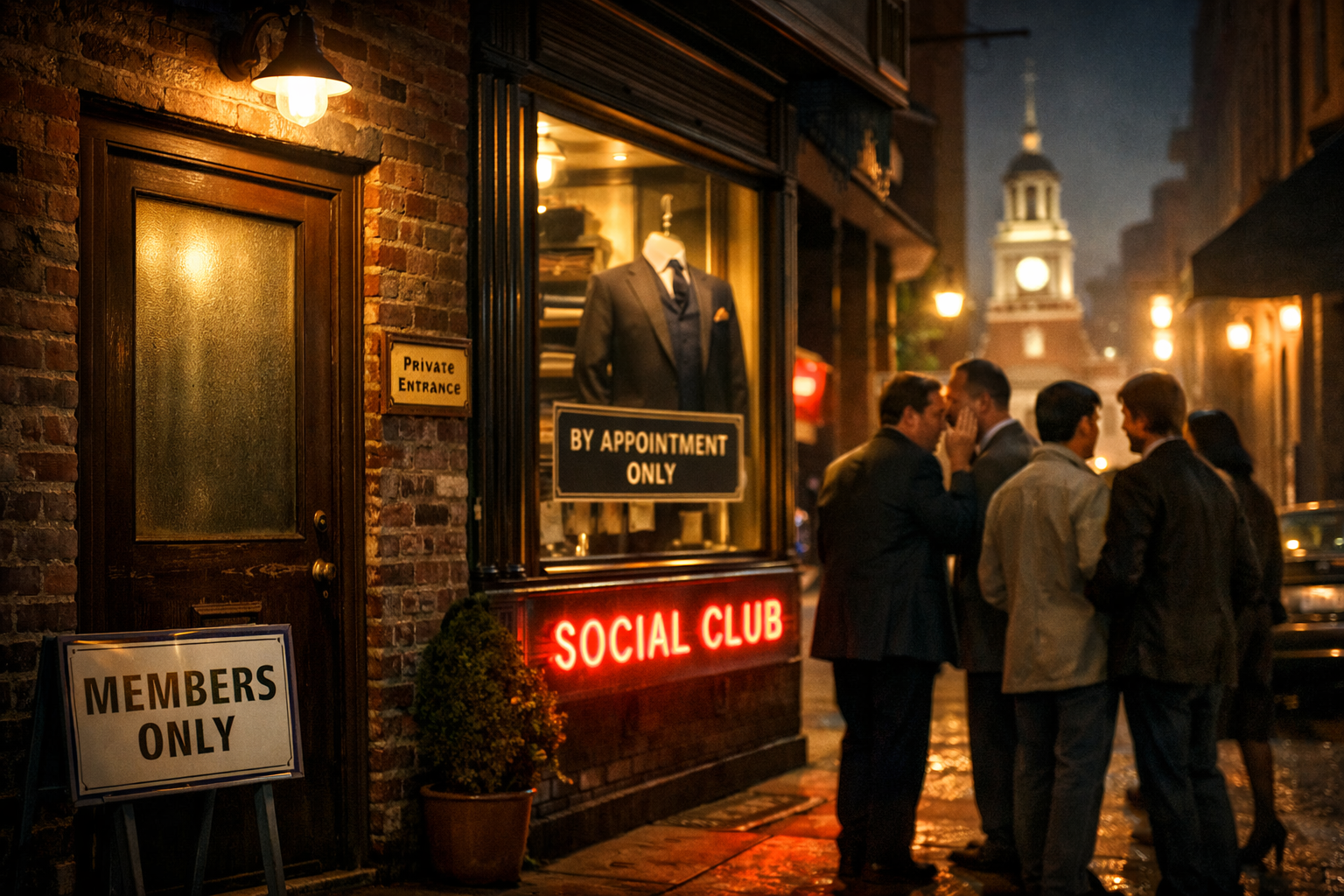
There's a strategy that the world's most coveted brands have spent decades trying to reverse-engineer. No paid ads. No social media. No phone number on the door. No influencers, no billboards, no email blasts. Just quality, reputation, and the quiet confidence that the right people already know where to find you.
The fashion industry calls it stealth luxury. The marketing world calls it anti-marketing. Patek Philippe wraps it into a tagline that's outlasted every advertising campaign any competitor has ever run.
Philadelphia just calls it how things work here.
Old Money Whispers
Old money, as they say, whispers. Philadelphia Magazine That line appeared in a Philadelphia Magazine piece about wealth in this city, and it captures something real about the culture here that predates every marketing trend by about two centuries.
Prominent Philadelphia old money families — the Wanamakers, the Drexels, the Biddles — built their influence through mercantile empires, endowed cultural institutions, and wielded social and political power across generations. Modern High Society The move of old Philadelphia moneyed families from the city to the suburbs had its start in the 1920s — vast estates surrounded by miles of walls, miles of driveway leading to great craggy mansions, a rural fantasy built along the railroad tracks to Paoli and up through the Wissahickon. Spirit News The Main Line wasn't built on advertising. It was built on reputation passed quietly through the right rooms, the right clubs, the right introductions.
That ethos didn't stay locked behind the gates of Ardrossan or Bryn Mawr. It seeped into the DNA of how Philadelphia does business — and it shows up everywhere once you start looking for it.
The Rabbit Club: The Most Exclusive Room You've Never Heard Of
If you want to understand how Philadelphia's whisper network operates at its purest, look no further than the Rabbit Club.
Located in an 18th-century stone building on the grounds of Bala Golf Club, the Rabbit is a 50-or-so-person all-male private eating club, so private that you more or less must inherit membership. It has no wait list — you must be blood-related to a current member to get in. And its famous hot brewed punch recipe has remained a secret to the outside world since its founding in 1866. Philadelphia Magazine
No website. No Yelp page. No marketing of any kind — because marketing implies you're trying to reach people who don't already know you exist. The Rabbit doesn't have that problem. The people who belong have always belonged, and the people who don't belong were never supposed to.
That's the absolute ceiling of whisper-network thinking. But the principle scales down the entire Philly business landscape.
The Union League: 160 Years of Not Needing to Advertise
The Union League of Philadelphia is a private club founded in 1862, with a Second Empire-style building completed in 1865 and added to the National Register of Historic Places in 1979. Wikipedia It has been the gathering place for Philadelphia's business elite — lawyers, financiers, politicians, executives — for a century and a half.
Today, the Union League is a private, members-only Five Star Platinum Club with over 3,500 members, counting among them many top leaders in business, academia, law, medicine, politics, religion, and the arts. Unionleague
How does one join? You must identify a proposer who has known you for at least one year prior to proposing you for membership. You then need six sponsors willing to write letters of recommendation. Once you are added to the monthly posting list, you are considered a candidate and officially begin the membership process. Unionleague The initiation fee runs $7,500, and annual dues are several thousand more on top of that.
There is no application on the homepage. There is no "Join Now" button. There isn't a referral program or a promotional offer. The path into the Union League runs entirely through human relationships — through people who know people, who vouch for people, who open doors that don't open any other way.
That's not an accident. It's a design philosophy. And it's been working since Lincoln was president.
Palizzi Social Club: Where No Reviews Are the Review
On a quiet residential block just off East Passyunk, in the same South Philly rowhouse it has occupied since 1918, sits one of the most talked-about restaurants in the city — a place that officially does not allow you to talk about it.
The Filippo Palizzi Club was founded in 1918 by immigrants from the town of Vasto, Italy, who wanted a gathering place as they navigated their new world. For nearly a century it remained a private Italian social club. When chef Joey Baldino revived it, he kept the rules: dress nice, no hats, no reviews, no photos. He wanted to keep it quiet, local, small. Philadelphia Magazine
Things didn't quite turn out that way. The news about Palizzi being open to new members caused a spike in applications so extreme that PayPal temporarily suspended the club's account and shut the whole thing down. Philadelphia Magazine
Palizzi Social Club remains committed to its roots, offering authentic Italian cuisine served family style in a setting free of phones and photography. CBS News The club does not disclose the number of members. It routinely gets requests but limits its ranks to avoid overcrowding. Membership is cash only. The next round of memberships after the 2025 opening won't be available until May 2027. The Philadelphia Inquirer
The no-reviews rule is the masterstroke. By prohibiting the primary mechanism through which restaurants build discoverability, Palizzi forced all of its word-of-mouth into actual conversation — the kind that happens face-to-face, over dinner, between people who trust each other. The result is a reputation that travels further and sticks harder than any five-star Yelp profile ever could. As one reviewer who couldn't help themselves wrote: "I know the rules say no reviews, but I can't help myself. A place like this? I'm congenitally incapable of not talking about it. It's not that I can't keep a secret; it's just that, in this case, I refuse to." Philadelphia Magazine
That's the power of a whisper network operating at full velocity. The rules created the mystique. The mystique created the demand. The demand created a two-year wait for a $20 membership to a 45-seat dining room in South Philly.
Commonwealth Proper: The Appointment-Only Tailors Upstairs on Chestnut Street
There is no sign at street level. You ring a bell. You take the stairs to the second floor. You are buzzed into a showroom with a private bar, master tailors on staff, and a full workshop — none of which you would know existed from standing on the sidewalk below.
Commonwealth Proper's flagship showroom is perched on the second floor on the sprawling corner of 19th and Chestnut Street. Make an appointment, ring the bell, and they'll buzz you up for a private consultation. Commonwealthproper
The name "Commonwealth" pays homage to a group of progressive Philadelphia tailors who founded a labor union to improve working conditions in the 1800s, when Philadelphia was the country's garment production and style epicenter. Commonwealth Proper The founders started the company in 2008 because they couldn't find a well-fitting white shirt. Seventeen years later, they have showrooms in Philadelphia, Pittsburgh, Atlanta, and Washington, D.C. — built almost entirely on the backs of clients who told other clients, who told other clients, who told other clients.
Commonwealth Proper's clients keep coming back because of their vision and dedication to keeping their impeccable style consistent. Designandmerchandising The showroom experience — the private consultation, the whiskey while you're measured, the tailors who remember your last order — is designed to create the kind of story worth telling at a dinner table. And in a city full of lawyers, executives, and professionals who all went to the same ten schools and work in the same three buildings, those dinner tables are connected.
Appointment only. Second floor. Ring the bell. That's not an accessibility limitation — it's a positioning statement. You're not browsing. You're a guest.
What Luxury Brands Figured Out (That Philly Already Knew)
The modern luxury industry didn't invent the whisper network. It borrowed it.
Old money brands typically spend less on advertising than their flashier competitors. Their reputation spreads through word of mouth, inherited wardrobes, and institutional relationships with schools, clubs, and families. The marketing budget goes into materials and construction instead. Social Life Magazine
Subtlety separates old money brands from nouveau riche favorites. If the average person on the street identifies something as expensive, it's probably too obvious for old money circles. The recognition should come from those who share the same reference points. Everyone else should see nothing unusual at all. Social Life Magazine
Patek Philippe doesn't run Super Bowl ads. Their entire brand promise — "You never actually own a Patek Philippe. You merely look after it for the next generation" Social Life Magazine — is built on the same intergenerational relationship logic that powers the Rabbit Club and the Union League. You don't buy in. You belong, or you don't.
The difference between Philadelphia and everywhere else is that this isn't a strategy layered on top of the culture here. It is the culture. The Wanamakers understood it. The Biddles understood it. The guy running the best law firm in Center City with no website and a three-month waitlist understands it. Joey Baldino understood it when he prohibited photography in a 45-seat restaurant and accidentally created one of the most sought-after reservations on the East Coast.
The Mechanics of a Whisper Network
So what's actually happening when a business thrives without visible marketing? Strip away the mystique, and there are a few consistent mechanisms at work.
Quality becomes the distribution channel. When the work is genuinely exceptional, the people who experience it become evangelists. Not because they were incentivized to — because they can't help it. A perfect meal, a perfectly fitted suit, a contractor who shows up exactly when they said and does exactly what they promised: these experiences create stories. Stories travel through networks. The whisper network is just word of mouth operating at a higher register, among people whose recommendations carry real weight.
Scarcity drives inbound. When a business is hard to find, hard to get into, or hard to book, the difficulty itself signals value. The Palizzi membership that's cash-only, limited to 100 people, and available for four Thursdays every two years isn't failing at marketing — it is marketing. The inaccessibility is the message. The Union League's six-sponsor, multi-interview, months-long application process isn't an inefficiency in their membership process — it's the reason membership means something.
Social proof travels through trusted networks. The most powerful referral isn't a five-star Google review. It's a peer — someone whose judgment you respect, whose taste you trust — leaning across a table and saying "you need to call this person." That carries a weight no ad impression, no sponsored post, no influencer placement ever will. And in Philadelphia, where neighborhoods are tight, industries are interconnected, and everyone went to the same twelve schools, those peer networks are extraordinarily dense and powerful.
The absence of noise creates signal. In a marketplace saturated with brands screaming for attention, silence is distinctive. A business with no social media, no paid ads, and no promotional presence that still has a full book of business is making a statement louder than anything in their competitor's ad spend. The silence says: we don't need to chase you. The right people already know.
This Isn't a Strategy for Every Business — And It's Not an Excuse to Hide
Let's be direct about something: the whisper network only works if the product or service is genuinely exceptional. This is not an excuse to avoid marketing. It is not a justification for a bad website, no online presence, or the belief that good work alone will somehow find its audience in 2025.
The Rabbit Club can have no web presence because its membership is inherited. The Union League can require six sponsor letters because 160 years of institutional gravity does the recruiting. Palizzi can ban reviews because the food is good enough that people break the rule anyway — and because the prohibition itself generates more press than any PR campaign would.
These businesses earned the right to operate this way. That took decades. What's interesting is what happens when businesses that have genuinely earned a strong reputation don't recognize it — and keep marketing like they haven't. They undercut themselves. They look like they're chasing. And in a city with a finely tuned sense of who's real and who's performing realness, that's a credibility problem.
The other trap is the opposite: businesses that have great reputations inside their existing network but have never extended beyond it. The whisper network travels fast within communities and slowly across them. A contractor beloved in Chestnut Hill might be completely unknown in Fishtown. The tailor everyone in Big Law knows might be invisible to the founders building companies in the Navy Yard. The reputation is real. The reach is just limited.
What This Means for Philadelphia Businesses Right Now
The whisper network has always existed in Philadelphia. What's changed is that it now has digital infrastructure.
A referral used to travel from one person to another over dinner at the Union League. Now it travels through a text, a LinkedIn DM, a Slack message in an industry group, a comment in a Passyunk neighborhood Facebook page. The medium is newer. The mechanism is identical.
This means the fundamentals that have always driven the best Philadelphia businesses — reputation, relationships, craft, word of mouth — are more scalable than they've ever been. A single strong referral can now reach ten people instead of one. A piece of content that feels like a genuine recommendation from a peer can travel through networks at a velocity that paid media never achieves.
The businesses that understand this aren't choosing between the whisper network and digital marketing. They're using digital marketing to amplify the whisper — to extend the reach of a reputation that was already earned, into rooms that the existing network hasn't reached yet.
That's a fundamentally different posture than running ads. It starts with the assumption that the reputation is real, the work is excellent, and the job of marketing is to let more of the right people discover what the right people already know.
Palizzi didn't ban reviews to stay small. They banned reviews because Joey Baldino understood that mystique, not reach, was the product. The mystique drove the reach anyway. The PayPal account got suspended because applications crashed it.
That's the lesson. Build something worth whispering about. Then make sure the whisper can travel.
Talk to us about your digital presence →
Ritner Digital is a Philadelphia-based digital marketing agency. Named after a street in South Philly. Built on the same principles the city runs on.
Frequently Asked Questions
What is a whisper network in business, and how does it work?
A whisper network is a reputation-driven referral system where business travels entirely through trusted personal relationships rather than advertising or public marketing. No campaigns, no sponsored posts, no cold outreach — just one person telling another person "you need to call them." It works because the source of the recommendation carries implicit credibility. When someone whose judgment you respect vouches for a business, you arrive pre-sold in a way that no ad can replicate. The mechanics are simple: exceptional work creates stories, stories travel through networks, and networks — especially tight ones like Philadelphia's — move those stories fast. The result is a full book of business from people who already trust you before the first conversation.
Is the whisper network strategy only for luxury or exclusive businesses?
No — but it is only for businesses with genuinely excellent work. The Rabbit Club and the Union League operate at one extreme: so exclusive that membership is inherited or requires six sponsor letters. Most businesses can't and shouldn't operate that way. But the underlying principle — build something worth talking about, then let the talking do the work — applies to any business at any price point. The tailor, the contractor, the accountant, the restaurant with no sign and a three-month wait: none of them are luxury brands in the traditional sense. What they share is a product or service so good that the people who experience it can't help but tell someone. That's accessible to any business willing to earn it.
Why does Philadelphia specifically have such a strong culture of word-of-mouth business?
A few reasons that compound each other. Philadelphia has deep roots in old money culture — families like the Wanamakers, Drexels, and Biddles built wealth through reputation and relationship long before advertising existed as an industry. That ethos filtered into the city's professional and civic culture. Combine that with the city's physical density: Philadelphia's neighborhoods are tight, its industries are interconnected, and its professional class is relatively small and cross-connected. Everyone went to the same schools, eats at the same restaurants, knows the same people. In that environment, a strong reputation travels fast and a bad one travels faster. It creates natural selection pressure toward quality — and toward the quiet confidence of businesses that don't need to shout.
Palizzi Social Club bans reviews and photography — doesn't that hurt their business?
The opposite. The no-reviews, no-photography rule is the most effective marketing decision Joey Baldino ever made, even if he didn't frame it that way. By eliminating the standard mechanisms of restaurant discoverability, Palizzi forced all conversation about it into real-world, peer-to-peer recommendation — the highest-trust form of word of mouth that exists. The prohibition on reviews became the story. The story generated more press coverage, more curiosity, and more demand than any review campaign could have produced. When they briefly opened 100 memberships in 2025, they sold out in four Thursday afternoon sessions at the door. Cash only. No online purchasing. The next opening won't be until 2027. That's not a restaurant struggling with obscurity — that's a masterclass in manufactured scarcity driving compounding demand.
Can a small or new Philadelphia business use this strategy, or do you need decades of history first?
You don't need decades — but you do need a foundation. The whisper network isn't a launch strategy. It's a growth strategy for businesses that have already proven the quality of their work within a small initial circle. The realistic path for a newer business looks like this: do exceptional work for a small number of clients, turn those clients into genuine advocates through the experience you create, then let the referrals compound. The mistake newer businesses make is trying to skip the foundation and manufacture mystique before the work is there to back it up. Silence only signals confidence when there's something real behind it. Without that, it just signals absence.
What's the risk of relying entirely on word of mouth with no digital presence?
The whisper network travels fast within communities and slowly across them. A contractor beloved in Chestnut Hill might be completely unknown in Fishtown. A law firm that every attorney in Center City knows might be invisible to the founders building companies in the Navy Yard. The reputation is real — the reach is just limited to the rooms your existing clients already move in. The practical risk is ceiling. You can sustain a business entirely on referrals. Growing it into new markets, new demographics, or new geographies without any digital presence is significantly harder. The businesses that operate purely on word of mouth are often leaving real money on the table — not because their reputation isn't strong enough, but because the network it travels through isn't wide enough.
How is this different from just having a bad marketing strategy?
Intention and quality. A business with no marketing because it never got around to it is not the same as a business with no marketing because it doesn't need it. The distinction is everything. Palizzi isn't ignoring marketing — it's executing a deliberate strategy built around scarcity and mystique, and the quality of the food and experience is the foundation that makes it work. Commonwealth Proper isn't hiding — it's creating a private, appointment-only experience that signals the kind of clientele it wants to attract, and the quality of the tailoring backs that positioning up completely. The businesses that get this wrong are the ones that confuse mystery with mediocrity, or mistake a lack of reach for a strategy. You have to earn the silence. It doesn't work as a substitute for doing the work.
The Union League requires six sponsor letters and a months-long process to join — why would anyone put up with that?
Because the difficulty is the point. The elaborate membership process isn't a friction problem — it's a feature. Every additional requirement signals that membership means something and that not everyone gets in. By the time someone completes a six-sponsor, multi-interview, months-long process to join a club with a $7,500 initiation fee, they haven't just paid for access — they've invested in an identity. That investment deepens their commitment to and advocacy for the institution in a way that a simple credit card transaction never would. It's the same psychology that makes people defend brands they've waited in line for, or restaurants they had to call in a favor to get into. The process creates stakeholders, not just members. And stakeholders are far more powerful as word-of-mouth advocates than customers who simply bought something.
If word of mouth is so powerful, why do businesses need digital marketing at all?
Because the whisper network has a reach ceiling and a speed ceiling. It is the most trusted channel that exists — but trust without reach only takes a business so far. Digital marketing doesn't replace the whisper network. It extends it. A well-executed content strategy, a strong search presence, and a digital footprint that reflects the quality of your work allows the reputation you've built in one room to reach people in rooms you've never been in. The goal isn't to turn a whisper into a shout — it's to give the whisper a longer path to travel. The businesses that get this right use digital marketing the same way Philadelphia's best businesses have always operated: with confidence, with substance, and without desperation.
What does Ritner Digital actually do for businesses that have strong reputations but limited digital presence?
We start by figuring out where the gap is between what you're known for and what the internet knows about you. That usually means pulling your search data, auditing your website, and mapping the keywords your ideal clients are actually searching when they're looking for what you do. From there we build the digital presence that the reputation deserves — not louder, not more aggressive, just more reachable. The work you've already done has earned you a reputation inside your network. Our job is to make sure that reputation is findable by the people outside of it who would choose you if they could only find you. The whisper network built the business. Digital marketing scales it.