What Rocky Taught Philadelphia About Underdog Branding — And Why the City Never Needed to Be Told
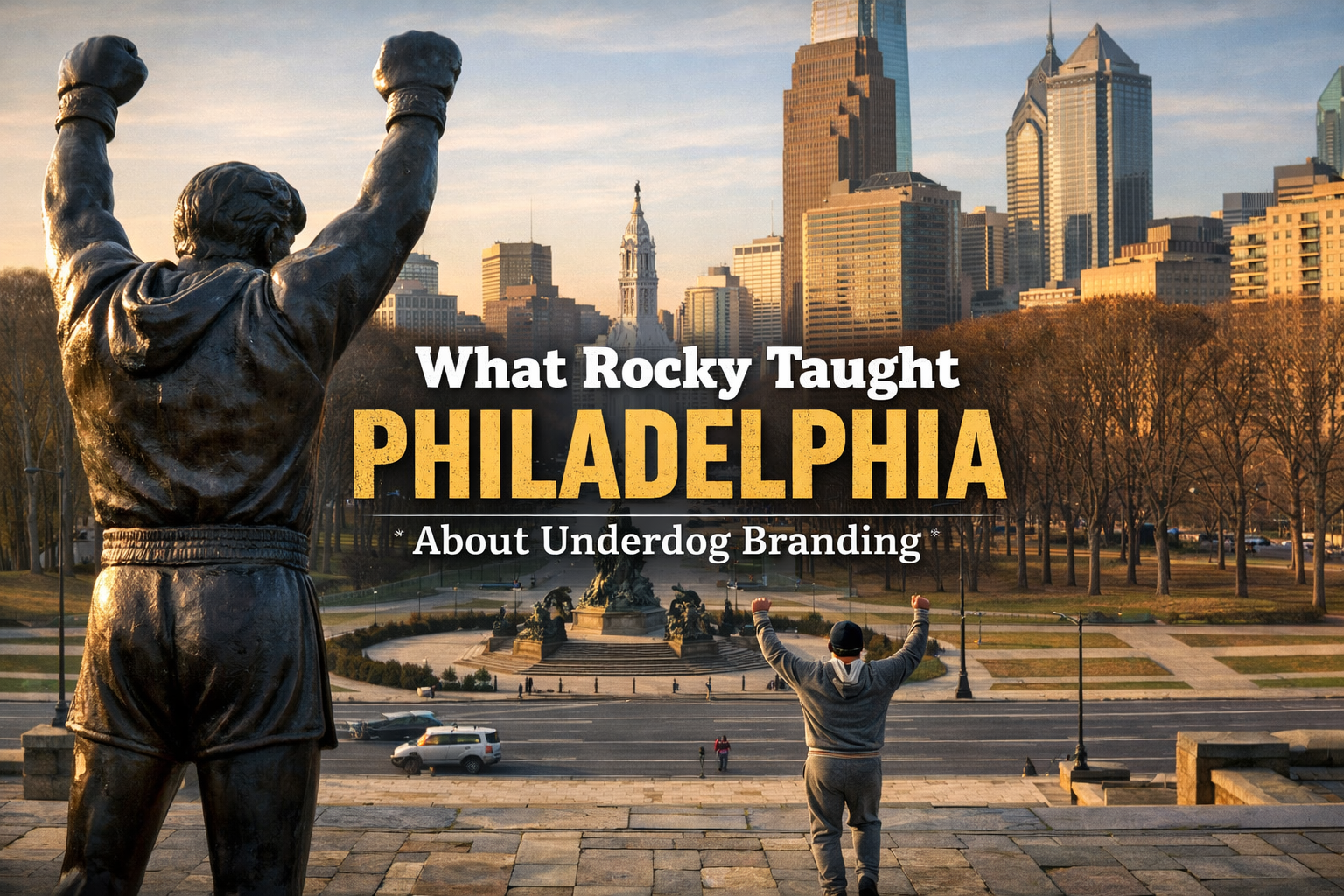
In 1975, a broke, mostly unknown actor named Sylvester Stallone watched a club fighter named Chuck Wepner go fifteen rounds with Muhammad Ali on closed-circuit television in a Los Angeles theater. Wepner was a 40-to-1 underdog. He had no business being in the same ring as Ali. He got knocked down, got back up, and went the distance anyway.
That night, Stallone started working on a screenplay. Three days later, the first draft was ready. No Film School
He shopped the script aggressively, refusing offers of $125,000, then $250,000, and finally $360,000 — massive money at the time — because the producers wouldn't let him star. Cord Cutters News A struggling actor with sixteen uncredited roles to his name, who had slept at the Port Authority Bus Terminal and taken a $200 role in a softcore film just to survive, turned down a third of a million dollars on the conviction that the story only worked if he was the one telling it.
United Artists eventually agreed to cast Stallone, giving him a shoestring budget of $960,000 to work with. Rocky was filmed in just 28 days. Encyclopedia Britannica
Rocky became the highest-grossing film of 1976, earning approximately $225 million worldwide. It received ten Academy Award nominations and won three, including Best Picture. Wikipedia
The film that Rocky was is almost beside the point for this conversation. What matters is what it became — and what it reveals about a city that recognized itself on screen before the credits finished rolling.
Philadelphia in 1976: The Perfect City for an Underdog Story
Rocky didn't invent Philadelphia's identity. It crystallized something that was already there, and gave it a shape the rest of the world could see.
Philadelphia during the 1970s was far from the manufacturing powerhouse of previous decades. Declining economic conditions, political corruption, and an increase in crime can be seen throughout the scenes of Rocky. The loss of industrial and manufacturing jobs after World War II had left members of the working class struggling to find whatever jobs they could to afford basic housing and food. Encyclopedia of Greater Philadelphia
This was not a city on top of the world. It was a city that had seen better days, that knew what it felt like to be overlooked, underestimated, and counted out. New York had the skyline and the swagger. Boston had the Ivy League mystique. Los Angeles had the weather and the glamour. Philadelphia had rowhouses, a working waterfront, an Italian Market that smelled like provolone and ambition, and a bone-deep conviction that you didn't need anyone's permission to be great.
Rocky's gritty perseverance became symbolic of the spirit of the city, suggesting that actual Philadelphians could similarly succeed in the face of seemingly overwhelming challenges. Rocky's ability to beat the odds corresponded to Philadelphia's own arc — no longer the manufacturing power it once was, suffering from woes related to crime and political corruption, 1970s Philadelphia, like Rocky, was down and out. Encyclopedia of Greater Philadelphia
The film worked as a mirror. Philadelphians looked at Rocky Balboa — a debt collector from Kensington who trained in a frozen meat locker, who nobody believed in, who didn't win the fight but went the distance — and they didn't see a movie character. They saw themselves.
The Origin Story as Brand
Here's what's easy to miss about Rocky's impact on Philadelphia: it wasn't manufactured.
No city planner sat in a conference room in 1975 and decided Philadelphia needed an underdog rebrand. No marketing firm was hired to develop a campaign around grit and perseverance and blue-collar pride. No consultant produced a 40-page deck about authentic urban identity. A broke writer with a three-day script and nothing to lose made a movie about a broke boxer with a once-in-a-lifetime shot and everything to lose — and the city grabbed it because it was true.
Before Rocky, Philadelphia was certainly known for its historical significance — Independence Hall, the Liberty Bell — but it didn't necessarily have the same pop culture allure as New York or Los Angeles. Rocky changed that. The film instantly branded the city as a place of grit, determination, and underdog spirit. Wonderful Museums
The statue didn't even start as a monument. After filming was complete, a debate arose between the Philadelphia Museum of Art and Philadelphia's Art Commission over whether the statue met the definition of art. City officials argued that the Rocky statue was not "art" but a "movie prop," and eventually moved it to the front of the Philadelphia Spectrum. Wikipedia The city's art establishment spent years fighting over whether Rocky belonged on the steps of a world-class museum — and in the end, the people won. In January 2026, the Philadelphia Art Commission approved a proposal to permanently install the city-owned Rocky statue atop the steps of the Philadelphia Art Museum on the East Terrace. Association for Public Art
Fifty years of arguing, and the underdog won that fight too.
What the Steps Actually Mean
The Rocky Steps comprise exactly 72 granite slabs, built in 1932 as part of the Benjamin Franklin Parkway's grand design, meant to impress visitors approaching the Philadelphia Museum of Art. Rocky creator Sylvester Stallone has recounted that the genesis of the iconic scene occurred when the film crew, constrained by a tight budget, identified the steps while searching for filming locations around the city at night. Wikipedia
That's worth sitting with. The most iconic branding moment in Philadelphia's history — the image that tens of millions of people associate with this city — happened because a crew with no money was scrambling for a free location. The Rocky Steps weren't chosen because they were symbolic. They became symbolic because they were chosen.
The scene's symbolism depended on the museum's cultural significance. Rocky's journey from working-class Kensington to a recognizable bastion of high culture foreshadowed the wealth and cultural clout that the boxer earned as his career progressed. Encyclopedia of Greater Philadelphia A man from the streets, running to the top of the steps of one of the greatest art museums in the world, arms raised, "Gonna Fly Now" swelling behind him — it's not subtle. It's not supposed to be. Great branding never is.
The Rocky Steps have since been the backdrop for the annual Independence Day celebration, large concerts including Live 8, and the 2017 NFL Draft — the first time the draft was held outdoors. Wikipedia A staircase that was chosen because it was free has become one of the most recognizable landmarks in American cultural life. That's not marketing. That's mythology.
The Real Lesson: Authenticity Doesn't Scale. It Compounds.
Every brand consultant in the country will tell you that authenticity is the most important quality a brand can have. They're right. What they can't tell you is how to manufacture it — because you can't.
Rocky worked as Philadelphia's brand story because it was genuinely true. The grit was real. The working-class roots were real. The sense of being overlooked by a country that paid more attention to New York and Los Angeles was real. The film didn't invent those qualities and assign them to the city. It found them already there and gave them a face.
This is the thing about underdog branding that most businesses misunderstand when they try to borrow the playbook. The underdog position isn't a posture. It's a fact. Rocky Balboa worked as a character because Stallone was actually broke and unknown when he wrote the script. The story resonated because it was autobiographical. As Sylvester Stallone once said, "If I say it, you won't believe it. But when Rocky said it, it was the truth." Atavist
The businesses that successfully leverage underdog positioning are the ones where it's genuinely true — where the founder actually did build something from nothing, where the company actually does compete against better-funded rivals, where the team actually does work harder because they have more to prove. Borrowed underdog energy reads as fake immediately. Authentic underdog energy compounds.
The Rocky spirit became shorthand for Philly's ethos: a blue-collar work ethic, an unwavering belief in oneself despite humble beginnings, and a refusal to back down. When a Philly sports team wins a championship, fans celebrate with Rocky-esque arm pumps, sometimes even running up the Art Museum steps. It's a collective identity that instills pride and a sense of shared resilience. Wonderful Museums
That shared identity is worth billions to the city's economy, tourism, and culture — and it was never planned. It accumulated, over fifty years, through genuine resonance between a story and a place.
Three Things Rocky Got Right That Every Business Should Study
1. The story was specific before it was universal.
Rocky isn't set in "a city." It's set in Kensington. Rocky doesn't train in "a gym." He trains at Mickey's, a specific, crumbling, real-feeling place. The Italian Market, the frozen meat locker, the rowhouse on Tusculum Street — the specificity is what made the story feel real, and the realness is what made it universal. Businesses that try to appeal to everyone by being specific to no one produce nothing worth remembering. The tightest, most local story is almost always the one that travels furthest.
2. The protagonist didn't win. He went the distance.
Rocky loses the fight by split decision. He doesn't beat Apollo Creed. The film ends with him screaming Adrian's name in the chaos of the ring, not with a championship belt. And audiences loved it — because what Rocky proved wasn't that underdogs always win. It's that underdogs who show up, do the work, and refuse to quit earn something more important than a title. They earn respect. For businesses, this is the difference between marketing your wins and marketing your character. People trust character more than trophies.
3. The underdog earned every inch of it.
The genesis of Rocky is now Hollywood lore. Stallone was flat broke, his wife pregnant, when he took his script to United Artists. They offered $75,000 — and later up to a quarter million dollars — to make the film with a star and director of their choice. Stallone held out. TCM He didn't just write an underdog story. He lived one. The credibility of the myth comes from the authenticity of the origin. A business whose brand story is "we built this from nothing with everything against us" only works if that's actually true — and if the evidence of the work is visible in everything they do.
What This Means for Philadelphia Businesses Right Now
Philadelphia's underdog identity is its most durable competitive asset — and it's available to every business in this city for the cost of being genuine about who you are and how you got here.
The problem is that most businesses try to look bigger than they are before they've earned the right to. They adopt the visual language of enterprise before they've built the substance of enterprise. They flatten their origin story in favor of seeming established, when the origin story — the scrappy, specific, against-the-odds version of how the thing actually started — is the most powerful piece of content they own.
Philadelphia has always known this. The city that produced Rocky, that built a world-class restaurant scene out of row homes and neighborhood markets, that invented American democracy in a room full of people who had no idea if it was going to work, has always understood that the story of getting there is more compelling than the story of having arrived.
This cultural association has done more for Philadelphia's branding than any traditional marketing campaign ever could, creating a powerful, recognizable image that is both authentic and inspiring. Wonderful Museums
The steps didn't need a marketing team. They needed a story worth telling. So does your business.
Ritner Digital is a Philadelphia-based digital marketing agency. Named after a street in South Philly. Built the same way Rocky was — on the work.
Frequently Asked Questions
What is underdog branding and does it actually work?
Underdog branding is the practice of positioning a business around its scrappy origins, its competition against larger or better-resourced rivals, and its commitment to earning every inch of its reputation rather than inheriting it. And yes — when it's genuine, it's one of the most powerful brand positions available. The reason it works is psychological: people root for underdogs. They distrust the establishment. They want to believe that quality and determination can beat money and size. When a business authentically occupies that position — when the story is actually true — it creates an emotional connection that no amount of polished advertising can replicate. When it's performed rather than earned, audiences see through it immediately. The line between authentic underdog positioning and cringe is whether the story is real.
Why does Rocky resonate so specifically with Philadelphia and not other cities?
Because the city and the story were genuinely the same. Rocky wasn't filmed in Philadelphia because the location scouts thought it would make good branding. It was filmed there because Stallone was working with a million-dollar budget and needed free locations — and what he found in the streets of Kensington, the Italian Market, and the steps of the Art Museum matched the story he was telling. The resonance was accidental and then permanent. Philadelphia in the mid-1970s was economically struggling, politically battered, and culturally overshadowed by New York and Los Angeles. Rocky Balboa was economically struggling, socially dismissed, and competing against a champion with every advantage. The parallel wasn't manufactured. It was observed. And that's exactly why it stuck.
Can a small business actually use underdog positioning, or is that only for consumer brands?
Any business can use it — provided the position is genuine and the story is specific. The mistake most small businesses make is thinking underdog branding means playing up how small you are. It doesn't. It means being honest about where you started, what you were up against, why you chose to compete anyway, and what the work has actually cost. A law firm that started in a 200-square-foot office and now represents clients that the big Center City firms tried to poach. A contractor who built a business entirely on referrals while the national chains ran TV ads. A restaurant that opened in a neighborhood nobody believed in and now has a two-hour wait on Saturdays. These are underdog stories — and they're more persuasive than any corporate brand narrative, because the people hearing them have lived versions of the same story themselves.
Rocky lost the fight. How is that a useful branding lesson?
It's the most useful one. Rocky loses by split decision at the end of the first film. He doesn't win the championship. He goes the distance, proves everyone wrong about what he was capable of, and screams for Adrian in the chaos of the ring. Audiences didn't feel cheated — they felt inspired. Because what Rocky demonstrated wasn't that underdogs always win. It's that underdogs who show up fully, who prepare completely, who refuse to quit, earn something more enduring than a trophy: they earn respect and belief. For businesses, this translates directly. You don't have to be the biggest, the fastest-growing, or the most award-winning. You have to demonstrate, through everything you do and everything you publish, that you are absolutely committed to the quality of the work. That commitment is more persuasive than any claim.
What's the difference between an authentic origin story and one that just sounds good?
Specificity and cost. A genuine origin story has specific details that could only come from someone who was actually there — the name of the first client, the office that was also the kitchen, the deal that almost didn't close, the moment where quitting felt like the rational option. A manufactured origin story is vague and inspirational in a way that applies to any business. It talks about "passion" and "dedication" and "a vision" without ever telling you what the passion cost or what the vision looked like at 2am when nothing was working. Stallone's story works because it's embarrassingly specific — the homelessness, the pornographic film he made for $200 to survive, the $360,000 he turned down because he refused to let someone else play the character he'd written as himself. That level of specificity is what creates belief. Strip out the specifics, and you have a press release.
How does Philadelphia's underdog identity translate into a practical digital marketing strategy?
In three ways. First, your origin story is content. The specific, honest account of how your business started, what you were up against, and why you kept going is the most compelling thing you can publish — more compelling than a list of services, more compelling than a client roster, more compelling than a mission statement. People make decisions based on who they trust, and trust is built through story. Second, local specificity is a competitive advantage. Philadelphia businesses that are genuinely, specifically of this city — that reference the neighborhoods, the culture, the shared references — create a connection with local customers that national competitors can never replicate. Third, demonstrated competence over time beats claimed excellence every time. The businesses that build their digital presence around showing the work — case studies, process, results, the actual evidence of what they do — outperform the ones that just assert they're the best.
Stallone refused to sell the script unless he could star in it. What's the business lesson there?
Know what the asset actually is — and don't let anyone separate you from it. Stallone understood that the script worked because of the parallel between his real life and Rocky's story. If he sold the script and let someone else play the character, the myth collapsed. The underdog story told by an established star with a comfortable life is just a movie. The underdog story told by a broke, unknown actor who turned down $360,000 on the bet that he was the only person who could tell it authentically — that's Rocky. For businesses, the equivalent question is: what is the thing that makes your story yours, and are you protecting it? A lot of businesses outsource or obscure the very elements — the founder's voice, the genuine origin, the specific expertise — that made them worth choosing in the first place. Don't sell what you can't get back.
The Rocky statue was initially rejected as "not art" by Philadelphia's Art Commission. What does that tell us about how markets judge brand value?
That the market is usually right and the gatekeepers are usually wrong. Philadelphia's art establishment spent years arguing that a bronze movie prop didn't belong on the steps of a world-class museum. The people disagreed — loudly, consistently, and over decades. In January 2026, the Art Commission finally voted to permanently install the statue atop the steps. Fifty years later, the underdog won. The business lesson is that brand value isn't determined by who the experts say belongs. It's determined by who the audience actually shows up for. Reviews, gatekeepers, and industry consensus have their place — but the ultimate measure of a brand is whether people seek it out voluntarily, repeatedly, and with genuine feeling. The Rocky statue draws more visitors to that museum than almost any work inside it. That's not an argument against high art. It's an argument for paying attention to what people actually care about.
How does this connect to what Ritner Digital actually does?
We help businesses find and tell the story that's already there — and build a digital presence that makes that story reachable by the people who need to hear it. Most businesses we work with have a genuinely compelling origin, a real differentiator, and a track record that would close deals if prospects could find it. The problem isn't usually the substance. It's that the substance is invisible — buried in a website that doesn't rank, content that doesn't convert, and a brand presence that doesn't reflect the quality of the actual work. What we do is close that gap. We make the whisper louder, the story more findable, and the digital presence worthy of the reputation that's already been earned on the ground. Rocky already had the fight in him. He just needed Mickey to show him how to train. That's the job.