The Garage Gym, the Corner Barbershop, and the Neighborhood Spot That's Been There Since Before You Were Born
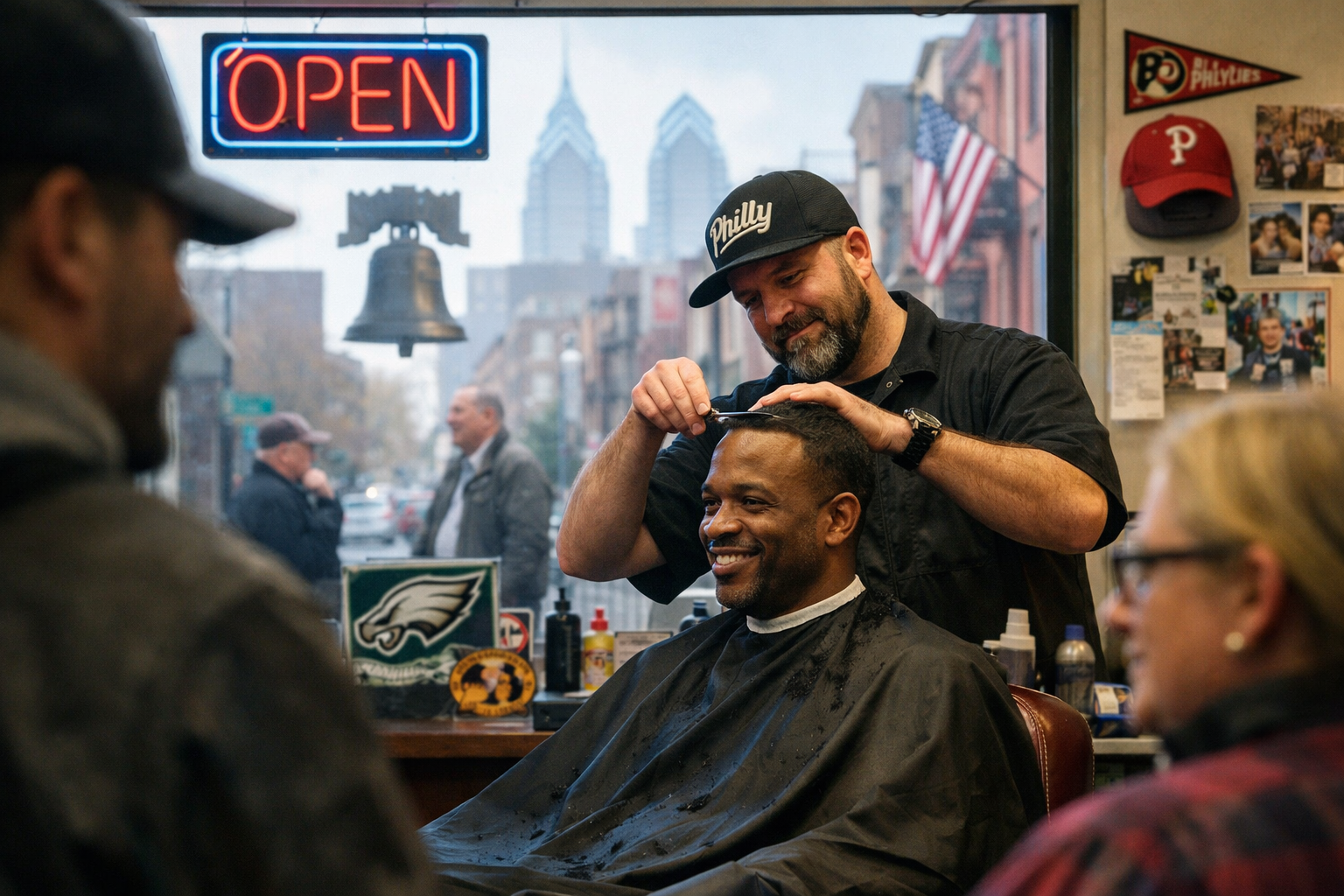
There is a barbershop somewhere in this city — maybe in Fishtown, maybe in the Northeast, maybe on a South Philly block that hasn't changed much since your grandfather was young — where a man drives 45 minutes from the suburbs every six weeks to get his hair cut. His wife thinks he's being stubborn. His neighbors have a perfectly good barber three blocks from his new house. He doesn't care.
There is a garage gym somewhere in Kensington or Frankford or Port Richmond where people who could afford a nicer place with newer equipment and air conditioning that actually works drive past three other gyms to get there. There is a corner breakfast spot where the owner knows you take your eggs over-easy and your coffee black, and where you would feel vaguely disloyal eating anywhere else on a Saturday morning.
These businesses are not exceptional in the way that a Michelin-starred restaurant or a viral social media brand is exceptional. They are exceptional in a quieter, more durable way: they have become irreplaceable to a specific group of people. And in Philadelphia — a city of 100 distinct neighborhoods where identity is more likely to be defined by a zip code than by a borough or a borough — that specific group of people is enough to sustain a business for decades.
This post is about what creates that kind of loyalty, why it is almost impossible to manufacture, and — critically — how a business that has genuinely earned it can extend its reach without losing the thing that makes it worth reaching for.
Philadelphia Is a City of Neighborhoods, and That Changes Everything
To understand hyperlocal loyalty in Philadelphia, you have to understand how this city is built.
"In a city like Philadelphia, neighborhoods are part of your identity. If you grow up in a neighborhood, you often want to remain living there your whole life because it's who you are." Greenlining
That's not hyperbole. In South Philadelphia, it's not uncommon to meet a born-and-raised resident whose mother, grandmother, and even great-grandmother lived in the same house. It's not often you find a place in one of the largest cities in the country where everybody knows your name, but that's what makes South Philly so darn special. Neighborhoods
Traditional streets lined with awning-covered rowhomes house families who have lived there for generations. It is, as many people have noted, a proper neighborhood — the kind of place where people come together on a weekend night with their neighbors. RentCafe
This intergenerational rootedness is the soil that hyperlocal loyalty grows in. When the same families live on the same blocks for three and four generations, the businesses that serve them don't just acquire customers — they acquire history. The barbershop that cut your father's hair and your grandfather's hair before that isn't just a place that does good fades. It's a node in the social network of the block, the neighborhood, the community. You don't switch to the cheaper place around the corner any more than you'd switch families.
Barbershops have remained vital sites of neighborhood sociability throughout Philadelphia's history. The trade has offered an appealing career choice for those with ambition, and barbershops have consistently served as more than just places to get a haircut — they are community institutions. Encyclopedia of Greater Philadelphia The black barbershops of South Street and North Broad, the Italian barbershops of South Philly, the Irish-Catholic neighborhood shops of Fishtown and Port Richmond — each was a specific reflection of a specific community at a specific moment, and each accumulated a loyalty that no advertising campaign ever could have created.
What Hyperlocal Loyalty Actually Is
Hyperlocal loyalty is not satisfaction. It is not even preference. It is something closer to identity.
When someone drives 45 minutes back to their old neighborhood to get a haircut, they are not making a purely rational economic decision. They are not comparing price per cut, wait times, or Yelp ratings. They are going back to a place that knows who they are — not just what kind of fade they want, but their name, their family, their history, their neighborhood. The service is part of it. The recognition is the thing.
Some families visit the same barbershop for decades, passing the tradition down. These spaces often serve as safe spaces for expression, where clients feel comfortable sharing their stories, struggles, and celebrations. Each barbershop or salon mirrors the neighborhood's diversity, music, fashion, and traditions — they are living history books, capturing the essence of a community through conversation, style, and tradition. Associatedbarbercollege
The garage gym works the same way. The people who drive past three other gyms to get to the one in the converted rowhouse with the peeling paint and the owner who remembers your deadlift PR from three years ago are not there for the equipment. They are there because that gym knows them. They've sweated through hard things in that room. They've had conversations in that parking lot that mattered. The gym is woven into a chapter of their life, and changing gyms would feel like tearing out a page.
This is the thing that national chains and venture-backed fitness studios cannot buy their way into: accumulated shared experience. You can't acquire it with a better app or a nicer locker room. You can only accumulate it, slowly, by showing up for people consistently over a long period of time.
The Three Things That Actually Build This Kind of Loyalty
Strip away the romanticism and the mechanism is simple — but the execution is genuinely hard.
They know your name. Actually know it.
Not because it's in the CRM. Because you've been coming for seven years and the owner remembers. There is a neurological reason this matters: being recognized by name triggers a different response than being served. It signals belonging. It signals that you are not a transaction but a person. And in a city where generations of families have stayed in the same neighborhoods precisely because those neighborhoods felt like extensions of their families, that signal is everything.
Being "local" used to mean being close. Now it means being connected. Physical proximity isn't enough — you need cultural proximity. Customers don't just want to shop nearby. They want to feel seen by the places they shop. Uppervalleybusinessalliance
They were there before it was a good idea.
The corner breakfast spot that's been operating since 1974 didn't open because someone ran the demographics on the neighborhood and identified an underserved market. They opened because someone needed to make a living and had a space and could cook. They survived because they were good and consistent and showed up every single day for decades. The loyalty they've accumulated is inseparable from the longevity. You can't fake having been there through the bad years — the years when the neighborhood was rough, when the block was struggling, when most businesses were leaving rather than staying. The ones that stayed earned something permanent from the people who stayed with them.
The service is genuinely, specifically excellent at the thing they do.
The garage gym with the loyal following is not a mediocre gym with good marketing. It is an excellent gym — specific to the needs of the people who train there, built around a culture that those people have helped to create over years, staffed by coaches who care about outcomes rather than membership numbers. The barber who people drive across town for is not a decent barber who happens to be conveniently located. He is exceptional at the specific kind of cut his clients want, in the specific cultural context of the neighborhood where he's built his career, in a way that feels personal rather than transactional.
The businesses that thrive in Philadelphia's tightest neighborhoods are the ones that see themselves not just as service providers but as part of the community fabric — brands that evolve with the times while honoring the character of the neighborhood. Venture Philly Group
Why You Can't Manufacture This — And What Trying Looks Like
The marketing industry has spent a lot of energy in the last decade trying to produce the aesthetic of hyperlocal authenticity without the substance of it. You see it everywhere: the national chain that opens in Fishtown and hires a local muralist to paint the wall and names a sandwich after a neighborhood street. The fitness franchise that puts a few vintage Philly photos behind the reception desk and uses the word "community" seventeen times in their onboarding materials.
Philadelphians see through this immediately. Not because they're uniquely suspicious — because they know what the real thing looks like, and they've been comparing the imitations to it their entire lives. When you grow up going to the same barbershop as your father, when you know what genuine neighborhood loyalty feels and sounds and smells like, the performed version is obvious in a way it might not be in a city without that deep rooted history.
The tells are consistent: the genuine neighborhood institution talks about specific people, specific memories, specific history. The imitation talks about "community" and "roots" and "authenticity" without ever naming anyone. The genuine place has customers who have been coming for twenty years. The imitation has a loyalty program with a punch card. The genuine place is slightly uncomfortable, slightly worn, slightly imperfect in ways that communicate that the money went into the product rather than the presentation. The imitation is polished in a way that feels like it was designed by someone who did a lot of research about what Philadelphia neighborhood businesses look like.
None of this means that new businesses can't build real hyperlocal loyalty. They can — but it takes years, not quarters, and it requires genuine commitment to a specific community rather than a strategy targeting a specific demographic.
The Specific Challenge: Loyalty That Doesn't Travel
Here is the problem that most hyperlocal Philadelphia businesses eventually face: the loyalty is real, but its geographic range is limited by the network that built it.
The South Philly barbershop that every Italian-American in the neighborhood has been going to since 1982 is beloved in a ten-block radius and unknown five miles north. The garage gym in Frankford has members who would fight you if you said a bad word about it, but it doesn't appear in any search result that a newcomer to the neighborhood would find. The corner breakfast spot has a line out the door on Saturday mornings and zero digital presence, which means that every person who moves into the neighborhood has to discover it by accident or through a neighbor — a slower process that loses customers to the places that are easier to find.
This is the gap that digital presence is actually built to close. Not to replace the loyalty or cheapen it or turn the neighborhood spot into a brand. But to extend the reach of a reputation that already exists and is already earned — into the rooms that the existing network hasn't reached yet.
Step into a corner deli, ask how long they've been there, and you'll get more history in five minutes than any tour could give you. Hometress The problem is that the person moving into the apartment two blocks away doesn't know to walk in. A Google Business Profile that's been optimized, a handful of reviews that articulate specifically what makes the place worth going to, a website that reflects the actual character of the business rather than a generic template — these things put the corner deli on the map for the people who would become regulars if they could only find it.
How Digital Presence Extends Hyperlocal Loyalty Without Destroying It
The mistake most neighborhood businesses make when they finally engage with digital marketing is trying to make themselves look bigger and more polished than they are. They build a website that looks like a corporate chain. They write a bio that sounds like a press release. They post generic social media content about "quality service" and "community values."
This strips out the exact things that made the business worth finding in the first place.
The right approach is the opposite: use digital presence to make the specific, genuine character of the business more discoverable. A barbershop doesn't need a website that looks like a spa chain's. It needs a Google Business Profile with accurate hours, a handful of genuine reviews from real customers who describe specifically why they drive past other shops to get here, and maybe a page on the site that tells the actual story of how the shop came to be and what it means to the neighborhood. That's it. That's enough to turn the person who just moved to the block from someone who walks past every day into someone who walks in.
For the garage gym, it means showing up in local search when someone types "gym near me" or "strength training [neighborhood name]." For the corner breakfast spot, it means having a Google Business Profile that's current, accurate, and reviewed by the people who already love it — so the person who moves to the neighborhood in October finds it in November instead of February.
The businesses that thrive won't be the loudest. They'll be the ones that show up in the right moments — with the right context, the right humanity, and the kind of care that makes someone feel like a neighbor, not a number. Uppervalleybusinessalliance
The goal is not to turn the neighborhood institution into a brand. It is to make sure that when the right person is looking for what it genuinely is, they can find it.
The Bottom Line
Philadelphia has always been built on the kind of loyalty that makes people drive 45 minutes back to their old neighborhood for a haircut. That loyalty is real, it is hard-earned, and it is one of the most durable competitive advantages a local business can have.
But loyalty without reach is a ceiling. The barbershop that every old-timer knows and no newcomer can find is one generation away from closing when the neighborhood turns over. The garage gym that the original members would die for but that doesn't appear in any search result is leaving real growth on the table.
Digital presence — done right, done in a way that reflects the actual character of the business rather than performing a generic version of it — is how the legacy of the neighborhood institution extends past the block it was built on. Not louder. Just further.
The whisper network built it. Digital marketing helps it travel.
Talk to Ritner Digital about your local presence →
Ritner Digital is a Philadelphia-based digital marketing agency. Named after a street in South Philly. We help local businesses build digital presence that reflects who they actually are — and makes sure the right people can find them.
Frequently Asked Questions
What is hyperlocal loyalty and how is it different from regular customer loyalty?
Regular customer loyalty means someone prefers your business over competitors. Hyperlocal loyalty means your business has become part of who someone is. It's the difference between a customer who gives you a good Yelp review and a customer who drives 45 minutes from the suburbs because switching barbers would feel like a small betrayal of their own history. Hyperlocal loyalty is built through accumulated shared experience — years of being known by name, being served consistently, being present through the good and bad years of a neighborhood's life. It doesn't live in a punch card or a rewards app. It lives in memory and identity. That's what makes it extraordinarily durable, and extraordinarily difficult to manufacture from scratch.
Why do Philadelphia neighborhoods produce this kind of loyalty more than other cities?
Because the neighborhoods are genuinely old, genuinely rooted, and genuinely distinct from each other in ways that matter to the people who live in them. Philadelphia is a city where families have stayed on the same blocks for three and four generations — where your identity is more likely to be defined by whether you're from South Philly or the Northeast or Fishtown than by the city as a whole. When that kind of intergenerational rootedness is the norm, the businesses embedded in those neighborhoods accumulate history alongside their customers. The barbershop that cut your grandfather's hair, your father's hair, and now your hair isn't just a barbershop. It's a living record of your family's presence in a place. That's a level of institutional significance that no national chain can replicate, no matter how many local murals they commission.
Can a new business build hyperlocal loyalty, or is it only possible for places that have been around for decades?
A new business can absolutely build it — but not quickly, and not through marketing. The path is the same regardless of how long you've been open: show up consistently, know your customers as people rather than transactions, be genuinely excellent at the specific thing your neighborhood needs, and stay through the difficult periods when leaving would be easier. What new businesses can't do is shortcut the time component. The loyalty that makes someone drive past three other gyms to get to yours is the product of years of shared experience. You cannot compress that timeline with a better logo or a more active Instagram. What you can do is start building it from day one by treating every customer like someone you plan to still know in ten years — because in a Philadelphia neighborhood, you probably will.
What's the biggest mistake neighborhood businesses make with their digital presence?
Trying to look bigger and more polished than they are. The garage gym that builds a website designed to look like an Equinox. The corner barbershop that writes a bio that sounds like a corporate press release. The breakfast spot that posts generic "great food, great service" social media content instead of anything that reflects its actual character. This approach strips out the exact qualities that make the business worth finding in the first place. The person searching for a barbershop in your neighborhood isn't looking for the most corporate-looking option. They're looking for the place that feels right — that feels like it actually belongs here, that has a specific point of view and a real history. Digital presence that reflects the genuine character of the business is far more effective than digital presence that performs a sanitized version of it.
My business runs entirely on word of mouth and has for years. Why would I need digital marketing?
Because word of mouth travels within your existing network and stops at its edges. The people who already know about you will keep coming and keep referring. But every person who moves into your neighborhood, every young professional who just relocated to the block, every person who's been driving past your sign for six months and hasn't walked in yet — they're not in your network. They're searching Google, reading reviews, looking at your Google Business Profile to see if you're still open. If your digital presence is nonexistent or outdated, those people never become customers. They go to the place they can find. Your reputation is real and it's earned, but it's invisible to anyone outside the circle that built it. Digital marketing closes that gap without changing what the reputation is built on.
How do reviews factor into hyperlocal loyalty and local search?
Reviews are the digital equivalent of a neighbor leaning over the fence and saying "you need to go here." They're the most trusted form of word of mouth that exists online, and they're also one of the primary signals Google uses to determine how prominently your business appears in local search results. For a neighborhood business, the reviews that matter most are the specific, detailed ones that articulate exactly why someone is loyal — not "great service" but "I've been coming here for eight years and they still remember how I like my coffee." That kind of review does two things simultaneously: it signals to Google that your business is legitimate and active, and it signals to the person reading it that this place has the kind of depth worth seeking out. Encouraging your most loyal, longest-tenured customers to leave reviews is one of the highest-leverage, lowest-cost things a neighborhood business can do.
What does a good Google Business Profile actually do for a local business?
It puts you on the map — literally and figuratively. When someone searches "barbershop near me" or "breakfast spot in [neighborhood]" or "gym in Fishtown," Google's local algorithm determines which businesses to show based on a combination of proximity, relevance, and prominence. A fully optimized Google Business Profile — accurate hours, correct address, photos that actually show what the place looks like, a populated business description, and active review responses — dramatically improves your visibility in those results. For a neighborhood business that relies on local foot traffic and local word of mouth, appearing in Google's local three-pack for relevant searches is the single most high-impact digital presence improvement available. It's not glamorous. It doesn't require a social media strategy or a content calendar. It requires accuracy, completeness, and active maintenance — and most neighborhood businesses either have an incomplete profile or one that hasn't been updated in years.
Is social media important for hyperlocal businesses, or is it overhyped?
It depends on the business and the neighborhood, but the honest answer is that it's less important than most people assume and more important than most neighborhood businesses treat it. For a barbershop or a garage gym or a corner spot, social media isn't primarily a lead generation tool — it's a credibility signal. When someone discovers your business and looks you up, what they find on Instagram or Facebook tells them whether you're still active, whether you have a personality, whether you're the kind of place worth walking into. An account with the last post from three years ago raises a flag. An account with consistent posts showing real work, real customers, and genuine character reinforces the decision to show up. You don't need a content strategy. You need a presence that looks like the business is alive and worth visiting. That's a much lower bar, and it's achievable without a social media manager.
How do you build digital presence for a neighborhood business without it feeling cheap or generic?
Start with the story, not the template. The reason most neighborhood businesses end up with digital presence that feels wrong is that they used a website builder that gave them a generic layout and generic placeholder copy, or they hired someone who writes the same thing for every client. The antidote is specificity. Name the neighborhood. Name how long you've been there. Name what you actually do and who you actually serve. Tell the real origin story — not the sanitized version, but the actual version with the actual details that could only come from someone who was there. Use photos that show the real space, the real people, the real texture of the place. The digital presence that works for a neighborhood institution is the one that makes someone feel like they already know the place before they've walked in — because it accurately reflects what the place actually is, rather than what a generic business in that category is supposed to look like.
What's the connection between hyperlocal loyalty and broader digital marketing strategy?
Hyperlocal loyalty is the foundation. Digital marketing is the extension. The businesses that have built genuine loyalty in their immediate community have already done the hardest work — they've earned a reputation that is real, durable, and worth amplifying. What digital marketing does is make that reputation findable by the people who haven't encountered it yet. Local SEO gets you in front of the person who just moved to the neighborhood and is searching for exactly what you do. A well-maintained Google Business Profile converts that search into a visit. Reviews from loyal existing customers build trust with people who have never heard of you. A website that accurately reflects your character gives someone who found you online a reason to walk in. None of this replaces the loyalty. It extends it — past the edges of the network that built it, into the rooms the existing word-of-mouth hasn't reached. The whisper network built the business. Digital marketing helps the whisper travel further.