South Philly vs. The Main Line: Two Completely Different Approaches to the Same Whisper Network
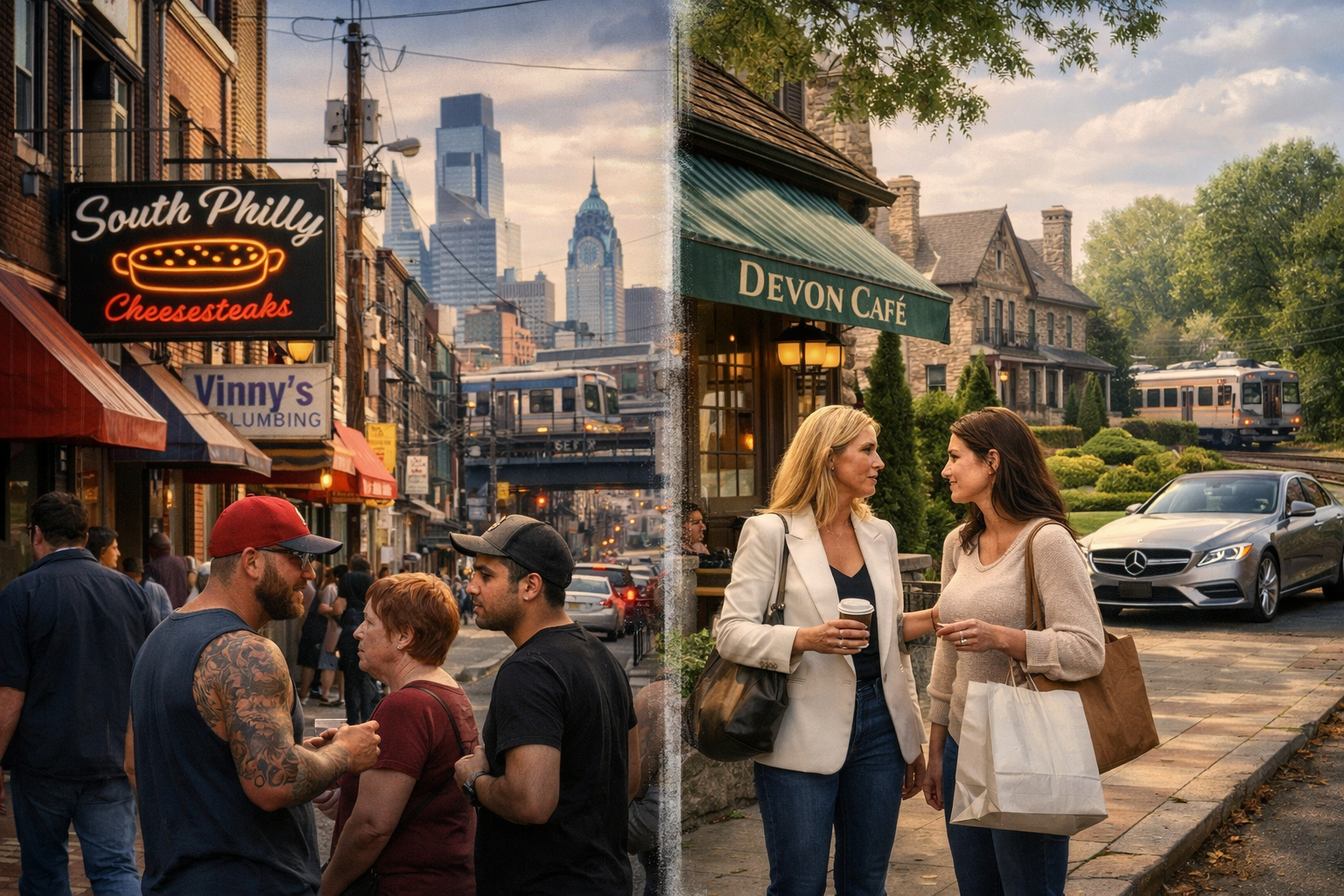
They are separated by about twelve miles, a train ride, and approximately three tax brackets. But South Philadelphia and the Main Line operate on the same fundamental principle: the best businesses don't advertise. They get recommended.
The mechanism is identical. The texture is completely different. And if you run a business in either market — or if you serve both — understanding that difference is the difference between a digital strategy that actually works and one that quietly misses the room it's supposed to reach.
The Same Principle, Two Completely Different Worlds
In South Philadelphia, the whisper network runs through block captains and church basements and the corner table at the same red-gravy restaurant where the same families have been eating for thirty years. Deeply felt ties to South Philadelphia are nurtured through visits to family, friends, and churches for festivals, and trips to restaurants and specialty stores — affective borders that extend far past the river. Encyclopedia of Greater Philadelphia The recommendation travels face-to-face, across a kitchen table, over the back fence, through the parish bulletin.
Through the Philadelphia More Beautiful Committee network, more than 6,500 block captains participate in programming throughout the year, promoting civic pride, public safety, and neighborhood empowerment. City of Philadelphia These are the connective tissue of neighborhood life — the people who know everyone on the block, who organize the cleanups and the block parties, who are the first call when something needs to get done. When a block captain tells you a contractor is good, you don't look them up on Google. You call them.
On the Main Line, the same whisper travels differently. The Main Line became known for its exclusive country clubs, polo fields, and elite social circles — Philadelphia's version of the Hamptons, with old money families dominating local society. MontCo Living The recommendation moves through the Merion Golf Club locker room, through the sidelines of an Episcopal Academy lacrosse game, through a school board meeting in Wayne, through the inherited introductions that constitute the social infrastructure of communities built along the Pennsylvania Railroad's route west of the city.
With the birth of the Main Line in the late 1800s, there came an extreme type of class-consciousness. The flood of wealth that created American family fortunes in the late 19th century settled around a handful of cities and was expressed in different forms of conspicuous consumption and elaborate social behaviour. Pennsylvania Center for the Book That class-consciousness has softened over the decades, but the network architecture it produced — the private schools, the country clubs, the inherited social circles — remains intact and remains the primary channel through which trust and reputation travel.
Same mechanism. Completely different texture. And if you're trying to build or extend a business reputation in either market, the texture matters enormously.
How South Philly's Network Actually Works
South Philadelphia's whisper network is horizontal and dense. It operates at the level of the block, the parish, the neighborhood association, the extended family. Traditional streets lined with awning-covered rowhomes house families who have lived there for generations — the kind of place where people come together on a weekend night with their neighbors. RentCafe
The consequence of this density is that information — including business recommendations — travels fast and carries enormous social weight. When someone on your block tells you to use their plumber, they are staking their own credibility on the recommendation. The social cost of a bad referral in a neighborhood where everyone knows everyone is real. So the recommendations that make it through this network are genuine, specific, and backed by direct personal experience.
Philadelphia's block captain program operates under the Philadelphia More Beautiful Committee, an effort to unite people with their neighbors. Block captains carry responsibilities of hosting parties, organizing cleanups, and making a lot of phone calls — connecting neighbors not just with the city but with each other. The Philadelphia Citizen These are the nerve endings of the South Philly social network. The block captain who has lived on the same street for twenty years doesn't just know the neighbors — they know the businesses the neighbors use, the contractors who showed up when they said they would, the shops that are actually worth walking to.
The referral in South Philly is often earned in plain sight. The contractor whose work you can see from the sidewalk — the front steps they rebuilt, the roof they replaced, the facade they painted — is being reviewed by every person who walks past. There are no hidden evaluations here. The quality of the work is visible to the community, and the community remembers.
What this means for a business operating in South Philly: your reputation is built at close range, through specific, observable work, within a community that has long institutional memory. The person you do excellent work for today will be talking about you at Sunday dinner for years. The person you disappoint will be doing the same thing.
How the Main Line's Network Actually Works
The Main Line's whisper network is vertical and structural. It operates through institutions — schools, clubs, charitable boards, alumni networks — rather than through geography. The trust is inherited as much as earned, and the introductions that matter most are the ones that come with explicit social endorsement from someone inside the network.
The Main Line was originally settled in the late 1600s by Welsh Quakers who purchased 40,000 acres of land from William Penn. By the late 1800s, the Pennsylvania Railroad converted the surrounding land into large and stately manors, insisting that many of its executives move out to these new suburbs and commute to Philadelphia. ReidrosenthalgroupThe social infrastructure that grew up alongside those estates — the country clubs, the private schools, the charitable institutions — was designed to serve a community of people who already knew each other through work, through family, through faith, and through the shared experience of inhabiting a very specific stratum of Philadelphia society.
That infrastructure is still the primary channel through which business reputation travels on the Main Line. Residents join country clubs nearby for world-class golfing, summer swimming leagues, fine dining, and social opportunities — some of the more popular ones being Merion Golf Club, Overbrook Golf Club, Aronimink Golf Club, and Philadelphia Country Club. Wagnerrealestate These are not just recreational amenities. They are the rooms where deals get discussed, where attorneys refer clients to financial advisors, where contractors get recommended to homeowners, where the professional service relationships that sustain businesses on the Main Line are built and maintained.
The private school network is equally structural. The Episcopal Academy, The Shipley School, and Friends' Central School are among the region's top private schools, each with a community that connects families across generations. Themacdonaldteam When two families have had children at the same school for twelve years — when they've sat in the same bleachers, attended the same galas, served on the same parent committees — the referrals that flow between them carry the weight of an extended relationship. The accountant whose kids went to Shipley with your kids isn't just a professional recommendation. He's a known quantity in your community.
What this means for a business operating on the Main Line: your reputation is built through institutional presence and endorsed introduction. The first time someone hears your name matters less than who said it and in what context. A cold email or a targeted Facebook ad does almost nothing in this market. A referral from a member of the same club or a fellow alum of the same school does almost everything.
Where the Networks Diverge: Speed vs. Depth
The South Philly network moves faster. The density of relationships means a strong reputation can travel across a neighborhood quickly — a single exceptional job, reviewed by a block captain, can generate three new clients within the month. The feedback loop is tight and the geography is compact.
The Main Line network moves slower but penetrates deeper. An introduction that lands right — that comes from the right person in the right context — can open a relationship that lasts decades and generates referrals across multiple social circles simultaneously. But getting that introduction takes time, patience, and genuine participation in the community rather than a transactional approach to it.
Both networks share one absolute: you cannot buy your way in. In South Philly, the families who have been on the same block for three generations can spot a newcomer performing community membership rather than living it. On the Main Line, the old money families who built the country clubs and the private schools have seen enough new money try to purchase social standing to know exactly what it looks like. In both markets, authenticity isn't optional. It's the admission ticket.
What This Means for Digital Strategy: Two Different Translations
Here is where businesses consistently get this wrong: they build a digital strategy as if both markets respond the same way, when the underlying network architecture is completely different.
For a South Philly business, the digital strategy is an amplification of visibility within a dense, local network. The goal is to make it easier for the people who are already talking about you to point others toward evidence of your work. A Google Business Profile with accurate hours, real photos of actual jobs, and genuine reviews from neighbors and longtime customers extends the reach of the block-level conversation into search. Local SEO built around specific neighborhood keywords — not just "Philadelphia" but "South Philly," "Passyunk Square," "Pennsport," the actual blocks and neighborhoods where your reputation lives — captures the people who are new to the area and searching for exactly what the block captain would have told them about if they'd met yet.
The content that works for South Philly audiences is specific, local, and unpretentious. Photos of actual work in actual rowhouses. Reviews that use the language of the neighborhood. A business bio that mentions the neighborhood by name and reflects genuine roots there rather than generic "serving the Philadelphia area" language. The person who grew up on these streets can tell immediately whether a business belongs here or is performing belonging.
For a Main Line business, the digital strategy is a credentialing tool that supports and extends the institutional network, not a replacement for it. On the Main Line, someone who receives a referral from a trusted contact will almost always do a digital due diligence check before engaging. They'll look at the website, read the about page, look for evidence that the business operates at the level the referral implied. The digital presence doesn't generate the relationship — it validates the introduction.
This means a Main Line business needs a digital presence that reflects the understated quality of the market it serves. The Main Line vibe is often described as understated wealth — towns that feel like historic "villages" centered around their respective train stations. It is a place where history is preserved aggressively, where you won't find neon signs or chaotic strip malls. Reidrosenthalgroup A website that looks like it was built by someone who cares about craft, with language that reflects genuine expertise rather than marketing copy, and a portfolio or case study section that demonstrates specific work for the specific caliber of client the business wants to attract. Not loud. Not promotional. Credible.
The content that works for Main Line audiences is authoritative and specific to their world. A financial advisor writing about multigenerational wealth planning for Main Line families. An architect writing about working within historic preservation requirements in Lower Merion Township. A contractor writing about the specific challenges and materials of restoring 19th-century stone estate construction. This is content that demonstrates genuine expertise in a way that the people searching for it immediately recognize as coming from someone who actually does this work, not someone who read about it.
The Translation Error Most Businesses Make
The most common mistake businesses make when operating across both markets — or when trying to establish themselves in one of them — is applying the same digital voice to both audiences.
A business that serves both South Philly and the Main Line needs to understand that the same message lands completely differently in each room. The straightforward, working-class confidence of a South Philly contractor's voice sounds like bragging in a Wayne living room. The understated, credentialed language of a Main Line professional service provider sounds cold and inaccessible at a South Philly block association meeting.
This isn't about code-switching for the sake of it. It's about understanding that the whisper network in each market translates trust through completely different signals — and that your digital presence needs to match those signals if it's going to function as a natural extension of the network rather than a disruption of it.
The block captain on Tasker Street recommends based on what she's seen with her own eyes and heard from her neighbors. The member of Merion Golf Club recommends based on who the person is in the context of their shared world. Both recommendations carry enormous weight. Both are nearly impossible to manufacture. Both can be extended and supported by digital presence that speaks the right language for the right room.
The Bottom Line
South Philly and the Main Line are the same city's approach to the same human need: finding businesses you can trust before you've worked with them. The path to that trust runs through different rooms, different institutions, and different social codes — but the destination is identical.
The businesses that thrive in both markets are the ones that understand they can't replicate the network digitally. They can only make themselves more visible within it, more credible to the people the network sends their way, and more reachable by the people who are just arriving and haven't found the network yet.
The whisper travels differently depending on the block. The job of digital marketing is to make sure it can travel further — in the right language, to the right people, in the right room.
Talk to Ritner Digital about your local digital strategy →
Ritner Digital is a Philadelphia-based digital marketing agency. Named after a street in South Philly. We work in both rooms.
Frequently Asked Questions
Why does the same word-of-mouth mechanism work so differently in South Philly versus the Main Line?
Because the social architecture of each community is completely different, even though both run on trust and personal recommendation. South Philly's network is built on density and proximity — families on the same blocks for generations, block captains who know everyone, parishes and neighborhood associations that create horizontal connections across the community. Information travels fast because the relationships are close and the geography is compact. The Main Line's network is built on institutions and inherited structure — country clubs, private schools, charitable boards, alumni networks that connect people across decades. Information travels more slowly but penetrates more deeply, because the endorsements that matter most come with significant social weight attached. Same mechanism, completely different plumbing. A digital strategy that ignores the plumbing misses the room entirely.
Can a business actually market to both South Philly and Main Line audiences at the same time?
Yes — but not with the same voice, the same content, or the same channels. A business that serves both markets needs to understand that what signals credibility and trustworthiness in one room actively undermines it in the other. The direct, unpretentious, neighborhood-specific language that builds trust in South Philly sounds presumptuous on the Main Line. The understated, credentialed, institution-aware language that works on the Main Line sounds cold and disconnected in South Philly. This doesn't mean you need two entirely separate brands — it means you need a digital strategy that is specific enough to speak authentically to each audience, in the context that audience actually inhabits. The businesses that try to split the difference and speak generically to both end up resonating with neither.
What does good local SEO actually look like for a South Philly business?
Hyper-specific and neighborhood-rooted. Not "Philadelphia plumber" but "South Philly plumber," "plumber in Passyunk Square," "plumber in Pennsport" — the actual geography of where your reputation lives and where your customers are searching. Your Google Business Profile needs to reflect the real character of the business: genuine photos of actual work done in actual rowhouses, reviews from real customers who use the language of the neighborhood, a description that mentions the specific areas you serve and doesn't sound like it was written by someone who has never been south of South Street. The person who just moved to the neighborhood is searching locally and specifically. If your digital presence is generic, you're invisible to them — and they'll find whoever isn't.
What does good digital presence look like for a Main Line business?
It looks like earned credibility, not promotional marketing. On the Main Line, the digital presence serves a very specific purpose: it validates the introduction. When someone receives a referral from a club member or a school parent and looks you up, what they find needs to confirm that you operate at the level the referral implied. That means a website that reflects genuine craft and professional quality — not loud, not flashy, not full of superlatives, but clearly the work of someone who takes what they do seriously. A well-written about page that explains your specific expertise in the specific context of this market. Portfolio content or case studies that demonstrate work for clients at the relevant level. And language that is specific enough to signal that you actually know this community — not generic "serving the Philadelphia suburbs" copy that could apply to anyone anywhere.
How do block captains and community organizations factor into a South Philly business's marketing strategy?
They are the most powerful marketing channel in the market — and they're not a channel you can buy. Block captains in Philadelphia are trusted precisely because they are not paid to recommend anything. When a block captain tells her neighbors about a contractor, an electrician, or a local shop, the recommendation carries the full weight of her standing in the community. The implication for business is that the path to this channel runs entirely through the quality of the work and the quality of the relationship. Show up when you say you will. Do the work right. Be a recognizable presence in the neighborhood rather than an anonymous service provider. The block captain doesn't recommend businesses she doesn't know — she recommends businesses she's watched operate, whose work she's seen, whose owners she's met. Digital marketing can extend that reach once it exists. It can't create it.
Why do Main Line businesses need digital presence at all if referrals are so dominant in that market?
Because the referral is the beginning of the process, not the end of it. When someone on the Main Line receives a recommendation from a trusted contact, the next step — almost universally — is a digital due diligence check. They look at the website. They read the about page. They look for evidence that the business is what the referral suggested it was. If what they find doesn't match the implied credibility of the introduction — if the website looks outdated, if the about page is generic, if there's no evidence of work at the relevant level — the referral loses its momentum. The trust that was transferred person-to-person evaporates when the digital presence fails to support it. In a market where the introduction is everything, letting the digital presence undermine it is an expensive mistake.
What's the biggest mistake businesses make when trying to enter the Main Line market from outside it?
Moving too fast and too transactionally. The Main Line's network is built on institutional membership and endorsed introduction. You cannot cold-email your way into it, you cannot run targeted Facebook ads to it, and you cannot buy presence in it. The businesses that successfully establish themselves in this market do so by genuinely participating in its institutions — not as a strategy, but as a genuine long-term commitment to being part of the community. Joining the right organizations. Showing up consistently at the right events. Building relationships that predate any business transaction. The digital presence supports this — it makes you findable and credible when someone who met you at a charity event looks you up the next morning — but it cannot substitute for the institutional legitimacy that the market requires. Patience is not optional here. Neither is genuine presence.
What's the biggest mistake businesses make when trying to enter the South Philly market from outside it?
Performing community membership rather than earning it. South Philadelphia has extremely well-developed instincts for detecting inauthenticity. Families who have been on these blocks for three and four generations have seen plenty of businesses try to appropriate neighborhood identity without doing the work of actually belonging to it. The local mural on the wall, the neighborhood street name in the logo, the "South Philly proud" language in the marketing — if these aren't backed by genuine roots, genuine relationships, and genuinely excellent work that the community can see and evaluate, they don't just fail to build trust. They actively create suspicion. The path into South Philly's whisper network is the same for outsiders as it is for anyone: show up, do excellent work, be present and consistent over time, and let the block decide. There are no shortcuts and no substitutes.
How does the digital strategy differ for a service business versus a retail or restaurant business in each market?
For service businesses — contractors, attorneys, financial advisors, healthcare providers — in both markets, the digital strategy is primarily about search visibility and credibility validation. You need to show up when someone is looking for what you do, and you need to look like the right answer when they find you. For retail and restaurant businesses, particularly in South Philly, the social proof layer is more active — Google reviews, Instagram presence, a Google Business Profile with current hours and real photos all function as a running public record of the customer experience that the neighborhood consults in real time. On the Main Line, retail and restaurant businesses benefit significantly from being embedded in the town center identity of their specific community — Ardmore, Wayne, Bryn Mawr each have distinct characters, and businesses that visibly reflect and reinforce that character build loyalty faster than those that feel transplanted from somewhere else.
What does Ritner Digital specifically do for businesses operating in Philadelphia's neighborhood markets?
We start by understanding which room you're actually trying to reach — because the strategy that works in one room actively fails in another. That means a real audit of where your current digital presence lands, who it speaks to, and what signals it sends to the specific audiences you're trying to reach. From there we build the local SEO infrastructure that makes you findable in the geography that matters, the content that speaks the right language for the right market, and the Google Business Profile and review strategy that extends the reach of the reputation you've already earned. We don't apply the same template to every local business because local businesses aren't the same. South Philly needs a different strategy than the Main Line. A contractor needs a different strategy than a law firm. We build what the specific market actually requires — not what the generic playbook says.