What Wawa Got Right That Most National Brands Never Will
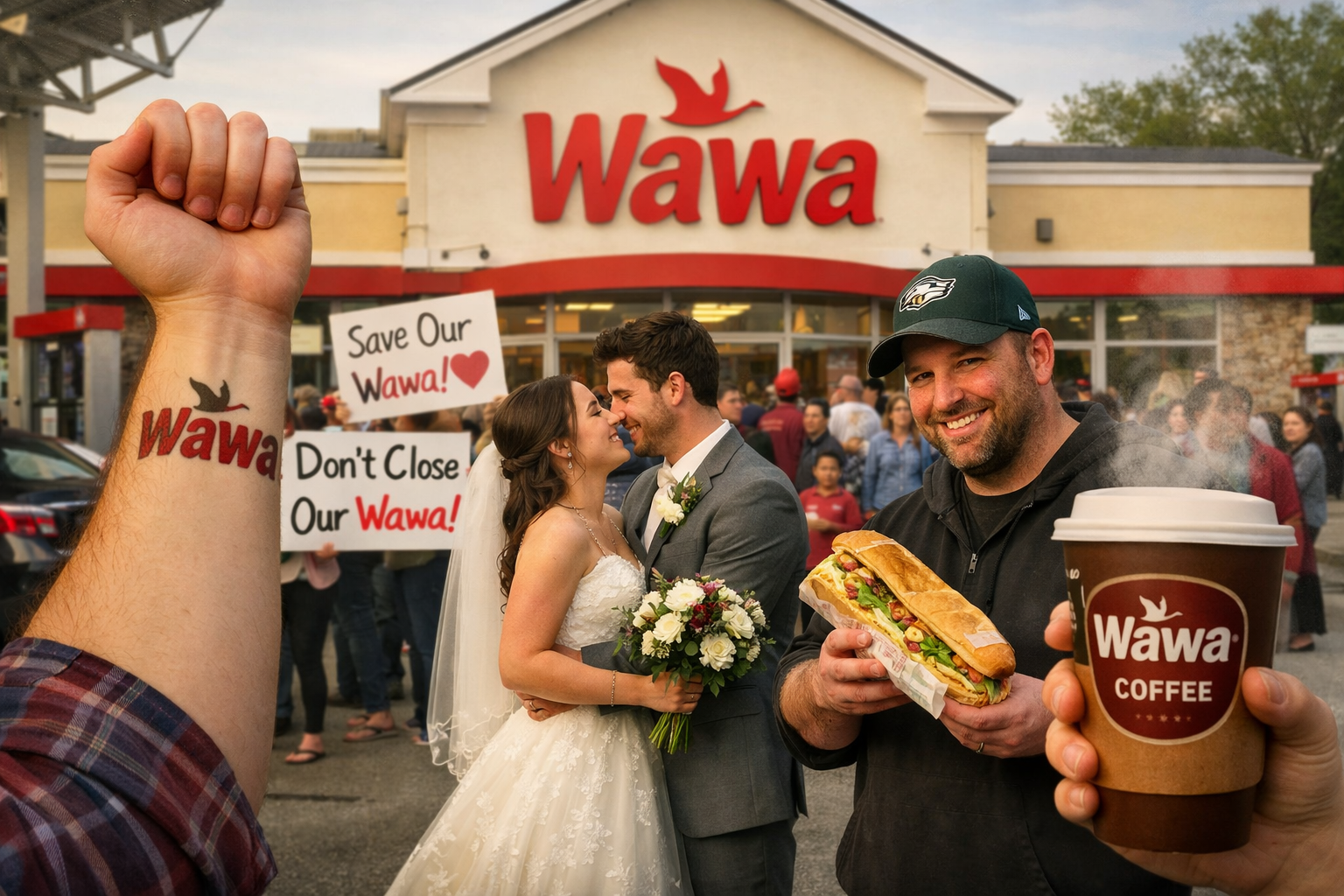
There is no Wawa Super Bowl commercial. There is no Wawa celebrity endorsement deal. There is no Wawa influencer campaign, no national billboard rollout, no advertising blitz timed to a product launch. The company has been doing business in the Delaware Valley since 1964, and for most of that time it has grown not by buying attention but by earning it — one cup of coffee, one hoagie, one consistent interaction at a time.
The result is something that hundreds of millions of dollars in marketing budgets have tried and failed to manufacture: a customer base that protests when a location closes, that gets the logo tattooed on their body, that holds their wedding at the store where they met, that drives past three competitors to get to "their" Wawa on the way to work every single morning.
The New York Times once called Wawa's customer base a cult. Mashable did the same, interviewing a man who claimed not to care about Wawa, only to realize he visited at least four different Wawas a day. Mashed When a Wawa closed at 20th and Locust in Philadelphia in 2008, there were protests complete with signs, chants, and a catchy slogan: "WawaTF?" Mashed
People do not protest the closing of a 7-Eleven. They do not get tattoos for Sheetz. They do not write love letters to Circle K. Wawa is doing something categorically different from every other business in its category — and it has almost nothing to do with advertising.
Where It Started: A Dairy Farm and a Problem Worth Solving
The Wawa business began in 1803 as an iron foundry. In 1890, George Wood moved to Delaware County, Pennsylvania, where he began the Wawa Dairy Farm, importing cows from Guernsey and buying 1,000 acres of land in the Chester Heights area. Since pasteurization was not yet available, many children faced sickness from consuming raw milk. Wood arranged for doctors to certify his milk was sanitary and safe for consumption, which convinced many consumers to buy the product. Wikipedia
That detail matters more than it might seem. Wawa didn't start by selling something people already trusted. It started by solving a real problem — unsafe milk for children — and building trust through documentation, through certification, through the willingness to be held accountable for the quality of what it produced. The brand's foundational commitment was to something genuinely useful and demonstrably better.
In the 1960s, many consumers began buying milk in stores instead of using home delivery. Wawa started to open its own stores to adjust to these market changes. On April 16, 1964, Grahame Wood opened the first Wawa Food Market at 1212 MacDade Boulevard in Folsom, Pennsylvania. Wikipedia Eight years later, there were 100 stores.
Notice what happened here: when the market changed, Wawa didn't fight the change or try to advertise their way back to relevance. They adapted — moved where their customers were going, met them there, and kept delivering what they were already known for. This adaptability, rooted in genuine responsiveness to customer behavior rather than marketing trends, would become one of the defining features of how the company grows.
The Core Product: Genuinely Excellent at Something Mundane
The convenience store industry is not a glamorous industry. It exists to provide basic necessities — coffee, fuel, food, everyday essentials — quickly and reliably. No one goes to a convenience store for an experience. They go because they need something and they don't have much time.
Wawa decided to be genuinely excellent at exactly that. Not aspirationally excellent, not "premium" in a way that raises prices without raising quality, but actually, observably, consistently excellent at coffee and sandwiches and customer interaction — things that most convenience stores treat as commodities.
Wawa is famous for its obsession with quality control, which started with the dairy. Everything about its private label coffee — from the brew island where you pour to the proprietary blend of beans that's a company secret — is carefully analyzed and tweaked to achieve maximum customer satisfaction. Wawa moves about 195 million cups of coffee a year, and sold its billionth cup way back in 2008. Mashed
195 million cups of coffee a year. Not from a national chain with thousands of locations competing against Starbucks and Dunkin'. From a regional convenience store that started as a dairy farm, that still has its headquarters in a small Pennsylvania town named after a goose.
A pivotal moment was the 1975 introduction of the hoagie, which shifted Wawa's identity beyond milk and groceries into prepared foods. It became a critical differentiator that fueled customer loyalty and sales growth for decades. In 1984, Wawa installed the first touchscreen deli ordering system, streamlining the custom sandwich process and dramatically improving order accuracy. Porter's Five Forces
The touchscreen ordering system in 1984 is worth pausing on. This was three decades before touchscreen ordering became an industry standard. Wawa didn't introduce it because a competitor forced them to, or because a marketing consultant said it would make the brand feel modern. They introduced it because the person behind the deli counter — "Mary, the person behind the deli counter" — was writing orders down by hand, and volume was growing faster than handwriting could keep up with. Njam-data The innovation was in service of the product, not the brand image.
The Employee Ownership Model: Why the Person Behind the Counter Cares
Walk into a Wawa and the interaction is different from most convenience stores. Not dramatically different — this isn't fine dining service, it's a convenience store — but consistently warmer, more competent, more engaged than you expect. That consistency is not an accident.
"We believe in sharing ownership with the people who deliver the Wawa brand, our associates. They own 38% of the company." Wharton School That's a former CEO of Wawa, talking to the Wharton School about what makes the company work. Employee ownership, through a profit-sharing plan introduced in 1977 and an Employee Stock Ownership Plan formalized since, means that the person making your hoagie has a financial stake in whether you come back tomorrow.
The Harvard Business Review noted that Wawa, alongside QuikTrip, delivered a unique customer experience that you don't expect when you walk into a convenience retailer. They said it all comes down to the people and their investment in training and belief in the people who deliver that brand experience. Mashed
"Our associates are our brand ambassadors. Our associates make us a living brand. Customers come in — yes, they want a cup of coffee, they want a hoagie, they want the necessities to get through the day. But they come in for that Wawa experience. That cup of coffee is more than a cup of coffee. It's the interaction with the coffee host or hostess. It's that good morning from the person behind the register." Wharton School
That's not a marketing statement. That's an operational truth — one that flows directly from employee ownership. When your associates own a piece of the company, they behave differently than associates who are just earning a wage. They stay longer. They care more. They are the brand in a way that no campaign can replicate. Wawa has low turnover relative to the industry, invests heavily in employee training through its Wawa University program, and even uses software analytics to understand what drives new employees to quit so they can solve those problems before losing people. Mashed
Private. On Purpose.
"We never want to go public because we want to take a long-term point of view." Wharton School
This is one of the most consequential decisions in the company's history and one of the least discussed. Wawa has remained privately held for over 120 years. That means no quarterly earnings calls, no analyst pressure to optimize for short-term revenue, no temptation to cut quality to hit a margin target.
It means that when Wawa decided to expand into Florida in 2012 — a long, expensive, multi-year commitment to establishing brand presence in a market that had no existing Wawa loyalty to build on — they could absorb years of losses while the brand found its footing. As a privately held company, you can make a major commitment when you go to a new market of that nature. You have to make a major commitment when you go to a new market, and you don't make money for the first couple years. As a privately held company, you can do it if you're willing to withstand some short-term loss for long-term gain. Wharton School
Private ownership is what allows Wawa to think in decades rather than quarters. The brand loyalty that makes customers protest store closings and get tattoos is not built in a fiscal year. It is built through consistent, patient, compounding investment in product quality and customer experience over sixty years. That investment is structurally incompatible with the pressures of public markets.
The Cult of the Specific Wawa
Here's a detail that reveals everything about how Wawa's brand loyalty actually works: people don't just love Wawa. They love their specific Wawa.
One customer was on a first-name basis with the employees at her local Wawa and was even compelled to create social networking groups full of people claiming their love not just for Wawa but for the specific Wawa location they visit most often. Some communities have several Wawa locations, but for many customers, only one will suffice when they need a cup of coffee or a hoagie, often resulting in driving further than necessary to "their Wawa." Pennsylvania Center for the Book
This is the deepest form of brand loyalty available in retail: not loyalty to a chain, but loyalty to a location. Loyalty to the people who work there, the specific rhythms of that specific store, the morning routine that is associated with that particular building at that particular intersection. When that location closes, it's not a corporate inconvenience — it's a personal loss.
"It's kind of like a cult. It's not enough to just sell products. What is the experience that goes along with that product? And Wawa certainly has that experience. They were able to take the parts and pieces of what was working in other businesses and combine it to create this entity that really suited the needs of the people. It's not like 'McDonald's Plus' or 'Better Than 7-Eleven.' It's just its own experience. You know, the Wawa Experience." Njam-data
The Wawa Experience. A convenience store. Named after a goose. Built on a dairy farm in Chester County. With customers who protest its closings and name their dogs after it and, yes, get married in its parking lots.
What Wawa Got Right That Most National Brands Get Wrong
National brands typically try to manufacture loyalty through awareness — carpet-bombing markets with advertising until their name is the one that comes to mind when the relevant need arises. The bet is that presence in the mind leads to presence in the shopping basket.
Wawa built loyalty through experience — showing up every day with consistently good coffee and consistently good food and consistently genuine human interaction, until the brand wasn't just present in the mind but woven into the daily rhythm of millions of people's lives.
The distinction sounds subtle. The results are completely different.
Advertising-built awareness is rented. It exists as long as the media budget exists. The moment Pepsi stops advertising, Pepsi awareness starts to erode. There is no accumulated asset — just attention that was purchased and has to be continuously re-purchased.
Experience-built loyalty is owned. Every positive interaction Wawa has ever had with a customer is a deposit in an account that compounds over time. The customer who has been going to the same Wawa for fifteen years is not neutral about the brand — they have fifteen years of morning coffee, fifteen years of hoagies on the way home from work, fifteen years of a familiar face behind the counter knowing how they like their order. That relationship is not going to be disrupted by a competitor's ad spend.
Fuel was a monumental change in the direction of Wawa — one of the single biggest influences in the trajectory of the organization. The people who knew their local Wawa knew their local Wawa. But now the traveler knew Wawa too. It really grew the demographic of shopper. Now they don't build a Wawa without the gas pumps. Njam-data
Even the gas strategy was about experience rather than advertising. By adding fuel, Wawa didn't run a campaign to tell people they now sold gas. They put fuel pumps at the location where people already came every morning — and the people who stopped for gas discovered the coffee and the hoagies. The product did the marketing.
The Business Lesson That Applies Well Beyond Convenience Stores
Most businesses cannot replicate Wawa specifically. You cannot open a Delaware Valley convenience store and expect sixty years of brand compounding to appear on your balance sheet next quarter.
But the principles are available to any business willing to actually apply them.
Be genuinely excellent at the specific thing your customers need. Not marketing-speak excellent — actually, observably, consistently excellent in a way that your customers can verify with their own experience every time they interact with you. Wawa's coffee tastes better than most convenience store coffee. That's not a positioning statement. It's a fact people can test for $1.50.
Make your employees stakeholders, not just labor. The Wawa experience is delivered by people who own a piece of what they're building. The quality and consistency of that experience is inseparable from that ownership structure. Any business that wants loyal customers needs employees who have a genuine reason to care.
Stay private in your thinking even if not in your structure. Make decisions that serve the long-term relationship with your customer base rather than short-term metrics. The businesses that build the deepest loyalty are the ones that sacrifice short-term revenue to preserve long-term trust — that don't cut the coffee quality to hit a margin number, that don't eliminate the thing customers love to fund something customers don't care about.
Show up. Every day. For decades. Without stopping.
Today it is clear that convenience is no longer the only selling point for stores like Wawa. Wawa's good neighbor philosophy, its unique business model, and its long history of success make Wawa a valuable asset to the many communities it serves. Its efforts in the community have helped create a devoted customer base that would never enter another convenience store. Pennsylvania Center for the Book
A devoted customer base that would never enter another convenience store. That's the destination. The path is sixty years of not cutting corners, not chasing trends, not mistaking advertising for the thing advertising is supposed to support.
The brand is the product. The product is the brand. Wawa figured that out in 1964, and they've been proving it every morning since.
Talk to Ritner Digital about building a brand that actually compounds →
Ritner Digital is a Philadelphia-based digital marketing agency. We help businesses build digital presence worthy of what they've actually built. Named after a street in South Philly. Hoagie optional.
Here are the FAQs, written in Ritner Digital's voice:
Frequently Asked Questions
How did Wawa build such extreme brand loyalty without major national advertising?
By being genuinely excellent at something people needed every day, then showing up consistently for sixty years without stopping. Wawa's loyalty wasn't purchased through media spend — it was accumulated through daily positive experiences that compounded over time. Every cup of coffee that was exactly what someone expected. Every hoagie made right. Every morning interaction with an employee who actually seemed to care. Multiply those interactions across sixty years and millions of customers and you get something that no advertising campaign can replicate: a brand that is woven into the daily rhythm of people's lives rather than merely present in their awareness. The difference between awareness and loyalty is the difference between a billboard someone drives past and a relationship someone would defend.
What is the Wawa Experience and why does it matter so much to brand loyalty?
The Wawa Experience is the sum of every interaction a customer has with every element of a Wawa store — the coffee quality, the hoagie customization, the cleanliness, the speed, the warmth of the employee behind the counter — executed consistently across hundreds of locations and millions of daily visits. It matters because it's the thing that advertising is theoretically supposed to support, but rarely does on its own. Most convenience stores sell the same things Wawa sells. The product categories are identical. What Wawa figured out — and what most competitors never have — is that the experience surrounding the product is the actual differentiator. When the experience is consistently excellent, customers don't just return. They develop a relationship with the specific location, the specific employees, the specific morning routine. That relationship is extraordinarily resistant to competitive disruption.
Why does Wawa's employee ownership model matter for customer experience?
Because the person making your hoagie has a financial stake in whether you come back. Wawa employees own roughly 38 to 40 percent of the company through an Employee Stock Ownership Plan. That ownership structure changes the fundamental dynamic of the customer-employee relationship. The employee who owns a piece of the business is not just earning a wage — they're building something. Their behavior, their engagement, their willingness to go slightly beyond what's required, reflects that ownership in ways that are subtle but cumulative. Harvard Business Review specifically called out Wawa as an example of a convenience retailer that delivers an unexpectedly high level of customer experience, and attributed it directly to the company's investment in people and training. The experience doesn't happen despite the employee structure. It happens because of it.
What's the difference between advertising-built awareness and experience-built loyalty?
Advertising-built awareness is rented. You pay for it every period and it exists only as long as you keep paying. The moment the media budget pauses, the awareness starts to erode because there's no underlying relationship sustaining it — just presence in the mind that was purchased and has to be continuously re-purchased. Experience-built loyalty is owned. Every positive interaction is a deposit in an account that compounds over time. A customer who has been going to the same Wawa for fifteen years has fifteen years of accumulated positive experience that no competitor's ad spend is going to dislodge. That accumulated asset doesn't appear on a balance sheet, but it shows up in behavior — in protest signs when a location closes, in tattoos, in the specific loyalty that makes someone drive past three other options to get to their Wawa. No advertising campaign has ever produced that. Only experience, delivered consistently over time, can.
Can small businesses actually apply Wawa's approach, or is this only for large chains?
The scale is different but the principles are identical. Be genuinely excellent at the specific thing your customers need — not in a marketing-speak way, but in a verifiable, testable, every-single-time way. Make your people stakeholders in the outcome — whether through ownership, compensation tied to customer outcomes, or simply a culture that treats employees as the primary delivery mechanism for the brand promise. Make decisions that serve the long-term relationship with your customer base rather than short-term metrics. Show up consistently without stopping. A three-person service business that executes on these principles will build the same kind of compounding loyalty that Wawa built — just at a different scale. The corner barbershop that's been on the same block for thirty years and has customers driving in from the suburbs is running exactly the same playbook. The mechanism is identical. The logo is smaller.
Why does Wawa staying private matter so much to its brand strategy?
Because brand loyalty is built in decades and public markets think in quarters. When Wawa expanded into Florida in 2012, they knew they wouldn't make money for the first couple of years. As a privately held company, they could absorb that — because the decision was evaluated against the long-term relationship with a new customer base, not against next quarter's earnings call. Public companies face constant pressure to optimize short-term metrics at the expense of long-term brand equity. They cut quality to hit margins. They eliminate the things customers love to fund things customers don't care about. They chase trends instead of deepening the thing they're already genuinely excellent at. Wawa has been able to stay true to what it is because it doesn't answer to public markets. Most businesses aren't public — which means they have the same structural advantage available to them, if they're willing to use it.
What does "my Wawa" loyalty tell us about how deep brand loyalty actually works?
It tells us that the deepest form of loyalty isn't loyalty to a brand — it's loyalty to a specific experience in a specific place with specific people. People don't love Wawa generically. They love their Wawa — the one with the employee who knows their order, the one that's part of their morning commute, the one they've been going to for seven years. That specificity is what separates genuine loyalty from preference. Preference is fragile — it shifts when a competitor offers something better or cheaper. Genuine loyalty is tied to identity and memory and accumulated experience, and it survives most competitive pressures because it's not a rational calculation anymore. The lesson for businesses is that the goal isn't to be the best option in a category comparison. It's to become so embedded in a customer's routine that the comparison stops happening — that your business becomes the default, the reference point, the thing they'd have to consciously decide to leave.
What's the marketing lesson in Wawa adding gas stations?
That the best marketing often isn't marketing at all — it's strategic product or service expansion that puts you in front of new customers at a moment when they're already receptive. When Wawa added fuel, they didn't run a campaign announcing it. They added pumps at locations where their existing customers already came every morning. People stopped for gas and discovered the coffee. People who had never been to a Wawa before pulled in for fuel and walked out as hoagie converts. The product extension did the acquisition work that an advertising campaign would have tried to do — but far more effectively, because it was delivering real value rather than making a claim. The underlying principle applies to any business: the most powerful way to reach new customers is to be genuinely excellent at one thing that gives you a natural reason to expand into an adjacent thing they already need.
Why did people protest a Wawa closing with signs and chants when most store closings generate zero public reaction?
Because people don't protest the closing of a transaction. They protest the loss of a relationship. When a 7-Eleven closes, customers find another 7-Eleven — because 7-Eleven is fundamentally interchangeable with itself. Every location is identical, every interaction is scripted, every product is the same. There's no relationship to lose. When a Wawa closes, customers lose their Wawa — the specific location that is part of their daily life, staffed by people they know by name, embedded in a routine that has accumulated years of meaning. The protest isn't irrational. It's the logical expression of loyalty that was genuinely earned. For businesses, the question worth asking is: if we closed tomorrow, would anyone protest? Would anyone miss the relationship — not just the convenience? The answer to that question tells you everything about the kind of brand equity you've actually built.
What does Wawa's story mean for Ritner Digital clients specifically?
It means the digital presence we build for you should reflect what you've actually built — not what your category is supposed to look like, not a generic version of your industry's template, but the specific character of a business that shows up consistently and delivers genuine value. Wawa didn't build its brand by looking like every other convenience store. It built it by being something different from every other convenience store and then showing up daily for sixty years. The role of digital marketing in that context is to make the genuine excellence visible — to give the people who don't know you yet a way to find what the people who do know you already can't stop recommending. We don't manufacture loyalty. We extend it. The loyalty you've earned through the work is the asset. Our job is to make sure it travels as far as it deserves to.
Talk to Ritner Digital about building a brand that compounds →