The Philadelphia Story: Why This City Has Always Been Allergic to Hype — And What That Means for Your Brand
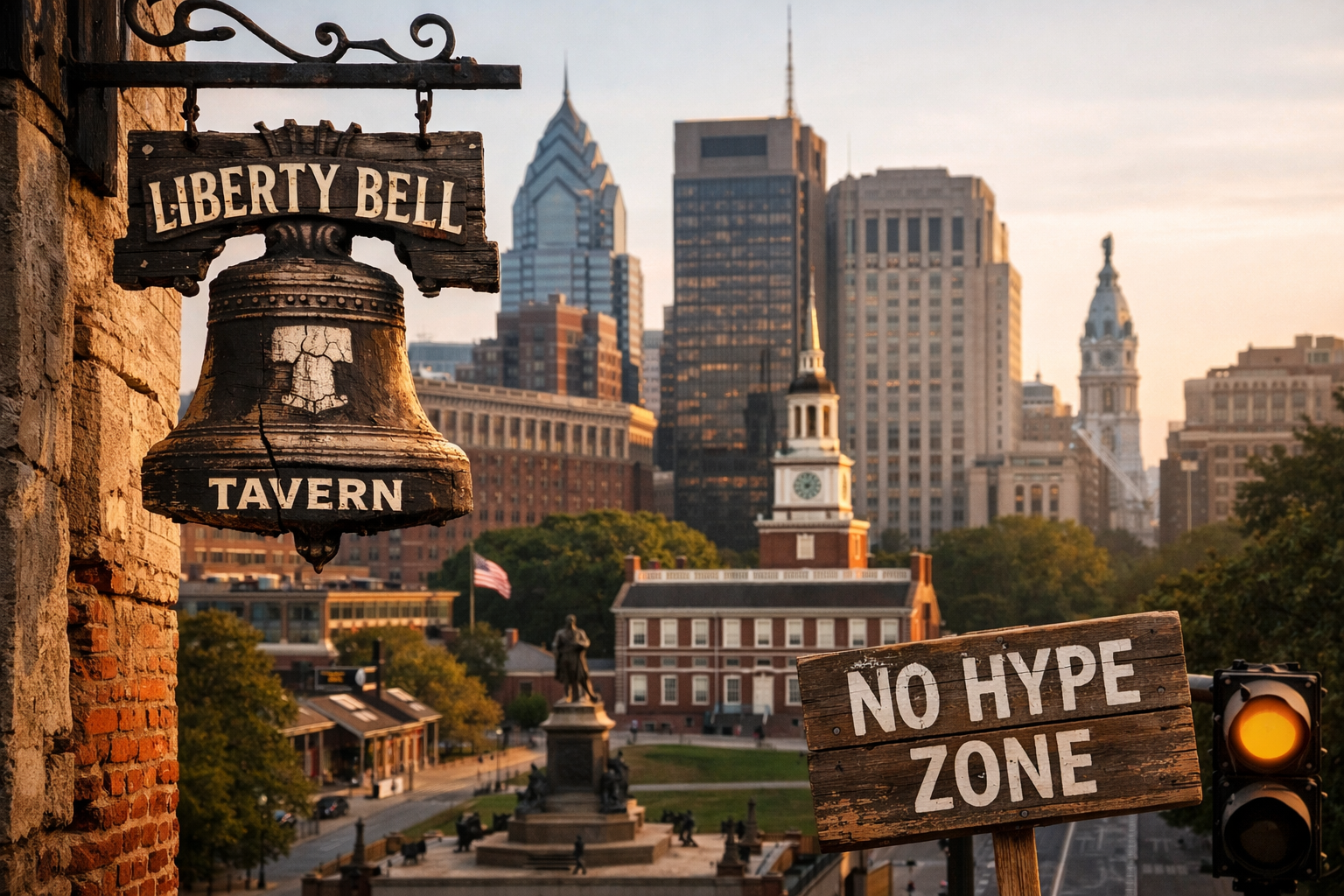
New York performs. Los Angeles curates. Washington projects power. Boston claims heritage.
And Philadelphia? Philadelphia does the work. Dares you to notice. And then, when you don't, shrugs and does the work again tomorrow.
This is not an accident of personality. It is the product of a very specific history — a city that was the most important place in America for the better part of a century, then watched that importance get redistributed to cities that were louder about wanting it. A city that wrote the Declaration of Independence, ratified the Constitution, hosted the nation's capital, and then lost all three to places that were better at the politics of visibility.
Philadelphia served as the nation's capital on multiple occasions between 1775 and 1800, and remained the nation's largest city until the late 18th century, serving as its financial and cultural center until being eclipsed in population by New York City in 1790. Wikipedia
Then it lost everything. Not through failure — through politics, through geography, through deals made in back rooms between men who wanted the capital closer to their plantations. Philadelphia became the ex-capital for several reasons, including a deal between Alexander Hamilton and Thomas Jefferson, and a compromise over slavery. Constitution Center The city that built the country got outmaneuvered by it.
What do you do with that? You develop a chip on your shoulder. And you keep working.
The Original American Underdog
A common explanation suggests Philadelphia's underdog identity emerged as far back as 1800 when the city lost its status as the nation's capital, which was moved to Washington, D.C. As a result, Philadelphians came to consider their city an underdog city. The Conversation
Two hundred and twenty-five years of being the city that should have been at the center of everything — and isn't. Two centuries of watching other cities get the credit, the attention, the prestige that Philadelphia's history arguably deserves more than any of them. The place that invented American democracy, that produced Benjamin Franklin and the Continental Congress and the Liberty Bell, that was the beating heart of the most consequential political moment in the history of the Western world — perpetually framed as the overlooked city between New York and Washington.
"Nobody gave us nothing," as Philadelphia playwright Bruce Graham put it. "New York is rich and sophisticated. Washington is connected and powerful. Boston is the upper crust. And what's Philly? We're cheesesteak." Star Tribune
That quote lands like a joke and cuts like something much more precise. Philadelphia has embraced the cheesesteak identity — the blue-collar, no-nonsense, don't-tell-me-what-I-am identity — not as a consolation prize but as a genuine value system. We don't need your validation. We know what we did. We know what we built. The fact that you forgot doesn't change the history.
This is not false modesty. It's not performative humility. It's a deeply rooted cultural refusal to claim what hasn't been earned through the work itself — and a corresponding suspicion of anyone who claims it too loudly before the work is done.
What Allergic to Hype Actually Looks Like
Philadelphia's resistance to self-promotion shows up everywhere once you start looking for it.
It shows up in the Wawa that became the most loyal convenience store brand in American retail without running a Super Bowl ad. It shows up in Palizzi Social Club, which banned reviews and photography and accidentally created the most sought-after dining experience in the city. It shows up in the Main Line families who have been running the same law firms for four generations and whose websites still look like they were designed in 1997 — because the clients already know who they are.
It shows up in the way Philadelphia restaurants prefer a James Beard nomination over a Yelp campaign, in the way South Philly contractors get their work evaluated by neighbors who can see it from the sidewalk rather than by online marketing, in the way the city's most durable brands tend to be the ones that said the least and did the most.
And it shows up, most famously and most misunderstood, in 1968 at Franklin Field, when fifty-four thousand fans braved a snowstorm and temperatures in the low twenties to watch a 2-11 Eagles team play its last meaningless game of a terrible season — and then booed a stand-in Santa Claus for the crime of showing up with candy canes when the season had already been a disaster.
Philadelphia's passionate yet downtrodden fans — 54,535 of them had braved temperatures in the low 20s and a snowstorm to make it to the game — weren't having it. Visit Philadelphia
The national narrative, recycled every December for fifty-seven years, is that Philadelphia is a city so heartless it booed Santa Claus. The actual story is that fifty-four thousand people showed up in a blizzard for a losing team because they were genuinely invested — and then refused to pretend the season had been something it wasn't. "Fans were in no mood for it. It was the end of a terrible season, they wanted the head coach fired, they were in no mood to welcome a shabby Santa Claus throwing cheap candy canes up into the stands." WHYY
That's not heartlessness. That's a refusal to perform enthusiasm that isn't earned. That's the Philadelphia ethos in a nutshell: we showed up because we care, and because we care, we won't pretend a bad thing is a good thing to spare someone's feelings.
New York would have cheered the Santa. Los Angeles would have Instagrammed him. Philadelphia threw snowballs — and fifty-seven years later still doesn't entirely regret it.
Why This Allergy to Hype Produces Durable Brands
The paradox is this: the cultural resistance to self-promotion that makes Philadelphia uncomfortable for marketers to work in is precisely what makes Philadelphia brands, when they actually earn traction, so extraordinarily durable.
Brands built on performance rather than positioning don't evaporate when the ad spend stops. They compound. Every interaction that earns genuine loyalty adds to a foundation that doesn't require maintenance. The customer who found a business through someone they trusted, whose first experience confirmed what they were told, who has been going back for years because the thing is actually good — that customer is not going anywhere because a competitor runs a smarter campaign.
Philadelphia's reputation is strong and not exactly flattering, but it is one that is not entirely unearned. It's rough around the edges and it insists on staying that way. The Culture Crush
That roughness is structural. It's the same quality that makes the city reject hype — the same quality that makes it demand the real thing. And the businesses that have operated inside that culture long enough to absorb it tend to produce something that businesses built on marketing strategy rarely achieve: a reputation that is worth more than any campaign could buy.
The Italian Market has been on 9th Street since the 1880s. It has no unified marketing department, no social media strategy, no brand guidelines. It has 140 years of being exactly what it is, every single day, for every person who walks through it. That's not a brand. That's a fact. And facts are harder to compete with than campaigns.
The Three Ways Philly's Anti-Hype Ethos Shows Up in Business
Working class over aspirational class. Philadelphia's business culture has always skewed toward the doer over the announcer. The contractor who shows up when he says he will and leaves the job site cleaner than he found it is more valued here than the one with the sleek marketing materials and the testimonial reel. The accountant who has been doing the same families' taxes for thirty years is more trusted than the new firm with the polished branding. The restaurant that has been serving the same neighborhood for decades is more beloved than the one that opened six months ago to critical acclaim. In Philadelphia, the credential is the track record, not the pitch deck.
Earned trust over manufactured awareness. Philadelphians are suspicious of anything that comes too loud, too polished, too eager to impress. This manifests as an almost forensic scrutiny of newcomers — businesses, people, ideas — that presents itself too well. The city has a finely calibrated sensitivity to the difference between genuine quality and performed quality, between something that earns confidence and something that tries to purchase it. The businesses that navigate this successfully are the ones that let the work do the talking from day one, that are patient enough to let the reputation build through experience rather than promotion.
Direct over diplomatic. In Philadelphia, grittiness can be defined as a working-class ideology that thrives on being the underdog and emphasizes toughness, hard work, physicality, and a combative defiance. The Conversation This directness is not rudeness — it's a communication style that values truth over comfort, that would rather tell you the real thing than a flattering version of it. In a business context, this is an extraordinary asset: a city that calls it like it is produces businesses whose word means something, whose promises are real, whose reputation is based on what they actually did rather than what they said they would do.
What This Means for Brand Strategy
If you're building a brand in Philadelphia, the Philly ethos is not a constraint to work around. It's the framework your strategy should operate within.
The city will find out if you're performing quality rather than delivering it. The whisper network that operates through block captains and country clubs and the corner table at the same restaurant for thirty years will surface the gap between what you claim and what you do — faster and more permanently than any bad review. In a market where reputation travels through trusted personal networks, the gap between brand promise and actual experience is fatal.
But the inverse is equally true: in a market this resistant to hype, a business that genuinely earns its reputation has a competitive moat that advertising cannot bridge. The competitor who outspends you on awareness campaigns hasn't necessarily outcompeted you if your actual customer experience is better. The city's built-in hype filter works both ways — it rejects manufactured credibility, and it rewards genuine credibility with a loyalty that compounds instead of requiring continuous maintenance.
The digital strategy that works for a Philadelphia business is one that reflects this orientation. Not loud. Not promotional in a way that performs enthusiasm the market hasn't ratified. Content that demonstrates genuine expertise rather than claiming it. Case studies that show actual work rather than aspirational positioning. A Google Business Profile and review presence that reflects what real customers actually experienced — not a managed reputation, but an accurate one. A website that looks like it was built by someone who cares about the work rather than someone who wants to look like they care about the work.
The difference is detectable. Philadelphians are very good at detecting it.
The Brand Philadelphia Never Had to Build
Philadelphia is one of the most historical cities in the United States, but a fictionalized character of a boxer is more idolized than Ben Franklin, William Penn, or any other figure who actually lived there, including George Washington. The Culture Crush
Philadelphia didn't brand itself as the birthplace of American democracy. It just was. It didn't build a campaign around liberty and independence. It hosted the conversations, produced the documents, and watched other cities get the credit for the century that followed. The brand that stuck — the underdog city, the working-class city, the city that does the work and dares you to notice — wasn't manufactured by a marketing firm. It accumulated through 225 years of exactly that behavior.
That's the lesson. Not that Philadelphia is resistant to marketing — it isn't. It's that the most durable brand identity is the one that emerges from genuine character rather than being applied over it. The campaign that lasts is the one that accurately reflects what's actually there.
New York performs. Los Angeles curates. Philadelphia just does the work.
And the brands that understand that — that build on that, that extend it digitally rather than replacing it with something more palatable to the national imagination — are the ones that will still be here in sixty years, the way Wawa is still here, the way the Italian Market is still here, the way the block captains and the corner barbershops and the corner tables at the same restaurant are still here.
Durable beats loud. Every time. It just takes longer to show up in the metrics.
Talk to Ritner Digital about building a brand that's built to last →
Ritner Digital is a Philadelphia-based digital marketing agency. Named after a street in South Philly. We don't run Super Bowl ads either.
Frequently Asked Questions
Why is Philadelphia so resistant to hype and self-promotion compared to other major cities?
Because the city has 225 years of evidence that hype doesn't hold. Philadelphia was the most important city in America for the better part of a century — the birthplace of American democracy, the financial and cultural capital of the new nation, the city where the Declaration of Independence was written and the Constitution was ratified. Then it lost the capital to a political deal, lost its financial dominance to New York, and watched city after city get the credit and the visibility that Philadelphia's history arguably deserved more than any of them. What you develop from that experience isn't bitterness, exactly. It's a deep structural skepticism about claims that outrun the work behind them. Philadelphia knows that the loudest voice in the room isn't necessarily the one that built something worth talking about. That skepticism became a cultural value, and that cultural value shaped how the city's businesses and residents relate to self-promotion.
What does "allergic to hype" actually mean in a business context?
It means the market has a finely calibrated ability to detect the gap between what a business claims and what it actually delivers — and it punishes that gap more severely than most markets do. In Philadelphia, reputation travels through dense personal networks where everyone knows someone who's worked with you, eaten at your restaurant, hired your firm. A fabricated brand story or an inflated value proposition doesn't survive contact with that network for long. But the inverse is equally true: a business that genuinely earns its reputation in this market has a competitive moat that is extremely difficult to bridge through advertising alone. The city's hype filter works both ways. It rejects manufactured credibility and rewards genuine credibility with compounding loyalty. The anti-hype culture isn't a barrier to marketing. It's a quality standard — and businesses that meet it have something extraordinarily durable.
Is the Santa Claus booing story actually relevant to Philadelphia's business culture, or is it just a sports anecdote?
It's more relevant than it looks. The Santa Claus incident is almost always framed as evidence of Philadelphia fans' heartlessness — a city so brutal it booed the embodiment of holiday cheer. But the actual context is the opposite: 54,000 people showed up in a blizzard for a 2-11 team because they genuinely cared, and then refused to perform enthusiasm for a shabby stand-in Santa throwing candy canes at the end of a terrible season. That's not heartlessness. That's an unwillingness to pretend a bad thing is a good thing because the occasion calls for it. In business terms, that's the customer who won't give you a five-star review because it was a five-star experience — not because they're mean, but because you didn't earn it yet. Philadelphia audiences hold things to a real standard, not a performed one. The businesses that build lasting reputations here are the ones that earn that standard rather than trying to manage around it.
How does Philadelphia's history of losing its capital status connect to the city's brand identity today?
More directly than most people realize. The chip-on-the-shoulder identity that defines Philadelphia's cultural character — the underdog posture, the resistance to being told you're not good enough, the defiant refusal to seek outside validation — has its roots in a very specific historical loss. This was the first city of the most important nation in the world, and it got outmaneuvered by a political deal. The capital went south. The financial center went north to New York. The cultural prestige followed. What stayed was everything the city had actually built: the infrastructure, the institutions, the working-class communities, the deep neighborhood roots. Philadelphia learned to find its identity in what it had built rather than in what others recognized. That orientation — build it first, let recognition follow — became the city's default posture, and it's the posture that produces the most durable businesses.
What does authentic brand building look like for a Philadelphia business specifically?
It starts with letting the work set the standard rather than the marketing setting the expectation. In most markets, you establish the brand promise first and then try to deliver on it. In Philadelphia, that sequence backfires — because the market will evaluate whether the promise is real before it accepts it, and a promise that outruns the reality gets rejected immediately. The approach that works here is the opposite: do the work to a standard that's genuinely higher than the market expects, let the early customers experience that standard directly, let the word-of-mouth begin naturally, and then use digital presence to extend the reach of a reputation that's already real. The content, the website, the SEO strategy — all of it should reflect what's actually there, not what you aspire to be. Aspiration sounds like hype in this market. Evidence sounds like credibility.
Why do Philadelphia's most durable brands tend to avoid aggressive marketing?
Because the brands that have been here long enough to understand the market have learned that aggressive marketing triggers the hype filter. When a business oversells itself in Philadelphia, the city's dense referral networks immediately test the claim against direct experience — and if the experience doesn't match the promise, the reputation damage is swift and lasting. The businesses that have been here for decades and remain embedded in the community understand this implicitly: don't claim more than you can deliver, let the delivery do the claiming, and trust that the whisper network will do the work that advertising would otherwise have to do. The Italian Market hasn't run a campaign in 140 years. Wawa never bought a Super Bowl spot. The most beloved law firms on the Main Line don't advertise at all. These aren't oversights. They're strategies that emerged from understanding exactly how the market actually decides who to trust.
How does this anti-hype culture translate into digital marketing strategy?
It means your digital presence should be an accurate reflection of your actual character rather than an aspirational version of it. A website that looks more polished than your business actually is creates a dissonance that Philadelphia customers pick up on immediately — and dissonance erodes trust before the first conversation. The content that works in this market demonstrates genuine expertise rather than performing it: case studies that show actual work, not vague success stories; blog posts that reflect real knowledge of the specific industry and community, not generic templates with your logo on them; reviews that sound like real customers describing real experiences, not coached testimonials. The SEO strategy should target the specific, local language your actual customers use when they're looking for what you do — not the broad, optimistic keywords that make you look bigger than you are. In short: build digital presence the way the city builds reputation. Show the work. Let it speak.
Isn't being anti-hype a disadvantage in a digital landscape that rewards visibility and volume?
Only if you mistake visibility for credibility. The digital landscape does reward volume — more content, more ads, more presence across more channels. But volume without substance is noise, and in Philadelphia's market, noise triggers the hype filter rather than building trust. The businesses that win here over time aren't the loudest — they're the ones whose digital presence accurately reflects genuine excellence, whose search visibility is built on content that actually demonstrates expertise, whose reviews are real and specific and earned, whose reputation online matches what the whisper network already says about them offline. The question isn't whether to be visible — it's whether the visibility reflects something real. When it does, visibility and authenticity reinforce each other. When it doesn't, no amount of volume makes up for the credibility gap.
What's the connection between Philadelphia's working-class identity and its resistance to brand performance?
Working-class culture values the real thing. It values people who do what they say, who show up when they commit to showing up, who put the quality of the work above the quality of the presentation. It is deeply suspicious of anyone whose presentation is significantly better than their substance — because that gap, in a working-class context, usually means someone is trying to take something from you rather than earn it. Philadelphia's working-class identity runs through South Philly, through the Northeast, through Kensington and Fishtown and every neighborhood where families built their lives around doing honest work and expecting honest dealing in return. That value system shapes how the entire city evaluates businesses, products, and brands — not just the working-class neighborhoods. When the Wharton MBA and the South Philly block captain both have finely tuned hype detectors, you're operating in a market where authenticity isn't a marketing strategy. It's the entry ticket.
What does Ritner Digital do differently because of this understanding?
We don't build digital presence that looks better than what's actually there. We build digital presence that makes what's actually there more findable, more credible, and more reachable — to the people who would choose you if they could only find you. That means starting with an honest audit of where your reputation currently stands, what your actual customers say about you, and where the gap is between your current digital presence and the quality of the work you've actually done. From there we build content, SEO strategy, and local presence that reflects the genuine character of your business rather than a generic version of your industry. The city will accept nothing less. And honestly, neither will we. We're Philadelphia. We're allergic to hype too.
Talk to Ritner Digital about building a brand that reflects what you've actually built →