Reading Terminal Market and the Power of Earned Scarcity
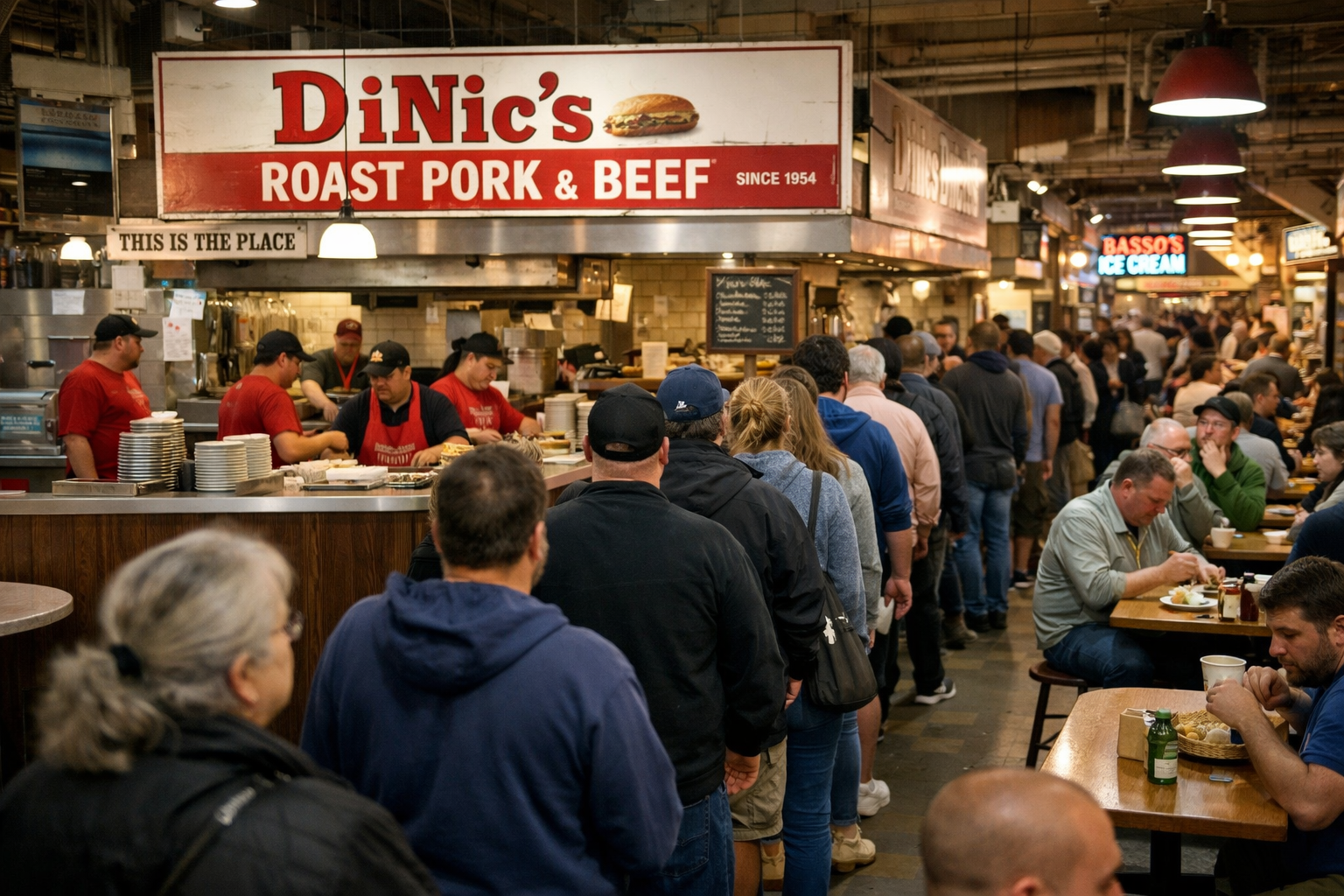
On a Tuesday morning at 11am, there is a line at DiNic's.
Not a polite, two-person line. A real line — the kind that snakes past the neighboring stalls, past people eating at communal tables, past tourists who came for the cheesesteak and are now reconsidering their priorities. It is 11am on a weekday. The lunch rush hasn't started. And people are waiting.
DiNic's is not a restaurant. It is a stall in a market. There is no Instagram campaign. There is no OpenTable reservation system, no loyalty app, no influencer partnership, no retargeting ad following you around the internet after you Googled "best sandwich Philadelphia." There is a counter, a family recipe, and a line that has been forming at roughly the same hour for forty-five years.
The line is the advertisement. It always has been.
What Reading Terminal Market Actually Is
Reading Terminal Market is an enclosed public market located at 12th and Arch Streets in Center City Philadelphia. It opened in 1893 under the elevated train shed of the Reading Railroad Company after the city of Philadelphia advocated to move public markets from the streets into indoor facilities for both safety and sanitary reasons. Wikipedia
Reading Terminal Market stands as America's oldest continuously operating public market, serving Philadelphia since 1893. This 78,000-square-foot National Historic Landmark houses over 80 independent merchants, from Pennsylvania Dutch bakers and Amish produce vendors to award-winning cheesesteak shops and artisan butchers. Tabski
Over its 130-year history, the market has survived the Great Depression, World War II, the collapse of the Reading Railroad, the suburban exodus that gutted American downtowns in the postwar decades, the completion of the Center City Commuter Connection in 1984 which ended the Reading Terminal's function as a train station and dramatically impacted foot traffic, and a period by 1979 when occupation of the market had fallen drastically. Wikipedia Revitalization efforts began in 1980, and by the mid-1990s the market had returned to something like its original purpose.
What makes this survival remarkable isn't just that the building still stands. It's that the vendors inside it — many of them the same families, at the same stalls, making the same things they've always made — didn't modernize their way back to relevance. They just kept doing what they did, at the same quality, with the same attention, until the world turned back around and found them where it left them.
The Specific Vendors and What They Actually Did
DiNic's Roast Pork: Tommy Nicolosi's culinary legacy began in 1918, when his grandfather Gaetano opened a butcher shop in South Philly. On occasion, Gaetano would cook big specialty roasts for customers in the garage out back. This eventually led to an off-shoot sandwich business, and in the late 1970s, DiNic's Roast Pork and Beef was born. Tommy DiNic's is now in its fourth generation, as Tommy owns and runs the shop with his son Joey. Reading Terminal Market
In 2012, Adam Richman of the Travel Channel declared it the "Best Sandwich in America," catapulting the shop to national fame. PhillyBite Magazine The sandwich that won that distinction is the same sandwich the family has been making since the 1970s: slow-roasted pork, sharp provolone, broccoli rabe, a Sarcone's Italian roll. Nothing was reinvented for the competition. Nothing was modernized for the audience. Tommy DiNic's philosophy is simple: "We just follow the fundamentals, and it's working. We think we have an excellent product, and we like to keep it personalized, from us to you." PhillyBite Magazine
A century of family history, a garage in South Philly, and a commitment to fundamentals. The Travel Channel found them. The line was already there.
Bassetts Ice Cream: Still operating at its historic Reading Terminal Market counter since 1893, family-run Bassetts Ice Cream has been serving its signature scoops dating back to 1861, making it the oldest ice cream company in the nation. The company is currently in its sixth generation. PHILADELPHIA.Today
Bassetts Ice Cream was the first merchant to sign a lease at the Reading Terminal Market in 1892 and is still owned and operated by the same family today. Made with cream and milk sourced from a co-op of dairy farmers in western Pennsylvania, each flavor is hand crafted and tested to perfection. Reading Terminal Market
Bassetts has been there ever since, remaining the only original merchant to still have a presence at the market. The Takeout Every other vendor from opening day has come and gone. Bassetts is still at the same counter, still with the original marble, still making the same ice cream with the same family's recipe. When a Soviet premier visited America, Bassetts made the ice cream they served him. They still serve the same vanilla.
Beiler's Bakery: Beiler's Donuts began over 30 years ago at Reading Terminal Market. Alvin Beiler — an Amish-raised farmer from Lancaster County who married the Mennonite daughter of the first Pennsylvania Dutch merchant in the Reading Terminal Market — has been cited as the mastermind behind this treasured bakery. Beiler's is still owned and operated by multiple generations of the same Pennsylvania Dutch family, who pride themselves on using recipes and baking techniques that have been passed down for hundreds of years. Travel Thru History
There are around 50 delightful flavors of yeast-raised doughnuts available at Beiler's Bakery, named one of the 20 best dessert spots in the country by Fodor's. Visit Philadelphia They sell out by early afternoon. Every day. Not because they created artificial scarcity — because they make a finite number of donuts and the finite number runs out before the demand does. The line in the morning is the knowledge of that scarcity made visible.
The Mechanics of Earned Scarcity
Here is what all three of these vendors have in common, and what distinguishes them from the vast majority of businesses that try to manufacture the same effect:
The scarcity is real. DiNic's has a finite number of roast pork sandwiches it can produce in a day. Beiler's has a finite number of donuts. Bassetts has a finite number of scoops. These limits are not manufactured for marketing effect — they flow naturally from the commitment to making things by hand, from scratch, at a quality level that doesn't scale cheaply. You can't double the output without halving the product. The vendors know this and have accepted it. The scarcity is the consequence of the quality, not a strategy layered on top of it.
The quality is observable before purchase. The line itself is information. When you walk into Reading Terminal Market and see forty people waiting at a counter that holds six, you don't need a review to know something is worth having. The social proof is physical and immediate — the aggregate judgment of everyone who arrived before you, expressed in the most unambiguous possible form. You are watching people who know something you don't know yet vote with their time. The line is the most credible advertisement in the building because it cannot be faked.
The consistency is absolute. Roger Bassett's maxim for success at Reading Terminal Market is straightforward: stand out with an abundance — or better yet, an overabundance — of fresh food glistening in cases or steaming on counters. IncThe vendors that have been in the market for decades have not survived by being inconsistent and getting lucky. They have survived by being so reliably excellent that the person who came last Tuesday knows exactly what they're going to get this Tuesday, and that certainty is its own form of value. You don't have to research DiNic's every time you go. You know what it is. That knowability compounds into loyalty in a way that no surprise can.
The product is irreplaceable by proximity. The Reading Terminal Amish pretzel vendors come from Lancaster County. They travel hours to be at their stalls on Wednesdays through Saturdays. Their offerings include handmade soft pretzels, shoofly pie, apple dumplings, homemade jams, fresh vegetables, and hearty breakfast platters. These vendors represent the living history that makes Reading Terminal Market more than just a food hall — it's a cultural institution. TabskiYou cannot get a Reading Terminal pretzel anywhere other than Reading Terminal. The geographic specificity is inseparable from the product identity. You are not buying a pretzel. You are buying this pretzel, from this family, at this stall, in this market.
What the Market Survived That Most Businesses Can't
The Reading Terminal Market's near-death in the 1970s is instructive. In 1913 there were 250 food vendors and 100 farmers selling their goods, but suburbanization and railroad decline hurt the market badly enough that in 1959 the cold storage area was closed and dismantled, and by 1979, occupation of the market fell drastically. Project for Public Spaces
The market didn't survive because it pivoted. It didn't survive because it rebranded. It didn't launch a social media strategy or hire a PR firm or rebrand around the food hall trend that would make the concept newly legible to a generation that grew up on Instagram.
It survived because the vendors who stayed kept making excellent things. And when the revitalization effort finally created the conditions for the market to grow again — new nonprofit management in the 1990s, the development of Center City around it, the eventual tourism boom — the quality was already there waiting. The new visitors didn't need to be convinced. They just needed to find it. The annual spend within the market is now $60 million, with more than seven million visitors passing through each year. Inc
Bassetts didn't pivot when grocery stores and food halls proliferated around them. They stayed at the same counter, with the same marble, making the same ice cream. When the world caught back up with quality, Bassetts was still there making it.
This is what genuine product excellence actually looks like across time. Not a growth trajectory. Not a pivot. Just the same thing, done right, every single day, until the world comes to find it — and then the day after that, and the day after that.
The Food Hall Imitation and Why It Misses the Point
The Reading Terminal Market has inspired hundreds of imitators. Every major American city now has at least one food hall positioned as a curated collection of artisan vendors in a architecturally distinguished space. They have names like "The Assembly" and "The Collective" and "The Market." They have photographers at the opening and write-ups in the food press and Instagram accounts with 80,000 followers before a single donut has been sold.
Most of them struggle within three years.
The reason is that they mistake the aesthetic of Reading Terminal for the substance of it. They replicate the physical form — the stalls, the communal seating, the neon signage, the mix of cuisines — without replicating the thing that makes Reading Terminal what it is: decades of accumulated product excellence, delivered consistently by families who staked their livelihoods on a single thing being genuinely good.
You cannot manufacture a Bassetts. Bassetts is what it is because a family has been making the same ice cream since 1861, has been at the same counter since 1893, and has never once decided that the counter needed a rebrand. The new food hall with the gorgeous design and the curated vendor list has none of that history — and history, in the food world, is not a cosmetic quality. It is the actual product. When you eat at Bassetts, you are eating 165 years of accumulated refinement. The ice cream tastes like what it is: something that survived everything.
What This Means for Businesses That Aren't a Food Hall
The Reading Terminal vendors are a case study in the purest form of brand building available: make something excellent, make it consistently, let the quality accumulate into reputation, and trust that the reputation will do the work that advertising would otherwise have to do.
Most businesses are not capable of this — not because they lack the quality, but because they lack the patience. The pressure to grow, to scale, to post consistent content, to run quarterly campaigns, to show year-over-year improvement, is fundamentally in tension with the orientation that built DiNic's. You don't become a four-generation roast pork institution by optimizing the funnel. You become one by making the same sandwich, the same way, every single day, for forty-five years.
But the principle scales. The corner barbershop that's been on the same block for thirty years and has customers driving in from the suburbs operates on exactly the same principle as Bassetts: same product, same quality, same consistency, same irreplaceability. The contractor whose work speaks for itself in the neighborhood. The accountant the same families have used for three generations. The business that is, in a very specific sense, the only place you can get the thing it makes.
What Reading Terminal teaches is that scarcity isn't a marketing tactic. It's a consequence of genuine excellence. When you make something limited in quantity because you refuse to compromise the quality, the scarcity happens naturally. And the line that forms around it is worth more than any campaign you could design.
The line is the advertisement. It always will be.
Talk to Ritner Digital about building a brand that earns its reputation →
Ritner Digital is a Philadelphia-based digital marketing agency. We help businesses build digital presence worthy of what they've actually built. Named after a street in South Philly. We're partial to the roast pork.
Frequently Asked Questions
What is earned scarcity and how is it different from manufactured scarcity?
Manufactured scarcity is a marketing tactic — artificially limiting supply to create demand that wouldn't otherwise exist. Limited edition drops, countdown timers, "only 3 left" notifications. It works in the short term and it's everywhere. Earned scarcity is something completely different: it's the natural consequence of making something genuinely excellent at a scale that refuses to compromise quality. DiNic's doesn't produce a finite number of roast pork sandwiches to create urgency. They produce a finite number because making them the right way takes the time it takes, requires the ingredients it requires, and cannot be scaled without becoming something other than what it is. The line that forms is not a marketing outcome. It is a quality outcome. And the difference between a line that forms because of manufactured scarcity and one that forms because of earned scarcity is that the second kind doesn't disappear when the tactic stops working. It deepens over decades.
Why has Reading Terminal Market survived for 130 years when most food halls fail within three years?
Because the vendors that anchor it are not tenants performing a food concept — they are families who staked their livelihoods on a single thing being genuinely excellent, and kept that standard through every era the market survived. Bassetts was at the same counter through the Great Depression, through World War II, through the suburban exodus that gutted American downtowns, through the railroad's collapse, through the period in the 1970s when the market's occupation fell drastically. They didn't pivot. They didn't rebrand. They made the same ice cream. When the world came back around, the quality was still there waiting. The new food halls that fail within three years are replicating the aesthetic of Reading Terminal — the stalls, the neon, the curated vendor mix — without the substance that makes the aesthetic meaningful. You cannot design your way to 130 years of accumulated product excellence. You can only earn it, one day at a time, for 130 years.
What does the line at DiNic's actually tell us about how brand reputation works?
It tells us that the most credible form of social proof is physical and immediate. When you walk into Reading Terminal Market and see forty people waiting at a sandwich counter, you don't need a review. You are watching the aggregate judgment of everyone who arrived before you, expressed in the most unambiguous possible form — their time. They gave up something real and irreplaceable to stand in that line. That is a stronger signal than five stars on Google, stronger than a glowing writeup in a food publication, stronger than anything a marketing campaign could produce. The line cannot be gamed. It is either there or it isn't. And when it's been there consistently for forty-five years, it has compounded into something that no advertising budget can replicate: a reputation that precedes itself, that makes people seek the line out rather than avoid it, that has become part of the identity of the place.
DiNic's was named the best sandwich in America in 2012 — did that recognition create the line or validate it?
It validated it. The line at DiNic's was already there before the Travel Channel showed up. The Nicolosi family had been at the Reading Terminal since 1980, building a following through consistent excellence for over thirty years before national recognition found them. What the Travel Channel award did was extend the reach of a reputation that was already real — it put the name in front of people who hadn't found it yet and gave them a reason to seek it out. That's the correct sequence. The quality came first. The reputation built organically within the community. The national recognition followed. The mistake most businesses make is trying to run that process in reverse — to seek the recognition before the quality is there to back it up, to use visibility as a substitute for substance. DiNic's worked because there was something genuine underneath the award. The award just helped more people find it.
Can a business actually build earned scarcity, or is it something that just happens to genuinely great products?
Both. You can't manufacture the scarcity — that's the whole point. But you can create the conditions for it by making decisions that prioritize quality over scale, consistency over growth, the integrity of the product over the short-term pressure to produce more of it. Beiler's sells out every day not because they set out to create a sell-out dynamic but because they make a finite number of donuts the right way and the demand exceeds that number. The sell-out is the consequence of refusing to compromise. Any business that makes that same commitment — that says the thing we make has a right way and a wrong way, and we will only ever make it the right way — is creating the conditions for earned scarcity. Whether the line actually forms depends on the quality of the product. But the orientation that makes the line possible is a choice, available to any business willing to prioritize it.
Why do the new food halls that imitate Reading Terminal tend to fail?
Because they replicate the form without the substance. They get the architecture right — the stalls, the communal tables, the mix of cuisines, the carefully curated vendor list. They hire photographers and build Instagram accounts and generate press coverage on opening day. What they can't replicate is time. When you eat at Bassetts, you are eating 165 years of accumulated refinement — a recipe that has been tested and adjusted and passed down through six generations of a family that has made this their life's work. The new food hall's ice cream vendor opened eight months ago. They might be excellent. But excellent and 165 years of excellent are different things, and the person eating the ice cream knows the difference even if they can't articulate why. Authenticity of origin is not a branding claim. It is a quality that shows up in the product itself, in ways that are perceptible even when they're not nameable.
What's the connection between Reading Terminal's model and how Ritner Digital thinks about brand building?
The same logic that makes DiNic's worth standing in line for is the logic that makes genuine digital presence worth building. In both cases, the work comes first. The reputation follows from the work. The visibility extends the reach of the reputation. In the Reading Terminal model, the quality is the foundation, the consistency is the structure, and the line is the result. In digital marketing, the quality of what you actually do is the foundation, the consistency of how you show up — in search, in content, in reviews, in your Google Business Profile — is the structure, and the inbound leads are the result. What we don't do is try to manufacture a reputation that the work hasn't earned yet. What we do is build the digital infrastructure that makes a reputation already earned visible to the people who haven't found it yet. The line is already forming at your counter. Our job is to make sure the people looking for what you do can see it.
Bassetts has been at the same marble counter since 1893 — is there a business lesson in staying in one place that long?
Yes, and it's counterintuitive in an era that valorizes pivoting. Bassetts staying at the same counter is not stubbornness or failure to adapt. It is the recognition that the counter is the brand. The original marble, the location in the market, the continuity of presence — these are not incidental to what Bassetts is. They are constitutive of it. The person who comes to Bassetts isn't just buying ice cream. They're participating in something that has been happening in that spot for over 130 years, that connects them to every person who has stood at that counter before them. That's not replicable by moving to a better location or opening additional outlets. The depth of the loyalty Bassetts has earned is inseparable from the depth of the commitment they've demonstrated — to the place, to the product, to the family's standards across six generations. The business lesson isn't that you should never move or expand. It's that continuity of presence, when the thing you're present with is genuinely excellent, is itself a competitive advantage that compounds over time.
What does "the line is the advertisement" mean for businesses that operate primarily online or without a physical location?
The principle translates even without a physical line. The line is a metaphor for visible social proof that cannot be manufactured — the evidence that real people are choosing this thing, repeatedly, and that their repeated choice signals something genuine about its quality. Online, the equivalent is reviews that are specific and credible rather than generic and coached, referrals that come through trusted relationships rather than incentive programs, search rankings earned through genuine authority rather than technical manipulation, case studies that show real work and real outcomes rather than vague claims. In every case, the question is the same: is the evidence of quality observable, specific, and independently verified by people who had something to lose by choosing poorly? When it is, the digital equivalent of the DiNic's line forms naturally. When it isn't — when the reviews are templated and the case studies are vague and the reputation hasn't actually been earned — no amount of traffic will close the deal that genuine proof would close immediately.
What's the single most important thing Reading Terminal teaches businesses about marketing?
That marketing is most powerful when it has something real to amplify — and nearly useless when it doesn't. DiNic's doesn't run ads. Bassetts doesn't have a social media strategy. Beiler's doesn't do email campaigns. What they have is a product so genuinely excellent that the people who experience it cannot help telling other people, and those other people cannot help coming to see for themselves, and the accumulation of those experiences over decades is a brand worth more than any campaign could produce. The lesson isn't that marketing is unnecessary. It's that the businesses which rely most heavily on marketing are often the ones with the least underneath it. The businesses with something genuinely excellent underneath don't need to shout — they need to be findable. Our job is to make them findable. The rest, the quality has already handled.
Talk to Ritner Digital about building a brand that earns its reputation →