The Italian Market Didn't Need a Brand Strategy. It Was One.
There is no unified logo for the Italian Market. No brand guidelines, no color palette, no approved font. No marketing department coordinates the messaging, no social media manager schedules the posts, no consultant has been retained to articulate the positioning.
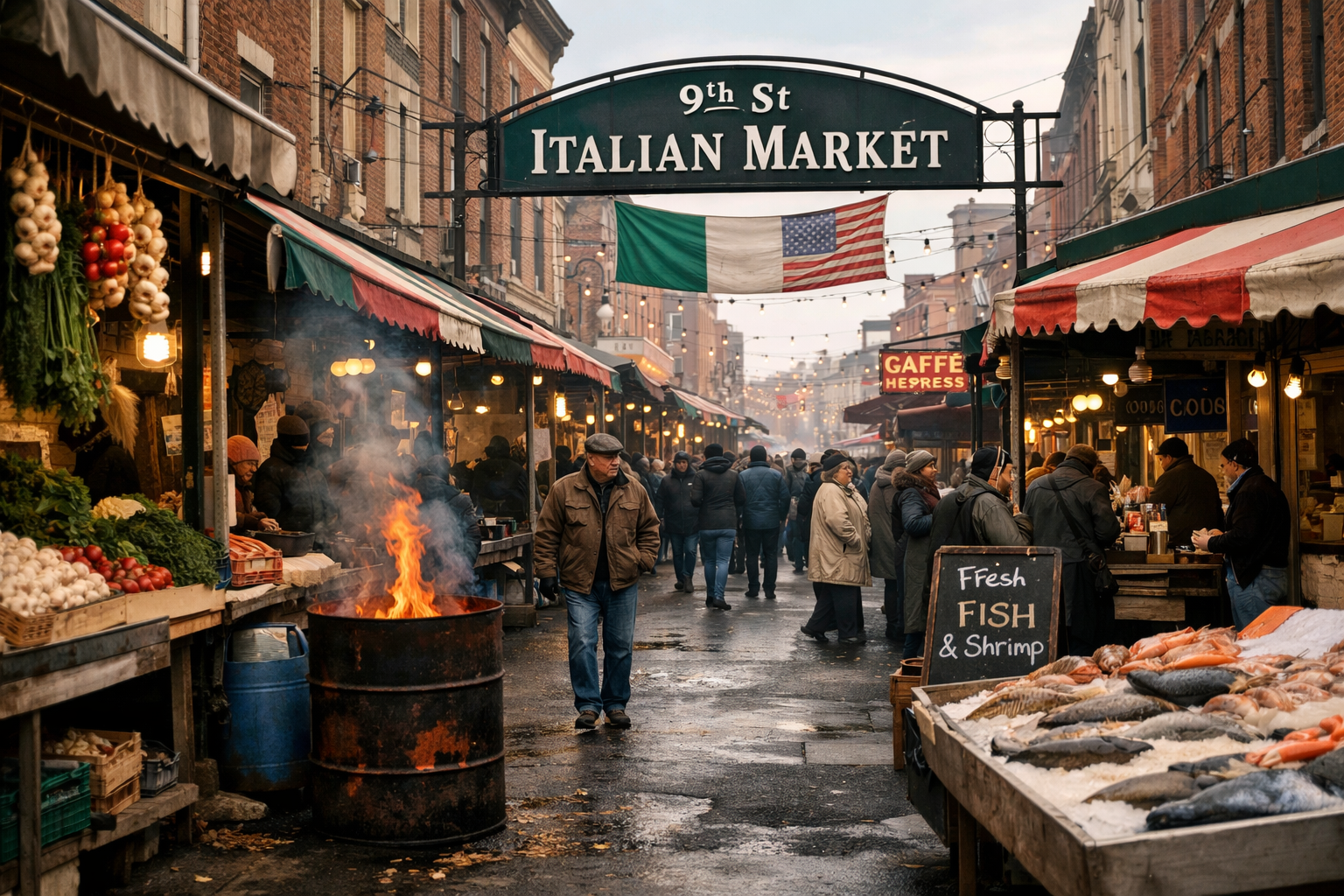
There are awnings — metal, colorful, extending over the curb in a way that has been roughly consistent for over a century. There are barrels of fire in the winter, when vendors use them to keep themselves and their customers warm while they work. There is the smell — herbs and spices and fresh seafood and ground coffee and something cooking somewhere, all of it layered together in a combination that is immediately, unmistakably 9th Street and nowhere else on earth. There is the sound of multiple languages, the crackle of butcher paper, the particular ambient noise of a working street market that has been working continuously since the 1880s.
The influx of international influences on the South 9th Street Italian Market, and its surrounding neighborhood is a wonderful assault on the senses. The smell of herbs and spices, fresh seafood, and ground coffee beans mingles perfectly with the crackle of the butcher's brown paper, multiple languages heard on the street, and the sight of fresh sheets of pasta and silky ribbons of homemade chocolate drying in storefront windows — not to mention the dozens of rows of colorful produce. Italianmarketphilly
That sensory environment is not designed. It is accumulated. It is the physical residue of 140 years of people selling things they grew, made, imported, and cured — first because their community needed it, then because the city needed it, then because people came from everywhere to experience what had built up in that specific half-mile of South Philadelphia that cannot be replicated anywhere else.
The Italian Market didn't need a brand strategy. It was one. And it still is.
How It Actually Started
The market began in the mid-to-late 1880s when Antonio Palumbo, an Italian immigrant, opened a boarding house in the neighborhood for other Italians. Businesses sprang up to serve this growing community and began to form the largest, outdoor, continuous market in the country. Food stalls began to occupy the east side of 9th Street, where merchants sold fresh fish, fruit and vegetables. A number of butcher shops began to offer the highest-quality cuts of meat. Cheese shops, restaurants and bakeries filled the west side of South 9th Street. Italianmarketphilly
There was no grand plan. There was a boarding house, then a community, then the businesses that a community needs when it is building itself from scratch in a new country. The market didn't arise from a real estate development strategy or a municipal initiative to create a commercial district. It arose from necessity — from the basic human requirement for food, for goods, for a place to buy and sell in a language you understood, among people who shared your history.
Endemic poverty in Southern Italy and Sicily resulted in mass immigration at the turn of the 20th century, with upwards of four million Italians resettling in the United States in the hopes of securing a better life. The burgeoning Italian community repurposed the first floors of the area's row homes as storefronts, retaining the other floors for family living quarters and boarding rooms. Hidden City Philadelphia
The architecture itself is the original brand identity: buildings where people lived upstairs and worked downstairs, where the business was not separate from the life but continuous with it. Where the owner was not a distant investor but the person behind the counter, whose family ate the same food they sold, whose reputation was inseparable from the quality of what they produced. That structure — family ownership, multigenerational presence, life and livelihood occupying the same building — is the foundation on which everything else was built.
Around this time, successful lobbying efforts resulted in city and state governments designating 9th Street as a curb market, thereby permitting merchants the right to sell their products out of pushcarts and stands along the sidewalk. Hidden City Philadelphia This distinctive commercial district gradually became known as the Italian Market by the middle of the 20th century. Hidden City Philadelphia Before that, South Philadelphians just said they were going to 9th Street, and everyone knew what that meant.
What Accumulated on 9th Street
The community was somewhat self-contained: there was a bank, a funeral home, furniture store, tailor, seamstress, barber, doctor, dentist. The market continued to thrive and service the community with the opening of butchers, bakeries, a butter store, clothing shops, pharmacy, realtor, shoemaker, restaurants and bars. Ralph's is still operating today as the oldest family-owned Italian restaurant in the country. Italianmarketphilly
At the market's zenith in the 1960s, there were 30 butcher shops and 23 fish stores, and the fruit, vegetable, and other stands extended uninterrupted from Wharton to Christian Street. Jewish people sold clothing, Greeks had spice stores, and Italians the rest, mostly. Fante's Kitchen Shop
What makes this accumulation significant is the density of it. Thirty butcher shops on a single street is not redundancy — it is a complete ecosystem. Each butcher had a specialty, a regular clientele, a reputation built around a specific cut or a specific preparation or a specific relationship with a specific supplier. The competition sharpened everyone. The density attracted customers who could comparison-shop and find exactly what they needed rather than settling for what was available. The street became a destination not despite its concentration of similar businesses but because of it.
This is the Italian Market's foundational brand insight, the one that no consultant would have recommended and that emerged organically from the logic of immigrant community building: when you put genuinely excellent, genuinely specialized businesses in close proximity to each other, the whole becomes vastly more valuable than the sum of its parts. The market is not the sum of its vendors. It is something that exists only in the combination of them — a sensory and commercial environment that no individual vendor could create alone.
The Specific Businesses and What They Teach
Di Bruno Bros.: In 1939, Italian immigrant brothers Danny and Joe Di Bruno opened a small store in Philadelphia's historic Italian Market. The brothers focused on providing premium imported cheeses, gourmet meats, and specialty items. Aside from just selling cheese, Danny and Joe firmly believed in the stories behind each cheese. They noticed their customers not only enjoyed the flavors but also remembered the stories, and the brothers, being natural storytellers, were always excited to share the history and craftsmanship of their cheeses. Di Bruno Bros.
In 1965, as chain grocery stores began to grow in popularity, they reinvented their neighborhood grocery store into a gourmet cheese shop. Di Bruno Bros. "House of Cheese" was born out of a trip to Switzerland that exposed them to some of the best cheeses in the world. Drexel University LeBow College of Business
That pivot is worth examining. Chain grocery stores arrived and made the neighborhood grocery model unsustainable. Instead of trying to compete as a grocery store against businesses with superior scale and distribution, Di Bruno Bros. doubled down into specificity — became the best possible version of the most specific thing they could be excellent at. The cheese cave in the original 300-square-foot store on 9th Street is now the founding location of a four-generation brand with five Philadelphia locations, a wholesale business, and international recognition. The original 9th Street storefront, lovingly known as The House of Cheese, remains — wall to wall delicacies filling the shop's tiny 300-square-foot space. Di Bruno Bros.
The lesson: when the market shifts, don't compete against the new paradigm on its own terms. Find the specific thing you do better than anyone else and become incomparably excellent at it. The 300-square-foot store that survived the supermarket era did so not by getting bigger but by getting more specific.
Fante's Kitchen Wares: Fante's Kitchen Wares stocks any gadget needed to cook the goods sold by its across-the-street neighbors — like it has since 1906. Philly-injury-law
Since 1906. A kitchen supply store on a food market street, selling the equipment required to cook the food sold by the businesses around it. The business model is the market itself — it exists in relationship to its neighbors, not in isolation from them. Fante's doesn't compete with the butchers and the cheese shops. It completes them. Its value is inseparable from the ecosystem it inhabits.
This is a profound piece of brand positioning that was never articulated as brand positioning: define yourself in relation to the community you serve, not in relation to abstract category competitors. Fante's is not trying to be the best kitchen supply store in America. It is trying to be the essential kitchen supply store for the people who shop at the Italian Market. That specificity has kept it relevant for 120 years.
Ralph's Italian Restaurant: Ralph's is still operating today as the oldest family-owned Italian restaurant in the country. Italianmarketphilly It opened on 9th Street in 1900. It has been in the same family for 125 years. It is three blocks from where it started. It is the oldest family-owned Italian restaurant in America not because of a marketing campaign but because the family kept showing up, kept cooking the same food, kept serving the same community across five generations of change in the neighborhood, the city, and the country.
The Immigrant Brand Logic That Advertising Can't Replicate
The Italian Market's identity — and the identity of every long-lived business on it — was built on a logic that has nothing to do with marketing and everything to do with survival.
Immigrants starting businesses in a new country had one asset that transcended capital: reputation. In a community where everyone knew everyone, where word traveled in the same language you spoke at home, where a bad batch of sausage or a short-weighted fish could destroy the social trust that was the only currency worth having — quality was not a marketing strategy. It was survival.
"Danny and Joe believed in themselves and their name — Di Bruno," their grandson recalled. "They were never going to disappoint people." Drexel University LeBow College of Business
Not disappointing people. That's the brand strategy. That's the whole thing. A commitment so total to the quality of what you produced and the integrity of how you operated that the reputation would take care of itself — because in a community that tight, in a market that visible, in a street that dense with relationships and observation, there was simply no alternative.
The Italian Market is the physical manifestation of that commitment, accumulated over 140 years by hundreds of families making the same bet: that genuine quality, delivered honestly and consistently to a community that knows the difference, will outlast anything else.
The entire block is visually striking, with bright signs and colorful metal awnings extending over the curb to protect vendors and buyers. The conviviality of the market makes the experience all the more memorable. In wintertime, many vendors set up burn barrels in the street near their stands to keep themselves, and shoppers, warm. Project for Public Spaces
Those burn barrels in the winter are not a branding decision. They are a practical response to cold weather that also happens to create an atmosphere of warmth and community that no designed experience can manufacture. The market's brand is entirely composed of decisions like this — functional, necessary, accumulated — that together create something that feels irreplaceable because it is.
Why the Market's Diversity Is the Point, Not a Complication
The Italian Market has not been exclusively Italian for most of its history. Although it is considered the social and commercial heart of the Philadelphia Italian community, the Ninth Street Market also contained many Jewish businesses in its inception. Hidden City Philadelphia The area continues to attract new immigrants as a significant number of Vietnamese, Korean, Chinese and Mexican-run businesses have joined the traditional Italian shops in the market. Wikipedia
"We are a market of immigrants, and we're not challenging any of those labels," said artist Michelle Angela Ortiz, who has worked on the Our Market project celebrating the street's mixed heritage. "What we basically are saying is that Ninth Street is all-encompassing." Billy Penn
This matters because the temptation, for any institution with a strong identity, is to freeze that identity at its most recognizable moment and resist anything that complicates the picture. The Italian Market could have tried to remain exclusively Italian. It would have died. Instead, it did what it has always done: absorbed the newest wave of immigrants, gave their businesses a home in the ecosystem of the street, and became more itself in the process — more diverse, more alive, more genuinely representative of the immigrant culture that built it.
Today you can find dishes crafted by James Beard Award-winning chefs, including Phila Lorn of Cambodian noodle house Mawn and Cristina Martinez of Casa Mexico and South Philly Barbacoa — alongside the traditional Italian specialty shops that have been there for generations. Visit Philadelphia
A James Beard Award-winning Cambodian restaurant and a hundred-year-old Italian cheese shop on the same block. That's not a contradiction. That's the Italian Market functioning exactly as it always has — as a place where immigrants build something excellent, where the excellence accumulates, where the accumulation becomes the brand.
What Rocky Saw That He Didn't Need to Understand
The Italian Market was featured in Rocky and Rocky II, most notably in the running training montage where a vendor tosses the boxer an orange in the first film. Wikipedia
Stallone filmed Rocky's training montage on 9th Street in 1976. "I remember being out there watching the filming," recalled Bill Mignucci of Di Bruno Bros. "They let us out of school that day, they lined us up by class order from Washington to Christian Street. It was awesome." ITALY Magazine
Rocky didn't run through the Italian Market because it was a famous landmark. He ran through it because it was where his character lived — because the Italian Market was the physical environment of South Philadelphia working-class life, the place that existed before anyone had to ask what it meant. The market wasn't a symbol in the film. It was a fact. And fifty years later it is still a fact, still on the same street, still smelling like garlic and fresh fish and something cooking somewhere.
That's the only brand strategy that lasts: be so genuinely, specifically, unmistakably what you are that you become impossible to replicate, impossible to replace, and impossible to imagine the place without.
The Italian Market didn't need a brand strategy. It was one. And every business in it, every business that has lasted on it, understood that the market is the brand — and their job was simply to be worth belonging to it.
Talk to Ritner Digital about building digital presence worthy of what you've built →
Ritner Digital is a Philadelphia-based digital marketing agency. Named after a street in South Philly. We know what 9th Street smells like at 8am on a Saturday.
Frequently Asked Questions
Why has the Italian Market survived for 140 years when most commercial districts fade or gentrify into something unrecognizable?
Because it was never a commercial district in the developer sense — it was a community that happened to be commercial. The businesses on 9th Street didn't open because a real estate firm identified an underserved market segment. They opened because families needed to eat, needed work, needed a place to be in a new country among people who spoke their language. The market's survival across six generations of change — the supermarket era, the suburban exodus, the collapse of the surrounding industrial economy, waves of new immigration — is the survival of that community logic. Every new wave of immigrants that has found a home on 9th Street has reinforced the market's essential character: a place where people build something genuine for the community they belong to. You can't replicate that with a development plan. You can only create the conditions that allow it to happen, and then get out of the way.
What is the Italian Market's "brand" if it has no brand strategy?
The brand is the accumulated sensory reality of 140 years of genuine commerce on a specific half-mile of South Philadelphia. It's the smell of the place — herbs and spices and fresh seafood and ground coffee layered together in a combination that exists nowhere else on earth. It's the sound of multiple languages. It's the metal awnings and the burn barrels in winter and the butcher paper and the specific visual texture of a working street market that has been working continuously since the 1880s. None of this was designed. All of it is real. And the people who experience it know the difference between this and a designed experience immediately, even if they can't articulate why. The Italian Market's brand is the physical evidence that something genuine has been happening in this place for a very long time. That evidence is the most powerful brand asset available — and it cannot be manufactured, purchased, or accelerated. It can only be accumulated.
Di Bruno Bros. started as a small neighborhood grocery and became a nationally recognized specialty food brand. What did they get right?
Two things above everything else. First, they bet on specificity over scale when the market shifted. When chain grocery stores arrived and made the neighborhood grocery model unsustainable, Di Bruno Bros. didn't try to compete against businesses with superior logistics and distribution. They doubled down into the most specific thing they could be incomparably excellent at — cheese — and became the House of Cheese rather than the corner grocery. The 300-square-foot original location on 9th Street is now the founding anchor of a four-generation brand. Second, they understood that the story behind the product was part of the product. Danny and Joe Di Bruno were natural storytellers who noticed that customers remembered the history and craftsmanship of the cheeses as much as the flavor. That insight — that the provenance, the process, and the people behind a product are as valuable as the product itself — is the foundation of every successful artisan brand that has come since.
The market describes itself as a "wonderful assault on the senses." What does sensory experience have to do with brand building?
Everything. The most durable brand experiences are multisensory and impossible to replicate digitally. You cannot photograph the smell of 9th Street at 8am on a Saturday when the fish vendors are setting up. You cannot transmit the particular warmth of standing next to a burn barrel in February while a vendor wraps your sausage in butcher paper. You cannot deliver through a screen the specific atmosphere of a working street market where the transactions are real and the people are real and the whole thing has the texture of something that has been happening continuously for longer than anyone now alive can remember. These sensory realities create memory and attachment in ways that visual or verbal branding cannot reach. The Italian Market doesn't need to tell you it's authentic. You smell it before you see it. Authenticity, at that level, is self-evident.
The market has absorbed waves of new immigrants — Italian, Jewish, Mexican, Vietnamese, Korean — without losing its identity. What does that teach businesses about brand evolution?
It teaches that genuine identity is expansive rather than defensive. The temptation for any institution with a strong identity is to freeze it at its most recognizable moment and treat diversity as dilution. The Italian Market could have tried to remain exclusively Italian. It would have died — because the Italian families who built it eventually moved to the suburbs as they prospered, and without new immigrants willing to do what the original Italians did, the street would have emptied. Instead, the market did what it has always done: absorbed the newest wave of people with something genuine to offer, gave them a home in the ecosystem of the street, and became more itself in the process. The lesson for businesses is that genuine identity isn't threatened by evolution. It's threatened by stagnation. The thing that made the Italian Market what it is — immigrant families building something genuine for their community — is still what makes it what it is. The specific immigrants have changed. The logic hasn't.
Fante's Kitchen Wares has been on 9th Street since 1906. What is it actually selling that has kept it relevant for 120 years?
Belonging to the ecosystem. Fante's doesn't compete with the butchers and cheese shops on 9th Street. It completes them — selling the equipment needed to cook the food that the market's other vendors sell. Its value is not defined in relation to abstract category competitors like Williams-Sonoma or Sur La Table. It's defined in relation to the specific community it inhabits. The people who shop at the Italian Market need specific tools to prepare specific foods that are specific to the cultures represented on the street. Fante's provides those tools, has provided them for 120 years, and is irreplaceable to the ecosystem it serves in a way that no general kitchen supply store can be. The lesson is straightforward: define yourself in relation to the community you actually serve, not in relation to the broadest possible category you technically occupy. Specificity creates irreplaceability. Irreplaceability creates longevity.
What does "not disappointing people" mean as a brand strategy, and why is it more powerful than most marketing?
It means making a commitment so total to quality and integrity that the reputation takes care of itself. For the immigrant families who built the Italian Market, this wasn't a marketing insight — it was a survival imperative. In a community where everyone knew everyone, where word traveled in the same language you spoke at home, where a short-weighted fish or a bad batch of sausage could destroy the social trust that was the only currency worth having, the quality of what you produced was not a positioning decision. It was everything. That total commitment to not disappointing the people who depend on you creates a kind of reputation that advertising cannot manufacture, because it's built on direct personal experience rather than claims. Every customer who was not disappointed became an advocate. Every advocate brought someone new. Every generation of that compounding word-of-mouth built the foundation for the next. The Italian Market is what happens when enough businesses operate on that principle in the same place for long enough.
Rocky filmed his training montage on 9th Street. What does that tell us about how the Italian Market functions as a brand?
It tells us that the market had already become the environment of a story before anyone called it a brand. Stallone filmed on 9th Street because it was where his character lived — because the Italian Market was the physical reality of South Philadelphia working-class life, not a set dressed to look like it. The market wasn't a symbol in the film. It was a fact. And the scene where a vendor tosses Rocky an orange as he runs through the market at dawn — that's not a sponsored placement. That's the natural generosity of a community that has been feeding people for a hundred years expressing itself in a film about one of its own. The Italian Market's cameo in Rocky did for its national profile what the Travel Channel's award did for DiNic's and what the Wharton profile did for Wawa: it extended the reach of a reputation that was already real. The reputation came first. The recognition followed.
How does the Italian Market model translate to digital marketing strategy for businesses that aren't outdoor markets?
In three ways. First, specificity beats breadth. The businesses that have lasted on 9th Street are the ones that became incomparably excellent at specific things — the house of cheese, the kitchen shop for the people who cook what the market sells, the oldest family-owned Italian restaurant in America. Generic businesses don't last 120 years. Specific ones do. Digital strategy should reflect the same orientation: own a specific niche, speak to a specific audience, demonstrate specific expertise rather than claiming general competence. Second, the community you serve is your brand. The Italian Market's identity is inseparable from the community it serves and has always served. Your digital presence should reflect the actual people you work with and work for — not an aspirational demographic, but the real customers whose problems you solve and whose trust you've earned. Third, accumulated evidence beats manufactured positioning. The Italian Market's brand is the physical residue of 140 years of genuine commerce. Your digital brand should be the digital residue of genuine work — real case studies, real reviews, real content that demonstrates what you actually know and do. That accumulation is what makes a digital presence worth finding.
What would the Italian Market look like if it had been built by a modern brand consultancy instead of immigrant families?
It would look like every other food hall in every other American city that has tried to replicate what the Italian Market is: a beautifully designed space with curated vendors, a coherent color palette, a strong social media presence, and a grand opening that generates press coverage. It would be clean and photogenic and culturally coherent and almost certainly closed within five years. What it wouldn't have is 140 years of genuine commerce accumulated in the physical environment, three generations of the same family at the same stall, the smell that can't be designed, the burn barrels in winter that nobody planned, the vendor who tosses you an orange because that's what people do on 9th Street when someone runs past. You cannot design authenticity. You can only create the conditions that allow genuine things to happen, protect them from being replaced by cheaper imitations, and get out of the way while they accumulate into something that outlasts everyone who built it.
Talk to Ritner Digital about building a brand that outlasts the trend →