Why Philly Contractors Build Generational Businesses on Zero Advertising (And What That Actually Takes)
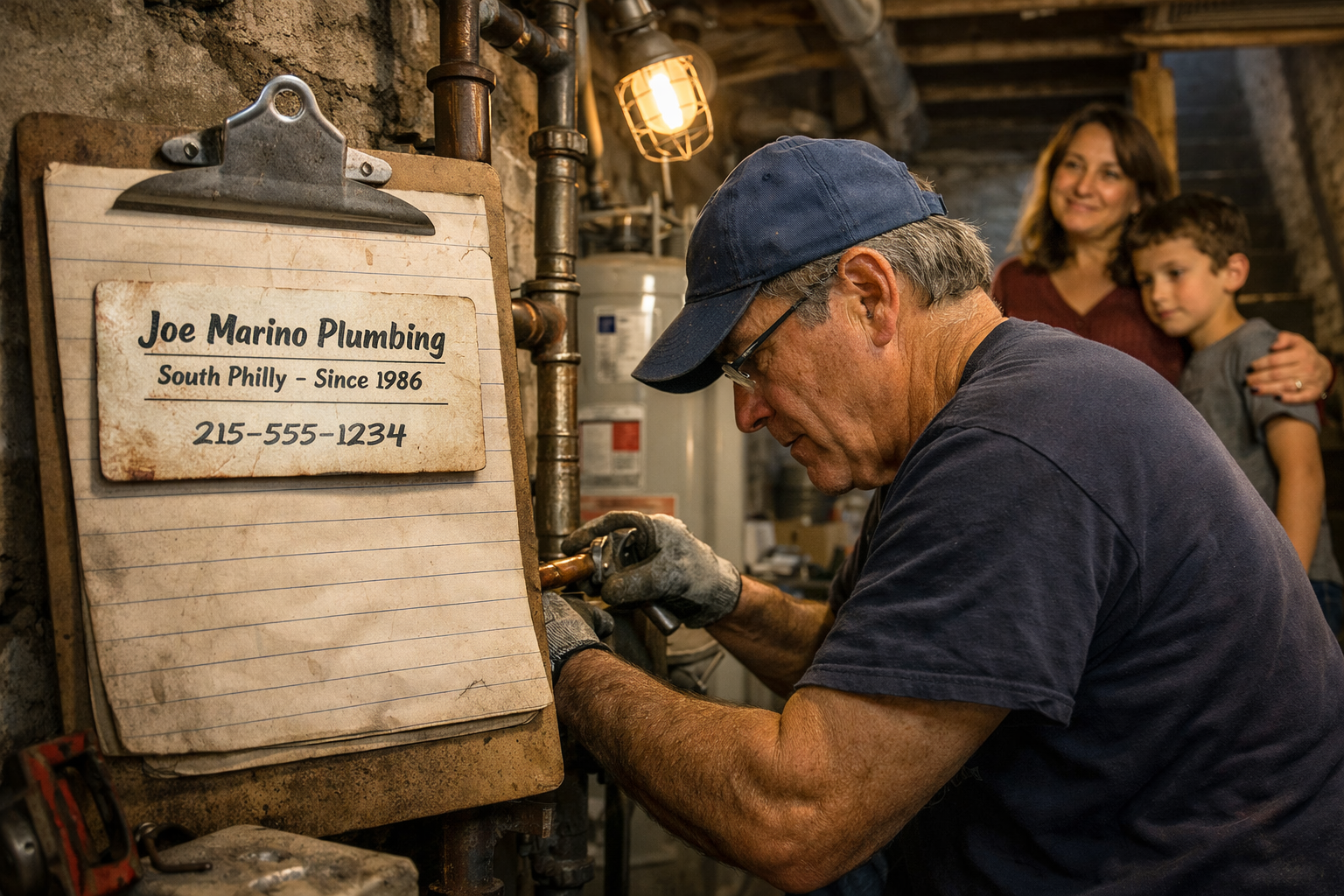
There is a plumber in South Philly who has been doing the same work, in the same neighborhoods, for the same families, for thirty-five years. He has no website. He has no Google Business Profile. He is not on Angi or HomeAdvisor or Thumbtack. His phone number lives in the contact lists of roughly four hundred households, passed from parent to child the way heirlooms and recipes are passed — not because anyone organized a referral program, but because when something works this well, you don't let the next generation figure it out on their own.
His schedule is full. It has been full for twenty years. He turns down more work than he takes.
This is not a unicorn story. This is how the trades have worked in Philadelphia's tight row home neighborhoods for as long as there have been row homes and tradespeople to fix them. The same electrician your parents called. The same roofer who has done half the houses on the block. The same contractor who shows up Monday at 8am exactly when he said he would and leaves the job site cleaner than he found it, because in a neighborhood where everybody knows everybody and your reputation lives on the same block as your customers, showing up when you say you will and doing the work right is not a brand strategy. It is the minimum required to keep operating.
The Row Home as the Architecture of Reputation
To understand why this model works the way it does in Philadelphia, you have to understand what Philadelphia is physically.
Seventy percent of the city's homes are rowhouses. Healthyrowhouse In Philadelphia, approximately 70% of the housing stock consists of row houses, with 75% of these structures being over 50 years old. NorthPennNow
Seventy percent. In a city of 1.6 million people. That is not a housing type. That is the fabric of the city itself.
Philadelphia's first rowhomes date back to the 1600s, influenced by the European city planning style seen in places like London and Amsterdam. As William Penn designed Philadelphia, he prioritized grid-like streets and efficient use of land, which led to the development of rowhouses as an ideal housing solution. MontCo Living
The inherent interconnectedness of row house construction — with shared walls and close proximity — had lasting consequences for Philadelphians who would own and live in them. Row house living at its best was an intimate one that encouraged strong neighborly bonds. Encyclopedia of Greater Philadelphia
Those shared walls are the foundation of the contractor's referral network. When your plumbing problem is heard through the party wall by your neighbor, and your neighbor has a plumber they trust, the referral doesn't require a Yelp review or a Google search. It requires a conversation on the stoop. When a roofer works on one house on a block of sixteen identical row homes built in the same decade by the same builder with the same materials, fifteen other homeowners are watching. They know what the work looks like. They can see whether the crew was careful with the property, whether they cleaned up when they left, whether the neighbor looks satisfied or frustrated when she passes them on the street.
The row home block is a quality control system. The work is visible to everyone who might ever need it done. The reputation is continuous and observable in a way it can never be in a city of detached suburban houses.
What the Referral Actually Transfers
The conventional marketing industry talks about referrals as if they are simply word-of-mouth recommendations — one person telling another person that a business is good. And that is part of it. But in Philadelphia's tight neighborhood networks, what a referral actually transfers is something deeper: personal accountability.
When your neighbor gives you her plumber's number, she is not just telling you he does good work. She is putting her own reputation on the line. She has been in this neighborhood for twenty years. You have seen her every day for twenty years. If the plumber she recommends shows up late, does shoddy work, or overcharges you, the next conversation you have with her will be uncomfortable. The social cost of a bad referral in a neighborhood this dense is real — it damages the relationship between the referrer and the recipient, not just the reputation of the business being referred.
This is why referrals in these communities are not casual endorsements. They are endorsements made only when the endorser is genuinely confident. Which means every referral that moves through the network carries the weight of a genuine voucher, not a casual suggestion. Which means the leads it generates are better qualified, more trusting, and more likely to convert than any cold inquiry from a digital platform.
According to Nielsen, 92% of consumers trust recommendations from people they know. Personal referrals remain the number one way prospective customers discover and choose local businesses. Unlike impersonal ads, a referral from a satisfied neighbor or friend carries emotional weight that no campaign can match. My Office Help
In Philadelphia's row home neighborhoods, that emotional weight is multiplied by the density of the social network and the visibility of the work. The contractor's reputation is not an abstraction living in a star rating. It is a physical fact, visible from the street, evaluated by people with genuine stakes in the quality of the assessment.
The Specific Things That Build This Kind of Reputation
The contractor who has been doing this for thirty-five years without a website did not get there by accident. There are very specific behaviors that build the kind of reputation that sustains a trades business through three decades of referral growth in a dense urban neighborhood.
You show up when you say you will. This sounds like the minimum. In the trades, it is the differentiator. The most common complaint about contractors, across every market and every trade, is that they don't show up when scheduled, don't return calls, don't communicate about delays. In a neighborhood where your customer's neighbor is watching, where the person who referred you is paying attention to how you treat their friend, where your next job is almost certainly in the same ten-block radius as your current one — failing to show up when you said you would is a reputation event that reverberates. Showing up on time, every time, is not a brand promise. It is the baseline requirement to participate in the network.
You do the work right, not just adequately. The row home is a specific, demanding technical environment. Philadelphia's row home housing stock is predominantly pre-1940, with older building systems, narrow floor plans, flat roofs behind parapets, and shared party walls that require specialized knowledge. Phillyhomeadvisors A contractor who has spent twenty years working in South Philly row homes understands the quirks of that specific housing stock — the typical plumbing configurations, the common electrical issues in homes of a certain era, the masonry characteristics that determine how a repair needs to be made — in a way that a generalist contractor or a national service company does not. That specific expertise is not marketed. It is demonstrated, job by job, in work that lasts and doesn't require callbacks.
You clean up. This is the detail that separates the contractors who get referred from the ones who don't. A row home is someone's entire world — their kitchen, their bathroom, their front stoop that faces the street where their neighbors walk past every day. Leaving the job site clean, treating the space with respect, not tracking mud through the house or leaving debris on the stoop — these are not above-and-beyond gestures. They are the observable evidence of whether a contractor respects the customer and the neighborhood. And in a neighborhood this dense, everyone sees it.
You price honestly and don't create surprises. In a tight-knit community where everyone compares notes, pricing that is significantly out of line with market rates — in either direction — generates conversation. The contractor who charges fairly, who doesn't pad estimates, who calls when something unexpected arises rather than springing it on the invoice — that contractor is discussed as trustworthy. That quality passes through the network. The contractor who does the opposite is also discussed.
You stay connected to the community. The plumber who has worked these neighborhoods for thirty-five years is not just a service provider. He is a person who lives in or near these neighborhoods, who has the same conversations about the Eagles and the Phillies and the state of the block, who knows which families have been there for decades and which ones are new. That presence — genuine, not performed — is the foundation on which the professional reputation is built.
Where the Referral-Only Model Hits Its Ceiling
Now for the part of this conversation that most contractors who've built this kind of business don't want to have: the model has a ceiling, and that ceiling can become a wall.
The referral network operates within a defined geographic and social range. The same density that makes it so powerful also limits it. The plumber everyone in South Philly trusts is unknown in Fishtown, unknown in the Northeast, unknown to the young professional who just moved into the neighborhood from somewhere else and doesn't have a neighbor yet who knows his number.
There are three specific ways this ceiling becomes a problem:
Generational turnover. Philadelphia's neighborhoods are changing. Long-established communities are seeing new residents who don't have decades of neighborhood relationships to draw on when their hot water heater fails. These residents default to Google, to Nextdoor, to whatever shows up first when they search for a plumber. The contractor with no digital presence is invisible to this growing segment of the market — not because their work isn't good enough, but because the channel through which new residents find contractors isn't the one this contractor operates in.
Geographic expansion. A contractor who wants to grow beyond the three-block radius where their reputation is established has to start building a new reputation from scratch in every new neighborhood they enter — unless they have digital infrastructure that makes their existing reputation portable. Reviews, case studies, a website that shows the quality of their work: these are the tools that allow a reputation built in one place to be visible to people in another. Without them, every new market is a cold start.
The retirement transition. The most underappreciated ceiling in a referral-only trades business is what happens when the owner wants to slow down or retire. A business that exists entirely in relationships — in phone numbers stored in four hundred contact lists, in the personal trust of customers who chose this contractor specifically because of who he is — is not a transferable asset. The reputation that took thirty-five years to build lives in the contractor himself, not in the business. When he retires, it largely goes with him. Building digital infrastructure — documented reviews, an online presence, case studies and photos of the work — is the process of making that reputation transferable. It is how the business survives the transition.
What Digital Presence Actually Does for a Contractor This Good
The trades contractors who have spent decades building ironclad referral moats don't need digital marketing to validate their reputation. They don't need a five-star average on Google to prove they do excellent work. Their customers already know.
What digital presence does for a contractor this good is three things:
It makes the reputation findable by people outside the existing network. The new resident who just moved into the neighborhood has no neighbor to ask yet. Their first move is a Google search. If your business doesn't appear in that search — or appears with an incomplete, unoptimized Google Business Profile and no reviews — you lose the customer to whoever does appear. The referral network would have sent them to you eventually. Digital presence gets them there now.
It extends the geographic reach of the reputation. A Google Business Profile with specific service area listings, with reviews that describe specific work in specific neighborhoods, with photos that show the actual quality of the work — this makes the reputation that exists in one part of the city visible and credible to potential customers in another part. Not instead of the referral network. In addition to it.
It makes the business transferable. A documented portfolio of work, a library of genuine customer reviews, a website that accurately reflects the quality of the operation — these are the assets that survive the owner. They are the foundation on which a transition can be built, whether that's a sale, a handoff to the next generation, or a gradual reduction in hours. Without them, thirty-five years of excellent work lives only in the memories of the people who experienced it.
The Synthesis
Row home Philadelphia runs on the same three plumbers, electricians, and contractors your parents used. That's not a limitation of the market. That's the market working exactly as designed — built on trust, accountability, visible quality, and the social fabric of a city where 70% of the housing stock shares its walls with the neighbors.
The model is not broken. The referral moat these contractors have built is the most durable competitive advantage available in any market. It took decades to build and it cannot be purchased, gamed, or replicated by a national franchise.
What is limited is the reach. The reputation exists. The work is excellent. The problem is that the people who need to find it, and would choose it if they could, can't always see it from where they're standing.
Digital presence — done right, done in a way that reflects the genuine character of the contractor and the actual quality of the work — closes that gap. It doesn't replace the referral network. It extends it. The reputation built on the block gets visible to the people not yet on the block. The work that earned thirty-five years of loyalty earns the next generation of customers who haven't met the neighbor yet.
The plumber with four hundred numbers in his customers' contact lists deserves a Google Business Profile that reflects what those four hundred people already know.
Talk to Ritner Digital about extending the reach of your reputation →
Ritner Digital is a Philadelphia-based digital marketing agency. Named after a street in South Philly. We know which plumber our neighbors use.
Frequently Asked Questions
Why do Philadelphia trades contractors specifically build such strong referral networks compared to contractors in other markets?
The physical structure of the city does most of the work. When 70% of the housing stock is row homes — attached, sharing walls, built in the same eras with the same materials on blocks where families have lived for generations — the contractor's work is constantly visible to everyone who might ever need it done. A roofer who works on one house in a South Philly row of sixteen identical homes built in the same decade is being evaluated by fifteen other homeowners who are watching whether the crew showed up on time, whether they left the stoop clean, whether the neighbor looks satisfied or frustrated. The density collapses the distance between doing excellent work and having that work generate new business. In a suburban market of detached homes, a contractor's reputation can be invisible to neighbors half a mile away. In a Philadelphia row home neighborhood, it is visible from the sidewalk.
What makes a personal referral from a neighbor so much more valuable than a Google review or a lead from Angi?
Personal accountability. When your neighbor gives you her plumber's number, she is not just passing along a recommendation — she is staking her own reputation on it. You see her every day. If the plumber shows up late, does poor work, or overcharges you, the next conversation between you and your neighbor will be uncomfortable. The social cost of a bad referral in a dense neighborhood is real and personal. Which means referrals only travel through these networks when the person making them is genuinely confident — not just satisfied, but confident enough to absorb the social risk of the endorsement. The lead that comes from a neighbor vouching for a contractor with twenty years of shared history behind the recommendation is fundamentally different from a lead generated by a pay-per-click ad. The trust is already transferred before the first phone call.
My contracting business runs entirely on referrals and my schedule is full. Why would I need digital presence at all?
Three reasons, and they all become more important over time. First: generational turnover. Philadelphia's neighborhoods are changing, and new residents who haven't yet built neighborhood relationships default to Google when their boiler fails. They're not in your referral network yet — but they would choose you if they could find you. Second: geographic expansion. If you ever want to grow beyond the blocks where your reputation is already established, digital presence is how your existing reputation becomes visible in new territory. Without it, every new neighborhood is a cold start. Third: business continuity. A business that exists entirely in relationships — in phone numbers stored in customer contact lists, in the personal trust of people who chose you specifically — is not a transferable asset. When you're ready to slow down, retire, or hand off to the next generation, the reviews and portfolio and documented reputation you've built online are the assets that survive the transition. The work you've done deserves to outlast the person who did it.
What are the most important things a trades contractor needs to do to build a strong referral reputation in Philadelphia's neighborhoods?
Five things, in rough order of importance. Show up when you say you will — this sounds like the minimum but it is the primary differentiator in the trades. Do the work right, not just adequately — in the row home environment specifically, this means developing genuine expertise in the specific housing stock you're working in, not just general competence. Clean up after yourself — treating the customer's home with respect is the observable evidence of whether you respect the customer, and in a dense neighborhood everyone sees whether you left the stoop as you found it. Price honestly without surprises — in tight communities where neighbors compare notes, fair pricing travels through the network as its own kind of recommendation. And be genuinely present in the community rather than transactionally extracting from it. The contractor who has been in the neighborhood for thirty years is a person the community knows, not just a service it uses.
What does it mean for a referral network to "hit its ceiling," and how does a contractor know when they've reached it?
A referral network hits its ceiling when the natural geographic and social range of the existing relationships has been saturated — when most of the households within the network's reach either already know you or already have someone they use. The signs are subtle: growth plateaus despite continued excellent work, new customers start coming from progressively fewer sources, the business becomes dependent on a small number of long-standing clients rather than a diverse pipeline. The ceiling is not a failure. It is the natural limit of a model that was never designed to scale beyond the network that built it. For most single-operator or small-crew contractors in Philadelphia's neighborhoods, this ceiling is a comfortable, full business. For contractors who want to grow — into new neighborhoods, into larger project types, into a business that can be valued and eventually sold — the ceiling is the point at which digital infrastructure becomes not optional but urgent.
Isn't a contractor with no website or digital presence actually signaling exclusivity and quality, the way the whisper network works for high-end businesses?
For a very specific kind of client with existing access to the network, yes. The homeowner who grew up in the neighborhood, whose parents used the same contractor, who has a neighbor who will immediately give them the number — that person doesn't need the contractor to be Googleable. But that client is a declining share of the market in most Philadelphia neighborhoods, as generational turnover brings in new residents who don't have those connections yet. More importantly, there's a meaningful difference between a business that is hard to find because it's genuinely exclusive — like Palizzi Social Club, which banned reviews as a deliberate strategy backed by food that creates viral word of mouth regardless — and a business that is hard to find simply because it never built digital presence. The plumber who has been doing excellent work for thirty-five years is not making a strategic choice to be invisible to Google. He just never needed to be visible there. That's a different situation, and one that increasingly costs him the customers who would choose him if they knew he existed.
What specifically should a trades contractor's Google Business Profile include to extend their neighborhood reputation effectively?
At minimum: accurate business hours and service area, a phone number that is actually answered, and photos — real photos of actual completed work, not stock images. The photos matter more than most contractors realize. A homeowner searching for a roofer or an electrician is trying to evaluate quality before they've seen your work in person. Photos of actual jobs — before and after, detail shots showing care and craftsmanship — give them the visual evidence that a star rating alone cannot provide. Beyond that: a regular cadence of genuine reviews from real customers, responded to by the business. Reviews that are specific and describe actual work ("fixed our 1960s cast iron pipes in our Passyunk Square trinity in one afternoon, cleaned up completely, charged exactly what he quoted") do far more work than generic five-star reviews with no description. And a business description that names the specific neighborhoods you serve — not just "Philadelphia" but South Philly, Fishtown, the Northeast, wherever you actually work — because local SEO rewards geographic specificity.
How do you handle the transition when a contractor wants to retire or hand off the business to the next generation?
The transition is only possible if the reputation exists in a form that can be transferred. A business whose entire reputation lives in the contractor's personal relationships, in phone numbers stored in customers' phones, in the trust of people who chose this specific person — that business does not survive the transition intact. The next-generation owner starts from a disadvantage because the customers are loyal to the individual, not the business. The solution is building the documentation now, while the original contractor is still active and can speak to the work. That means a portfolio of completed projects with photos, a library of genuine reviews that describe specific work and specific qualities, a Google Business Profile and website that reflect the reputation the contractor has built rather than the generic contractor category they technically belong to. Each review and each documented project is a piece of the reputation that now lives in the business rather than in the contractor personally. The work you've done for thirty-five years deserves to outlast you.
What's the relationship between the trades referral network and digital marketing — is it either/or?
It's never either/or. The referral network is the foundation — the most trusted, most efficient, most durable lead generation system available to a local trades contractor, and nothing in digital marketing replaces it. What digital marketing does is extend the reach of the reputation the referral network has built. The neighbor referral reaches the people already in the network. The Google Business Profile reaches the people who just moved to the neighborhood and aren't in the network yet. The documented portfolio and reviews reach the homeowner in the next neighborhood over who searches for a contractor and needs credible evidence of quality before they call. Each channel serves a different entry point into the same funnel. The businesses that build both — that maintain the referral network through excellent work while also building the digital infrastructure that makes them findable by people outside the network — grow faster, reach further, and survive transitions better than the businesses that rely on either one alone.
What does Ritner Digital actually do for trades contractors who have strong reputations but limited digital presence?
We start with an honest audit of where the reputation currently stands — what customers are saying, where you're showing up in local search, what a prospective customer finds when they Google you after a neighbor gives them your number. From there we build the digital presence that reflects the quality that's already there: an optimized Google Business Profile with accurate service area targeting, a review strategy that makes it easy for your existing customers to document what they already know about you, photos and content that demonstrate actual work quality rather than claiming it, and local SEO built around the specific neighborhoods where you work and the specific services you provide. We don't manufacture a reputation you haven't earned. We make the reputation you have earned visible to the people who need to find it. The work you've done for three decades deserves to be findable by the people not yet on the block.
Talk to Ritner Digital about extending your reputation's reach →