The Passyunk Effect: Why the Best Businesses in Philly Let the Block Do the Marketing
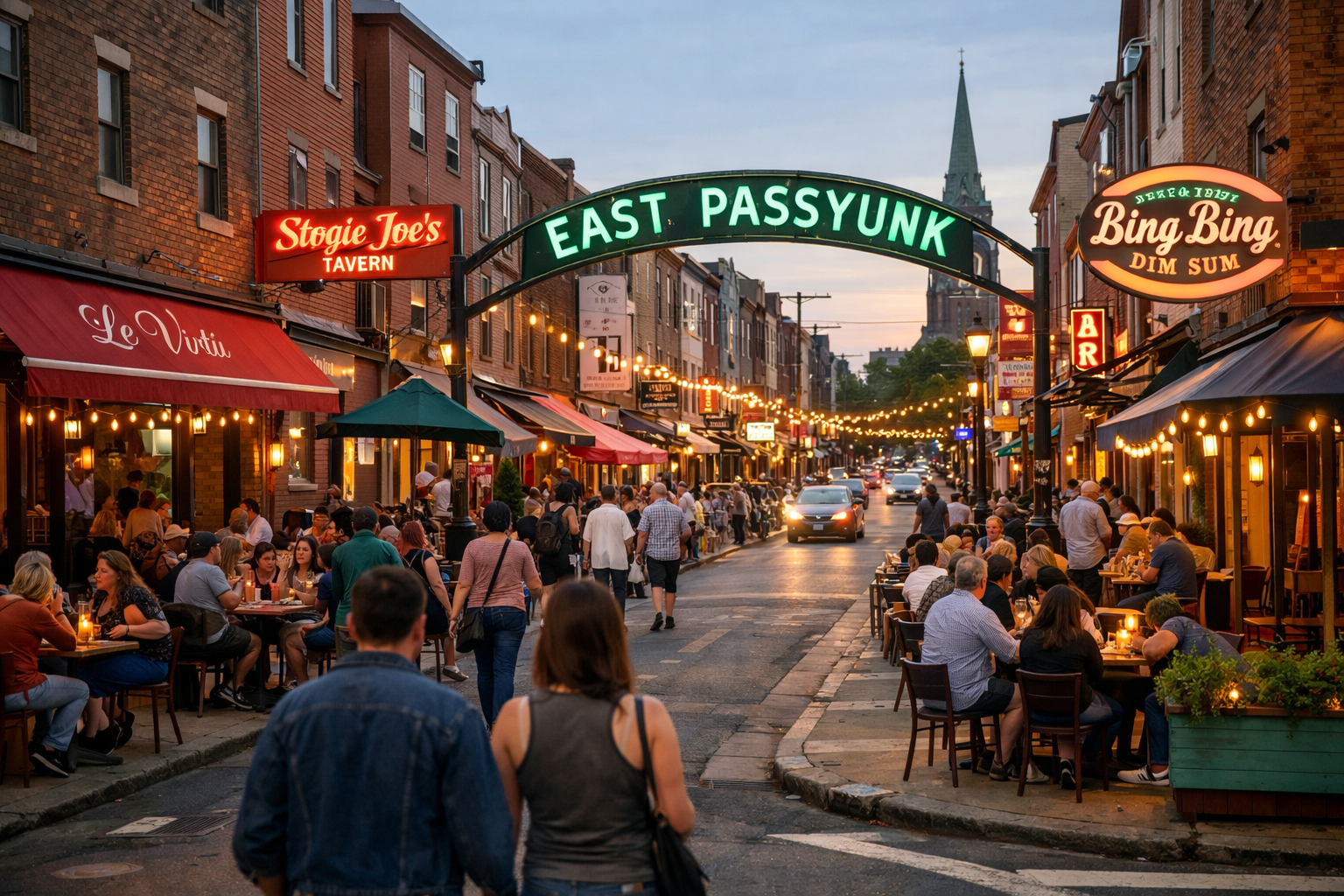
There is a diagonal street in South Philadelphia that cuts straight through William Penn's grid like it doesn't care about the plan. It predates the grid. It predates Penn. It predates every piece of marketing advice ever written about how to build a brand, attract customers, or create a destination people will travel across a city to reach.
East Passyunk Avenue is about a mile and a half long. It runs from the bottom of the Italian Market down through the heart of South Philly, past the Singing Fountain at Tasker Street, past rowhouses and storefronts and restaurants so good they've made national lists without ever running a single ad. It is, by nearly every measure that matters — foot traffic, critical acclaim, repeat visitors, independent business density — one of the most successful commercial corridors in America.
And almost nobody who built it set out to build it.
That's the lesson. Not the restaurants themselves, though they're worth studying. Not the BID programming or the fountain or the food tours. The lesson is what happened when enough people who cared deeply about quality decided to operate on the same block. They didn't build a brand. They built a gravity field. And everything that came after — the press, the reputation, the visitors, the accolades — followed the gravity.
That's the Passyunk Effect. And it applies to your business whether you're a restaurant or not.
What East Passyunk Actually Is
Start with the geography, because it matters.
East Passyunk Avenue is a diagonal drag that slashes through South Philadelphia's grid, bordered by Ninth Street, Snyder Avenue, South Broad Street, and Federal Street. The name comes from the Southern Unami dialect of the Lenni-Lenape people — it translates roughly to "in the valley" — and the corridor has functioned as a commercial strip for as long as there has been commerce in this part of the city. By the mid-20th century it was the spine of Italian American South Philly: mom-and-pop shops, "red gravy" restaurants, families living above their businesses, everything running on the same informal trust networks that powered the entire neighborhood.
Then, for a while, it stalled. The late 20th century was not kind to corridors like this one. Retail decentralized. Chains moved in nearby. Residents who could afford to leave did. The Avenue survived, but it wasn't thriving.
The revival started in 2002, with the creation of the East Passyunk Avenue Business Improvement District. Infrastructure improvements followed — cleaned storefronts, upgraded streetscaping, restored public spaces. But the BID didn't manufacture what came next. What came next arrived because of chefs.
In 2004, Chef Lynn Rinaldi opened Paradiso on the Avenue. At the time, the move was widely seen as a risk. The neighborhood was still predominantly Italian American, the dining scene was anchored by old-school red sauce spots, and there was no particular reason to believe the block could support the kind of ambitious cooking Rinaldi had in mind. She opened anyway.
She was right. And once she was right, other chefs noticed.
What followed over the next decade was not a coordinated strategy. It was a sequence of individual bets on quality, each one made more plausible by the one before it. Highly trained chefs — many of whom had come up in the city's fine dining establishments — began seeding new projects in the neighborhood with minimal capital. The economics worked in part because of Pennsylvania's BYOB culture: without alcohol sales driving revenue, the focus fell entirely on food. Without theatrical presentation requirements and corporate infrastructure, the cooking could be the whole point.
The results were remarkable. Nicholas Elmi, winner of Top Chef: New Orleans, opened Laurel — a 22-seat modern French-influenced BYOB that ranked No. 1 on Philadelphia Magazine's Best Restaurants list and No. 8 on GQ's nationwide Most Outstanding Restaurants ranking, with reservations booked three months out. Le Virtu brought rustic Abruzzo-region Italian and earned recognition as one of the 10 hottest Italian restaurants in the nation by Zagat. River Twice earned a Michelin recommendation. Gabriella's Vietnam packed the house nightly with Vietnamese street food so precise it became a national conversation. Chef Marc Vetri eventually brought Fiorella to the corridor.
Food & Wine named East Passyunk one of the 10 best foodie streets in America. Twelve of Philadelphia Magazine's top 50 restaurants are on the Avenue. The corridor is now home to more than 150 independently owned businesses, with roughly 75 percent locally owned — a number almost impossible to maintain in a neighborhood that has received the kind of national attention East Passyunk has received.
None of these restaurants ran Super Bowl ads. Most of them don't run any ads at all. The block does the marketing.
How a Reputation Engine Actually Works
Here is the mechanism, stated plainly:
When one exceptional business opens in a location, it signals to other exceptional businesses that the location can support quality. When a second one opens, it confirms the signal. When a third opens, the signal becomes a fact. At some point, the concentration of quality stops being a collection of individual reputations and becomes a single, more powerful reputation — the reputation of the place itself.
This is what happened on East Passyunk Avenue. The early restaurants didn't just build their own clientele. They built the credibility of the corridor. Every positive review of Laurel made someone more likely to come to East Passyunk, walk the block, and discover Le Virtu. Every food writer who covered Gabriella's Vietnam was also, implicitly, covering the neighborhood. Every diner who came for one restaurant and stayed to explore created foot traffic that every other business on the block benefited from.
Economists have a term for this: agglomeration effects. Businesses in close proximity to complementary, high-quality neighbors experience spillover benefits they didn't have to earn individually. The block becomes worth more than the sum of its businesses. The destination drives the discovery.
The Passyunk Effect is agglomeration, made visible on a diagonal street in South Philly.
But here's what's important for anyone running a business: the effect is not automatic. It doesn't happen because businesses are near each other. It happens because businesses near each other are all operating at a high level. Lower the quality bar and the effect reverses — instead of mutual elevation, you get mutual dilution. A bad restaurant on East Passyunk doesn't just lose its own customers. It slightly erodes the credibility the block has spent 20 years building.
Quality is the precondition. Everything else follows from it.
The Paradox at the Center of It All
Here's the part that should matter most to any business owner thinking about marketing.
The chefs who built East Passyunk's reputation were, in almost every case, focused almost entirely on their own restaurants. They were thinking about the sourcing, the menu, the 22-seat dining room, the seven-course tasting menu, the seasonal ingredients, the staff. They were not thinking about the corridor's brand positioning or their role in a neighborhood marketing ecosystem. They were thinking about the food.
The paradox is that this inward focus on craft is precisely what created the outward reputation that made the corridor famous.
This is not a coincidence. It is a pattern that appears everywhere in the kind of enduring Philadelphia business culture this blog has been documenting. DiNic's at Reading Terminal Market has been following the fundamentals since 1918 and earned "Best Sandwich in America" without a marketing department. Bassetts Ice Cream has been operating since 1861 and remains because the product has never slipped. The contractors and plumbers who built generational businesses in South Philly rowhouse neighborhoods did it by showing up and doing the work well enough that the neighbors told their neighbors.
The Passyunk Effect is just that pattern scaled to a block. Do the work so well that the work becomes the advertisement. Do it next to other people doing the same. Let the block carry the signal to people who haven't found you yet.
What the Block Can Do That No Ad Campaign Can
There are things that money can buy in marketing. You can buy impressions. You can buy clicks. You can buy placement in search results, space in someone's feed, a moment of attention from a person who was looking at something else.
What you cannot buy is the experience of walking East Passyunk Avenue on a Friday night when the Singing Fountain is running and three different restaurants have lines out the door and you can smell four cuisines from the same corner. You cannot buy the trust that comes from a friend who ate at Gabriella's Vietnam three times and finally convinced you to try it. You cannot buy the credibility of a neighborhood that has sustained 150 independent businesses over two decades without a single major chain replacing any of them.
That is earned. It is earned through the quality of what each individual business actually produces, amplified by the concentration of other businesses producing at the same level, transmitted through the social networks of people who experienced it and told someone else.
East Passyunk's marketing budget, collectively, is whatever each individual restaurant spends on Instagram posts and the cost of printing menus. The reputation it has built would be worth tens of millions of dollars to replicate through paid channels — and couldn't be replicated that way regardless of budget, because it isn't the product of spending. It's the product of quality stacked next to quality stacked next to quality on a diagonal street in South Philly until the whole thing became undeniable.
The Application Beyond the Avenue
You don't have to be on East Passyunk for this to matter to you. The Passyunk Effect operates at every scale.
It operates at the level of professional networks — when you're known as the best in your category in your market, you become the person other excellent people want to be associated with, and that association makes everyone more visible.
It operates at the level of industry positioning — when you occupy a clearly defined corner of your market and own it completely, the press and referrals that come to that corner come to you first.
It operates at the level of digital presence — when your website, your reviews, your Google Business Profile, and your social presence all communicate the same consistent quality signal, the platform algorithms treat you the way the corridor treated individual restaurants: they surface you to people looking for what you do.
What every business on East Passyunk understood, whether consciously or not, is that the market rewards clarity and punishes dilution. The restaurants that built the corridor's reputation were not trying to be everything. Laurel was 22 seats and a seven-course tasting menu. Le Virtu was rustic Abruzzo. Gabriella's Vietnam was Saigon street food done exactly right. River Twice was a seasonal seven-course commitment to Delaware Valley sourcing. The specificity was the point. The specificity was, in fact, the marketing.
Be so specifically excellent that the people looking for what you do have no other answer. Then make sure your digital presence is built well enough that when they're looking, they find you.
That's the whole model. East Passyunk has been running it for twenty years. It still works.
The Digital Passyunk Effect
There is a version of the Passyunk Effect that operates entirely online, and it follows the same rules.
Your Google Business Profile is your storefront. Your reviews are your line out the door. Your website is your dining room — and if it's slow, cluttered, and hard to navigate on a phone, it's the equivalent of a restaurant that smells wrong before you sit down. Your Google Maps ranking is your position on the block: the closer you are to the top, the more of the foot traffic you capture.
The businesses that get this right build the kind of digital presence that functions the way East Passyunk Avenue functions: as a self-reinforcing reputation engine. Good reviews drive visibility. Visibility drives new customers. New customers, if you do the work correctly, drive more reviews. The signal compounds over time exactly the way the corridor's reputation compounded — not through a single campaign, but through consistent quality, correctly documented, surfaced to the people who were already looking.
The businesses that get this wrong spend money on ads to manufacture attention they haven't earned. They get clicks. They don't get the line out the door. They don't get the neighborhood that markets itself.
East Passyunk didn't spend its way to relevance. It earned it. Then it made sure people could find it.
That second part — the "make sure people can find it" part — is what we do.
Ready to build the digital presence your business has already earned? Talk to Ritner Digital.
Frequently Asked Questions
What is the Passyunk Effect?
The Passyunk Effect is the phenomenon by which businesses concentrated in a high-quality corridor benefit from each other's reputations — each excellent business making the block more credible, which drives foot traffic that benefits all of them. East Passyunk Avenue in South Philadelphia is the clearest example, but the pattern appears anywhere that high-quality businesses cluster in a defined space.
Why did East Passyunk Avenue become a restaurant destination?
The transformation began with the creation of the East Passyunk Avenue Business Improvement District in 2002 and accelerated when trained chefs began opening ambitious, independently owned restaurants on the corridor starting around 2004. Each successful opening increased the credibility of the block and attracted more high-caliber operators. The concentration of quality created a destination reputation no individual restaurant could have built alone.
What makes East Passyunk different from other restaurant corridors?
Roughly 75 percent of East Passyunk businesses are independently owned — an extraordinary number for a corridor that has received national recognition. The Avenue has sustained over 150 independent businesses without the chain replacement that typically follows neighborhood fame. That independent density is both the source of the corridor's distinctiveness and the evidence that quality-first business culture is durable.
What is a BYOB restaurant and why does Philadelphia have so many of them?
A BYOB — bring your own bottle — restaurant allows guests to bring their own wine or beer, with no alcohol sales revenue for the restaurant. Philadelphia has a high concentration of BYOBs because state licensing requirements historically made liquor licenses expensive and difficult to obtain, creating a workaround that, ironically, focused both chefs and diners on food quality above all else. East Passyunk's BYOB culture was a significant factor in the corridor's rise.
How does the Passyunk Effect apply to businesses outside the restaurant industry?
Any business that occupies a clearly defined, high-quality position in its market and operates near other excellent businesses benefits from similar dynamics. In digital terms: a well-reviewed, well-positioned business on Google Maps receives traffic spillover from the credibility of the category it occupies. In professional terms: association with other excellent operators increases perceived quality. The mechanism is the same — quality proximity creates collective credibility.
What does it mean for a neighborhood to "do the marketing"?
When a corridor like East Passyunk becomes a recognized destination, the destination itself drives discovery. People come to the block looking for something good, find multiple options, and distribute their attention across multiple businesses. Word of mouth about any one restaurant also promotes the block. Press coverage of the neighborhood promotes every business on it. The place becomes the advertisement.
How does East Passyunk maintain its independent character despite national fame?
A combination of factors: the BID and PARC (Passyunk Avenue Revitalization Corporation) own several mixed-use properties on the corridor and lease to local tenants, giving them structural control over the retail mix. The corridor's diagonal geography and dense rowhouse surroundings create a physical intimacy that doesn't easily accommodate the footprint of major chains. And the reputation for quality and independence has attracted operators who specifically want to be part of that culture.
What role do online reviews play in the modern version of the Passyunk Effect?
Reviews are the digital equivalent of the word-of-mouth networks that built the corridor's reputation. A restaurant with 400 five-star reviews on Google and Yelp signals the same quality credibility that a line out the door signals on the street. The platform algorithms reward consistent review quality with search visibility, functioning as a digital version of the foot traffic spillover that benefits clustered, high-quality businesses.
What is the Singing Fountain and why does it matter?
The Singing Fountain sits at the intersection of East Passyunk Avenue, Tasker Street, and 11th Street — a triangle-shaped public space with benches and speakers that play music, functioning as the neighborhood's gathering hub. It serves as the visual anchor for the corridor: restaurants cluster around it, outdoor seating faces it, and it creates the kind of human-scale public space that makes a commercial corridor feel like a place rather than just a strip of storefronts. The PARC recently completed an extensive renovation of the fountain.
What is the business lesson of East Passyunk for owners who aren't on the Avenue?
Be so specifically excellent that the people looking for what you do have no other answer. Build your digital presence well enough that when they're looking, they find you. The Passyunk Effect is not geography-dependent — it's quality-dependent. A business that occupies its category with the same clarity and commitment that Laurel or Gabriella's Vietnam occupies theirs will generate the same kind of earned, compounding reputation, online and off.