Is Meme Marketing Still a Thing? Yes — But Not the Way You Think.
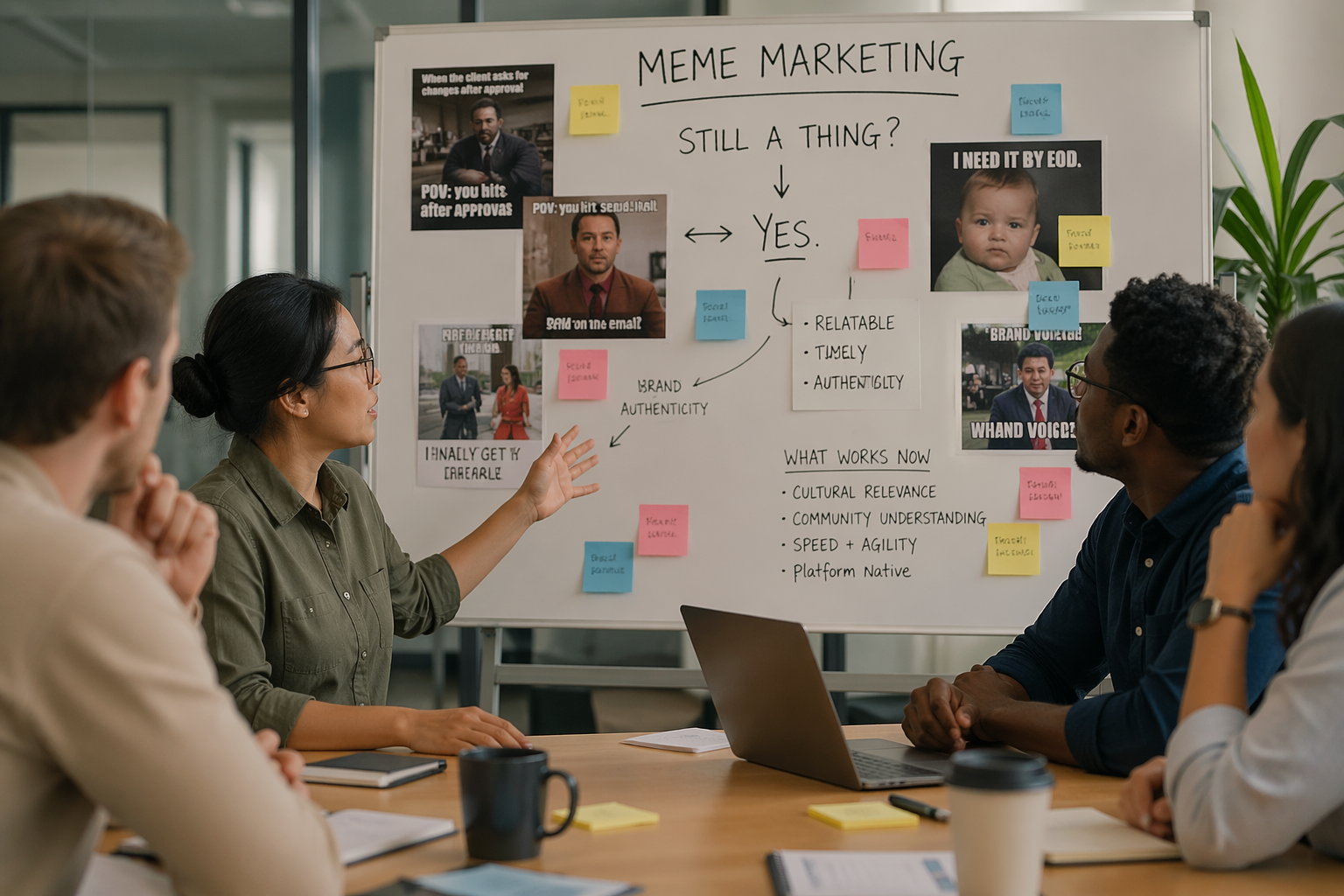
Every few years, someone in a marketing meeting asks the question: "Should we be doing memes?" And every few years, the answer is more complicated than the question deserves.
So let's settle it properly. Meme marketing is not only still a thing — it's bigger, more sophisticated, and more strategically important than it's ever been. The global meme industry was valued at $2.3 billion in 2020 and has since grown at a clip that outpaces most traditional advertising sectors. But the brands winning with memes in 2025 and beyond aren't doing what most people picture when they imagine "a brand doing memes." They're not slapping a product photo on a Distracted Boyfriend template and hoping for virality. They're doing something much more intentional — and much harder to fake.
Here's the full picture.
Meme Culture Is Not a Niche Anymore
Before we talk strategy, let's establish the scale of what we're actually dealing with.
Approximately 5 to 6 million memes are created daily, reflecting the pervasive nature of meme culture in digital communication. Instagram users alone share over one million memes daily. Amra & Elma This is not a corner of the internet for teenagers. It is the internet. Memes are how a significant portion of online culture processes news, emotions, relationships, and yes — brands.
More than three billion people use social media, and 60 percent use it to share memes and funny content. More than 60 percent of consumers in online communities say they would be more inclined to purchase from a business that uses memes in its advertising. Forms.app
Memes generate ten times more organic reach and 60 percent higher engagement rates than regular marketing graphics, with meme campaigns achieving 19 percent click-through rates compared to just 6 percent for average marketing campaigns. Cube Creative Design
Those numbers are hard to dismiss. But raw reach statistics only tell part of the story. The more interesting question is why memes work — and the answer gets at something fundamental about how people actually want to interact with brands today.
Why Memes Work: The Psychology Behind the Share
Memes are not random. They function because they tap into something specific about human communication — the need to feel understood, and the pleasure of recognizing a shared experience before anyone has to explain it.
Research published in marketing literature explains that memes function as "mental frameworks" or schemas that simplify complex ideas, dramatically lowering the cognitive load required for a user to understand and internalize a concept. Cube Creative Design A meme communicates in shorthand. It says "you know this feeling" without having to describe the feeling. That efficiency is enormously valuable in a content environment where attention is measured in seconds.
There's also the social function. 36 percent of individuals share memes to express emotions, 35 percent use them as coded messages, and 28 percent rely on them when words fall short. Amra & Elma Memes are a language — a way people communicate identity, humor, frustration, and belonging. When a brand participates in that language fluently, it stops being an advertiser and starts being a participant in the conversation.
That distinction is everything. Research shows that when brands engage in ways that feel less like marketing and more like shared digital culture, the content feels unexpected and entertaining and invites audiences into a moment. Humor, especially online, is a powerful emotional hook — it invites people to share the content and fosters emotional connection, making brands feel human. Yahoo!
That last word is the key one. Human. Consumers aren't looking for brands to be funny. They're looking for brands to feel like something other than a corporation reading from a marketing brief.
The Brands That Get It Right
The clearest case study in modern meme marketing is Duolingo — and it's worth examining in detail because what they've built is far more disciplined than it looks.
Duolingo didn't grow by following traditional advertising playbooks. Instead, it embraced unpredictability, internet culture, and an "unhinged" brand voice that keeps people talking — from Duo the Owl's aggressive lesson reminders to viral stunts like "Duo is dead." Blankboard
The chaos is intentional. This exaggerated personality is intentionally absurd — borderline cringe — but it works because it shows Duolingo doesn't take itself too seriously. By playing into the platform's chaotic humor, Duolingo has built a cult-like following far beyond the utility of its app. Peter Fisk
The key insight from their approach: the account is less about selling Duolingo to TikTok audiences, who notoriously don't want to be sold to, but entertaining them. The brand's ability to lean into "unhinged content," leveraging viral trends, interacting with other TikTokers in the comment section, and poking fun at themselves is meant purely to entertain. Digiday
Wendy's built the same playbook on Twitter years earlier — savage competitor jabs, real-time responses, self-awareness — and it became one of the most studied brand social media strategies in history. Ryanair did it in Europe, leaning into its own reputation for no-frills service and turning self-deprecation into entertainment. Scrub Daddy, the smiley-faced sponge brand from Shark Tank, has taken TikTok by storm with unexpectedly wild creative content, giving its sponges vibrant personalities that shine in quirky skits and leaning heavily into visual storytelling. NoGood
What these brands share is not a content calendar full of meme templates. They share a genuine brand voice, a willingness to be weird, and — crucially — consistency. Consistency is key. Duolingo never breaks character, whether in app notifications, TikTok videos, or real-world stunts. A one-time viral moment does not make a brand unforgettable. Blankboard
The Trap Most Brands Fall Into
Here's where the conversation gets uncomfortable. For every Duolingo, there are fifty brands who saw the headlines, convened a meeting, and decided to "start doing memes." Most of them failed — not because the strategy is wrong, but because they misunderstood what they were actually doing.
Timing presents the biggest challenge because memes have extremely short lifespans, and brands that use outdated or forced memes risk looking out of touch. A meme that was hilarious yesterday can become cringe-worthy overnight, creating potential embarrassment for companies. Wikipedia
Beyond timing, there's the deeper problem of authenticity. After Wendy's went viral, people started trying to copy and paste the same strategy. But what worked for Wendy's was built over years of consistent voice and genuine audience understanding — not a template anyone could replicate. Digiday
The misfires are instructive. The danger with mimicking one creator's type of content is that brands can go too niche. And missteps in meme marketing can move stock prices. Social media is no longer a game that can be played loosely — it's where brands are built and broken down. Substack
Even Duolingo, the gold standard, has stumbled. A post that worked contextually for a specific online subculture landed poorly with a broader audience, demonstrating that no brand is immune to the core risk of meme marketing: you are playing in a cultural space you don't fully control.
The line between clever and cringe-worthy is thin. When brands try too hard to be funny or provocative, they risk being perceived as inauthentic, self-serving, or out of touch. Worse, they can alienate audiences or trivialize serious issues. The performative nature of online branding means that missteps are both public and memorable. Yahoo!
What "Meme Marketing" Actually Requires in 2025
Meme marketing has matured beyond a social media stunt. The brands doing it well are operating with a sophistication that looks casual from the outside and isn't.
Research from interviews with digital marketing managers revealed that successful meme campaigns require dedicated teams with expertise in internet culture. Managers emphasized the importance of real-time trend monitoring and rapid content production. IJRPR This is not something you can assign to an intern or batch-schedule three weeks in advance. Memes are perishable goods. Speed and cultural fluency are the product.
The average meme lifespan has shortened to just four months, requiring agile content strategies — but also creating opportunities for quick trend adoption. Cube Creative Design That speed cuts both ways. You can ride a wave quickly, but you can also miss it entirely or arrive after it's already become a joke about brands trying to use it.
The honest requirements for meme marketing done right:
A genuine brand voice that doesn't change when the format does. A team with actual internet literacy, not just social media scheduling skills. Processes for real-time creation and fast approvals — the opposite of most brand content workflows. The self-awareness to know when a meme fits your brand and when it doesn't. And the discipline to say no more often than yes.
Success requires cultural fluency and genuine community participation rather than forced trend-chasing, with businesses treating memes as communication tools rather than gimmicky tactics. Cube Creative Design
Memes and the Bigger Picture
It's worth connecting meme marketing back to the broader shift happening in brand communications — because memes aren't a standalone tactic. They're a symptom of the same thing driving brands toward publisher models and away from interruptive advertising.
Consumers have opted out of being marketed to. They have chosen what to watch, what to follow, and what to engage with. In that environment, the only content that survives is content that earns its place — content that entertains, informs, or resonates. Memes, at their best, do all three simultaneously, in three seconds, for almost no production cost.
63 percent of consumers now expect brands to actively participate in meme culture, up from 41 percent in previous years, with Gen Z respondents significantly more likely to purchase from brands that demonstrate consistent and authentic meme engagement. Amra & Elma
That number is worth pausing on. Not just tolerating memes. Expecting them. From brands they're considering buying from.
The consumer has moved. The question is whether brands will move with them.
The Bottom Line
Is meme marketing still a thing? Absolutely. But the version of it that works in 2025 has almost nothing to do with grabbing a trending format and dropping your logo on it.
The brands winning with memes have built a genuine voice, committed to cultural fluency as an ongoing practice, and accepted that participating in internet culture means sometimes being weird, sometimes being wrong, and occasionally being spectacular. They're not running meme campaigns. They're running brands that speak the language of the internet — and doing it consistently enough that their audience looks forward to what they'll say next.
That's not a tactic. That's a brand strategy. And it's one of the most powerful ones available right now — for brands with the courage to actually commit to it.
Ritner Digital helps brands develop social content strategies that connect with modern audiences through authentic voice, cultural relevance, and publisher-first thinking. Get in touch.
Frequently Asked Questions
What exactly is meme marketing?
Meme marketing is the practice of using culturally relevant humor, recognizable formats, and internet-native content to build brand connection and engagement on social media. It's less about making jokes and more about participating fluently in the visual language of online culture — the same shorthand people use with each other every day. When done well, it doesn't feel like marketing at all. It feels like a brand that actually lives on the internet.
Is meme marketing only for consumer brands or Gen Z audiences?
It's most naturally associated with those spaces, but the underlying principle applies more broadly than most B2B or traditional brands want to admit. The real question isn't "is my audience on TikTok?" It's "does my audience have a sense of humor about their work or their industry?" If the answer is yes — and it almost always is — there's a version of this that fits. It may look more like dry wit on LinkedIn than unhinged chaos on TikTok, but the core mechanic is the same: meet your audience where their culture actually lives.
How is meme marketing different from just being funny on social media?
Being funny is a byproduct, not the strategy. Meme marketing specifically uses existing cultural formats — recognizable templates, trends, sounds, references — that carry built-in meaning for the audience. A brand that makes original jokes is doing one thing. A brand that fluently remixes the formats its audience is already using is doing something different: it's signaling cultural membership. That signal of "we get it" is what builds the kind of brand affinity that translates into actual loyalty.
How do we know when a meme is right for our brand versus when to stay out of it?
The simplest test is this: would your brand plausibly say this to a friend, or does it only make sense coming from a marketing team that spotted a trend? If the answer is the latter, skip it. Memes have an authenticity radar built into the audience — people can feel when a brand is reaching. The other test is timing. If you found out about the trend from a trade publication, it's probably already over. The brands that win with memes are plugged into culture in real time, not three weeks behind it.
What are the biggest risks of meme marketing?
There are three main ones. The first is timing — a meme that lands perfectly today can read as painfully dated next week, and brands with slow approval processes almost always arrive too late. The second is tone mismatch — memes that are edgy, ironic, or absurdist can easily land wrong if the brand doesn't have the established voice or credibility to pull them off. The third is cultural sensitivity — memes travel fast across very different audiences, and what reads as harmless in one context can carry unintended meaning in another. The solution to all three is the same: invest in people who actually understand internet culture, build fast internal approval lanes, and develop the discipline to say no more often than yes.
Do we need a dedicated team or can we outsource meme content?
You need someone — whether internal or external — with genuine cultural fluency, not just social media scheduling skills. The difference is significant. Someone who can schedule posts and someone who can feel when a trend is peaking and turn around a relevant, on-brand response in two hours are very different roles. The brands doing this best have empowered small, fast, culturally plugged-in teams with real creative latitude. The ones doing it worst have committees approving meme templates three weeks after the moment has passed.
How do we measure whether meme marketing is actually working?
Stop looking at impressions alone and start looking at engagement quality. Are people commenting, sharing, and tagging friends — or just scrolling past? Are you gaining followers who stick around, or one-time viral bystanders? Are people talking about your brand in the comments in a way that reflects actual affinity? Saves and shares are the metrics that matter most for meme content, because they indicate the audience found it worth keeping or passing on — which is the entire point. Virality that doesn't compound into anything is just noise with a good week.
Can small or local businesses do meme marketing, or is this only for big brands with big budgets?
Memes are one of the few content formats where a small business can genuinely punch above its weight. The production cost is near zero. The barrier isn't budget — it's cultural awareness and speed. A local restaurant, a regional service business, or a small B2B firm with a sharp sense of humor about its industry can build a genuinely engaged following through meme-native content. In fact, smaller brands often have an advantage here because they can move faster, take more risks, and feel less corporate — which is exactly what the format rewards.