The New Visibility Gap That Most Marketers Haven't Noticed Yet
Something has shifted in how your prospective customers find and evaluate brands — and most marketing dashboards aren't measuring it.
ChatGPT processes over 2.5 billion queries daily. Google AI Overviews now trigger on roughly 48% of all searches. Perplexity is the fastest-growing research tool in enterprise. And 89% of B2B buyers consult generative AI during their purchasing journey. Getpassionfruit
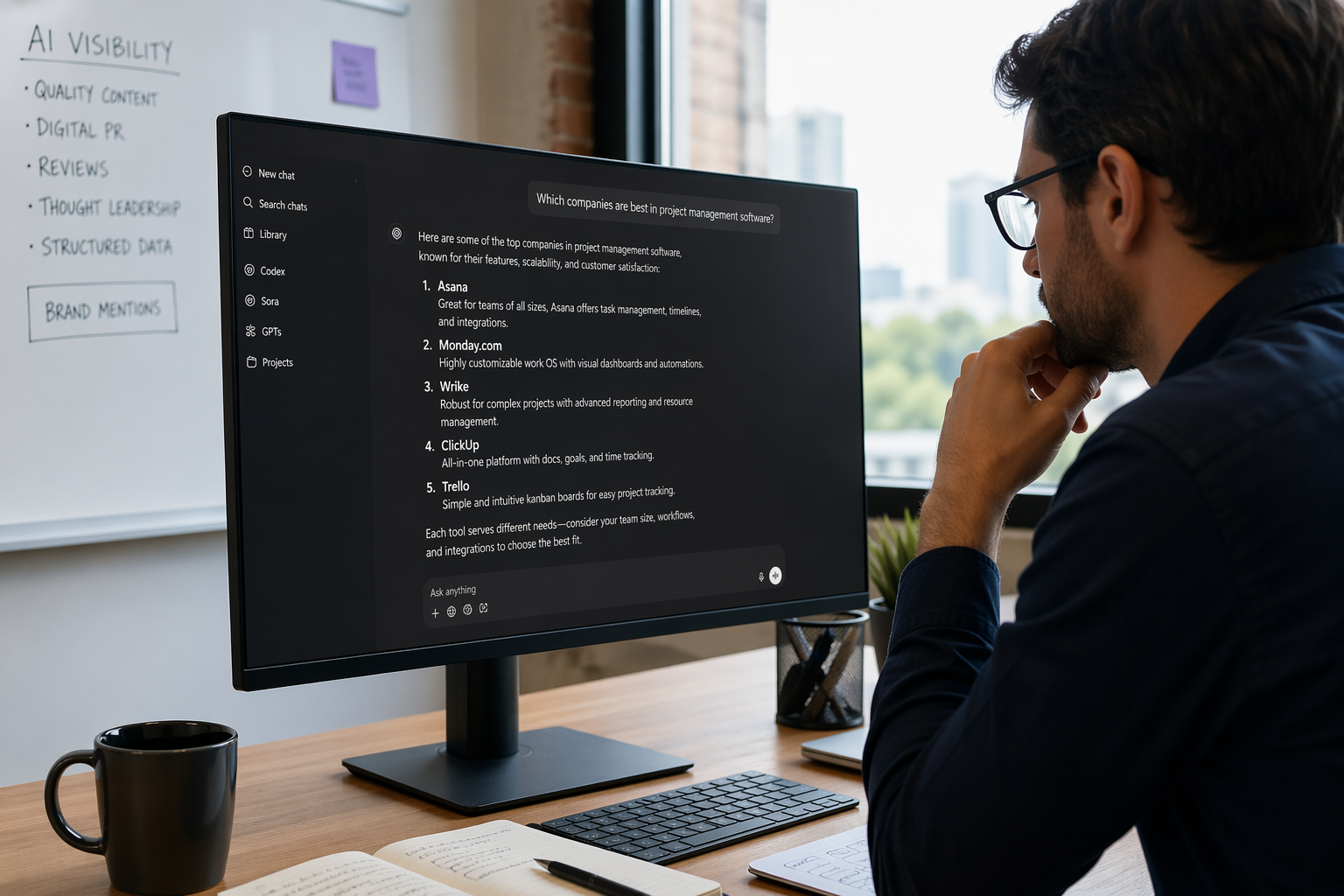
When a buyer asks ChatGPT "what's the best project management software for remote teams" or "which accounting firms are known for working with manufacturing companies," they receive a synthesized conversational answer — not a list of links to evaluate. And in that answer, some brands appear. Others don't. The brands that appear get considered. The brands that don't are invisible to that buyer at the most critical moment in their decision process.
Here's what makes this especially important: your Google rankings may have nothing to do with it. Across ChatGPT, Perplexity, Copilot, and AI Mode, around 80% of cited URLs do not rank in Google's top 100 results for the original query. Superlines
Your competitor who barely shows up in traditional search might be dominating the AI responses your prospects see every day. And you may have no idea it's happening.
This guide explains exactly why AI systems cite some brands and not others, how citation behavior differs across platforms, how sentiment about your brand is formed in AI responses, and — most importantly — how to identify which sources are driving your AI visibility so you can influence it.
Part 1: How AI Systems Actually Decide What to Say About Your Brand
Before you can influence your AI visibility, you need to understand the mechanism behind it. AI systems don't work like search engines that rank pages. They work by synthesizing patterns across massive amounts of training data and, increasingly, live web content.
The Frequency and Consensus Signal
If ChatGPT has seen that a particular word or phrase appears much more frequently when a certain context shows up on the web, it is more likely to produce that word than alternatives. This is how large language models determine output — essentially, words that frequently follow other words based on training data. SparkToro
Applied to brands, this means: if the sentence "for X type of problem, companies often use [Brand Y]" appears across many independent sources on the internet — review sites, forums, trade publications, blog posts, YouTube comments — then when a user asks an AI about that problem type, Brand Y is far more likely to be mentioned than a brand that only appears on its own website.
According to research from Profound and Semrush, AI platforms scan for agreement across multiple independent sources before confidently citing a brand. If your product appears consistently across Reddit discussions, YouTube tutorials, industry publications, review sites like G2, and your own website — all with similar positioning and messaging — AI systems gain confidence in recommending you. This is the "consensus signal" that triggers citations. Conversely, if you only exist on your own website with minimal external validation, AI systems treat your claims with skepticism. Sapt
This is the core dynamic. AI visibility is not primarily about SEO. It is about how broadly and consistently your brand is discussed — and in what context — across the entire ecosystem of sources the AI system draws from.
Domain Authority Still Matters, But Differently
Domain authority is the number one predictor of AI citations. SE Ranking's study of 2.3 million pages found that high-traffic sites earn three times more AI citations than low-traffic ones, with domain traffic as the strongest factor. Superlines
This means that a brand mentioned on a high-authority publication — a major trade magazine, a widely-read industry blog, a top-tier news outlet — carries significantly more AI citation weight than the same brand mentioned on a low-traffic niche site. Where your brand appears matters, not just that it appears.
Freshness Is a Meaningful Signal
Pages updated within 60 days are 1.9 times more likely to appear in AI answers than older content. Superlines
AI systems that use real-time web retrieval — like Perplexity, which crawls live, and ChatGPT when it uses its browse capability — favor recent content. A competitor who publishes regularly on topics relevant to your industry will accumulate fresh citations that push them ahead of a brand with great historical content that hasn't been updated.
Part 2: Why Different AI Platforms Cite Different Brands
One of the most underappreciated facts about AI visibility is that the three dominant platforms — ChatGPT, Google AI (Overviews, Gemini, AI Mode), and Perplexity — use meaningfully different sources and weigh different signals. A brand that dominates in one may be nearly invisible in another.
Yext analyzed more than 6.8 million citations across 1.6 million responses from Gemini, ChatGPT, and Perplexity. There is very little overlap in what each AI model cites. If you optimize for just one, you risk being invisible in the others. These models aren't just different tools — their distinct citation behaviors reveal different approaches to trust and authority. Yext
How Gemini Thinks About Brand Authority
52.15% of Gemini citations came from brand-owned websites. It favors structured, factual content directly from a brand's domain — especially pages with schema markup, local landing pages, and consistent subdomains. It also incorporates data from Google Business Profiles, though it doesn't cite them directly. Gemini rewards ownership. The more structured and complete your website is, the more likely you are to show up. Yext
The implication: for Gemini, your own website is your primary lever. Technical SEO, schema markup, well-organized content with clear factual claims, and a complete Google Business Profile all feed Gemini's trust signals for your brand.
How ChatGPT Thinks About Brand Authority
ChatGPT's approach looks different from Gemini's. Instead of relying on owned content, it appears to draw more from directories and listings. 48.73% of citations came from third-party sites like Yelp, TripAdvisor, and MapQuest. ChatGPT rewards broad distribution and consistency across sources. Make sure your listings are accurate, consistent, and complete across every platform that matters. Yext
ChatGPT appears to operate on the principle that if many independent sources mention a brand in the same context, the brand must genuinely be associated with that context. Your presence on review platforms, directories, trade databases, and third-party recommendation lists is critical for ChatGPT visibility in a way it isn't for Gemini.
How Perplexity Thinks About Brand Authority
Perplexity sources a bit more narrowly, leaning into industry-specific directories rather than general listings. In healthcare, Zocdoc drives citations. In hospitality, it's TripAdvisor. For subjective, unbranded queries, niche sources make up 24% of all citations. Perplexity rewards specialization. Being present and accurate in trusted niche directories signals authority — especially in verticals like healthcare, food, and hospitality. Yext
Perplexity crawls the web in real time — every response is based on fresh web content, not training data. Perplexity is the only major AI platform where brand visibility directly translates into trackable referral traffic in Google Analytics 4, because every citation is clickable with an inline link. Getpassionfruit
The Scale of the Difference Between Platforms
The same brand can see citation volumes differ by 615 times between Grok and Claude, proving that multi-platform tracking is essential. Superlines
That's not a typo. 615 times. A brand that appears in AI responses constantly on one platform may effectively not exist on another. Building your AI visibility strategy around a single platform is a structural mistake.
Part 3: What Sources Are Actually Driving AI Citations
Understanding which specific sources feed AI citations about your brand — and your competitors — is the foundation of any strategic response. The source landscape is more varied than most marketers expect.
Reddit Has Become a Dominant Source
Reddit alone has 100 million daily active users generating conversations about brands. AI engines draw heavily from Reddit, LinkedIn, and YouTube, which ranked among the most-referenced domains by major large language models in October 2025. eMarketer
Reddit's citation share grew by at least 73% from October 2025 to January 2026 across all tracked platforms and categories. On Perplexity, 24% of all citations come from Reddit. ALM Corp
For most industries, there are subreddits where your target customers discuss vendor recommendations, share experiences, and compare products. If your brand is being recommended in those discussions — or criticized — AI systems are ingesting that content and using it to form their understanding of your brand.
Structured Data and Technical Signals
Websites with author schema are three times more likely to appear in AI answers. Sites implementing structured data and FAQ blocks saw a 44% increase in AI search citations. Superlines
Schema markup — the structured data code that tells search engines and AI systems what type of content a page contains — is one of the most direct technical levers for improving AI visibility. FAQ schema, Organization schema, and Article schema with author attribution all increase the probability that your content gets cited.
Third-Party Review Platforms
AI platforms scan for agreement across multiple independent sources before confidently citing a brand. Review sites like G2, Trustpilot, and industry-specific directories are heavily weighted independent validators. Sapt
Your reviews on G2, Capterra, Trustpilot, Google Business Profile, Yelp, and industry-specific platforms don't just influence purchase decisions directly — they are actively ingested as authority signals by AI systems determining which brands to cite.
Wikipedia and Knowledge Graphs
Wikipedia remains one of the highest-trust sources for AI systems training and retrieval. For established brands with Wikipedia presence, the content there often directly shapes what AI systems say about them. For brands without Wikipedia entries, the absence is a meaningful gap in the AI knowledge graph.
Earned Media and Authoritative Publications
Content with statistics, citations, and quotations achieves 30 to 40% higher visibility in AI responses. SuperlinesCoverage in trade publications, industry research reports, and recognized news outlets is some of the most valuable AI citation fuel available. A quote from your CEO in a Forbes article, a mention in a respected industry newsletter, a case study published by an analyst firm — these carry disproportionate weight relative to their perceived marketing value.
YouTube
YouTube presence is heavily weighted by AI systems. Even basic tutorial and thought leadership content builds the video presence that AI systems use as a signal of category expertise. Sapt Brands that have built genuine YouTube audiences in their category — tutorials, explainers, demos, thought leadership — are accumulating AI citation signals that brands without YouTube presence are not.
The Role of Crawlability
To increase visibility in AI answers, start by ensuring your site is crawlable for AI bots like GPTBot and CCBot so your content is actually accessible. Superlines
There is a direct and often overlooked relationship between AI crawler access and AI citation frequency. Amazon has been aggressively blocking AI crawlers, with nearly 50 specific user agents restricted in its robots.txt file by late January 2026 — including all three of OpenAI's crawlers. Walmart, which has not taken the same approach, filled that gap. Its ChatGPT citation share has risen steadily across the same period. ALM Corp
Check your robots.txt file. If you are inadvertently blocking GPTBot, CCBot, PerplexityBot, or Google's extended crawlers, you are removing yourself from those platforms' citation pools.
Part 4: How AI Systems Form Sentiment About Your Brand
Being mentioned in AI responses is only half the equation. How you're mentioned — the sentiment and context that surrounds your brand name — shapes whether those mentions help or hurt you.
Sentiment framing captures the tone and context surrounding a brand mention. Positive or neutral framing contributes to credibility and user confidence. Negative framing may suppress engagement even when the brand is visible. HubSpot
The Sources That Shape Sentiment
AI sentiment about your brand is formed by the aggregate of what independent sources say about you, weighted by those sources' authority. This includes:
Customer reviews across platforms — the cumulative sentiment of your G2, Trustpilot, and Google reviews directly influences how AI systems characterize your brand quality. A brand with hundreds of reviews saying "excellent customer support" will be described in AI responses as having strong customer service, because that claim has independent validation across multiple sources.
Reddit discussions — when users recommend or criticize your brand in communities, that sentiment becomes part of the AI's contextual understanding. A pattern of posts saying "avoid Brand X, their support is terrible" will influence AI sentiment characterizations even if your own website says the opposite.
Earned media framing — how journalists and publications describe your brand in news coverage shapes AI training data. A brand consistently described as "industry-leading" or "trusted by enterprise companies" in trade press will see that framing echoed in AI responses. A brand associated with controversy will see that framing reflected too.
The Volatility of AI Sentiment
AI Overview content changes roughly 70% of the time for the same query, and when the answer updates, almost half of the citations are replaced with new sources. Only about 30% of brands remain visible in back-to-back AI responses for the same query. Superlines
This volatility means that AI sentiment about your brand is not static. A wave of negative reviews, a controversial news story, or a shift in how Reddit communities discuss your category can move your AI sentiment relatively quickly. The same is true in the positive direction — a major earned media win, a surge of positive customer reviews, or a viral piece of helpful content can improve your AI characterization.
Part 5: Why Your Competitor Appears and You Don't — The Most Common Causes
With the underlying mechanisms understood, most competitive AI visibility gaps trace back to one or more of these specific causes:
They Have Broader Third-Party Presence
Your competitor is mentioned on dozens of directory sites, review platforms, and industry databases where your brand has no presence. ChatGPT in particular relies heavily on this distributed third-party signal. The fix is systematic listing building — not just major directories but the industry-specific platforms and databases that AI systems use as authority signals in your vertical.
Their Customers Are More Vocal on Community Platforms
Your competitor's customers discuss their product on Reddit, in LinkedIn communities, and in industry forums. Your customers may be equally satisfied but don't happen to congregate in the same communities — or haven't been encouraged to share their experiences publicly. The fix is engaging authentically in the communities where your buyers are active and making it easy for satisfied customers to become advocates in those spaces.
Their Content Is More Consistently Structured for AI Parsing
44.2% of AI citations come from the first 30% of content on a page. Sapt Competitor content that front-loads its key claims, uses clear question-based headings, implements schema markup, and includes citations and statistics is more easily parsed and cited by AI systems. A competitor with technically inferior expertise but better-structured content will consistently outperform in AI citations.
They Have More Earned Media Coverage
Coverage in recognized trade publications, research reports, and authoritative news outlets is one of the most powerful AI citation drivers. A competitor who has invested in PR and thought leadership — placing articles in industry publications, generating original research that gets cited, building executive profiles on high-authority platforms — is accumulating AI citation signals that are very hard to replicate without similar investment.
Their Content Is Fresher
40% to 60% of cited sources change month-to-month across Google AI Mode and ChatGPT, making visibility far less stable than organic search rankings. eMarketer A competitor that publishes regularly — blog posts, case studies, updated product pages, new research — maintains fresh content that recency-sensitive AI platforms prefer. A brand that last updated its cornerstone content 18 months ago is at a structural disadvantage.
Part 6: How to Measure Your AI Visibility and Identify Citation Sources
You cannot improve what you cannot measure. But measuring AI visibility requires different methods than traditional analytics because, as noted, most AI mentions never generate trackable clicks.
Only about 20% of ChatGPT mentions include clickable citation links that show up in GA4. The other 80% — the brand recommendations, comparisons, and descriptions that shape purchasing decisions — are completely invisible to traditional analytics. Getpassionfruit
Manual Prompt Testing
The simplest and most immediate approach: manually query ChatGPT, Perplexity, and Google AI Mode with the prompts your prospective customers would actually use. Document which brands appear, in what context, with what sentiment, and which sources are cited.
Run the same prompts multiple times — AI responses vary, and a single query doesn't give you a representative picture. Running the same question ten times will give ten different answers. The signal is in the frequency: brands that appear consistently across multiple runs have genuine AI visibility, while brands that appear once or twice may just be catching an edge case. SparkToro
Track: which competitors appear in responses to your category queries, what sources are cited alongside them, how your own brand is described when it does appear, and what sentiment language surrounds each brand.
Dedicated AI Monitoring Tools
A growing category of purpose-built tools has emerged specifically to track brand visibility across AI platforms:
Otterly.AI tracks brand mentions and citations across ChatGPT, Perplexity, Google AI Overviews, AI Mode, and Microsoft Copilot. You define search prompts that mirror real user queries, and Otterly.AI automatically runs these across multiple AI engines, identifying which brands get cited, how often, and in what context. This reveals your Share of AI Voice — the percentage of citations you own versus competitors — and highlights which queries you're winning or losing. Otterly
HubSpot's AEO Grader evaluates brand presence across ChatGPT, Perplexity, and Gemini on five dimensions. The tool evaluates your brand across five scored dimensions — sentiment, presence quality, brand recognition, share of voice, and market position — with sentiment carrying the most weight because it measures how AI characterizes your brand, not just whether it recognizes you. HubSpot
Profound, BrandMentions.link, Superlines and other platforms offer various combinations of AI brand tracking, competitive benchmarking, and citation source analysis.
Tracking Perplexity Traffic in GA4
Because Perplexity always provides clickable citations, it's the one AI platform where referral traffic appears cleanly in your analytics. Perplexity referral traffic appears cleanly in GA4 under Acquisition → Referral filtered to perplexity.ai. Getpassionfruit Monitoring this source in your analytics gives you a partial window into AI-driven discovery that is completely invisible for ChatGPT.
The Four Metrics That Actually Matter
AI visibility comes down to four signals: mentions, or how frequently the brand appears in AI responses tied to key topics; citations, or whether those responses link back to your owned content or just describe you abstractly; sentiment, or whether that context reads positive, neutral, or critical; and share of voice, or how often the brand appears relative to competitors across a consistent prompt set. HubSpot
These four metrics — tracked consistently across a prompt library relevant to your category — give you the most actionable picture of your AI visibility position and how it's moving over time.
Part 7: What You Can Actually Do About It
Understanding the problem is the first step. Here's how to close the AI visibility gap between you and competitors who are appearing when you aren't.
Build Consistent Presence Across the Sources AI Systems Trust
The most impactful single action is expanding your presence across the third-party sources that AI systems use as authority validators. This means:
Comprehensive directory listings across every relevant platform in your industry — not just major generalists like Google and Yelp, but the vertical-specific databases and directories that feed AI systems in your category.
Active review generation across G2, Trustpilot, industry-specific review platforms, and Google. Not just accumulating reviews — actively encouraging specific language about your strengths, so the consensus signal AI systems read is the narrative you want.
Wikipedia presence if you meet notability criteria. For established brands, the absence of a Wikipedia entry is a meaningful gap in the AI knowledge graph.
Engage Authentically in Community Platforms
Reddit, LinkedIn communities, and industry forums are now primary AI training and retrieval sources. Any brand that has wanted to be serious about community but hasn't started should absolutely start taking that more seriously now. eMarketer
This doesn't mean creating self-promotional accounts or gaming subreddits. It means having genuine subject-matter experts engaging helpfully in the communities where your buyers have conversations — answering questions, sharing research, participating in debates. The brands that appear most consistently in AI responses about their category are often the ones whose expertise surfaces most frequently in organic community discussions.
Structure Your Content for AI Parsing
Pages updated within 60 days are 1.9 times more likely to appear in AI answers. Sites implementing structured data and FAQ blocks saw a 44% increase in AI search citations. Superlines
Update your cornerstone content regularly with new data, fresh examples, and current perspectives. Implement FAQ schema on pages that answer common questions. Add author schema to content pieces with named, credentialed authors. Front-load key claims in your content — the first 30% of a page generates a disproportionate share of AI citations.
Invest in Earned Media With AI Citation Value
Not all PR is equally valuable for AI visibility. Placements in high-authority trade publications, mentions in research reports, and coverage that uses the specific positioning language you want AI systems to associate with your brand carry the most citation weight. Build authentic presence across the sources AI systems cite most — PR, earned media, Reddit, Wikipedia, and social. Sapt
Audit Your Crawlability
Check your robots.txt file and ensure you are not inadvertently blocking the crawlers that feed AI platforms. Key user agents to verify access for include GPTBot (ChatGPT), CCBot, PerplexityBot, and Google-Extended. Blocking these removes you from those platforms' citation pools.
Conclusion: AI Visibility Is Now a Strategic Imperative
Brandi AI's 2026 trends report projects that by late 2026, a significant gap will emerge between brands that proactively manage AI visibility and those that don't. Leading brands will consistently appear in AI-generated recommendations, while others will be mentioned less often — losing market share and revenue to competitors they may not even view as threats. Sapt
The brands currently winning in AI search are not necessarily the ones with the highest Google rankings or the biggest advertising budgets. They're the ones with the broadest, most consistent, most authoritative presence across the ecosystem of sources that AI systems trust. They're generating fresh content regularly. They're earning coverage in respected publications. They're active in the communities their buyers use. They're structuring their content for AI parsing. And they're measuring what's happening.
Brand visibility has moved upstream from the SERP to the sentence. These are the new positions of 2026 — invisible on a results page, but visible everywhere else that matters. HubSpot
The competitive gap being created right now between brands that understand this and brands that don't will be very difficult to close once it's established. The time to start is before your competitors have fully figured it out.
Ready to Understand and Improve Your AI Visibility?
At Ritner Digital, we help businesses understand exactly where they stand in AI search — what's being said about them, which competitors are appearing in the responses they should own, and what's driving the gap. We then build the content, authority, and presence strategy to close it.
Book a free strategy call today and let's take a look at how your brand is showing up — or not showing up — in the AI responses your customers are seeing.
👉🏼 Schedule your call at ritnerdigital.com
Sources: Superlines AI Search Statistics 2026 | Yext AI Visibility Citation Analysis | HubSpot AI Search Visibility Playbook | Passionate Fruit AI Brand Monitoring Guide | ALM Corp AI Citation Patterns 2026 | SparkToro LLM Brand Visibility | EMARKETER GEO/AEO FAQ | Sapt AI Search Optimization Guide | HubSpot AEO Grader | Otterly.AI
Frequently Asked Questions
How is AI search visibility different from regular Google search rankings?
They're related but increasingly separate. In traditional search, Google ranks pages and users click through to websites. In AI search, the platform synthesizes an answer from multiple sources and presents it directly — often without any click. Your Google rankings predict almost nothing about your AI visibility. Research shows that around 80% of URLs cited by major AI platforms don't even rank in Google's top 100 results for the same query. A competitor with mediocre SEO but broad third-party presence, active community engagement, and structured content can dominate AI responses while barely registering in traditional search.
Why does my brand appear in some AI responses but not others, even for the same question?
AI responses are probabilistic, not deterministic. The same query run ten times will produce ten slightly different answers. Only about 30% of brands remain consistently visible across back-to-back responses for the same query. What you're seeing when your brand appears inconsistently is that you're in the mix — the AI's knowledge base includes you — but you don't have the signal strength to appear reliably. Consistent visibility requires the kind of broad, multi-source consensus that makes the AI confident in recommending you. Occasional appearances mean you have a foothold. Consistent appearances mean you've built genuine authority.
Which AI platform should I prioritize — ChatGPT, Perplexity, or Google AI?
All three, because they draw from meaningfully different sources and a brand that dominates one can be nearly invisible in another. That said, if you have to start somewhere, prioritize based on where your buyers actually are. ChatGPT has the largest user base and rewards broad third-party presence across directories and listings. Perplexity is the most important for B2B buyers doing research and is the only platform where AI citations translate directly into trackable referral traffic in your analytics. Google AI Overviews and Gemini favor your own website's structure and completeness. Most brands need a different tactical approach for each platform.
How do I find out which sources are currently driving AI citations about my brand or my competitors?
Start with manual testing — query ChatGPT, Perplexity, and Google AI Mode with the category questions your prospective customers would actually ask. Note which brands appear, what language surrounds them, and which sources are cited in responses. Run the same queries multiple times to distinguish consistent patterns from one-off appearances. For systematic tracking, purpose-built tools like Otterly.AI, Profound, and HubSpot's AEO monitoring product can automate this across a prompt library and track changes over time. Perplexity is the only platform where you can also see AI-driven traffic directly in Google Analytics 4, since every citation is clickable.
My competitor keeps appearing in AI responses about our category and we don't. What's the most likely reason?
The most common causes, in rough order of frequency: they have broader presence across third-party directories and review platforms that AI systems use as authority signals; their customers are more vocal on community platforms like Reddit and LinkedIn where AI systems pull heavily from; their content is more consistently structured with schema markup, FAQ blocks, and front-loaded key claims; they have more earned media coverage in recognized industry publications; or their content is simply fresher — updated regularly rather than published once and left static. Rarely is it one single cause. Usually it's a combination of two or three of these gaps that together create a significant visibility difference.
Can negative reviews or bad press affect what AI systems say about my brand?
Yes, significantly. AI sentiment about your brand is formed by aggregating what independent sources say about you, weighted by those sources' authority. If you have a pattern of negative reviews across multiple platforms saying the same thing — slow response times, billing problems, poor customer service — AI systems will incorporate that characterization into how they describe your brand. Similarly, if your brand has been covered negatively in recognized publications, that coverage influences AI training data. This is why proactive reputation management isn't just about consumer perception anymore — it directly shapes how AI systems characterize your brand to every future prospect who asks.
Does Reddit actually matter for AI visibility, or is that overhyped?
It genuinely matters, and the data is clear. Reddit's citation share in AI responses grew by at least 73% from October 2025 to January 2026 across major platforms. On Perplexity, approximately 24% of all citations come from Reddit. This isn't because AI systems have decided Reddit is the best source — it's because Reddit contains enormous volumes of authentic, user-generated discussion about products, services, and brands that AI systems treat as independent social proof. If your industry has active subreddits where buyers compare vendors and share experiences, what's being said there is actively shaping what AI systems recommend. That makes authentic community participation a genuine strategic asset, not just a nice-to-have.
We're blocking some crawlers in our robots.txt for performance reasons. Could that be hurting our AI visibility?
Quite possibly. If your robots.txt file blocks GPTBot, CCBot, PerplexityBot, or Google-Extended, those platforms cannot access your content for citation purposes. Amazon's experience illustrates the stakes clearly — after aggressively blocking AI crawlers, its ChatGPT citation share dropped sharply while Walmart, which left access open, filled that gap. Audit your robots.txt file specifically for AI crawler user agents and assess whether the blocking is intentional or accidental. For most brands, allowing AI crawlers to access their content is a straightforward win.
How often does AI visibility change, and how frequently should we be monitoring it?
More frequently than most brands expect. Research shows that 40% to 60% of cited sources change month-to-month across major platforms. AI Overview content changes roughly 70% of the time for the same query, and when it updates, nearly half the citations are replaced. This means AI visibility is significantly less stable than traditional search rankings, which tend to move slowly. Monthly tracking of a consistent prompt library is the minimum cadence for understanding trends. For brands in competitive markets or going through significant reputation events — a product launch, a PR issue, a surge in customer reviews — weekly monitoring is more appropriate.
What's the single most impactful thing a brand can do to improve its AI visibility?
Build broader independent validation across the sources AI systems trust most. Your own website is necessary but not sufficient — AI systems require corroboration from independent sources before confidently recommending a brand. The highest-leverage investment is ensuring your brand is accurately and positively represented across the third-party ecosystem: review platforms, industry directories, earned media coverage, community platforms, and Wikipedia if you qualify. For most brands that are underperforming in AI responses, the gap is not primarily their own content — it's the absence of consistent, independent third-party signals that confirm what their own website claims. Building that external validation is where the largest gains are typically found.