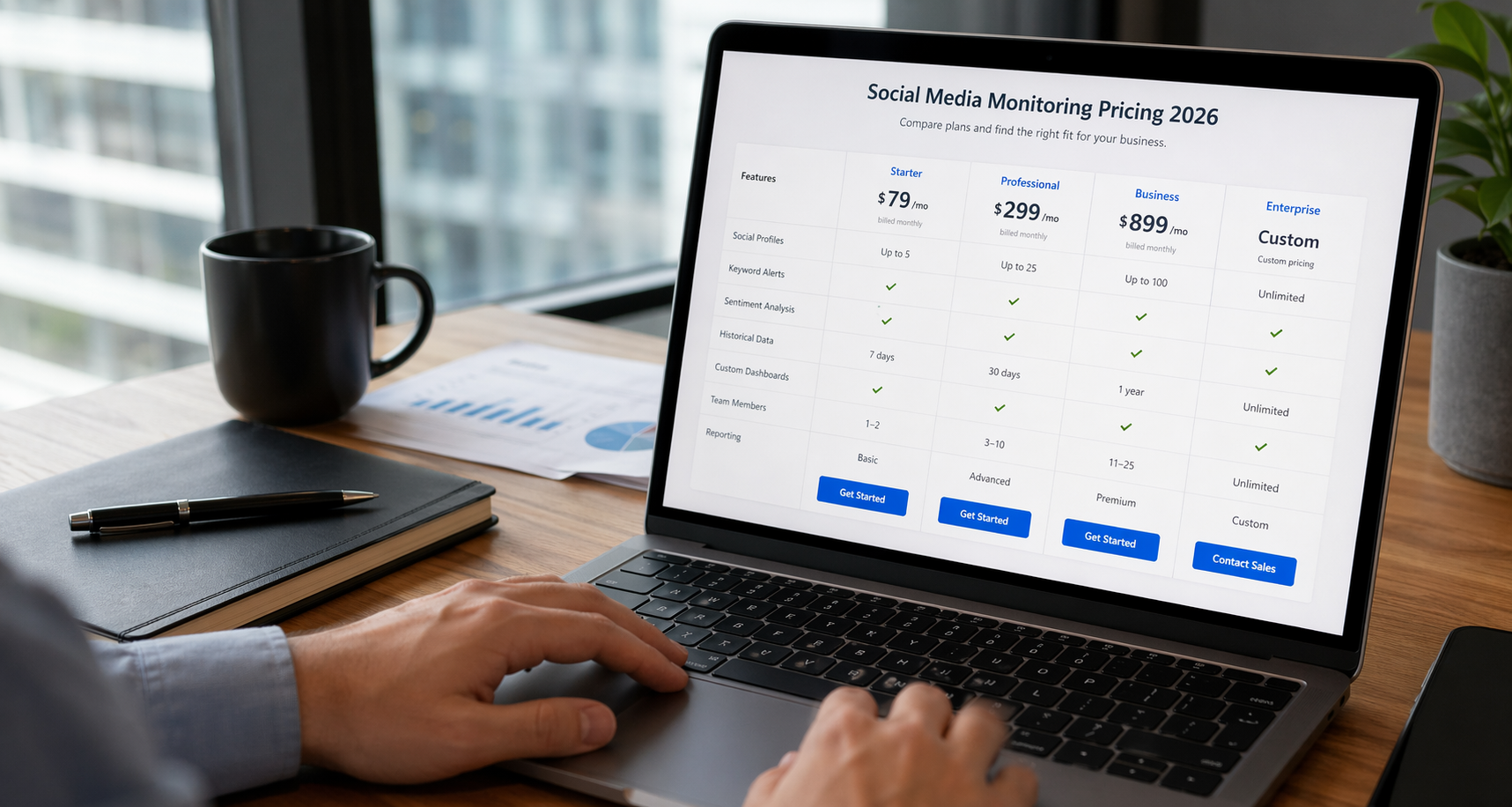
A Price Range That Goes From Free to $100,000 a Year
If you've started researching social media monitoring tools, you've probably encountered a frustrating reality: almost nobody publishes their prices. Instead, you get invitation-to-demo buttons, "contact us for a quote" forms, and pricing pages that reveal almost nothing useful.
The opacity is intentional. Enterprise software vendors negotiate pricing based on what they think you'll pay, and publishing transparent rates would undermine that model. But that doesn't mean you have to go in blind.
The social media monitoring market hit $6.56 billion in 2026, and 89% of marketers now use some form of monitoring for brand management. Pricing varies from free to $5,000 per month, and tools in this space solve different problems. Visualping
This guide cuts through the opacity. It covers what social media monitoring actually costs at every tier — from free tools that handle basic needs to six-figure enterprise contracts — what drives those prices up, what's actually included at each level, and how to figure out what your organization actually needs before you spend a dollar.
Part 1: The Full Price Spectrum
Before breaking down specific tools and tiers, it helps to see the landscape at a glance.
Pricing ranges from free tools like Google Alerts to $9,000 or more per year for enterprise platforms. Mid-range tools cost between $40 and $250 per month, covering platforms like Mention, Awario, Agorapulse, Hootsuite, and Sprout Social. Enterprise platforms like Brandwatch, Meltwater, and Talkwalker use custom pricing, typically starting at $9,000 or more per year. Improvado
Expanded into a full spectrum, the market breaks down as follows:
Free: Google Alerts, native platform analytics, X (Twitter) Pro basic features Budget ($40–$100/month): Mention, Awario, Brand24 entry tiers Mid-market ($100–$500/month): Hootsuite, Sprout Social, Agorapulse, BuzzSumo, Keyhole Upper mid-market ($500–$2,000/month): Sprout Social advanced tiers, Brandwatch entry-level Enterprise ($2,000–$100,000+/month): Brandwatch, Meltwater, Talkwalker, Pulsar — custom quotes only
Social monitoring tools range from free tiers to enterprise contracts above $100,000 per year. Pulsar That upper bound isn't theoretical — global brands with massive conversation volumes, multiple product lines, and dedicated social intelligence teams regularly spend at that level.
Part 2: Free Tools — What You Get and What You Don't
Free social media monitoring is real, but it comes with meaningful limitations that matter the moment your needs become serious.
Google Alerts
Google Alerts is the most widely used free monitoring tool. Set up a keyword — your brand name, a competitor's name, an industry term — and Google sends you an email when new web content contains that term.
The coverage is limited to web content that Google indexes, which excludes most social media platforms. The alert speed is slow — Google Alerts can take hours or even days to surface new content. Visualping There's no sentiment analysis, no reporting, no competitive benchmarking. For very small businesses or individuals who want basic web mention tracking and nothing else, it's a functional starting point. For any organization that actually needs to understand what's being said about them across social media, it falls well short.
Native Platform Analytics
Every major social platform — Instagram, Facebook, LinkedIn, TikTok, X — provides native analytics for your own accounts. These show you how your content performs, who your audience is, and what engagement looks like. What they don't show you is what's being said about your brand outside your own posts, or what's happening on competitor accounts.
Native analytics are free, genuinely useful for content performance, and completely inadequate for brand monitoring or competitive intelligence.
When Free Is Enough
Free tools make sense when you have very low brand conversation volume, no competitive monitoring needs, a minimal team, and only basic awareness needs. Most businesses outgrow free tools the moment they start caring about customer sentiment, competitor activity, or crisis detection.
Part 3: Budget Tier ($40–$100/Month) — Solid Monitoring for Small Teams
This tier delivers genuine monitoring capability — real-time alerts, sentiment analysis, multi-platform coverage — at a price that most small businesses and solo marketers can justify.
Brand24 — Starting Around $79/Month
Brand24 is generally the best social media monitoring tool for small businesses in 2026. It covers over 25 million sources, provides real-time alerts, and includes AI-powered sentiment analysis starting at $79 per month. Mention is a strong alternative with a more streamlined interface and a free plan for light use. Both offer 14-day free trials without requiring a credit card. Pulsar
Brand24 covers social media, news sites, blogs, forums, and review platforms. Its AI sentiment analysis identifies whether mentions are positive, negative, or neutral, and its real-time alerts can surface brand mentions within minutes of posting. For a small business that wants to know what customers are saying and catch problems before they escalate, Brand24 provides strong value.
Mention — Starting Around $41/Month
Mention is a mid-market social listening tool covering 30 or more source types including social networks, news, blogs, forums, and review sites. It balances simplicity with solid coverage, and its pricing sits between budget tools like Awario and premium platforms like Sprout Social. Improvado
Mention's entry tier has mention volume caps that fill up quickly for brands with high conversation volume — worth checking before committing. Its sentiment analysis is less sophisticated than Brand24's AI models, but the interface is genuinely intuitive and setup is fast.
Awario — Starting Around $49/Month
Awario offers real-time social monitoring, sentiment analysis, and competitive tracking at a price point that makes it accessible for small teams. Its boolean search capabilities allow more precise monitoring queries than many tools at this price level, which reduces noise in high-volume environments.
Who the Budget Tier Is For
Small businesses, solo marketers, startups, and agencies managing a handful of clients on tight budgets. If your primary needs are brand mention tracking, basic competitive monitoring, and reputation alerts — and your conversation volume is manageable — the budget tier covers you well.
Part 4: Mid-Market Tier ($100–$500/Month) — Full-Stack Monitoring for Growing Teams
This is where social media monitoring expands from pure listening into integrated social media management — scheduling, publishing, engagement, and monitoring in a single platform.
Hootsuite — Starting Around $99/Month for Teams
Hootsuite is ideal for mid-sized businesses that need scheduling, monitoring, and analytics across multiple profiles. It includes team collaboration tools, and its extensive app integrations make it a flexible choice for businesses with evolving needs. TrustRadius
Hootsuite's monitoring capabilities are powered by Talkwalker technology following Hootsuite's 2024 acquisition of the platform, though the features integrated into Hootsuite are more limited than those in the full Talkwalker platform. For teams that want monitoring and social publishing in a single workflow, Hootsuite is a practical choice.
Sprout Social — Starting Around $249/Month Per User
Sprout Social starts at $249 per month per user, but it justifies the cost with robust CRM features, advanced reporting, and intuitive collaboration tools. It's particularly well-suited for mid-sized marketing teams looking for detailed insights and cross-team visibility. TrustRadius
The per-user pricing model is worth noting carefully. A team of five using Sprout Social at the base tier would pay approximately $1,245 per month — which is solidly in upper mid-market territory even if you think of Sprout as a "mid-market" tool. That said, the platform's depth justifies the cost for teams that actively use its reporting, unified inbox, and listening features.
Agorapulse — Starting Around $79/Month Per User
Agorapulse sits between Hootsuite and Sprout Social in price and capability. Its monitoring features are solid for the price, and its unified inbox for managing conversations across platforms is particularly well-regarded. For agencies managing multiple client accounts, its agency-specific features and reporting make it a strong contender.
Keyhole — Starting Around $89/Month
Keyhole specializes in hashtag tracking, campaign monitoring, and influencer analytics. It provides real-time dashboards showing reach, impressions, and engagement for specific hashtags — making it ideal for teams running event or campaign-specific monitoring. Improvado
If your primary monitoring need is tracking campaign performance and measuring influencer impact, Keyhole delivers specialized value that general monitoring tools don't match. It's less useful as an always-on brand monitoring solution.
Who the Mid-Market Tier Is For
Growing teams that need a combination of publishing and monitoring, organizations that run regular social campaigns and need performance measurement, and businesses with multiple accounts or team members that need to collaborate on social media management.
Part 5: Enterprise Tier ($1,000–$100,000+/Month) — Intelligence at Scale
Enterprise social media monitoring is a fundamentally different product category. It's not just more mentions — it's AI-powered consumer intelligence, historical data archives, predictive trend detection, broad cross-channel coverage including broadcast and print, and the analyst resources to interpret it all.
Brandwatch — Custom Pricing, Typically $1,000+/Month
Brandwatch is the market-leading enterprise social intelligence platform, with one of the broadest historical data archives and the most sophisticated AI analytics available. It analyzes hundreds of millions of social media posts in real time and its AI model, called Iris, automatically surfaces significant patterns and anomalies.
Brandwatch's pricing is more flexible than Sprout Social's per-user model and is often better for organizations with many users but fewer social accounts. Multi-year commitments commonly yield 15 to 25% off annual pricing for two- to three-year terms. Volume-based discounting is standard, and competitive pressure from alternatives like Sprout Social, Meltwater, or Talkwalker often results in more aggressive pricing. Vendr
All Brandwatch pricing requires a direct conversation with sales — there are no published rates. The platform is best suited for large enterprises with dedicated social intelligence or consumer research functions.
Meltwater — Custom Pricing, Median Around $25,000/Year
Meltwater's pricing is custom only, with no public pricing page. The median buyer cost is $25,000 per year according to Vendr data, with a range of $6,000 to $100,000 or more depending on features. SocialRails
Meltwater blends traditional media monitoring — news, press, broadcast — with social media tracking. You can see how a story trends in the press alongside what's happening on social media, all in one tool. While Meltwater's social listening capabilities are solid, its core strength lies in its wider media coverage. Brandwatch
Meltwater is particularly well-suited for PR and communications teams that need to track earned media coverage alongside social conversations. Meltwater includes traditional media monitoring in addition to social listening, which can make it more expensive for buyers who only need social data. Vendr If your monitoring needs are purely social, Meltwater may be more platform than you need.
Talkwalker — Custom Pricing, Typically $1,000+/Month
Talkwalker monitors 150 million or more sources in 187 languages. Improvado Its breadth of coverage and multilingual capabilities make it the go-to choice for global brands that need to monitor conversations across international markets. Its image recognition technology — detecting logos and brand imagery in visual content — is a capability that few competitors match.
Talkwalker is best for brands needing logo and image detection in visual content. Pulsar For brands where visual brand presence is a monitoring priority — consumer packaged goods, fashion, sports — this functionality has genuine strategic value.
Who the Enterprise Tier Is For
Large brands with significant conversation volume, global operations, dedicated social intelligence or PR teams, and genuine need for the depth of analytics that enterprise platforms provide. Enterprise platforms like Brandwatch and Talkwalker deliver powerful analysis but require dedicated analyst resources to unlock that value. Pulsar The tool alone doesn't deliver the insight — you need the team to interpret and act on it.
Part 6: What Actually Drives the Price Up
Understanding what makes social media monitoring expensive helps you avoid paying for capabilities you won't use.
Mention Volume and Data Coverage
Most mid-market tools charge based on the volume of mentions they track per month. Hit your limit and you either pay more or stop getting alerts. Enterprise tools typically move to unlimited mentions — but the data infrastructure required to deliver that is a core driver of enterprise pricing.
Calculate total cost based on users, mention volume, and required features rather than just the advertised starting price. Eclincher
Number of Users and Seats
Per-user pricing models — Sprout Social being the most prominent example — can make costs escalate sharply as your team grows. A platform that looks affordable for a team of two becomes a significant expense for a team of ten. Always model your realistic user count before committing to a per-seat pricing model.
Historical Data Access
Real-time alerts are standard across most paid tiers. Historical data — the ability to look back at conversations from six months or two years ago — is often a premium feature or enterprise-only capability. If trend analysis over time is important to your use case, verify what historical data access each plan provides.
Source Coverage Breadth
Most tools track Facebook, Instagram, X (Twitter), LinkedIn, YouTube, and TikTok. Advanced platforms also cover Reddit, forums, blogs, news sites, podcasts, and review platforms. Visualping Talkwalker and Meltwater sit at the broadest end of coverage. Budget tools have narrower source lists that may miss niche communities where your audience is actually having conversations.
Sentiment Analysis Sophistication
Basic sentiment analysis — positive, negative, neutral — is table stakes across most paid tiers. AI-powered sentiment analysis that detects nuance, irony, emerging crises, and topic-specific sentiment is where platforms diverge significantly. Enterprise tools like Brandwatch offer meaningfully deeper sentiment intelligence than budget alternatives.
Integration Requirements
Beyond subscription fees, mid-market social monitoring budgets should account for integration costs. Connecting monitoring data to CRM, helpdesk, or BI tools typically requires either native integrations included in higher tiers or developer time to build custom connections. Xpoz
If you need your monitoring data to flow into Salesforce, HubSpot, Slack, or your business intelligence stack, verify which integrations are included in your tier versus available at additional cost.
Part 7: Hidden Costs That Most Buyers Miss
The monthly subscription is rarely your total cost of social media monitoring. Several additional expenses catch buyers off guard.
Implementation and Onboarding
Factor in implementation time, usually one to two weeks, and training, often one to two weeks. Total first-year cost for most SMBs ranges from $2,000 to $8,000 including tool fees and staff time. InfluenceFlow
Setting up monitoring queries, configuring dashboards, training your team, and connecting integrations all take time that has real cost — either in staff hours or in implementation fees charged by the vendor.
Overage Fees
Mention-cap plans charge extra when you exceed your monthly limit. Before a product launch, a PR crisis, or a viral moment, your mention volume can spike dramatically — and hitting an artificial ceiling at that exact moment undermines the tool's core value. Ask vendors explicitly how overages are handled and at what cost.
Annual Contract Requirements
Meltwater requires annual contracts as standard, with no monthly billing available. SocialRails Most enterprise platforms operate the same way. You're committing to 12 months (or more) of spend before you know whether the tool delivers value in your specific environment. Always push for a meaningful trial period with real data before signing a long-term commitment.
Price Increases at Renewal
If you commit to a multi-year term, negotiate clear terms around user growth, module additions, and renewal pricing. Ensure that renewal increases are capped, for example, no more than 3 to 5% annually. Xpoz
Without explicit renewal caps in your contract, vendors can raise prices significantly at the end of your term — particularly if you've become dependent on the platform and switching costs are high.
Part 8: How to Choose the Right Tier for Your Organization
The right social media monitoring investment isn't determined by what sounds impressive or what your largest competitor uses — it's determined by your actual use cases, team size, and conversation volume.
Start With Use Cases, Not Features
Teams using monitoring primarily for customer service response need a different tool than teams using it for audience research or PR crisis management. Pulsar and Brandwatch suit insight-first workflows. Sprout Social and Mention suit response-first workflows. Meltwater suits media-first workflows. Pulsar
Before evaluating tools, write down what you'll actually do with monitoring data. Who will receive the alerts? What decisions will they make? What would constitute a successful outcome six months from now? The answers point clearly to which tier and which platform makes sense.
Test With Real Data
During trial periods, evaluate ease of setup, alert accuracy, reporting quality, and support responsiveness. Use real keywords and real data. A tool that looks great in a sales demo might disappoint with your actual mention volume. Eclincher
Every tool performs better in a controlled demo environment than in production. Take advantage of free trials, and insist on testing with your actual brand keywords and your actual conversation volume — not the vendor's showcase accounts.
The Mid-Market Reality Check
Mid-market teams face a pricing cliff: they've outgrown small-business tools but don't need enterprise platforms that bundle capabilities they'll never touch. The most common mistake is purchasing a platform for its competitive intelligence module when 80% of daily usage is basic mention tracking. Xpoz
Be honest about what you'll actually use. Many organizations buy enterprise capabilities and use 20% of the platform. A well-configured mid-market tool used consistently delivers more value than an enterprise platform used occasionally.
Part 9: Getting the Best Price — Negotiation Basics
Because most serious monitoring tools use custom pricing, negotiation is standard practice — and buyers who don't negotiate consistently pay more than those who do.
Get competing quotes. Even if you prefer Brandwatch, demonstrating that you're seriously considering competitors and have received competitive quotes typically results in more aggressive pricing and concessions. Vendr The same dynamic applies to Meltwater and other enterprise vendors.
Time your purchase to the vendor's fiscal calendar. Brandwatch's fiscal year ends in December, with quarterly closes in March, June, September, and December. Sales teams face significant pressure to close deals before quarter-end and year-end, and buyers who time negotiations to align with these periods often secure better pricing. Vendr
Push for multi-year discounts with exit provisions. Multi-year commitments generate larger discounts, but they also reduce your flexibility. Negotiate renewal caps and define what happens if your needs change before the term ends.
Ask what's negotiable beyond price. Vendors often have more flexibility on training credits, additional user seats, feature unlocks, and implementation support than on the headline price. These add-ons have real value and cost nothing extra to ask for.
Conclusion: Match the Tool to the Problem, Not to the Budget Ceiling
Companies that invest in monitoring see an average 10.2% year-over-year revenue increase from faster response times and better competitive positioning. Visualping The return on investment is real — but it's only realized when the tool matches your actual needs and your team actually uses it.
For most small businesses, a $79 to $100 per month tool like Brand24 or Mention delivers everything needed to protect reputation, track competitors, and respond to customers. For growing mid-market teams, Hootsuite or Sprout Social combine monitoring with the publishing and collaboration tools that make the investment efficient. For large enterprises with dedicated intelligence functions and global conversation volume, the Brandwatch and Meltwater tier provides capabilities that lower-priced tools genuinely cannot match.
The answer to "how much does social media monitoring cost?" is: exactly as much as your situation requires — and not a dollar more.
Not Sure What You Actually Need?
At Ritner Digital, we help businesses make sense of their digital marketing technology stack — including social media monitoring — so they're investing in tools that solve real problems and generating the data that actually informs decisions.
Whether you're evaluating your first monitoring tool or reassessing an enterprise contract that isn't delivering, we can help you figure out the right fit for your budget and your goals.
Book a free strategy call with Ritner Digital today.
👉🏼 Schedule your call at ritnerdigital.com
Sources: Visualping Best Social Media Monitoring Tools 2026 | Improvado Social Media Monitoring Comparison | Pulsar Platform Social Monitoring Guide | Prowly Media Monitoring Cost Guide | Vendr Brandwatch & Meltwater Pricing Data | TrustRadius Social Media Management Pricing | InfluenceFlow Social Monitoring Tools Guide | SocialRails Meltwater Pricing | Brandwatch Social Media Monitoring Tools Guide | Xpoz Social Monitoring Costs by Company Size
Frequently Asked Questions
Do I really need a paid social media monitoring tool, or can I get by with free options?
It depends entirely on what you need monitoring to do. If you're a very small business with low brand conversation volume and just want occasional alerts when your name appears online, Google Alerts and native platform analytics may be sufficient. But the moment you need to understand customer sentiment, track what competitors are doing, catch a PR issue before it escalates, or measure the impact of a campaign across platforms — free tools fall short in ways that matter. Most growing businesses find that the $79 to $100 per month entry point for a tool like Brand24 or Mention is worth it within the first month of actual use.
Why do enterprise tools like Brandwatch and Meltwater never publish their prices?
Custom pricing models allow vendors to charge based on what each buyer can pay — larger organizations with bigger budgets consistently pay more than smaller ones for comparable configurations. Publishing transparent rates would undermine that model. It also gives sales teams leverage to create urgency and bundle features that may or may not be necessary. The practical implication for buyers is that you should always get competing quotes before engaging seriously with any enterprise vendor, because price is genuinely negotiable and the initial quote is rarely the best available.
What's the difference between social media monitoring and social media listening?
The terms are often used interchangeably but technically describe different scopes. Monitoring is reactive — it tracks specific mentions, keywords, and brand names as they happen and alerts you to them. Listening is more analytical — it looks at broader conversation patterns, sentiment trends, and audience insights over time to inform strategy. In practice, most platforms now do both to varying degrees, with enterprise tools like Brandwatch skewing toward the deeper analytical listening end and budget tools like Brand24 and Mention focusing more on real-time mention tracking. When evaluating tools, ask specifically which use cases each platform handles well rather than relying on how they label themselves.
Sprout Social's per-user pricing looks expensive for a larger team. Is there a better model for us?
Per-user pricing makes Sprout Social genuinely expensive for large teams — five users at the base tier runs well over $1,000 per month before any advanced features. If team size is a concern, look at tools with flat-rate or tiered pricing that doesn't scale per seat. Hootsuite's team plans, Agorapulse, and enterprise platforms like Brandwatch offer pricing structures that can be more economical for larger organizations. When modeling total cost, always calculate based on your realistic user count across the next 12 to 18 months, not just current team size.
How much should I budget for social media monitoring as a small business?
For most small businesses, $79 to $150 per month covers everything genuinely needed — real-time brand mention alerts, basic sentiment analysis, competitor tracking, and coverage across major social platforms, news, forums, and review sites. Tools like Brand24, Mention, and Awario all deliver meaningful capability in this range. Factor in one to two hours of setup time and a brief learning curve. The total first-year investment for a small business choosing an appropriate tool is typically $1,000 to $2,000 including subscription fees and the staff time to configure and learn the platform.
Can I use my social media management tool for monitoring, or do I need a separate tool?
Many social media management platforms — Hootsuite, Sprout Social, Agorapulse — include monitoring features as part of their suite. For most small and mid-sized businesses, the monitoring capabilities built into these platforms are sufficient, and consolidating into one tool simplifies both the workflow and the budget. Where a separate dedicated monitoring tool makes sense is when you need deeper consumer intelligence, broader source coverage including forums and niche communities, or crisis detection capabilities that go beyond what management platforms typically offer. Enterprise teams often run both — a management platform for publishing and engagement, and a dedicated listening platform for intelligence.
What sources should I make sure a tool covers before signing up?
At minimum, confirm coverage of the platforms where your audience actually has conversations — and don't assume. Most tools reliably cover Facebook, Instagram, X, LinkedIn, YouTube, and TikTok. Coverage of Reddit, niche forums, review platforms like Google Reviews and Trustpilot, and industry-specific communities varies significantly between tools and pricing tiers. Request a demo using your actual brand keywords before committing, and specifically ask the vendor to show you results from the sources that matter most to your business. A tool that misses the forum or community where your customers are most active has a fundamental blind spot.
How do I know if a monitoring tool is actually worth what it costs?
Define success before you start. Before signing up for any tool, write down specifically what you'll use it for and what outcomes you expect — fewer unanswered customer complaints, faster crisis response, better competitive intelligence, more informed content decisions. Then measure those things after 90 days. Most monitoring tools offer enough trial period to get a genuine read on whether the platform delivers value in your specific environment. If you can't articulate what a successful outcome looks like, you're not ready to evaluate tools — you're just buying software.
Is it worth negotiating price with monitoring tool vendors?
Absolutely, and most buyers don't do this enough. For enterprise platforms like Brandwatch and Meltwater, negotiation is standard practice and the initial quote is rarely the best available price. Tactics that consistently work include getting competing quotes and making that visible to the vendor, timing your purchase to align with the vendor's quarter-end or year-end, asking for multi-year discounts with explicit renewal caps, and bundling add-ons like additional seats or training into the base price rather than paying for them separately. For mid-market tools with published pricing, negotiation is less common but annual billing instead of monthly typically saves 15 to 20%.
What questions should I ask during a vendor demo before committing?
The questions most buyers don't ask but should: How quickly does the tool actually detect a mention after it's posted — in minutes or hours? What happens when I hit my mention volume cap mid-month? What sources are explicitly not covered by my plan tier? What does the contract say about renewal price increases? Who is my dedicated support contact and how quickly do they respond? Can I see results using my actual brand keywords right now, not your demo data? What's the process if I want to cancel before my contract ends? These questions reveal what the sales presentation is designed to obscure and give you a realistic picture of what you're actually buying.