Budgets Are Moving With More Intention Than Ever Before
Marketing budget season looks different in 2026 than it did even two years ago. The channels that were growing simply because digital was growing have matured. Attribution has gotten harder. Privacy changes have eroded the data signals that justified entire budget categories. AI has disrupted organic search in ways that are still being worked out. And CFOs are asking harder questions about every dollar.
Marketing budgets in 2026 are not shrinking — they're being consolidated around confidence, efficiency, and defensibility. Channels tied directly to conversion, retention, and owned data are absorbing spend, while those with declining signal quality or unclear ROI are losing ground. Neil Patel
Into this environment, the question of where to put the next dollar — and where to take one away — has never mattered more. This guide cuts through the noise with data on which U.S. digital marketing channels are seeing the largest planned budget increases heading into 2027, why those increases are happening, and what the channels losing ground have in common.
The Macro Picture: Where Overall Budgets Stand
Before breaking down channel-level trends, it helps to understand the overall budget environment U.S. marketers are operating in.
A majority of small businesses — 60% — plan on increasing their 2026 marketing and advertising budgets from what they were in 2025. Nearly half of marketing professionals say that over half of their marketing budget will be allocated to digital channels. Clutch
61% of B2B marketers are increasing overall spend this year, with 20% holding flat and 19% decreasing. B2C is slightly more cautious: 57% are increasing, 32% holding flat, and 11% decreasing. Neil Patel
But the overall increase obscures a significant internal reallocation. Over a third of marketers are shifting toward lower-cost digital channels like social media and organic content, and 33% plan to decrease traditional media spending — TV, print, radio, and out-of-home — with those budgets shifting to digital channels offering superior measurement, targeting, and cost-efficiency. Clutch
The dominant theme: money is moving from channels that are hard to measure to channels that are easy to defend.
Channel 1: Connected TV (CTV) — The Fastest-Growing Established Channel
No digital channel is seeing more aggressive budget growth right now than Connected TV — and the data from multiple independent sources is remarkably consistent.
Nearly 70% of CTV advertisers expect to increase their spending this year on the channel, with an average increase of 17%. Marketing Dive
eMarketer's latest forecast expects U.S. retail media ad spend linked to CTV to grow 45.5% in 2025, with one in five CTV ad dollars projected to go to retail media by 2027. Aidigital
The reasons for this growth are structural, not cyclical. Streaming has now officially overtaken linear TV in viewership share. In 2025, streaming surpassed cable and broadcast viewership for the first time, according to Nielsen data. Ad-supported content now accounts for nearly 74% of all TV watching. Roku
That audience shift means CTV is no longer a complement to the TV buy — it is increasingly the TV buy. CTV will comprise over one-third of all TV ad spend in 2026, with retail now the largest ad spending category on CTV, accounting for just under 20% of total spend. Tatari-tv
What's particularly notable is where CTV budget growth is coming from. 36% of advertisers who plan to spend more on CTV will redirect those dollars from social, according to the Interactive Advertising Bureau, while 32% plan to reallocate those budgets from paid search. Roku
The 2026 CTV story is also about performance, not just reach. The 2026 IAB NewFronts saw every major streaming platform pitch CTV as a full-funnel, measurable performance channel — not a brand awareness vehicle. Shoppable video, interactive pause ads, and programmatic CTV via Amazon DSP are the formats attracting the most interest from performance-focused advertisers, with brands able to attribute CTV exposure directly to sales outcomes. Entrustech Inc.
The projection heading into 2027: CTV growth accelerates further as the Disney+/Hulu integration creates massive combined inventory, measurement infrastructure improves, and mid-size brands that have been testing in 2026 scale their investment.
Channel 2: AI-Assisted SEO and Content — A Sharp Rebound
After a period of uncertainty about what AI search meant for organic strategy, SEO budgets are rebounding sharply — and for a specific reason.
SEO spend has rebounded sharply. After a softer 2025, 61% of marketers are now increasing SEO budgets, up from 44% last year. The return of confidence in organic search reflects better AI tools for content production, clearer ROI measurement, and recognition that organic visibility still matters even in a zero-click environment. Neil Patel
The AI dimension of SEO investment is particularly striking. 98% of marketers plan to increase AI SEO spend in 2026. Teams have figured out that AI can accelerate research, content production, and optimization cycles without sacrificing quality. Neil Patel
The economics of AI-assisted content production are reshaping what SEO investment buys. AI tools are reducing content production costs by 30% to 40% in 2026 versus pre-AI baselines. The remaining cost will be concentrated in strategy, editorial oversight, original research, and human review. Emulent
This cost reduction is allowing marketing teams to produce significantly more content — and specifically, to produce the structured, well-sourced content that both traditional search engines and AI systems favor. Sites implementing structured data and FAQ blocks saw a 44% increase in AI search citations. Pages updated within 60 days are 1.9 times more likely to appear in AI answers. Superlines
The budget increase in SEO is not a vote against AI search — it's a recognition that being visible in AI answers requires exactly the same foundational investment in quality content and authoritative presence that strong SEO has always required, plus new tactics specifically for generative engine optimization.
The projection heading into 2027: Content marketing budgets continue rising as a share of total marketing spend. Content marketing budgets rose to 26% of total marketing spend in 2026, making content the single largest line item in most marketing organizations' budgets. Emulent That trajectory continues into 2027 as brands compete for AI citation visibility alongside traditional search rankings.
Channel 3: Creator and Influencer Marketing — Moving From Tactic to Infrastructure
Influencer marketing has completed its transition from a discretionary experiment to a core budget line item — and the scale of growth reflects that maturation.
U.S. social media creator revenue will reach $21.10 billion in 2026, more than doubling since 2022, according to EMARKETER's February 2026 forecast. Net Influencer
The nature of influencer investment has shifted significantly. Nano and micro-influencers — creators with smaller but more engaged audiences — are now driving a larger share of spend than celebrity or macro influencers. Nano and micro-influencers now account for nearly half of U.S. creator spend at 49.9%, up from less than a fifth a few years ago. Net Influencer
More importantly, creator content has broken out of social media and into other channels. Best Buy integrated creator-generated content into connected TV placements for the first time during the 2025 holiday season, and the influencer-led creative performed on par with traditional CTV assets. Net Influencer
Gap launched a cross-brand creator affiliate and advocacy program that spans its portfolio of stores. "The utility of creator content means we are absolutely weaving it into our PDPs," said Gap's Head of Influence Cory Weaver, referring to product display pages — "We're seeing wonderful success there." Net Influencer
The creator economy is also absorbing the social commerce explosion. U.S. livestreaming retail ecommerce sales are projected to rise 35% to $19.76 billion in 2026, and TikTok Shop is forecast to reach $23.41 billion in U.S. ecommerce sales in 2026, a 48% year-over-year increase. Net Influencer
The projection heading into 2027: Creator budgets continue expanding as the channel proves performance metrics beyond just engagement — directly attributable to sales, in-store traffic, and product page conversion rates.
Channel 4: Retail Media — Now a Top-Three Line Item for Many Brands
Retail media advertising — buying ad placements on retail platforms like Amazon Ads, Walmart Connect, Target Roundel, and Instacart — has gone from a specialty channel to a standard budget line item in a remarkably short period.
Retail media is the fastest-growing channel, with Amazon Ads, Walmart Connect, and Instacart now absorbing 15% of eCommerce budgets on average. If you sell physical goods, this is no longer optional. Digital Applied Team
eMarketer's latest forecast expects U.S. retail media ad spend to reach $58.79 billion in 2025 and $69.33 billion in 2026. Aidigital
What's driving this growth is primarily the measurement story. Retail media networks can close the attribution loop that has become so difficult everywhere else — connecting ad exposure directly to purchase data within the same platform. In an environment where iOS changes and cookie deprecation have eroded cross-channel attribution, the ability to see from impression to checkout in one system is extraordinarily valuable.
The expansion of retail media into CTV is accelerating the trend further. Retail media-driven CTV ad spend is growing roughly three times faster than retail search, signaling a major shift toward full-funnel TV performance. Retailers can build CTV segments around past purchases, category interest, or loyalty behaviors, and brands can run CTV ads against those segments and measure in-store or e-commerce sales. Tatari-tv
The projection heading into 2027: Retail media continues growing as more retail networks mature their ad products, measurement improves, and brands that have proven ROI in 2026 scale their investment. Non-endemic advertisers — brands that don't sell through a specific retailer but want access to their audience data — represent the next wave of retail media budget allocation.
Channel 5: Paid Search — Resilient But Under Pressure, Increasingly AI-Driven
Paid search remains indispensable for capturing high-intent buyers, and budgets continue to grow — but the nature of what that investment buys is changing significantly.
Paid media represents the largest single category in modern marketing budgets, capturing 30.6% of total marketing investment in 2025 with projections showing continued growth through 2026. Academyofcontinuingeducation
The pressure points are real. AI search is cannibalizing branded clicks, with zero-click rates on branded queries climbing past 60% as AI Overviews answer intent in-SERP. Google Ads costs continue rising, making inefficient campaigns unsustainable. Digital Applied Team
The budgets flowing into paid search are increasingly concentrated on high-commercial-intent keywords — the searches that signal someone is ready to buy right now — while informational and research-stage queries get absorbed into SEO and content budgets. Success requires surgical precision: targeting only high-intent keywords, implementing strict negative keyword strategies, and leveraging AI bidding smartly rather than blindly. ALM Corp
Performance Max campaigns — Google's AI-driven cross-channel format — are absorbing a growing share of paid search budgets as advertisers trade manual control for algorithmic efficiency. The debate over how much control to cede to automation is one of the defining paid search questions heading into 2027.
The projection heading into 2027: Paid search budgets continue growing in absolute terms but shrink as a percentage of total digital spend as retail media and CTV absorb a larger share. The channel remains essential for bottom-funnel capture but faces ongoing pressure from rising CPCs and AI-driven zero-click behavior.
Channel 6: Email and Owned Channels — The Quiet Winners of the Attribution Crisis
As third-party data erodes and attribution becomes harder across digital channels, owned channels — especially email — are experiencing a quiet resurgence in both investment and status.
41% of marketers identify email as their most effective channel, ahead of social media at 16% and paid search at 16%. Unlike social followers, your email list is a permanent asset. ALM Corp
Over a third of marketers are shifting toward lower-cost digital channels like social media and organic content as economic and business conditions drive toward more defensible marketing investments. Clutch
The investment in email in 2026 is qualitatively different from past years. The shift is away from blast newsletters toward sophisticated behavior-triggered sequences, purchase-based segmentation, and AI-powered send-time optimization. The channel's ROI advantage is most pronounced when it's used as a retention and lifecycle tool rather than a pure acquisition vehicle.
First-party data strategy — building and activating owned data assets that don't depend on third-party signals — is the broader category that email investment sits within. Brands investing heavily here are building audience infrastructure that compounds in value as third-party data becomes less reliable.
The projection heading into 2027: Owned channel investment accelerates as privacy regulations tighten and the value of first-party data increases relative to third-party alternatives. Email remains the highest-ROI channel per dollar for most businesses with a sizable customer base.
What's Losing Ground: The Channels Seeing Budget Cuts
Understanding where budgets are growing requires understanding where they're coming from.
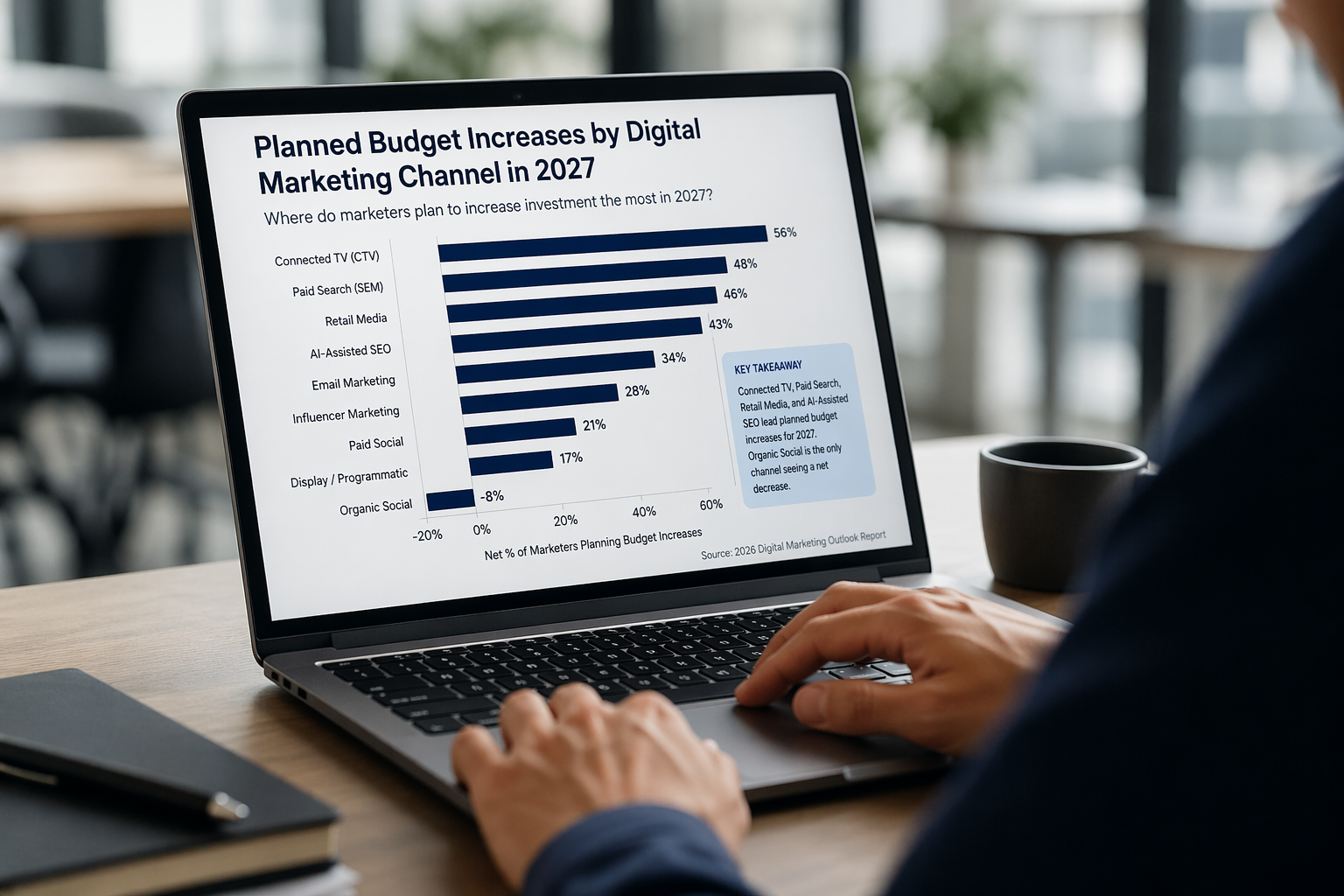
Organic social media is facing the steepest pullback of any digital channel. 64% of marketers are planning budget decreases in organic social. Organic reach has declined to the point where most brands treat social as a support channel, not a growth engine. Neil Patel Investment in social remains — but it has shifted from organic posting teams to paid social, creator content, and social commerce.
Linear TV, print, and radio continue their long structural decline. A third of marketers anticipate a decrease in traditional media spending such as TV, print, radio, and out-of-home, with those dollars migrating to digital channels. Clutch
Volume-based content production is being rationalized. Only 32% plan increases in content creation spend, while 31% plan to reduce spend. This reflects a shift away from volume-based content strategies toward fewer, higher-quality assets that can be repurposed across channels. Neil Patel The era of producing fifty blog posts a month to capture long-tail search traffic is over. What replaced it is producing ten pieces with original research, expert commentary, and genuine depth — each designed to serve multiple channels.
The Channels to Watch in 2027 and Beyond
Beyond the channels seeing the largest current budget increases, several emerging channels are in the experimentation phase today that will likely become significant budget items by 2027.
Generative engine optimization (GEO) — the practice of optimizing content and digital presence specifically for AI search citations — is growing from a niche concept to a standard marketing investment. The GEO market was valued at $848 million in 2025 and is projected to reach $33.7 billion by 2034 at a 50.5% CAGR. 54% of U.S. marketers plan to implement GEO within three to six months. Superlines
Agentic commerce — AI agents that browse, research, and purchase on behalf of users — is moving from experiment to pilot. The 10% experimentation budget should include agentic commerce pilots and zero-click SEO in 2026. Digital Applied Team Brands that build visibility with AI agents now will have structural advantages when agentic commerce scales.
Podcast advertising continues to mature as a B2B channel. Podcast sponsorship for B2B is moving into the "growth bet" category of marketing budgets — emerging, promising, scaling — for companies above a certain revenue threshold. Digital Applied Team
Making Sense of It All: A Framework for Budget Decisions
The channel-level data is useful, but the more important question is how to think about your own allocation decisions heading into 2027.
Three factors should frame every channel investment decision: attribution clarity — can you trace a dollar spent to a measurable business outcome? Compounding potential — does the channel build equity over time, or does it require constant reinvestment with no residual value? Audience alignment — does the channel reach the buyers most likely to convert at the funnel stage you need to influence? Brand Vision
Applied to the growth channels above: CTV scores high on audience alignment and is improving on attribution clarity. SEO and content score high on compounding potential. Retail media scores exceptionally high on attribution clarity. Email scores high on all three for businesses with established customer bases. Creator marketing is strongest on audience alignment and is developing its attribution infrastructure.
Marketers must balance investments across channels, ensuring that content, advertising, branding, and partnerships work together to support both short-term performance and long-term growth. It's less about pouring everything into one channel, and more about making sure you're investing in both short-term wins like paid ads and longer-term assets like content and brand visibility. Clutch
The most defensible marketing budgets in 2027 will be the ones where every channel investment can be explained not just by historical performance but by a clear theory of why it will continue to work as the environment continues to change.
Conclusion: The Investment Thesis for 2027
The channels seeing the largest budget increases heading into 2027 share a common characteristic: they are either measurable, compounding, or both. CTV is earning its investment by proving performance metrics. SEO is compounding value over time in a way that paid channels cannot. Retail media closes the attribution loop that has opened up everywhere else. Email builds owned assets that appreciate in a cookieless world. Creator content is delivering measurable conversion outcomes that extend beyond social engagement.
The channels losing budget have the opposite characteristic: they're either increasingly difficult to measure, generating activity without provable business outcomes, or being disrupted by structural changes in how audiences consume media.
The marketing teams that will be best positioned in 2027 are the ones making allocation decisions today that balance immediate performance with long-term compounding — not chasing the newest channel, but building a channel mix that is defensible, diversified, and deliberately structured for the measurement environment they actually operate in.
Ready to Build a Channel Strategy That's Positioned for What's Coming?
At Ritner Digital, we help businesses make smarter decisions about where their marketing dollars go — across digital channels, across budget levels, and across the full lifecycle from brand awareness to conversion. Whether you're allocating a six-figure budget or figuring out where your first $5,000 of marketing investment should go, we can help you build a channel mix grounded in real data.
Book a free strategy call with Ritner Digital today.
👉🏼 Schedule your call at ritnerdigital.com
Sources: Clutch.co Marketing Budget Planning 2026 | NP Digital Marketing Budget Trends 2026 | Emulent Digital Marketing 2026-2028 Projections | EMARKETER Creator Trends 2026 | EMARKETER CTV FAQ 2026 | Advertiser Perceptions CTV Survey 2026 | IAB CTV Outlook | eMarketer Retail Media Forecast | ALM Corp 2026 Digital Marketing Budget Guide | Brand Vision Marketing Budget Allocation Guide | WebFX Digital Marketing Budget Research | Roku Growth Marketer CTV Predictions | Superlines AI Search Statistics
Frequently Asked Questions
Should I be shifting budget away from paid search given all the AI search disruption?
Not away from it entirely — but the allocation within paid search deserves a hard look. The case for paid search remains strong for bottom-funnel, high-intent queries where someone is ready to buy right now. What's weakening is paid search's value for research-stage and informational queries, which AI Overviews are increasingly answering without a click. The smart move isn't to pull paid search budget wholesale — it's to tighten your keyword targeting ruthlessly, cut spend on low-commercial-intent queries, and redirect that portion toward channels that capture earlier-stage awareness, like content, creator marketing, or CTV.
We're a small business with a limited budget. Which of these growth channels actually makes sense for us?
At small business scale, the channels with the best combination of accessibility, measurable ROI, and compounding value are SEO and content, email, and creator/micro-influencer marketing. CTV and retail media are growing fast but require minimum budgets and infrastructure that put them out of reach for most small businesses right now. Focus your investment on building owned assets — a strong website, email list, and content library — before spending on channels that require continuous reinvestment to maintain results. Micro-influencer campaigns with authentic creators in your niche can also deliver strong results at relatively low cost, particularly for local or niche businesses.
Is CTV advertising actually accessible for mid-size companies or is it still for big brands only?
It's genuinely accessible now in a way it wasn't two or three years ago. Self-service platforms like Roku Ads Manager, Amazon DSP, and programmatic buying through platforms like StackAdapt or The Trade Desk have lowered the entry point significantly. A 60-day test campaign can be run for $5,000 to $15,000 — enough to learn what creative formats work, which audience segments respond, and what your attribution looks like before committing larger budgets. The 2026 IAB NewFronts made clear that every major streaming platform is actively courting mid-size advertisers, not just Fortune 500 brands. If you sell consumer products or services, the window to build CTV competency before competitors do is open right now.
Why is organic social media losing budget while paid social and creator marketing are growing?
Organic reach has collapsed on most platforms to the point where it functions more as a credibility signal than an actual growth channel. Posting consistently on Instagram or Facebook simply does not generate meaningful reach for most business accounts without paid amplification. That reality has pushed investment toward the two things that do work on social: paid ads that can reach defined audiences at scale, and creator content that benefits from the creator's existing audience and platform trust. The budget isn't leaving social — it's shifting within social from organic posting teams to paid social campaigns and creator partnerships, which both deliver measurable reach and are worth tracking as performance channels.
How should I think about retail media if my products aren't sold on Amazon or Walmart?
Retail media is most directly relevant to brands selling physical goods through retail channels, but the model is expanding in ways that matter to a broader range of businesses. Many retail networks now offer non-endemic advertising — allowing brands that don't sell through that retailer to access their audience data for targeting. If your target customers shop at a major retailer, that retailer's first-party purchase data can be used to reach them even if you don't have a product listing there. For service businesses and B2B companies, retail media is largely not applicable yet — though the closed-loop attribution model retail media pioneered is influencing how other digital channels are building their measurement infrastructure.
What does "compounding value" mean in the context of choosing marketing channels, and why does it matter?
A compounding channel builds equity over time that continues delivering value even when you're not actively investing in it. SEO is the classic example — content you publish today can generate leads for years. An email list you build this year becomes more valuable next year as it grows and as you learn more about your subscribers. Brand equity built through creator partnerships compounds into recognition that makes future campaigns more efficient. Non-compounding channels — like most paid advertising — stop delivering the moment you stop paying. Neither type is inherently better, but a marketing budget that's entirely non-compounding means you're perpetually renting attention, which becomes increasingly expensive and increasingly fragile when budgets get cut. The smartest 2027 budgets balance immediate performance from paid channels with compounding value from owned and organic channels.
How much of my budget should go to experimentation versus proven channels?
The 70/20/10 framework is the most widely cited guideline and still holds up well: 70% to proven channels that have demonstrated positive ROI over at least two consecutive quarters, 20% to growth bets that are emerging and promising but not yet fully proven at your scale, and 10% to genuine experimentation with new channels, formats, or approaches. In 2026 and 2027, the 10% experimentation category should include some exposure to GEO and AI search optimization, agentic commerce pilots if relevant to your business model, and whichever one or two emerging channels are most relevant to your audience. The discipline of the framework is the point — it prevents the natural temptation to either over-invest in last quarter's winners or chase every new trend at the expense of proven channels.
Email keeps appearing on these lists but it feels like an old channel. Is it actually growing?
Email is growing in strategic importance even if it doesn't feel new. The reason is structural: as third-party cookies disappear, iOS privacy changes erode signal quality across paid channels, and attribution becomes harder everywhere else, the channels where you own your audience and can measure directly become dramatically more valuable. Your email list is a first-party data asset that appreciates in value as the rest of the marketing ecosystem gets noisier and less measurable. 41% of marketers now identify email as their most effective channel — above paid search and social. What's changing is the sophistication of how it's used — moving from broadcast newsletters to behavior-triggered sequences, purchase-based segmentation, and AI-powered optimization — which is generating meaningfully better results than the email marketing of five years ago.
We've been hearing about generative engine optimization for a while. Is it really worth budgeting for separately from SEO?
Yes, and the urgency is increasing. GEO is not a completely separate discipline from SEO — many of the foundational investments overlap, like high-quality content, authoritative backlinks, and technical site health. But GEO requires specific additional tactics: structured data implementation, FAQ schema, content structured for AI parsing, presence-building on Reddit and community platforms, earned media in high-authority publications, and ensuring AI crawlers can access your content. These activities require intentional investment. The GEO market is projected to grow from $848 million in 2025 to $33.7 billion by 2034, and 54% of US marketers plan to implement GEO within the next six months. The brands building this capability now are establishing positions that will be very difficult for late movers to replicate.
How frequently should I be reassessing my channel allocation — annually, quarterly, or more often?
Quarterly at minimum, and monthly for channels with high spend or high volatility. Annual planning makes sense for setting overall budget envelopes and strategic priorities. But the data moves faster than annual cycles can capture — CPC trends, platform algorithm changes, competitive shifts, and AI search volatility all require faster response than once-a-year budget reviews allow. The best-performing marketing teams are reallocating 10 to 15% of their budget each quarter based on CAC trends, saturation signals, and channel-level payback periods. This doesn't mean constant disruption — it means building a review cadence that lets you act on real performance data rather than historical assumptions that may no longer reflect what's actually happening in your channels.