Hybrid Engine Optimization (HEO): The New Playbook for Search & AI Visibility in 2026
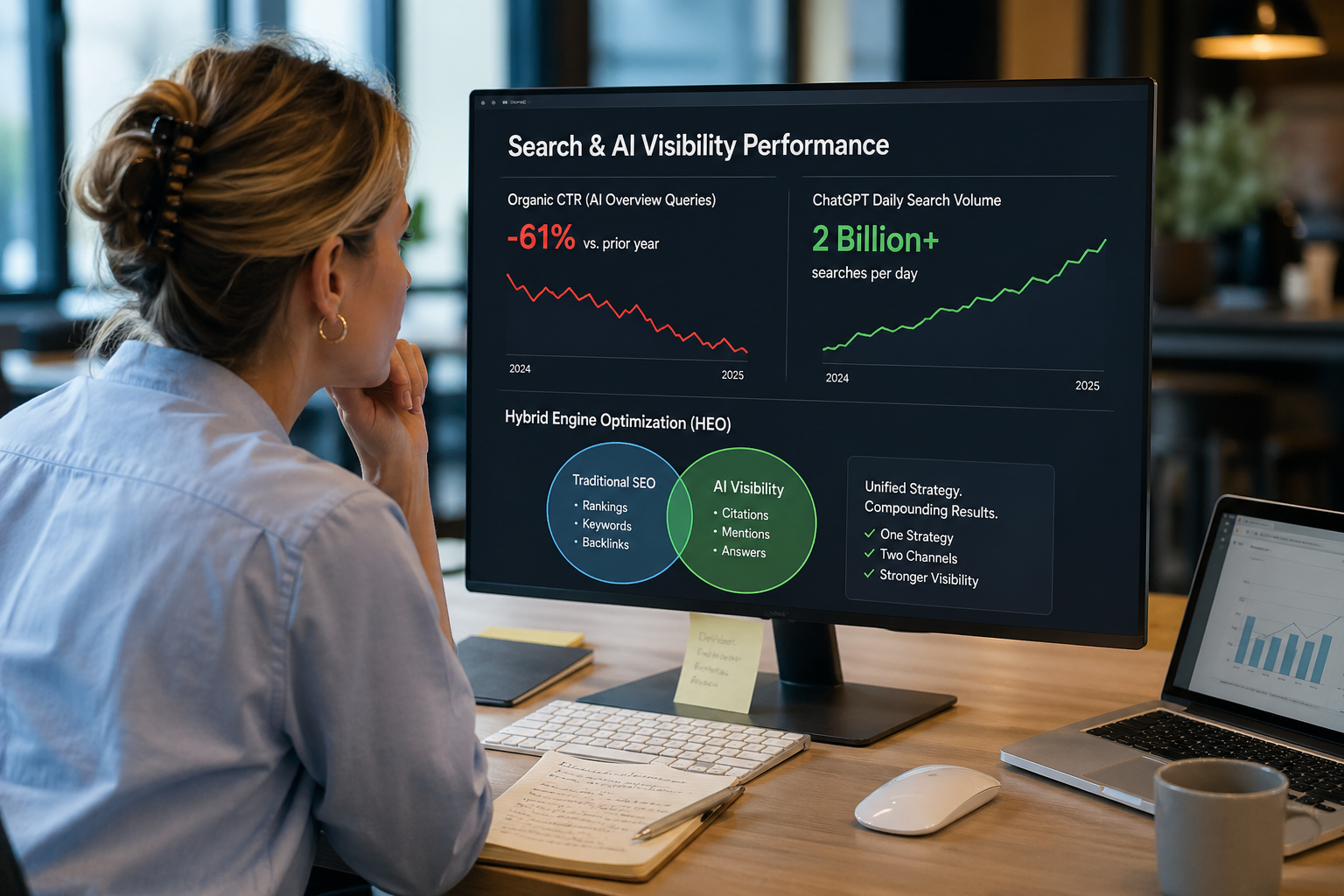
The Slide That Changed the Conversation
At SEO Week 2026 in New York City — one of the industry's most anticipated gatherings of the year, hosted by iPullRank and AirOps — a single slide stopped the room cold.
It read:
Hybrid Engine Optimization (HEO) Managing search & AI visibility as one measurable system, without sacrificing either.
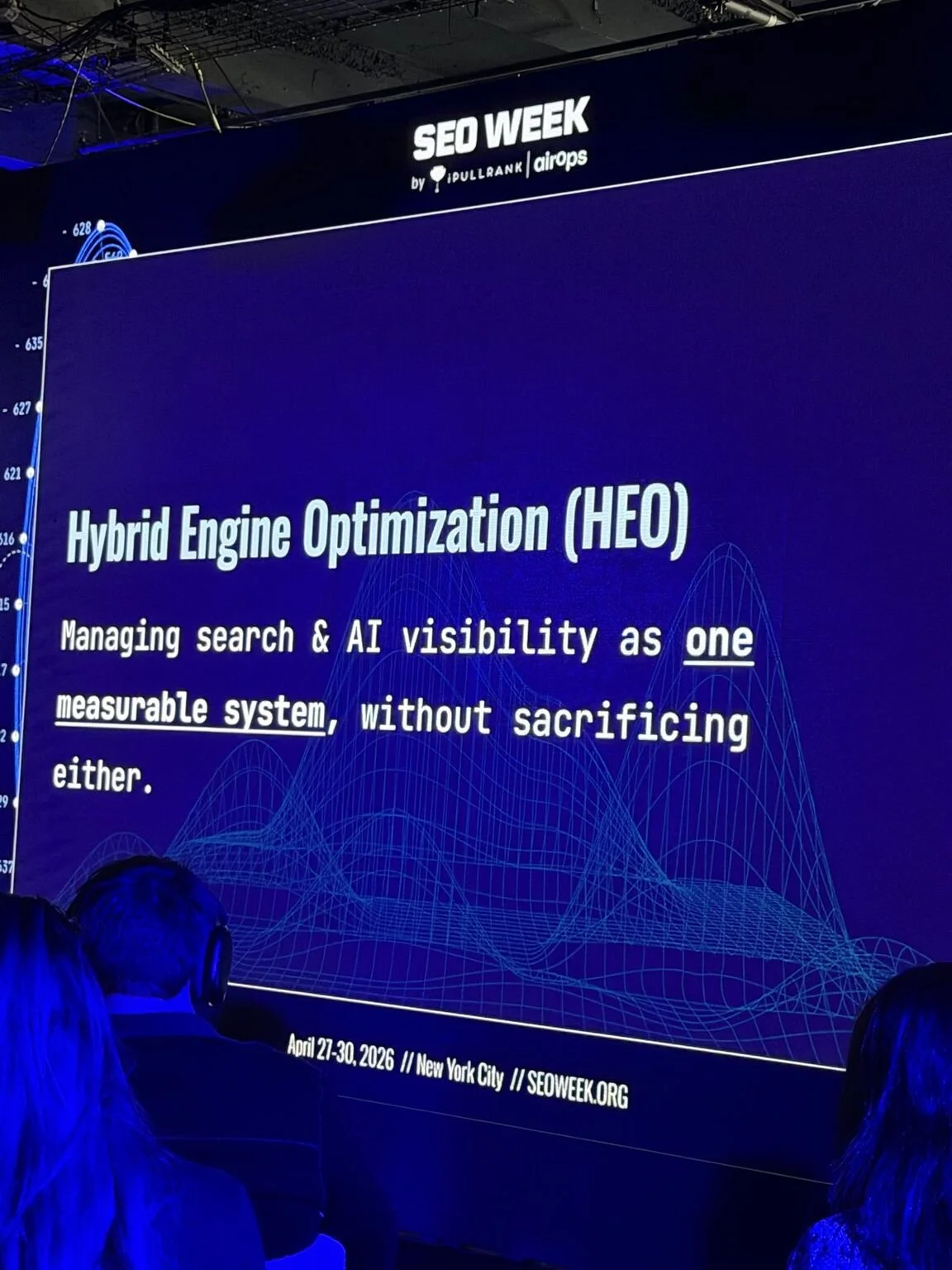
Simple. Direct. And for anyone who has been quietly watching their organic traffic numbers soften while AI answers eat into hard-earned click-through rates — absolutely urgent.
That slide wasn't just a catchy framework. It was a diagnosis. Search has split into two lanes, and most businesses are still driving in only one of them.
This post breaks down what HEO is, why it matters right now, what the data says, and what your business needs to do before the gap between you and your competition becomes impossible to close.
What Is Hybrid Engine Optimization?
HEO is the practice of managing your brand's visibility across both traditional search engines (Google, Bing) and AI-driven answer engines (ChatGPT, Perplexity, Google AI Overviews, Google AI Mode) as a single, unified, measurable system — rather than treating them as two separate problems.
The concept was introduced and formalized at SEO Week, with Jori Ford of iPullRank framing it this way: HEO is about blending SEO with AI discovery tools — visibility is no longer just about rankings, but about being present where queries are now turning into conversations and questions across engines and agents. iPullRank
The name is deliberate. "Hybrid" because the search landscape is no longer one thing. Queries that used to resolve in a list of ten blue links now resolve in a paragraph generated by a language model. Sometimes both happen simultaneously. Sometimes only one does. A strategy built for one world but not the other is a strategy built for half the internet.
And critically, search visibility in 2026 runs on a hybrid engine: traditional rankings still matter, but AI Overviews and assistant retrieval increasingly shape what gets seen, cited, and clicked. SEO Week
Why Now? The Numbers Tell the Story
If you're still treating SEO and AI visibility as optional extras rather than core business priorities, consider what's actually happening in the market right now.
The AI search audience is massive and growing fast.
ChatGPT has 883 million monthly users as of January 2026 and processes 2 billion queries daily. It is the 5th most visited website globally. That's not a niche early-adopter product. That's a platform bigger than most of the internet. Exposure Ninja
Google AI Overviews now reach 1.5 billion monthly users, and AI referral traffic is growing roughly 1% month over month across all industries. Superlines
By January 2026, ChatGPT leads the AI search market share with 60.7%, followed by Google Gemini at 15.0% and Microsoft Copilot at 13.2%. Sedestral
Traditional click-through rates are in freefall.
Organic CTR has dropped 61% for queries where an AI Overview is present. Let that sink in. If you rank #1 for a keyword and Google shows an AI Overview above your result, you lose more than half your expected clicks. Position Digital
Across all Google searches, 43% now end without any click to an external website — a figure that rises to 93% when Google's AI Mode is active. Sedestral
But AI citations are genuinely valuable.
Here's the flip side: the traffic you do get from AI platforms converts at a dramatically higher rate. AI Search traffic converts at 14.2% compared to Google's 2.8%, showing this traffic is dramatically more valuable. That's more than a 5x difference in conversion quality. Exposure Ninja
And ChatGPT users click out to external websites about twice as often as Google users — 1.4 links per visit compared with 0.6 from Google. Semrush
The implication is clear: a smaller volume of AI-driven visits can deliver better business results than a larger volume of traditional organic traffic. The question is whether you're optimized to capture them.
The Core Problem HEO Solves
For years, SEO was a well-understood discipline. You knew what signals mattered (backlinks, on-page optimization, technical health, E-E-A-T), you could measure your rankings, and you could track your traffic. The system was imperfect, but it was legible.
AI search broke that legibility — but it didn't replace the old system. It added a new one on top of it.
A page can rank well and still never appear in an AI response. The reverse can also happen: a page earns citations even when it doesn't drive a visit. An SEO strategy focused only on rankings misses a growing share of decision-making moments. AirOps
This is the core tension that HEO addresses. You can't abandon traditional SEO — Google still drives enormous volumes of traffic for commercial queries. But you can't ignore AI visibility either, because that's increasingly where research, discovery, and brand perception are being shaped.
Gartner predicts that traffic to the web from search engines will fall by 25% by 2026, primarily due to AI experiences handling queries without sending users to websites. Some verticals are projected to see 30-50% reductions by 2028. Growth Engines
The brands that treat this as a crisis will react. The brands that treat it as a system design problem — which is exactly what HEO does — will build something durable.
What Actually Gets You Cited in AI Search
Understanding HEO in practice means understanding the signals that AI systems use to decide what to cite. This is meaningfully different from traditional SEO ranking signals, and it varies by platform.
Freshness matters more than most people realize.
AI platforms tend to cite content that is about 25% "fresher" than traditional search — posted or updated within roughly 1,064 days compared to 1,432 days for traditional search. Pages updated within 60 days are 1.9x more likely to appear in AI answers. Superlines
Structured data is a significant multiplier.
Source citation improves by 30% when schema markup is included. And sites implementing structured data and FAQ blocks saw a 44% increase in AI search citations. Exposure NinjaSuperlines
Statistics and citations within your content signal credibility.
Content with statistics, citations, and quotations achieves 30-40% higher visibility in AI responses. AI systems are evaluating your content for the same things a thoughtful human editor would: Is this claim supported? Is this author credible? Is this information current? Superlines
Where your content sits on the page matters.
44.2% of all LLM citations come from the first 30% of text — the intro. This means your lead paragraphs need to front-load your most citable, authoritative claims. Position Digital
Format signals intent.
Listicles are the preferred format for commercial queries, sitting at a 25% citation rate compared to blogs and opinion pieces at 11%. Your content strategy should map formats to intent, not just topics. Position Digital
Different platforms behave very differently.
Only 11% of domains are cited by both ChatGPT and Perplexity. ChatGPT favors Wikipedia and encyclopedic content (47.9% of top citations), Perplexity heavily cites Reddit (46.7%), and Google AI Overviews prefer YouTube and multi-modal content (23.3%). Averi
This is a crucial insight: there is no single "AI SEO" strategy. A well-executed HEO program accounts for platform-specific behavior and optimizes accordingly.
The Hybrid Engine Score: Making It Measurable
One of the most practically useful concepts introduced at SEO Week 2026 was the idea of a Hybrid Engine Score — a weekly, measurable framework that separates meaningful signal from noise across both traditional and AI search surfaces.
The Hybrid Engine Score is a weekly, measurable scoring system that separates noise from signal, shows what's actually changing, and turns findings into a prioritized list you can run Monday morning. SEO Week
This matters because the biggest failure mode for brands navigating this transition isn't ignorance — it's measurement paralysis. Teams either track traditional rankings and ignore AI citations, or they try to monitor everything and end up overwhelmed. The Hybrid Engine Score provides a single weekly number that encompasses both.
In practical terms, a robust HEO measurement framework should track:
Traditional rankings for your target keywords across desktop and mobile
AI Overview inclusion rate — how often your content appears in Google's AI-generated summaries
Citation frequency across ChatGPT, Perplexity, and Gemini for queries relevant to your business
Brand mention velocity — how often your brand name appears in AI answers, even without a direct link
Conversion quality by source — separating AI referral traffic from organic search traffic to understand relative value
64% of marketing leaders are unsure how to measure success in AI search. Traditional marketing attribution models weren't built for AI-driven discovery. Getting your measurement infrastructure right is not a nice-to-have. It's the foundation of everything else. Averi
The Content Strategy for HEO
At SEO Week, AirOps CEO Alex Halliday offered a pointed observation: the brands pulling ahead in AI search aren't publishing more — they're publishing better. The three-part system the best content teams are building: brand context at the center, humans in the loop, and performance checks at the finish line. SEO Week
What does "publishing better" look like in HEO terms?
1. Build content that answers questions, not just targets keywords.
AI systems are answer retrieval machines. They're looking for content that directly, clearly, and authoritatively addresses a user's question. Long-tail, conversational queries are especially vulnerable to AI takeover — but they're also the queries where well-structured content has the best chance of being cited.
2. Make your brand the context.
To stay visible in AI-driven results, you need to train LLMs on your brand by creating answerable, structured, and brand-rich content — think FAQs, glossaries, explainer blocks — and strategically leveraging your presence across platforms. AI systems learn what your brand represents from the totality of your web presence, not just your website. iPullRank
3. Cover the full topical landscape.
Search is no longer about keywords — it's about deep semantic understanding. Modern information retrieval, NLP, and AI-enhanced ranking methods redefine what it means to create authoritative content. A brand that dominates a topic area holistically — covering definitions, comparisons, case studies, FAQs, and expert analysis — is far more likely to be cited across both traditional and AI surfaces than a brand that targets isolated keywords. SEO Week
4. Prioritize bottom-funnel content for AI traffic.
Bottom-funnel content like case studies and pricing pages gets the highest AI referral traffic, while top-funnel content (what-is and how-to guides) saw massive drops in the past two years. This doesn't mean abandoning top-of-funnel content — it means understanding that AI systems increasingly handle informational queries themselves, and your content investment should reflect that. Position Digital
5. Build third-party citation equity.
Brands are currently 6.5x more likely to be cited through third-party sources — like review sites, news, or forums — than through their own brand domains. PR, thought leadership, and strategic content placement across high-authority domains isn't just a brand exercise. In the HEO era, it's an infrastructure investment. Superlines
The Technical Foundation
HEO isn't just a content strategy — it requires a technical foundation that makes your content legible to AI crawlers and retrieval systems, not just traditional search bots.
Crawl logs are your truth source: they reveal what bots actually care about, helping you move beyond hypothetical tool data to real behavior and opportunity. AI platforms like ChatGPT, Perplexity, and Google send their own crawlers to your site. Understanding which bots are visiting, what they're reading, and what they're ignoring is foundational intelligence that most brands aren't collecting. iPullRank
Key technical priorities for HEO:
Schema markup — especially Article, FAQ, Organization, and Author schema
Clean site architecture with logical internal linking that signals topical authority
Fast load times — AI crawlers, like search crawlers, favor accessible pages
Visible author credentials — websites with author schema are 3x more likely to appear in AI answers
Regular content updates with visible timestamps — freshness is a real signal
Structured FAQ blocks — one of the highest-performing formats for AI citation
The Platform Landscape You're Optimizing For
Understanding HEO means understanding the distinct ecosystems you're operating in simultaneously.
Google (AI Overviews + AI Mode): Still the dominant force in search globally. AI Overviews now appear in 25.11% of Google searches, up from 13.14% in March 2025. Google's AI Mode represents the future direction of the platform — a fundamentally different search experience where citation, not ranking, is the primary visibility mechanism. Superlines
ChatGPT: Business and service sites account for 50% of all the sources ChatGPT cites. This is excellent news for brands with well-structured, authoritative websites. ChatGPT favors encyclopedic, well-sourced content and tends to draw heavily from established domains. Semrush
Perplexity: Smaller but higher-intent. 30% of Perplexity users are in senior leadership roles, while 65% are in high-income white-collar professions. If your business targets decision-makers and professionals, Perplexity visibility deserves focused attention. Exposure Ninja
Gemini: Growing rapidly. Referrals from Gemini to publisher sites grew by nearly 400% year-on-year, outpacing even ChatGPT's referral growth. Deeply integrated into Google Search, Gemini's influence on traditional search results is already significant and will only increase. Growth Engines
What This Means for Your Business
Let's bring this back to ground level. If you run a local business, a regional service company, an e-commerce store, or a professional services firm — HEO isn't an abstract concept for enterprise brands. It's the competitive reality you're operating in, whether you've named it or not.
Your potential customers are already using ChatGPT to research vendors. They're asking Google AI Overviews whether your type of service is worth using. They're getting recommendations from Perplexity before they ever visit your website. The question isn't whether this is happening — it's whether your brand shows up when it does.
The businesses that move on this now will:
Build measurable visibility across both traditional and AI search surfaces
Create content architectures that serve both ranking algorithms and AI retrieval systems
Develop the tracking infrastructure to understand where their customers are coming from and how those sources compare in quality
Establish brand authority that feeds citation across third-party platforms — the most powerful visibility signal in the AI era
The businesses that wait will find themselves optimizing for a search landscape that no longer fully exists while their competitors are already fluent in the one that does.
The Bottom Line
HEO isn't the death of SEO. It's SEO grown up — expanded to account for the full landscape of how people find information in 2026.
The slide from SEO Week said it as clearly as it can be said: managing search and AI visibility as one measurable system, without sacrificing either. That's not a future aspiration. That's the operational requirement of doing business online today.
The brands that internalize this — that stop treating traditional SEO and AI visibility as two separate budget line items with two separate strategies — are the brands that will compound their advantage over the next three years while everyone else tries to catch up.
Ready to Build Your HEO Strategy?
Ritner Digital helps businesses build search and AI visibility as a unified, measurable system — not two separate things running in parallel.
Whether you're starting from scratch or trying to understand why your traffic metrics don't match your content investment, we can help you build clarity, strategy, and results.
→ Let's talk. Contact Ritner Digital.
Sources: SEO Week 2026 (seoweek.org) · iPullRank (ipullrank.com) · AirOps (airops.com) · Exposure Ninja AI Search Statistics · Superlines AI Search Statistics · Position Digital AI SEO Statistics · Semrush AI SEO Statistics · Digital Applied AI Search & SEO Statistics · Growth Engines AI Search vs Google · Arc Intermedia AI Search Case Study · Sedestral AI Search Market Share · Averi B2B SaaS Citation Benchmarks Report
Frequently Asked Questions
What is Hybrid Engine Optimization (HEO)?
Hybrid Engine Optimization is the practice of managing your brand's visibility across both traditional search engines (Google, Bing) and AI-driven answer engines (ChatGPT, Perplexity, Google AI Overviews) as a single, unified, measurable system. Rather than treating SEO and AI visibility as two separate strategies with separate budgets and separate teams, HEO treats them as one interconnected system — because that's how your customers are actually finding you.
How is HEO different from regular SEO?
Traditional SEO focuses on ranking in search engine results pages. HEO expands that focus to include whether your content gets cited by AI systems when they generate answers — which is a fundamentally different mechanism. A page can rank #1 on Google and never appear in a ChatGPT or Perplexity response. Conversely, a page can earn AI citations without ranking particularly well in traditional results. HEO builds a strategy that captures both opportunities rather than optimizing for only one.
Why does HEO matter right now in 2026?
Because the numbers demand it. AI Overviews now appear in over 25% of all Google searches. ChatGPT processes 2 billion queries daily. Organic click-through rates have dropped 61% on queries where an AI Overview is present. At the same time, traffic that does come from AI platforms converts at more than 5x the rate of traditional organic traffic. The opportunity is real — but only for brands that are optimized to capture it.
Do I still need traditional SEO if I'm doing HEO?
Absolutely. Traditional SEO isn't dead — it's still the primary driver of high-volume traffic for most businesses, especially for commercial queries where AI Overviews are less dominant. HEO isn't a replacement for SEO. It's an expansion of it. The goal is to compete in both arenas simultaneously, using a unified content and technical strategy that serves both ranking algorithms and AI retrieval systems.
What types of content get cited by AI systems?
Several factors consistently improve your chances of being cited in AI-generated answers. Fresh content updated within the last 60 days is nearly twice as likely to appear in AI answers. Pages with schema markup see a 30% improvement in citation rates. Content that includes statistics, citations, and expert quotations achieves 30–40% higher visibility in AI responses. Structured formats — FAQs, listicles, clearly headlined explainers — outperform dense, unstructured prose. And critically, your intro matters most: 44% of all AI citations come from the first 30% of a page's text.
Does HEO work differently on ChatGPT vs. Perplexity vs. Google?
Yes — significantly. Only 11% of domains are cited by both ChatGPT and Perplexity. ChatGPT favors encyclopedic, well-sourced content and tends to cite established business and service websites heavily. Perplexity cites Reddit for nearly half its responses, making third-party community presence a real strategic lever. Google AI Overviews and AI Mode prefer YouTube and multi-modal content more than the other platforms. A mature HEO strategy accounts for these differences rather than applying a one-size-fits-all approach.
How do I measure HEO success?
You need to track metrics across both surfaces. On the traditional side: rankings, impressions, and click-through rates via Google Search Console. On the AI side: how often your content appears in AI Overviews, how frequently your brand is cited in ChatGPT and Perplexity responses for relevant queries, and brand mention velocity even when no direct link is included. Conversion quality by traffic source is also critical — AI referral traffic and traditional organic traffic perform very differently, and understanding that difference helps you allocate resources correctly.
How does schema markup help with AI visibility?
Schema markup gives AI systems structured, machine-readable signals about who you are, what your content covers, and why you're authoritative. Article schema, FAQ schema, Author schema, and Organization schema are particularly impactful. Research shows that websites with Author schema are 3x more likely to appear in AI answers, and sites that implement structured data and FAQ blocks see a 44% increase in AI search citations. Think of schema as making your content legible not just to search crawlers but to the AI retrieval systems that are increasingly driving discovery.
Is HEO only for large enterprises?
Not at all. While enterprise brands have more resources to deploy across multiple platforms simultaneously, the core principles of HEO — creating authoritative, well-structured, frequently updated content that earns citations on and off your own site — apply to businesses of every size. In fact, smaller and mid-sized businesses that move on this now have a real opportunity to build AI visibility in their niche before larger competitors fully wake up to the shift.
How do I get started with HEO for my business?
The first step is understanding where you currently stand — what your traditional rankings look like, whether your content is appearing in AI Overviews, and whether your brand is being cited in AI responses for the queries that matter to your business. From there, a structured HEO program addresses technical foundations (schema, site architecture, crawl health), content strategy (format, freshness, topical authority), and off-site presence (third-party citations, PR, community participation). That's exactly what we help businesses build at Ritner Digital.