The Search Landscape Broke — And People Went Somewhere Else
Something interesting happened as Google's AI Overviews ate into organic click-through rates and ChatGPT absorbed billions of informational queries. People didn't just sit there and take it.
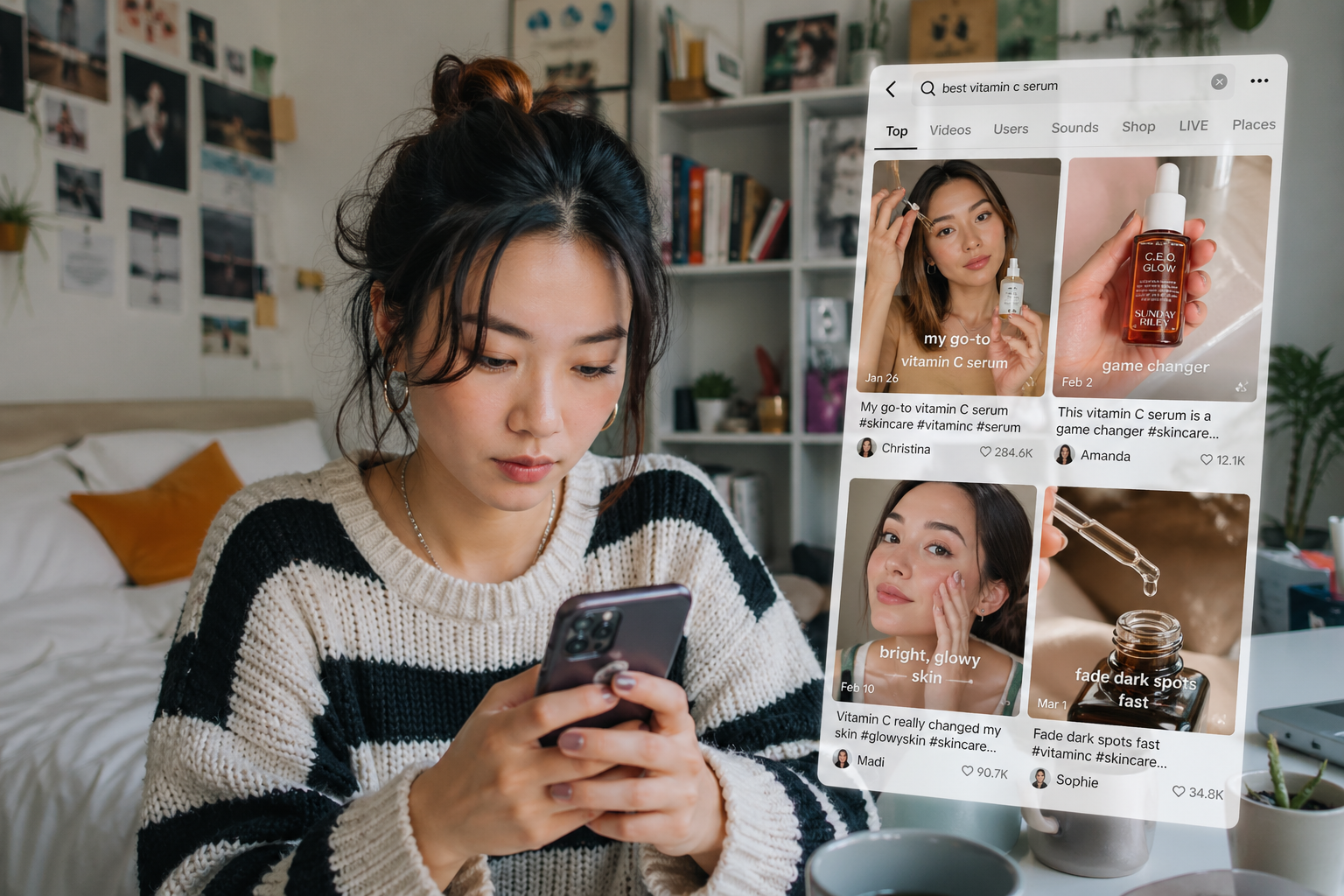
They went to TikTok. They went to Instagram. They went to YouTube, Reddit, and Threads. And they started searchingthere — not just scrolling.
The collapse of traditional search as the dominant discovery channel didn't create a vacuum. It created a migration. And the data on where people went, why they trust what they find there, and what it means for businesses is now impossible to ignore.
The Numbers: Social Has Become the New Front Door
Let's start with the headline statistic, because it reframes everything else.
According to Sprout Social's Q2 2025 Pulse Survey of more than 2,200 users across the US, UK, and Australia, 41% of Gen Z now turn to social platforms first when looking for information — ahead of traditional search engines at 32%, chat-based AI tools at 11%, and friends and family at 9%. Sproutsocial
Read that again. Among the generation entering its peak purchasing years, social media has already overtaken Google as the primary place people go to find information. Not eventually. Now.
And it isn't just Gen Z. 37% of consumers across all age groups prefer to go to social first when searching for product reviews and recommendations, and 35% prefer it for finding local restaurants and activities. Sproutsocial
A Rise at Seven analysis of 1.5 billion searches across the most-searched keywords on the internet found that Google's total search share has fallen to 34.5%, with the rest belonging to YouTube at 24%, Instagram at 20.9%, and TikTok at 16.7% — the new kings of discovery taking up 60% collectively. Rise at Seven
The same study found something even more pointed for marketers: every other platform combined — TikTok, YouTube, Pinterest, Reddit, ChatGPT — only gets 10% of the budget, yet drives over 60% of discovery in a 2025/26 search journey. Rise at Seven
There's your gap. Budget allocation is still living in 2019. Attention has already moved.
Why Social Search? The Trust Problem With Everything Else
To understand this shift, you have to understand what's driving it — and it's not just convenience or habit. It's a fundamental trust recalculation.
The most fascinating behavioral shift of the current decade is the aggressive transition from traditional search engines to social discovery. This inversion of the traditional discovery model stems from a deep-seated preference for user-generated content and peer answers over algorithmic web results. 46% of Gen Z explicitly prefer social platforms over Google when seeking information, heavily driven by a demand for authentic, human-verified answers rather than SEO-optimized corporate websites. Sociallyin
This matters enormously for brands. The thing people are fleeing isn't search — it's polished, optimized, manufacturedcontent designed to rank rather than to genuinely help. And ironically, the explosion of AI-generated content has made that problem significantly worse.
Only 7% of consumers trust AI-generated recommendations as much as human ones. Power Digital
According to the Edelman Trust Barometer, 80% of consumers see peers — real customers, creators, and everyday users — as the most credible source of brand information. Unlike brand ads that are scripted or AI-polished, peer content reflects lived experience: how a product actually works, feels, and delivers in real life. Buzzinly
Social platforms deliver that peer credibility at scale. A TikTok from a real customer unboxing your product carries more weight than a perfectly optimized product page — because it looks and feels like a human being telling the truth.
The Platform-by-Platform Discovery Picture
The shift to social search isn't monolithic. Different platforms serve different search intents, and understanding that is the difference between a social presence and a social strategy.
Gen Z fragments their daily search queries across different platforms depending on intent: nearly one in three use TikTok over Google to find cooking inspiration, and a significant portion specifically prefer Reddit for authentic product reviews. Sociallyin
87% of users are active on Instagram, and 60% rely on it for product research — up 16% from last year. 66% of users engage with TikTok for product discovery, and 54% use the platform specifically to research products or services. YouTube has surged as the go-to validation layer, with long-form reviews and unboxings shaping final purchase decisions. Power Digital
Platforms like Reddit, Discord, and LinkedIn Groups saw explosive growth in 2025, with 90% of Reddit users trusting the platform for product insights. Evergreen Social
51% of global social media users plan to spend more time on community-based platforms like Reddit in the next six months — rising to 63% for Gen Z and Millennials. Sproutsocial
The takeaway: your audience isn't on one platform doing one thing. They're bouncing between platforms depending on what stage of discovery they're in. Consumers now bounce between 3.6 platforms before making a purchase, taking up to 10 weeks and as many as 97 interactions to complete their journey. Rise at Seven
The Business Impact Is Real — And Already Measurable
This isn't just a cultural observation. The shift to social-first discovery has direct, quantifiable business consequences.
76% of consumers say content on social — ads, influencer posts, brand content — has influenced a purchase in the past six months. That number rises to 90% among Gen Z and 84% among Millennials. Sproutsocial
As of 2026, over 60% of product discovery happens on social platforms. Pravaah Consulting
According to Deloitte Digital, brands that are social-first see 10% higher annual revenue growth by showing up inside conversations, creator content, and communities. Sprout Social
User-generated content — the organic, peer-driven content that social platforms are built around — is performing especially well against traditional marketing. Social media posts featuring user-generated content drive 10.38x higher conversion rates compared to brand-created posts. Buzzinly
And for brands leaning into creator partnerships: influencer ads deliver nearly 2x the click-through rate of brand ads, with CPC running 25% lower for influencer ads while revenue metrics like ROAS and AOV remain consistent. Power Digital
The Authenticity Premium: What Consumers Are Actually Demanding
Here's where the data gets particularly interesting for brands trying to figure out what to actually do on social.
The rise of AI-generated content has created an unexpected side effect: authenticity has become the scarcest and most valuable signal in the entire digital ecosystem. 55% of social users say they are more likely to trust brands that publish human-generated content, and this rises to two-thirds of Gen Z and Millennials. Sprout Social
According to Sprout Social's Q4 2025 Pulse Survey, consumers say the number-one effort they want brands to prioritize in 2026 is crafting human-generated content. Pravaah Consulting
Winning brands are intentionally moving away from overly polished social content. Imperfections, natural pacing — even typos — signal authenticity, even when AI is at work behind the scenes. Over-editing is out. Hootsuite
This is counterintuitive to a lot of marketing instincts. We've spent decades polishing everything. But in a world flooded with AI-generated perfection, imperfection is the proof of humanity — and humanity is what people trust.
As Sprout Social's CMO Scott Morris put it: "AI drives a new premium on authenticity. The flood of easily generated content and deepfakes will push consumers to seek out content that feels human-generated and real, shifting authenticity from a brand differentiator to a prerequisite for engagement." Sprout Social
The Community Turn: Where Discovery Is Migrating Next
Beyond the major platforms, there's a quieter but significant migration toward smaller, more intentional digital spaces.
Consumers are moving to more private spaces like Discord, Reddit, Instagram Broadcast Channels, and Facebook Groups. The Q4 2025 Pulse Survey found that one of the top five things global social media users say brands should prioritize in 2026 is interacting with audiences in smaller digital spaces. Sprout Social
As Greg Swan of FINN Partners summarized: "The future of social media for brands will re-center community, not just content. People want connection, transparency, and real value from the brands they follow." Sprout Social
This is a meaningful distinction. Broadcasting content to a follower count is the old model. Participating in communities where your audience already has real conversations is the new one. The brands doing the latter are building something that compounds — reputation, trust, and organic advocacy that no algorithm change can wipe out overnight.
What This Means Strategically for Your Business
Pull all of this together and the strategic picture is clear, even if executing on it is genuinely hard.
Discovery has fractured. Your potential customers are no longer reliably reachable through a single channel or a single strategy. They're on TikTok searching for reviews. They're on Reddit asking real people for recommendations. They're on YouTube watching 12-minute product comparisons before they ever visit your website. And they're making judgments about your brand based on what they find — or don't find — in all of those places.
The businesses that treat this as a social media management problem will keep struggling. The businesses that treat it as a discovery architecture problem — asking seriously where their brand shows up across the full ecosystem of platforms their customers use to research, validate, and decide — will build a durable competitive advantage.
Practically, that means:
Social search optimization is now as important as website SEO. Every post, video, and caption is a searchable asset. It needs keywords, clarity, and a point of view — not just a pretty visual.
Peer credibility is infrastructure. User-generated content, reviews, and community participation are not nice-to-haves. They are the primary trust mechanism in the current discovery environment.
Platform-native content beats repurposed content. TikTok users, Instagram users, and YouTube users expect different things. Content built for one platform and pushed to all of them underperforms content made specifically for each.
Authenticity is a competitive moat. In the AI content flood, genuine human voices — your team, your customers, your community — are increasingly rare and increasingly valuable.
Community participation beats broadcasting. Showing up in the spaces where your customers already talk, and contributing real value without a hard sell, builds the kind of trust that drives word-of-mouth at scale.
The Bottom Line
The search landscape didn't just get disrupted by AI. It got disrupted by a generation that lost trust in what traditional search was delivering — and went looking for answers from real people instead.
Social media filled that gap. And it did so not by being louder or flashier than Google, but by being more human. More authentic. More peer-driven. More trustworthy in the ways that matter most to modern consumers.
For businesses, the question is no longer whether social discovery matters. The data settled that. The question is whether your brand shows up — credibly, consistently, and authentically — in the places where your customers are already looking.
Ready to Build a Discovery Strategy That Works in 2026?
Ritner Digital helps businesses show up across the full landscape of modern discovery — search, AI, and social — as one connected, measurable system.
→ Let's talk. Contact Ritner Digital.
Frequently Asked Questions
Is social media really replacing Google as a search engine?
Not entirely — but it is replacing Google as the starting point for discovery for a large and growing segment of consumers. Among Gen Z, social media has already surpassed traditional search engines as the first place they turn when looking for information. For product research, reviews, and local discovery, social platforms are now the preferred first stop for more than a third of all consumers across age groups. Google still processes enormous search volume, but it no longer has an exclusive hold on the top of the discovery funnel.
Which social platforms are people using most for search and discovery?
It depends on the intent. YouTube dominates for product validation — long-form reviews and unboxing videos shape final purchase decisions. TikTok leads for trend-driven discovery and product research among younger audiences, with 66% of users engaging with it specifically for that purpose. Instagram is where 60% of its users go for product research. Reddit has become the go-to for authentic, peer-reviewed recommendations, with 90% of its users trusting it for product insights. The key insight is that your customers aren't choosing one platform — they're bouncing between 3.6 platforms on average before making a purchase decision.
Why are people turning to social media for information instead of traditional search?
The core driver is trust. Consumers are increasingly skeptical of SEO-optimized corporate content, and the explosion of AI-generated material has made that skepticism sharper. Social platforms deliver something search engines struggle to replicate: peer-level credibility. When a real person shares a genuine experience with a product or service — unfiltered, unsponsored, in their own words — it carries a weight that a polished landing page simply can't match. 80% of consumers say peers are the most credible source of brand information, and that preference is directly shaping where people go to research.
Does this mean my business should abandon SEO and focus only on social?
No. The smart move is to build both simultaneously, because your customers are using both — often in the same purchase journey. Someone might discover your brand on TikTok, validate it on Reddit, Google your business name to find your website, and then read your reviews before converting. Abandoning any one of those touchpoints means losing people at that stage. The brands winning right now are treating search and social as complementary parts of one discovery system, not competing priorities with competing budgets.
What is "social search optimization" and how is it different from regular SEO?
Social search optimization is the practice of making your content findable within social platforms — treating every post, video, caption, and comment as a searchable asset, not just a piece of content to be broadcast. Just like traditional SEO, it involves keyword research, strategic positioning, and understanding search intent. But the execution looks different: it's about using natural language in video captions, building content around the specific questions your audience types into TikTok or Instagram's search bar, and ensuring your brand shows up when someone searches your category on Reddit or YouTube. The underlying logic is the same. The playbook is platform-specific.
Why does authenticity matter so much right now?
Because AI-generated content has flooded the internet with polished, flawless, perfectly optimized material — and consumers can feel it. In a landscape saturated with artificial perfection, genuine human content has become the scarcest signal of trustworthiness. The data reflects this clearly: 55% of social users say they're more likely to trust brands that publish human-generated content, and consumers surveyed say the number one thing they want brands to prioritize in 2026 is human-made content. Imperfections, natural pacing, and real voices aren't weaknesses anymore. They're proof of authenticity — and authenticity is what converts.
What is user-generated content (UGC) and why does it matter for discovery?
User-generated content is any content — videos, photos, reviews, posts — created by real customers or community members rather than the brand itself. It matters because it delivers peer credibility at scale. Social posts featuring UGC drive over 10x higher conversion rates compared to brand-created posts. For Gen Z specifically, 80% rely on user-generated videos to make final purchase decisions. UGC also feeds social search — when customers post about your brand organically, that content becomes discoverable by others searching for your product category. It's essentially word-of-mouth that the algorithm can index.
Should my business be investing in community platforms like Reddit and Discord?
If your audience is there — yes, and sooner rather than later. Community platforms are where the most trusted conversations about your industry and product category are already happening. 90% of Reddit users trust the platform for product insights, and 51% of global social media users say they plan to spend more time on community-based platforms in the next six months. The opportunity isn't to advertise in those spaces — it's to participate genuinely, answer questions, share expertise, and build the kind of reputation that gets cited when someone asks for a recommendation. That kind of trust compounds over time in a way that paid reach doesn't.
How do I measure whether my social presence is actually driving discovery and business results?
Start by separating vanity metrics from business metrics. Follower count and impressions tell you almost nothing about whether social is contributing to discovery and revenue. Instead, track direct traffic from social platforms in Google Analytics, monitor branded search volume for spikes that correlate with social activity, add a "how did you hear about us?" field to your intake forms with options like TikTok, Instagram, and YouTube, and watch for increases in review volume and community mentions. The goal is to build a picture of the full discovery path your customers take — and understand which social touchpoints are accelerating or stalling that journey.
How do I get started building a social discovery strategy for my business?
The first step is an honest audit of where you currently exist in the social discovery ecosystem — not just which platforms you post on, but whether your brand shows up when someone searches for your product category on TikTok, whether you're being discussed on Reddit, and whether your YouTube presence is answering the questions your customers are actually asking. From there, a real social discovery strategy maps your content to specific search intents on specific platforms, builds authentic peer credibility through UGC and community engagement, and connects social activity to measurable business outcomes. That's the kind of strategy we build with clients at Ritner Digital.