The Fake Profile Playbook: Why Companies Are Gambling Their Reputation (and Freedom) on LinkedIn Fraud
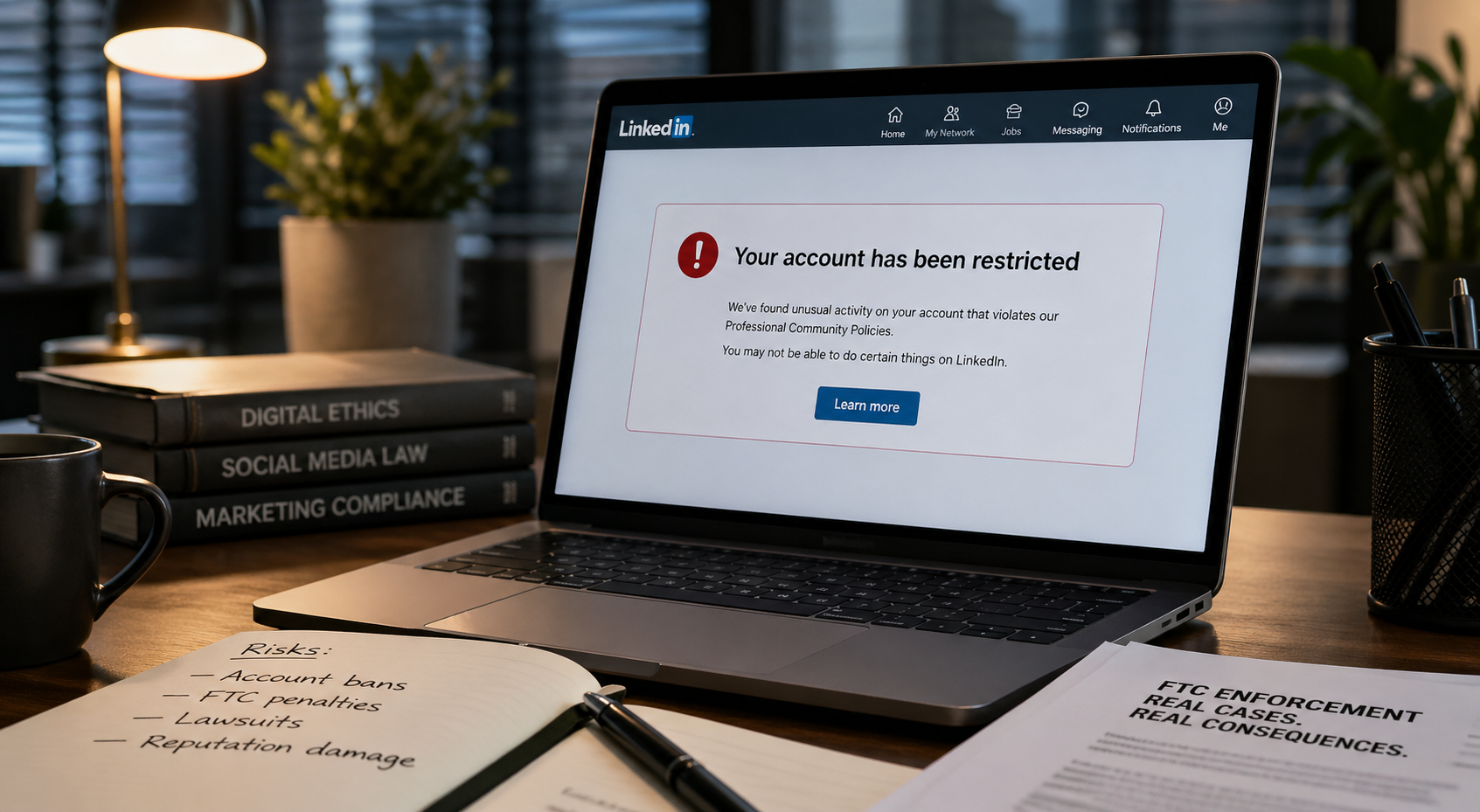
There's a tempting idea floating around B2B marketing circles. It goes something like this: What if we just created a few extra LinkedIn profiles? Employees liking our posts, a network of company pages pointing back to us, a little coordinated engagement to get the algorithm moving our way. It sounds low-stakes. It sounds like everybody's doing it. And in some corners of the industry, a lot of people are.
But the gap between how harmless this feels and how serious the consequences are is enormous — and getting wider every quarter. LinkedIn's detection systems have become frighteningly sophisticated. The FTC has sharpened its enforcement teeth around fake endorsements. And courts have seen enough cases to establish a clear paper trail of what happens to companies that get caught.
This post is a deep dive into the full picture: how fake profile networks operate, what LinkedIn is doing to kill them, the legal exposure companies are creating for themselves, and why even a well-intentioned employee outbound program built on inauthentic accounts is a liability you cannot afford.
Part One: The Anatomy of a Fake Profile Network
To understand the risk, you first have to understand what these operations actually look like — because they're not always crude or obviously malicious. Many are built by marketing teams who genuinely believe they're just "playing the game."
The simplest version is a company creating a handful of fictitious employee profiles. These accounts connect with real prospects, like and comment on the company's posts to boost algorithmic reach, and generally manufacture the appearance of a larger, more active organization than actually exists. At the next level of sophistication, companies build what the industry calls engagement pods — coordinated groups of accounts (real or fake) that agree to systematically interact with each other's content.
More elaborate operations create entire networks of fake companies. A shell organization might post thought leadership content that links back to the real company. A fake consulting firm might reference the real company as a partner. A fabricated industry analyst account might endorse the company's services. Each layer adds a veneer of third-party credibility that is, in reality, manufactured in-house.
According to a study by Lunio, an estimated 25% of LinkedIn traffic comes from bots and fake accounts — a staggering figure for a platform that has built its entire value proposition on professional authenticity. Researchers tracing the origins of LinkedIn's influencer economy found that pod platforms like Lempod, Podawaa, and Hyper Clapper enabled users to deploy pre-loaded generic comments at scale, using macros to pull in the first name of the post creator to make automated engagement appear personal. TheaioptimistTheaioptimist
The people running these operations often don't think of themselves as fraudsters. They think of themselves as growth hackers. That distinction, unfortunately, is not one that LinkedIn's legal team or the FTC is inclined to make.
Part Two: LinkedIn Knows What You're Doing — and Its AI Is Getting Better
The single most important thing to understand about the current LinkedIn environment is that the platform's ability to detect inauthentic behavior has undergone a fundamental transformation.
According to an analysis of LinkedIn's own engineering research papers, the platform ripped out its entire ranking system in mid-2024 and replaced it with a foundation model AI that reads and comprehends content like an expert consultant — moving from a system that counted signals to one that understands context and makes expert judgments about substance and relevance. Mark Schaefer
This isn't a minor update. The entire logic of how engagement is evaluated has changed.
LinkedIn's 2025 algorithm now tracks comment velocity, account relationships, engagement history, and even the semantic content of comments. When fifteen people comment within ninety seconds of a post going live, all using generic phrases, the system flags it. The old tricks — coordinating a quick burst of likes, rotating through templated comments, scheduling synchronized engagement — are exactly the behavioral signatures the new AI is trained to catch. DEV Community
A test comparing two posts on similar topics found that a post with 19 detailed comments that sparked real conversation reached 3.2 times more people and drove 8 times more profile visits than a post with 43 short, generic comments. The math has fundamentally shifted. Manufactured engagement doesn't just fail to help — it actively suppresses reach. DEV Community
LinkedIn has also made its enforcement posture publicly explicit. LinkedIn's VP of Product Management, Gyanda Sachdeva, stated the company's goal plainly: "Our goal is to make engagement pods entirely ineffective." The platform is investing in behavioral signal detection and limiting the reach of posts flagged for suspicious activity. The Linked Blog
LinkedIn has updated its policies to limit how many comments a member or LinkedIn Page can make within a certain time period — a direct structural response to automation abuse. LinkedIn removed over 80.6 million fake accounts at registration during the second half of 2024 alone, up from 70.1 million in the prior six months, and in the first half of 2024 detected over 86 million fake profiles and more than 142 million spam or scam incidents. Social Media TodayAllure Security
The scale of that detection is worth sitting with. Over 80 million fake accounts stopped before they could even get started — in a single six-month period. And those are only the ones caught at registration.
LinkedIn's Transparency Report documented that 99.65% of fake accounts were removed before users could report them, meaning the platform's AI caught them proactively. If your strategy depends on fake profiles surviving long enough to run a campaign, the odds are stacked heavily against you. Linkedsdr
Part Three: The "Employee Outbound at Scale" Temptation
A slightly more sophisticated version of the fake profile scheme involves real employees — but in ways that cross important lines.
The pitch sounds reasonable: get your sales team to post more, engage more, connect more. Have them like the company's content. Maybe coordinate posting times. Maybe script out some comments for them to leave. This is where many companies slide from aggressive-but-legal marketing into territory that creates real exposure.
The moment employee engagement is coordinated, scripted, and designed to create a false impression of organic enthusiasm, you've entered inauthentic territory — even if the accounts are real people. The FTC is clear that the issue isn't the channel; it's the deception.
The FTC's revised Endorsement Guides explicitly articulate a new principle regarding procuring, suppressing, boosting, organizing, publishing, upvoting, downvoting, or editing consumer reviews so as to distort what consumers think of a product — and the updated definition of endorsements was broadened to clarify the extent to which it includes fake reviews, virtual influencers, and tags in social media. Federal Trade Commission
If employees are liking and commenting on company posts as part of a coordinated internal program designed to manipulate visibility — without any disclosure of that coordination — you have an undisclosed material connection between the endorser (the employee) and the advertiser (the company). That's exactly what the FTC's guidelines are designed to catch.
The FTC sent notices to more than 700 companies putting them on notice that they could incur civil penalties of up to $43,792 per violation for practices including falsely claiming an endorsement by a third party, misrepresenting whether an endorser is an actual current user, and failing to disclose an unexpected material connection with an endorser. Federal Trade Commission
Scale that per-violation figure across hundreds of coordinated posts, multiple employees, and months of activity, and the math gets uncomfortable fast.
Part Four: What the Law Actually Says
Let's move from platform policy into legal territory, because the exposure here extends well beyond getting your account suspended.
LinkedIn's Terms of Service and Breach of Contract
LinkedIn's User Agreement explicitly states that it may remove or restrict access to content, features, services, or information when it believes it is reasonably necessary to avoid harm to LinkedIn or others, or to prevent misuse of its services — and reserves the right to take action against serious violations, including implementing account restrictions. LinkedIn
Violating those terms creates a breach of contract. But LinkedIn doesn't stop at account suspension. It litigates.
LinkedIn filed a lawsuit against Delaware company ProAPIs Inc. and its founder, accusing the company of openly violating LinkedIn's terms of service by creating more than a million fake accounts to scrape and resell member data. Through the lawsuit, LinkedIn sought a permanent injunction stopping ProAPIs from scraping LinkedIn data, deletion of all scraped data, and payment of actual and exemplary damages as well as attorney fees. CyberMaterialBleeping Computer
LinkedIn has also won a case against two companies that built a business specifically around selling inauthentic engagement — establishing a legal precedent that coordinated fake engagement is actionable, not just against platform policy. LinkedIn
The Computer Fraud and Abuse Act
Creating fake profiles is against LinkedIn's terms of service, and while there is legal debate about whether a terms of service violation constitutes a crime under the Federal Computer Fraud and Abuse Act, if a company gains any benefit from faking employees — such as a bank reviewing profiles while processing a loan application — it would constitute a crime. Avvo
That's a critical point. The moment a fake profile network is used in any context that confers a material benefit in a regulated transaction — financing, investor relations, a partnership agreement, a government contract — the activity shifts from civil liability to potential criminal fraud.
The FTC's Endorsement Rules and Fake Review Ban
The FTC's Endorsement Guides state, as alleged in FTC v. Devumi, LLC, that it is illegal to sell, purchase, or use bots or other fake social media accounts to market goods and services. Federal Trade Commission
In August 2024, the FTC finalized a new rule explicitly banning fake reviews and testimonials, which allows the agency to seek civil penalties from those who break the rule. This isn't theoretical enforcement guidance anymore. It's an active rule with penalty teeth. Luthor
The FTC's Business Impersonation Rule
The FTC's Government and Business Impersonation Rule went into effect in April 2024. Scams impersonating businesses resulted in $2.95 billion in consumer losses in 2024. Companies or individuals that violate the Impersonation Rule may be required to pay refunds to affected consumers and civil penalties of up to $53,088 per violation. Federal Trade CommissionFederal Trade Commission
If your fake company pages are designed to look like real, independent businesses when they're actually marketing vehicles for your organization, you are in the territory this rule was written to address.
Wire Fraud
This is where the stakes become severe. Wire fraud is a federal crime carrying penalties of up to 20 years in prison per count. It applies whenever someone uses electronic communications — including social media — to execute a scheme to defraud.
If a company creates fake LinkedIn profiles and uses them to mislead investors, secure contracts, obtain financing, or gain business relationships under false pretenses, federal prosecutors have the tools to pursue criminal charges. The fake profile operation itself may not trigger prosecution, but the business benefit derived from it can transform the entire scheme into fraud.
Attorneys have identified scenarios where fake employee profiles could constitute civil fraud even absent a criminal statute violation — for example, if a bank glances at fake profiles while processing a loan application. Now extend that logic to prospect due diligence, investor research, partnership vetting, or any of the dozens of moments in a business relationship where a counterparty reasonably relies on the accuracy of your company's LinkedIn presence. Avvo
Part Five: The Reputational Damage That Doesn't Show Up in Court Filings
Beyond the legal exposure, the practical business consequences of getting caught are severe in ways that are harder to quantify but no less real.
Prospects increasingly screenshot obvious fake outreach attempts and share them on Twitter, Reddit, and professional communities. Once a brand becomes associated with deceptive practices, that reputational damage compounds. Linkedsdr
A 2023 survey found that nearly 90% of consumers would lose trust in a brand if they felt it was hiding its promotional relationships. On LinkedIn — a platform built on professional credibility — the threshold for that loss of trust is even lower. Your prospects are sophisticated. Many of them are the same people running B2B companies, managing procurement decisions, and sitting on buying committees. They know what fake engagement looks like. They've seen the generic "Great insight!" comments. They notice when a company's follower count is wildly disproportionate to its engagement. Luthor
Getting caught doesn't just lose you a deal. It can permanently disqualify you from a prospect's consideration set and spread through professional networks in ways that no PR campaign can fully contain.
LinkedIn's own product leadership has made clear that the platform is moving toward rewarding meaningful interaction over manufactured attention, and that engagement pods disrupt the balance of the platform by creating echo chambers that reward consistency over quality. The companies that will win on LinkedIn in the coming years are the ones that invest in real thought leadership — not the ones still trying to game a system that has learned to see through the game. The Linked Blog
Part Six: What Actually Works Instead
The irony of the fake profile strategy is that the effort required to build and maintain a convincing network of inauthentic accounts is substantial. That same effort, redirected into legitimate activity, produces better results with zero legal risk.
Modern businesses are shifting toward frameworks where real professionals use their own established LinkedIn accounts to represent their company, supported by professional technical systems and clear contractor agreements. Real employee advocacy programs — where employees are genuinely empowered to share content, given training and editorial support, and encouraged to engage authentically — outperform fake networks in both algorithmic performance and trust-building. Linkedsdr
LinkedIn's new algorithm rewards posts that drive downstream actions: profile visits, follows, link clicks, and DM conversations initiated. A "like" from someone who immediately scrolled past is worth almost nothing to the system. Fake accounts, by definition, produce exactly that kind of hollow engagement. Real professional audiences produce the kind of engaged behavior the algorithm is now built to reward. DEV Community
What LinkedIn's evolving system actually rewards in 2025 and beyond:
Genuine thought leadership that reflects real expertise and point of view
Comments that spark threaded conversations and real replies
Content that drives profile visits, follows, and direct messages
Consistent posting from accounts with established, authentic professional histories
Engagement that comes from relevant professional communities, not coordinated pods
The bottom line is that the algorithm and the law have converged on the same answer: authenticity is the only durable strategy.
The Risk-Reward Calculation Is Not Close
Let's be direct about the math here.
The upside of a fake profile network is temporary algorithmic lift — and even that is rapidly disappearing as LinkedIn's detection improves. By 2024, the share of agencies attempting fake account strategies had dropped to 35% from approximately 60% in 2023, with projections suggesting less than 15% still attempt it — mostly with unsuccessful outcomes. Linkedsdr
The downside includes: permanent ban of your company page and associated accounts, breach of contract liability with LinkedIn, FTC civil penalties of up to $43,792 per violation on endorsement violations and up to $53,088 per violation on impersonation violations, potential Computer Fraud and Abuse Act exposure, potential wire fraud charges in cases where the fake network is used to derive material business benefits, and reputational damage that spreads through professional networks and is nearly impossible to reverse.
There is no version of this calculation that favors the fake profile playbook. The risk is existential. The reward is illusory.
We Build the Real Thing
At Ritner Digital, we specialize in LinkedIn strategies that actually hold up — under algorithmic scrutiny, under regulatory review, and under the judgment of the sophisticated B2B professionals you're trying to reach.
That means genuine thought leadership development. Real employee advocacy frameworks. Content strategies built around authentic expertise. Outbound programs that comply with LinkedIn's terms and the FTC's endorsement rules. Demand generation that compounds over time because it's built on trust, not manufactured signals.
If you've been approached by vendors selling engagement pods, fake profile networks, or "outbound at scale" programs that involve inauthentic accounts — or if you're wondering whether your current LinkedIn strategy has created exposure you need to address — we'd like to talk.
Get in touch with Ritner Digital →
The companies winning on LinkedIn right now aren't winning because they gamed the system. They're winning because they stopped trying to. Let us help you build the strategy that actually works.
Sources: Social Media Today; The Linked Blog; DEV Community / Synergist Digital Media; The AI Optimist / Lunio; Allure Security; FTC.gov — Endorsements, Influencers, and Reviews; FTC.gov — Business Impersonation Rule; FTC.gov — Notice of Penalty Offenses on Endorsements; LinkedIn News — Legal Actions Against Scraping; BleepingComputer; Avvo Legal Answers; ConnectSafely.ai; Schaefer Marketing Solutions / Trust Insights; LinkedSDR.
Frequently Asked Questions
Is creating a fake LinkedIn profile actually illegal, or just against the rules?
It depends on what you do with it. Creating a fake profile is a clear violation of LinkedIn's Terms of Service, which can result in account termination and potential breach of contract liability. But it crosses into criminal territory depending on how the profile is used. If a fake employee profile is viewed by a bank processing your loan application, by an investor conducting due diligence, or by a counterparty vetting a contract — and your company derives a material benefit from the false impression it creates — you're looking at potential wire fraud exposure under federal law. The fake profile itself may not be the crime. The business benefit obtained through the deception is.
What exactly is an engagement pod, and why is LinkedIn cracking down on them now?
An engagement pod is a coordinated group of accounts — real or fake — that agree to systematically like, comment on, and share each other's content in order to manipulate the platform's algorithm into treating that content as more popular and relevant than it actually is. LinkedIn is cracking down now because its detection systems have become substantially more sophisticated. The platform replaced its entire ranking system in mid-2024 with a foundation model AI that reads and comprehends content in context, tracks behavioral signals like comment velocity and account relationship patterns, and flags coordinated inauthentic activity proactively. LinkedIn's VP of Product Management has stated publicly that the company's goal is to make engagement pods "entirely ineffective."
Can LinkedIn actually detect fake accounts and coordinated engagement, or is this mostly a theoretical risk?
It's very much a real and immediate risk. LinkedIn removed over 80.6 million fake accounts at registration in just the second half of 2024 alone — meaning the platform's AI caught them before they could even become active. Its own Transparency Report documented that 99.65% of fake accounts were removed before any user ever reported them. On the engagement side, the current algorithm tracks comment velocity, the semantic content of comments, account relationship histories, and downstream user behavior after a post is seen. When fifteen accounts comment within ninety seconds using generic phrases, that pattern is caught. The detection isn't theoretical — it's automated, operating at massive scale, and getting more accurate every quarter.
We were thinking about having employees coordinate to like and comment on company posts. Is that a problem?
It can be, and the line is more easily crossed than most marketing teams realize. An organic employee advocacy program — where employees are genuinely encouraged to share content they find valuable — is legitimate. The problem begins when that activity becomes scripted, coordinated for timing, or designed to manufacture a false impression of organic enthusiasm. At that point, employees are acting as undisclosed endorsers of their own company, which puts you in direct conflict with the FTC's Endorsement Guides. Those guidelines require disclosure of material connections between endorsers and the brands they're promoting. A coordinated internal engagement program without disclosure of that coordination is exactly what the FTC's rules are written to address, with civil penalties of up to $43,792 per violation on the line.
What are the FTC penalties for fake reviews and fake endorsements?
The exposure is significant and structured around per-violation penalties, which add up fast at any meaningful scale. For violations of the FTC's Endorsement Guides — which cover fake reviews, undisclosed paid relationships, and manufactured social proof — companies face civil penalties of up to $43,792 per violation. For violations of the FTC's Business Impersonation Rule, which went into effect in April 2024 and covers fake company pages and false affiliation claims, the penalty is up to $53,088 per violation. Given that a coordinated fake engagement campaign might involve hundreds of posts, multiple accounts, and months of activity, the aggregate exposure can reach into the millions. The FTC finalized its rule banning fake reviews and testimonials in August 2024, giving regulators specific statutory authority to pursue these penalties rather than relying solely on broader FTC Act provisions.
Has LinkedIn ever actually sued a company over fake accounts?
Yes, repeatedly — and it has won. LinkedIn filed suit against ProAPIs Inc., whose founder allegedly created more than one million fake accounts to scrape member data and sell it commercially. LinkedIn sought a permanent injunction, deletion of all scraped data, and payment of actual and exemplary damages. LinkedIn also sued Singapore-based Mantheos, which used hundreds of fake accounts and virtual debit cards under false names to fraudulently obtain LinkedIn Sales Navigator subscriptions. In December 2023, LinkedIn won a case against two companies that had built a business specifically around selling inauthentic engagement — establishing legal precedent that coordinated fake engagement is actionable under breach of contract and potentially other theories. LinkedIn's legal team has made clear this is an ongoing enforcement priority, not a one-off.
What's the difference between a fake company page and a legitimate subsidiary or affiliate page?
The distinction is transparency and accuracy. A subsidiary, regional office, or affiliate brand operating as a distinct legal entity with real employees and real business activity can maintain its own LinkedIn page — that's standard practice. The problem arises when a company creates LinkedIn pages for entities that don't actually exist as independent businesses, or that misrepresent their relationship to the parent company in order to manufacture the appearance of third-party credibility. Fake analyst accounts endorsing your services, fictitious consulting firms listing you as a partner, or shell company pages designed to create the illusion of an ecosystem around your brand — these cross into fraudulent misrepresentation territory and can implicate the FTC's Business Impersonation Rule as well as LinkedIn's Terms of Service.
Could a company face criminal charges, not just civil penalties?
Yes, in the right circumstances. Wire fraud is a federal statute that applies whenever electronic communications are used to execute a scheme to defraud — and it carries penalties of up to twenty years in prison per count. If a fake profile network is used to mislead investors, secure financing, win contracts, or obtain business relationships under false pretenses, the scheme can meet the elements of wire fraud even if no individual fake profile action would have triggered criminal liability on its own. Legal experts have specifically flagged the scenario where a bank reviews fake employee profiles during loan processing as an example of conduct that would constitute a crime. The more sophisticated and financially consequential the fake network, the more seriously prosecutors are likely to treat it.
Does any of this apply to B2B companies specifically, or is it more of a consumer-facing concern?
It very much applies to B2B companies — arguably more so. LinkedIn is the primary professional networking platform for B2B sales, partnerships, and recruiting. The FTC's Endorsement Guides apply to commercial activity regardless of whether the end customer is a consumer or a business. B2B buyers conducting vendor due diligence frequently review LinkedIn profiles of company leadership and employees, check company page follower counts and engagement, and use LinkedIn's social proof signals to assess credibility. Fake profiles designed to inflate any of those signals create materially false impressions in a context where buyers are making significant purchasing decisions. That's precisely the kind of deception the FTC's rules — and fraud statutes more broadly — are designed to address.
What should we be doing instead to grow our LinkedIn presence legitimately?
The short answer is: invest in real expertise, surfaced consistently. LinkedIn's current algorithm rewards content that drives genuine downstream behavior — profile visits, follows, direct messages, and link clicks from users who actually engaged with the substance of what you posted. That means developing authentic thought leadership from people in your organization who have real points of view and real expertise. It means building an employee advocacy program where participation is voluntary, content is genuinely valuable, and there's no coordination designed to manufacture false signals. It means engaging in the comments of other people's posts with substantive contributions rather than generic affirmations. And it means being patient — because the companies building durable LinkedIn presence right now are the ones whose credibility compounds over time, not the ones chasing algorithmic shortcuts that are being systematically eliminated. Ritner Digital can help you build that strategy — reach out here.