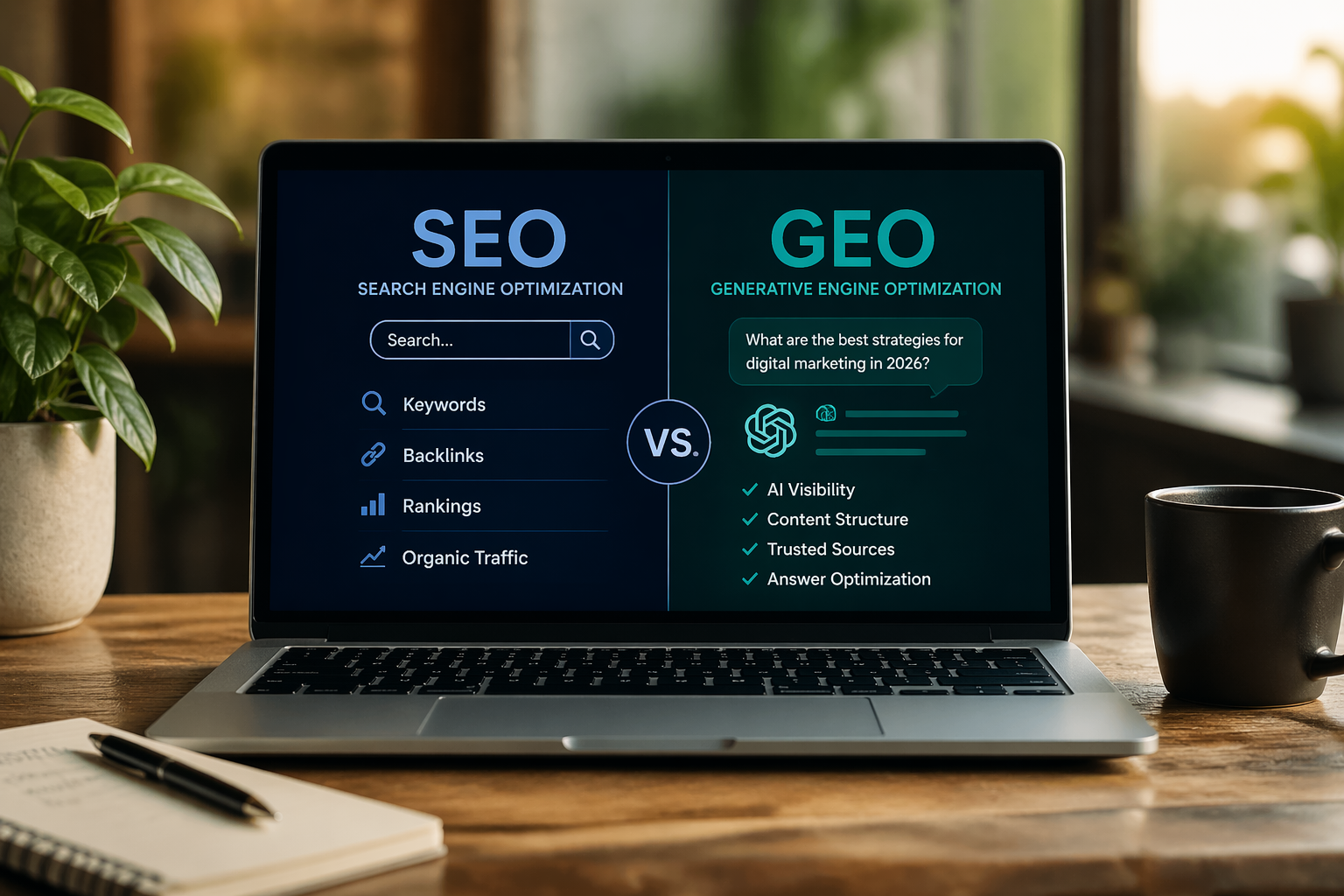
If you've been in digital marketing for more than five minutes lately, you've heard the acronyms flying: SEO, AEO, GEO, SGE, AI Overviews. The alphabet soup is real, and the confusion is understandable. But underneath all the jargon, a genuinely important question is taking shape for every business that depends on being found online:
Is the way you've been optimizing your content still working — and if not, what do you replace it with?
The short answer is that SEO isn't dead, but it's no longer sufficient on its own. Generative Engine Optimization — GEO — is the discipline that fills the gap. And understanding the difference between the two isn't just a marketing nerd exercise. It's a strategic decision that will determine whether your brand shows up where your customers are actually looking in 2026.
What Is SEO?
Search Engine Optimization is the practice most marketers know well. It's the process of optimizing your website and content to rank higher in traditional search engine results pages — primarily Google — so that users searching for relevant keywords find you, click through, and visit your site.
The core levers of SEO are: keyword research and on-page optimization, technical site health (speed, crawlability, mobile-friendliness), backlink authority from other credible websites, and content quality and relevance signals. The goal is a high-ranking link in a list of results. Success is measured in rankings, organic traffic, and click-through rates. SEO has been the dominant framework for digital visibility for two decades, and it still matters enormously. In early 2025, Google saw over 14 billion searches per day Contentful — a figure that makes it very clear traditional search is not going away.
But the nature of what users do with those search results is changing fast, and that's where GEO enters the picture.
What Is GEO?
Generative Engine Optimization is the practice of optimizing your content so that AI-powered platforms — ChatGPT, Google AI Overviews, Perplexity, Microsoft Copilot, Claude, and Gemini — cite your brand when generating answers to user questions.
Traditional SEO optimizes for ranking positions in a list of blue links. GEO optimizes for inclusion in an AI-generated answer. Enrichlabs The distinction matters because the user experience is fundamentally different. In SEO, a user sees your link in position three — they may or may not click. In GEO, the AI cites your brand, statistic, or definition directly inside its synthesized answer. Users consume your content without ever needing to visit your website — but they associate the knowledge with your brand.
The term GEO was formalized in academic research in 2024, when Princeton, Georgia Tech, and IIT Delhi published the foundational paper on the topic. It entered mainstream marketing vocabulary in 2025. By early 2026, most enterprise marketing teams have a GEO initiative. Most small and mid-sized business marketing teams have not started yet — which represents a significant first-mover opportunity. Enrichlabs
The Numbers That Make This Urgent
This isn't a theoretical future concern. The shift is already underway and accelerating.
Zero-click searches — where users get their answer without clicking any website — climbed from 56% of news-related Google searches in May 2024 to 69% in May 2025, a 13-percentage-point jump in a single year following Google's AI Overviews rollout. Similarweb If you're measuring SEO success primarily by organic clicks, you're measuring a shrinking pool.
AI-referred sessions jumped 527% year-over-year in the first five months of 2025. Frase That's not gradual adoption — that's a channel exploding.
According to Similarweb's 2026 Generative AI Brand Visibility Index, 35% of US consumers now use AI at the product discovery stage, compared to 13.6% who use search. Similarweb More people are beginning their product research in AI than in Google. For brands that haven't optimized for AI visibility, more than a third of their potential customers are starting a journey that never passes through their website.
And nearly a third of the US population — 31.3% — will use generative AI search in 2026, according to EMARKETER's forecast. eMarketer That's not a niche audience. That's a mainstream behavior that has crossed the adoption threshold.
GEO vs. SEO: The Five Key Differences
Understanding how these two disciplines actually diverge in practice is essential for building a strategy that works in both worlds.
1. What you're optimizing for
SEO optimizes for a ranked position in a list. The output is a link that users choose to click or not. GEO optimizes for being cited inside a synthesized answer. The goal in GEO shifts from earning a click to having your information included in the AI's response. WordStream The user may never visit your site, but they've absorbed your expertise and associated it with your brand.
2. How content needs to be structured
SEO rewards comprehensive, long-form pages that cover a topic in depth — typically organized around keyword clusters. GEO rewards self-contained paragraphs that can be extracted and attributed. Frase The AI isn't reading your entire post and ranking it — it's scanning for the clearest, most extractable answer to a specific question. Burying your point is an SEO strategy; it's an AEO penalty.
3. Where your presence needs to exist
Traditional SEO is primarily about your own website. In GEO, your content needs to exist wherever generative AI might draw from. When answering a question, generative AI might pull information from industry forums, community platforms, comparison sites, and publications — not just your homepage. WordStream Relying solely on your own website for GEO visibility means starting with one hand tied behind your back.
4. How long visibility lasts
SEO rankings, once earned, can persist for months or years with minimal maintenance. GEO citations are more volatile. 50% of content cited in AI answers is less than 13 weeks old. Frase Freshness is a citation signal in a way it never was for traditional SEO. Content that isn't regularly updated is actively at a disadvantage in AI search.
Between 40% and 60% of cited sources change month-to-month across Google AI Mode and ChatGPT, making AI visibility far less stable than organic search rankings. eMarketer GEO requires ongoing attention, not a set-it-and-forget-it approach.
5. How you measure success
SEO success is measured in rankings, impressions, clicks, and traffic — all relatively concrete and trackable. GEO success is measured in citation share: how often your brand appears in AI-generated answers when users ask relevant questions in your category. One travel brand tracked across 180 AI-generated responses found it appeared in just 13 of them — a Share of Model of 7.2% — for topics it should have owned entirely. Similarweb That 7.2% is the number GEO exists to move.
So Which One Wins?
Neither. They're not competing — they're compounding.
SEO lays the foundation for better success in AI search visibility. Nearly 40% of Google's AI Overviews rank in the top 10 organic search results, and nearly 70% rank in the top 100. Jasper Your traditional SEO work is not wasted — it's prerequisite. Domains with strong technical SEO fundamentals, high-quality content, and authoritative backlinks start GEO from a stronger position than domains that have neglected the basics.
But SEO alone is no longer enough. AI search sends some traffic, but it's still 91% less than traditional search, and from chatbots it's 96% less. The silver lining: conversion rates from GEO clicks are higher. Contentful The channel is smaller but the intent is stronger — users arriving via AI citation have already been pre-qualified by the AI's answer.
GEO is not a replacement for SEO — it is an additional layer. Brands that excel at GEO in 2026 are typically the same brands with strong traditional SEO foundations. The optimization principles overlap significantly, but GEO adds specific requirements around content structure, citation-friendliness, and data richness that SEO alone does not address. Enrichlabs
The practical way to think about it: SEO gets you ranked in the results. GEO gets you quoted in the answer. A complete visibility strategy in 2026 requires both.
What GEO Actually Requires That SEO Doesn't
There are several places where GEO strategy diverges meaningfully from what most SEO programs already cover.
Author credentials matter more. Anonymous content or generic "content team" bylines are GEO penalties. AI systems increasingly weight author credentials. Every piece of GEO-optimized content needs a named, credentialed author with a verifiable external presence. Enrichlabs This is a harder requirement than most SEO programs have historically enforced.
Original data is a force multiplier. Content incorporating original research, proprietary benchmarks, or unique survey findings gives AI models something they cannot source elsewhere. Publishing research that becomes a citation magnet — an annual industry report, a productivity benchmark study, original platform data — creates a compounding citation network that benefits every piece of content on your domain. Enrichlabs
Community platform presence is now strategic. Platforms like YouTube, Reddit, and LinkedIn are the most frequently cited across AI engines, with each platform showing its own preferences. ChatGPT frequently cites Reddit and Wikipedia, Perplexity emphasizes Reddit, LinkedIn, and G2, and Google tends to surface Facebook and Yelp. Jasper Being active and credible on these platforms used to be good brand practice. Now it's a citation signal.
Budget allocation shifts. One recommended framework for brands balancing SEO and GEO dedicates 40% to core SEO, 25% to digital PR, 20% to data and reporting, 10% to training, and 5% to experimentation. eMarketer Digital PR — earning third-party mentions and coverage — commands a larger share than in traditional SEO because earned media is the primary driver of AI citation authority.
The Window That Won't Stay Open
Every major shift in SEO has followed the same pattern. The transition from pre-social SEO to link-building dominance did not happen overnight. Neither did the shift from exact-match keywords to semantic search. What happened was that the brands that recognized the shift early and built the right infrastructure accumulated compounding advantages that were very hard to close later. GEO is that shift. Similarweb
The brands that were building links in 2005 while everyone else ignored them didn't just get a head start — they built structural advantages that lasted years. The same dynamic is playing out with GEO right now. The first-movers are establishing citation authority, training AI models to recognize their brand's expertise, and compounding their visibility while most of their competitors are still deciding whether GEO is real.
Gartner predicts a 50% drop in traditional organic traffic by 2028 due to the proliferation of AI-driven search. ePublishing That doesn't mean SEO is dying — it means the portion of customer discovery happening in AI answers is growing large enough to become a primary channel, not a secondary one.
The brands that invest in both SEO and GEO now will own visibility across both paradigms. The ones that don't will find themselves increasingly invisible in the places their customers are looking.
Ready to Build a Strategy That Works in Both Worlds?
At Ritner Digital, we help businesses combine the proven foundations of SEO with the emerging requirements of GEO — so your brand shows up whether a customer is searching Google or asking ChatGPT.
If you're not sure where your brand stands in AI search today, that's exactly where we start.
Contact Ritner Digital today to schedule a free strategy session and find out how your current visibility stacks up — and what a complete 2026 search strategy looks like for your business.
Sources: WordStream, Jasper, Frase.io, Similarweb, Contentful, EMARKETER, Enrich Labs, ePublishing
Frequently Asked Questions
What is the difference between GEO and SEO in simple terms?
SEO — Search Engine Optimization — is the practice of getting your website to rank higher in Google's list of search results so users click through to your site. GEO — Generative Engine Optimization — is the practice of getting your brand cited inside AI-generated answers on platforms like ChatGPT, Perplexity, and Google AI Overviews. SEO is about earning the click. GEO is about being the source the AI quotes, whether or not a click ever happens.
Is GEO replacing SEO?
No. GEO builds on top of SEO rather than replacing it. Strong traditional SEO — domain authority, quality content, technical site health, backlinks — is the foundation that makes GEO more effective. Nearly 40% of Google AI Overviews cite pages that already rank in the top 10 organic results, which means your SEO work directly supports your AI visibility. The brands winning at GEO in 2026 are typically the same brands with strong SEO foundations. What's changed is that SEO alone is no longer sufficient for complete digital visibility.
Why is GEO becoming important right now?
Several shifts are converging at once. Zero-click searches — where users get their answer without visiting any website — rose from 56% to 69% of Google searches in a single year. AI-referred website sessions jumped 527% year-over-year in early 2025. More than a third of US consumers now use AI at the product discovery stage, compared to 13.6% who use search. These aren't early-adopter statistics anymore — they reflect mainstream changes in how people find information, compare options, and make buying decisions.
How is content structured differently for GEO versus SEO?
SEO rewards comprehensive, long-form content that covers a topic thoroughly and signals relevance through keyword use, internal linking, and depth. GEO rewards self-contained, extractable paragraphs — specifically, clear answer capsules of 40–60 words that directly address a question without hedging, without excessive links inside the block, and without burying the point. For GEO, the most important content is often in the first 30% of a page. For SEO, depth and comprehensiveness throughout the entire page still matters. A well-constructed page can serve both goals simultaneously, but it requires intentional structure from the start.
Does my social media and community presence really affect GEO?
Yes, significantly. AI platforms pull heavily from community and third-party sources when constructing answers. ChatGPT frequently cites Reddit and Wikipedia. Perplexity favors Reddit, LinkedIn, and G2. Google AI Overviews draws from YouTube and Yelp. Being present, credible, and consistently described on these platforms is now a citation signal, not just a brand awareness exercise. Brands that actively participate in relevant Reddit communities, maintain a strong LinkedIn presence, and appear on industry review and comparison sites have measurably better GEO visibility than those that rely solely on their own website.
How long do GEO citations last compared to SEO rankings?
GEO citations are considerably more volatile than SEO rankings. Half of all content cited in AI answers is less than 13 weeks old, and between 40% and 60% of cited sources change month-to-month across major AI platforms. An SEO ranking, once earned, can hold for months or years with minimal maintenance. GEO visibility requires a consistent content refresh cycle — updating statistics, adding new context, and maintaining freshness signals on your most important pages. Treating GEO as a one-time project rather than an ongoing practice is one of the most common mistakes brands make when starting out.
What budget split should I use between SEO and GEO?
One recommended framework allocates 40% to core SEO, 25% to digital PR, 20% to data and reporting, 10% to training, and 5% to experimentation. The notable shift from a traditional SEO budget is the increased weight on digital PR — earning third-party mentions and coverage — because earned media is the primary driver of AI citation authority. Distributing your content and expertise across authoritative external platforms increases AI citation rates by up to 325% compared to publishing exclusively on your own site, which makes PR investment far more strategically valuable in a GEO context than it was in traditional SEO.
How do I measure whether my GEO strategy is working?
GEO requires different metrics than traditional SEO. Rather than tracking rankings and organic traffic alone, you need to measure citation share — how often your brand appears in AI-generated answers when users ask relevant questions in your category. Start by manually testing 10–20 high-intent prompts your customers would realistically use across ChatGPT, Perplexity, and Google AI Overviews, and note whether your brand appears. For ongoing measurement at scale, tools like OmniSEO, Profound, xSeek, and Similarweb's AI Search Intelligence are purpose-built for tracking AI brand visibility over time. Because AI responses are highly variable — with cited sources changing 40–60% month-to-month — consistent tracking across many prompts matters more than any single test.
Do small businesses need to worry about GEO, or is this only for large brands?
GEO is arguably more urgent for small and mid-sized businesses than for large ones. Enterprise brands often have the domain authority, third-party coverage, and name recognition that already generates some AI visibility by default. Smaller brands are more invisible in AI answers by default — and right now, most of them haven't started optimizing. That's actually the opportunity: the competitive landscape for AI citations in most local and niche markets is wide open. A small business that builds genuine topical authority, earns local and industry press coverage, and structures its content for AI extraction can establish a citation presence that becomes very difficult for later entrants to displace.