How to Rank in Google AI Overviews (Step-by-Step)
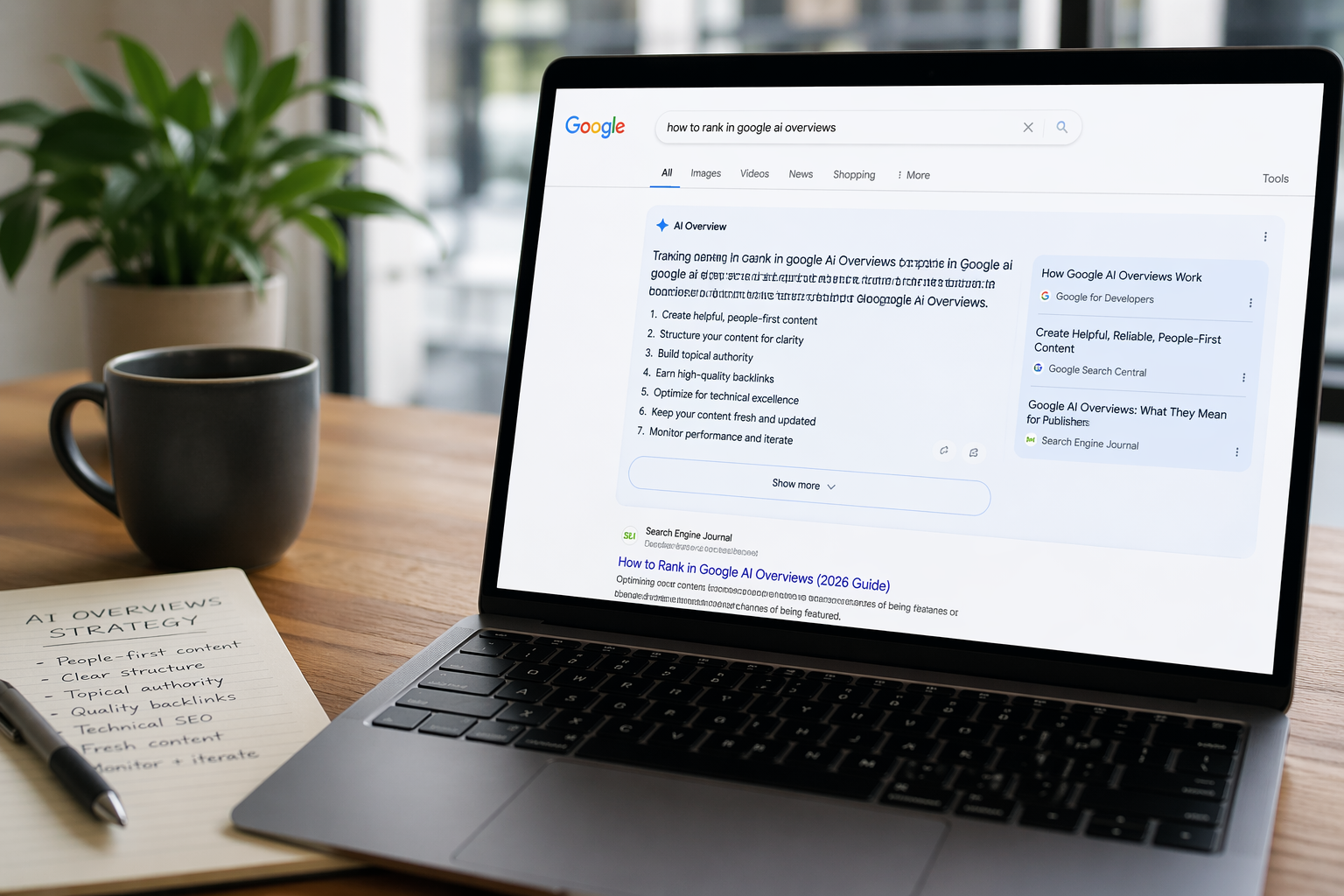
You've done everything right. Your site is fast, your content is thorough, your keyword research is solid — and you're ranking on page one. But when your customers search for what you offer, an AI-generated summary sits above your listing, synthesizes the answer from several sources, and sends the user on their way without a single click.
That's Google AI Overviews in action. And if your content isn't being cited inside that summary, your page-one ranking is delivering a fraction of what it used to.
The good news is that AI Overview placement isn't random. Being featured inside a Google AI Overview delivers 77% more clicks than ranking #1 below it. GrowthPro AI There is a clear set of signals Google's AI favors, and there are concrete, actionable steps you can take to earn a citation. This guide walks through all of them.
What Are Google AI Overviews?
Google AI Overviews are AI-generated summaries that appear at or near the top of search results for informational, how-to, comparison, and research-type queries. Powered by Google's Gemini AI, they synthesize information from multiple sources into a single, direct answer — and cite those sources inline.
By early 2026, AI Overviews appear for an estimated 40–60% of all U.S. search queries, with the highest concentration on how-to, definition, comparison, and research-type questions. Tech Talk Club
The scale of their impact on traditional organic traffic is significant. Organic click-through rates drop by 61% on searches that trigger AI Overviews, falling from 1.76% to 0.61%. But if your content gets cited inside an AI Overview, performance improves: cited pages earn 35% more organic clicks and 91% more paid clicks than competitors that aren't cited. Wellows
Being in the AI Overview isn't just about surviving the zero-click era — it's a genuine traffic and authority advantage over every competitor who isn't there.
How Google Selects Sources for AI Overviews
Before diving into the step-by-step optimization, it helps to understand what Google is actually doing when it selects AI Overview sources.
Google's AI doesn't simply pull from the top-ranked results. 47% of AI Overview citations now come from pages ranking below position five, which means AI Overviews operate on fundamentally different ranking logic than traditional search. Wellows Domain authority and backlink volume matter less than they used to. What matters more is content clarity, semantic completeness, structured formatting, and genuine expertise signals.
Analysis of 15,847 AI Overview results confirms that content scoring highly on semantic completeness is 4.2 times more likely to be cited — making semantic completeness the strongest predictor of AI Overview selection. WellowsSemantic completeness means your content provides a complete, self-contained answer that requires no external context or additional clicks to fully understand.
Think of it this way: Google's AI is looking for content it can confidently extract, present directly, and attribute correctly. Everything in this guide is designed to make your content easier to extract and more trustworthy to attribute.
Step 1: Target Question-Based Queries
The first step is making sure you're creating content around the types of queries that actually trigger AI Overviews.
Queries phrased as questions or how-to's are 84% more likely to display an AI Overview, and long-tail question queries of eight or more words show the highest trigger rates. Snezzi AI Overviews were built for informational intent — for users who want an answer, not a list of links to browse.
Audit your existing content and your keyword strategy. For every important topic your business covers, ask: what specific question is a user trying to answer when they search this? If your pages are built around broad keyword terms rather than specific questions, restructure them. A page targeting "digital marketing services" will rarely trigger an AI Overview. A page that answers "what digital marketing services do small businesses need" is precisely the kind of query that will.
Use Google's People Also Ask boxes, search autocomplete, and your own customer intake questions as a source of real question vocabulary. Build your content calendar around those questions, then go deep.
Step 2: Structure Content for Extraction
Once you're targeting the right queries, the way you structure your content determines whether Google's AI can actually extract and cite it.
Google's AI pulls from content that answers questions directly and concisely. Structure your content so that important answers appear within the first one to two sentences of a section. Tech Talk Club The AI is scanning for the clearest answer, not rewarding the most elaborate setup. If your point is buried in paragraph three, it won't be extracted.
Google AI Overview summaries typically contain about 169 words with 7.2 links per summary, showing how much Google values concise, information-rich passages. Mike Khorev Optimal passage length for AI extraction falls between 134 and 167 words — enough to be substantive, short enough to be self-contained.
Practically, this means:
Lead every section with a direct answer to the question that section addresses. Use descriptive H2 and H3 headings phrased as questions or clear topic statements — these act as signals to Google's AI about what each section covers. Keep your key answer passage clean and link-free; links inside answer capsules reduce extractability. Use bullet points, numbered lists, and tables for multi-part answers that need structure. And never bury your conclusion — state it first, then support it.
Step 3: Build Topical Authority Through Content Clusters
A single great article won't beat a site with twenty well-organized articles on the same subject. Google's AI treats topical authority as a trust signal that compounds across your entire domain.
Create pillar pages that cover broad topics in depth, then link them to supporting cluster articles that dive into subtopics. This structure signals to Google that you own the subject matter — not just a single keyword. YellowJack Media A pillar page on your core service area should connect to clusters on every related question your customers ask: definitions, comparisons, how-to guides, case studies, FAQs, and troubleshooting content.
The logic is straightforward: if Google's AI sees that your domain has answered twenty related questions on a topic with consistent depth and accuracy, it has more confidence citing you than a site with one isolated post. Topical authority is not built in a day — it's a content investment that makes every subsequent piece of content on that topic more likely to be cited.
Map out the full question landscape of your most important topics. Identify gaps in your current content. Prioritize filling those gaps with well-structured, answer-first posts that link back to your pillar pages and to each other.
Step 4: Implement Schema Markup
Structured data is one of the clearest signals you can send to Google's AI about what your content contains and how it should be interpreted.
Pages with FAQ schema are 60% more likely to be featured in AI Overviews compared to those without structured data. Snezzi And pages with proper schema markup are three times more likely to earn AI citations overall. Mike Khorev
The most valuable schema types for AI Overview optimization are:
FAQPage schema for any page answering multiple questions — this explicitly signals the Q&A structure to Google's AI. HowTo schema for step-by-step instructional content — it maps your steps directly to the format AI Overviews use for process queries. Article schema with author markup — this signals credibility and supports E-E-A-T signals. Organization and LocalBusiness schema — for consistency of your brand entity across Google's Knowledge Graph.
Nested schema structures are also a smart move, as they create entity relationships that AI detects when searching for authoritative results. Digivate The more clearly your schema communicates what your content is, who created it, and what entities it covers, the easier Google's AI can confidently cite it.
Step 5: Strengthen Your E-E-A-T Signals
Experience, Expertise, Authoritativeness, and Trustworthiness — E-E-A-T — are the quality signals Google uses to assess whether content is worth citing. In the AI Overview era, they carry more weight than ever.
Authors with proven qualifications in their fields receive higher quality scores. Case studies and personal accounts prove your content comes from real expertise. Person schema markup helps Google verify who authors are and what they know — and the sameAs property links author profiles across platforms to establish a consistent online presence. Mike Khorev
This means every piece of content you publish should have a named author with a bio, credentials, and links to their professional profiles. Generic "staff writer" or anonymous bylines are a disadvantage. If your team members have industry certifications, published work elsewhere, speaking credentials, or professional memberships, those need to be visible and linked.
Beyond authorship: cite your sources with links to authoritative third-party research. Include original data and firsthand experience in your content. Content with recent statistics, peer-reviewed sources, and high-tier citations gets 89% higher selection probability Wellows because Google's AI cross-checks facts in real time against authoritative databases. Vague, unsourced claims don't pass that verification.
Step 6: Add Multimodal Content
Text-only pages are at a structural disadvantage in AI Overview selection compared to pages that combine multiple content formats.
Pages that combine text, images, video, and structured data see 156% higher selection rates in AI Overviews, with full multimodal and schema integration delivering up to 317% more citations. Wellows
This doesn't mean loading every page with random media. It means supporting your written answers with genuinely useful visuals: an infographic that illustrates a process, a short video that demonstrates a concept, a data table that presents a comparison, a diagram that maps a system. Each format gives Google's AI more to extract and increases the signals that your content is comprehensive and authoritative.
Make sure all multimedia elements follow technical best practices — descriptive alt text on images, optimized video titles and transcripts, properly formatted tables with clear headers. These aren't just accessibility requirements; they're AI legibility requirements.
Step 7: Keep Content Fresh
Freshness is a more active citation signal for AI Overviews than it has historically been for traditional SEO rankings.
Articles with visible "Last Updated" dates, current statistics from 2025 or 2026, and fresh examples outperform evergreen content for fast-moving topics. Enrichlabs Adding a "What's changed in [current year]" section to important perennial posts is a straightforward tactic for signaling freshness to both AI systems and human readers.
Build a content maintenance schedule. Any page targeting a high-priority question that hasn't been updated in over six months is likely underperforming in AI Overviews. Refresh the statistics, update the examples, verify that all claims are still accurate, and update the last-modified date. This is less glamorous than publishing new content, but often higher ROI.
Step 8: Fix Your Technical Foundation
None of the content tactics above will work if Google's AI can't reliably access and crawl your pages. Technical SEO is the prerequisite, not an afterthought.
Keep your technical SEO on point: eliminate performance issues that slow down page load speed, fix crawl errors and broken links, ensure your website structure is clean with clear hierarchies, implement HTTPS, and leverage XML sitemaps and robots.txt to guide AI crawlers efficiently through your site. Digivate
Check your robots.txt file specifically for any directives that might be blocking AI crawlers. Some sites have added overly broad blocking rules that inadvertently prevent Google's AI systems from accessing content — which immediately disqualifies those pages from AI Overview consideration. Google Search Console is your primary diagnostic tool here: use the URL inspection feature to verify that your most important pages are accessible to Google's crawlers.
Step 9: Monitor and Measure
You can't improve what you don't measure. Google AI Overview tracking requires different tools and approaches than traditional rank tracking.
Google Search Console now includes an AI Overviews filter in the Performance report. Use this to identify which queries are triggering AI Overviews where your site is — or isn't — being cited. Sort by impressions to find your highest-visibility opportunities. Tech Talk Club
Beyond Search Console, third-party tools like Semrush's AI Overview tracker and Ahrefs' SERP feature tracker let you monitor competitor citations and track which content types earn AI Overview placement most often in your niche. Manual testing — searching your key queries in Google and noting whether your brand appears in the Overview — should be part of your regular content review cadence.
Track citation share as your primary KPI: of all the AI Overviews triggered for queries relevant to your business, what percentage cite your domain? That number is your starting point, and every optimization effort in this guide is designed to move it up.
What to Do First
If you're starting from scratch, here's where to focus first for the fastest impact:
Start by auditing your existing content for answer-first structure. Identify your ten highest-traffic informational pages and check whether each one leads with a clear, direct answer to the question it targets. Restructure any that bury the point. That single change, applied consistently, moves the needle faster than most other tactics.
Next, implement FAQ schema on every page that answers multiple questions — it's a high-leverage technical change with low implementation complexity. Then map your topical gaps and build a content calendar to fill them. From there, work through the rest of this guide systematically.
Ignoring AI Overviews in 2026 is like ignoring mobile optimization in 2015. It's not optional anymore. YellowJack Media The sites building this infrastructure now will compound their advantage as AI Overviews continue expanding. The ones waiting for the dust to settle will find a very large gap to close.
Ready to Start Ranking in AI Overviews?
At Ritner Digital, we help businesses audit their content for AI Overview readiness, restructure pages for extraction, implement schema markup, and build the topical authority that earns consistent AI citations.
If you're not sure where your content stands today, that's exactly where we start.
Contact Ritner Digital today to schedule a free AI visibility audit and find out which of your pages are positioned to rank in Google AI Overviews — and which ones need work.
Sources: Wellows, Digivate, Snezzi, YellowJack Media, Tech Talk Club, Enrich Labs, GrowthPro AI, Mike Khorev
Frequently Asked Questions
What are Google AI Overviews and how are they different from featured snippets?
Google AI Overviews are AI-generated summaries powered by Google's Gemini model that appear at or near the top of search results for informational, how-to, comparison, and research queries. Unlike featured snippets, which excerpt content from a single page, AI Overviews synthesize information from multiple sources into one cohesive answer and cite those sources inline. A featured snippet pulls your exact text. An AI Overview may draw from your content, rewrite it in its own words, and credit you as one of several sources — or it may not cite you at all if your content isn't structured for extraction.
Do I need to rank on page one of Google to appear in AI Overviews?
No — and this is one of the most important distinctions between AI Overviews and traditional search. Nearly half of all AI Overview citations come from pages ranking below position five in organic results. Google's AI is selecting sources based on content clarity, semantic completeness, structured formatting, and E-E-A-T signals — not purely on ranking position. A well-structured, authoritative page on a lower-authority domain can earn an AI Overview citation over a top-ranking page that buries its answers or lacks proper schema markup.
Which types of queries trigger Google AI Overviews most often?
AI Overviews appear most frequently on informational, how-to, definition, comparison, and research-type queries. Question-phrased queries and how-to searches are 84% more likely to display an AI Overview, and queries of eight or more words show the highest trigger rates. By early 2026, AI Overviews appear on an estimated 40–60% of all U.S. searches. They appear less frequently on purely transactional or navigational queries — someone searching for a specific brand name or typing in a URL is unlikely to see an AI Overview, but someone asking "how do I choose a digital marketing agency" almost certainly will.
What is semantic completeness and why does it matter for AI Overviews?
Semantic completeness means your content provides a full, self-contained answer to a question without requiring the reader to click elsewhere or gather additional context to understand it. It is the single strongest predictor of AI Overview selection, with content scoring highly on semantic completeness being 4.2 times more likely to be cited. In practical terms, this means each section of your content should begin with a direct answer, cover all the key aspects of that question within a tight passage of 134–167 words, and not rely on prior sections or external links to make sense on its own.
How much does schema markup actually help with AI Overview rankings?
Significantly. Pages with FAQ schema are 60% more likely to be featured in AI Overviews than those without structured data, and pages with proper schema markup overall are three times more likely to earn AI citations. The most valuable schema types for AI Overview optimization are FAQPage, HowTo, Article with author markup, and Organization or LocalBusiness. Schema doesn't guarantee placement, but it explicitly communicates to Google's AI what your content contains, who created it, and how it should be interpreted — reducing the ambiguity that causes pages to be passed over.
Does adding images and video really affect AI Overview citations?
Yes, more than most marketers expect. Pages that combine text, images, video, and structured data see 156% higher selection rates in AI Overviews, with full multimodal and schema integration delivering up to 317% more citations. The key is that the media needs to be genuinely useful and properly tagged — descriptive alt text on images, optimized video titles and transcripts, well-formatted tables with clear headers. Random stock photos don't move the needle. A process diagram that illustrates your written explanation, or a short video that demonstrates a concept your article covers, adds real extractable value that Google's AI rewards.
How often should I update my content to stay visible in AI Overviews?
A quarterly refresh cycle is a practical minimum for high-priority pages. AI Overviews favor fresh content — articles with visible last-updated dates, current statistics from the current year, and recently updated examples outperform evergreen content that hasn't been touched. Any page targeting an important question that hasn't been updated in more than six months is likely underperforming in AI Overviews regardless of how strong it was when originally published. A simple update checklist — refresh statistics, verify accuracy, add a "what's changed" section, update the modified date — applied quarterly to your most important pages is often higher ROI than publishing entirely new content.
How do I track whether my content is being cited in AI Overviews?
Google Search Console now includes an AI Overviews filter in the Performance report, which lets you see which queries are triggering AI Overviews where your site is or isn't being cited. Sort by impressions to identify your highest-opportunity queries. Third-party tools like Semrush's AI Overview tracker and Ahrefs' SERP feature tracker let you monitor competitor citations and track which content types earn placement most often in your niche. Manual testing — searching your target queries in Google and noting whether your content appears — should also be part of your regular content review. Track citation share as your primary KPI: of all the AI Overviews triggered for queries relevant to your business, what percentage currently cite your domain.
Can local businesses rank in Google AI Overviews?
Yes, though AI Overviews appear less frequently for local queries than for informational ones — currently showing on about 23% of "near me" searches, with higher rates in categories like restaurants at 38%. For local businesses, the optimization priorities are a fully completed and regularly updated Google Business Profile, consistent NAP data across all directories, review content that can be summarized by AI, locally relevant FAQ content on your website, and LocalBusiness schema markup. The relative scarcity of AI Overviews in local search also means competition for those placements is lower — a local business that invests in AI Overview optimization now stands out significantly in a field where most competitors haven't started.