Why Your Website Isn't Showing Up in Perplexity — And How to Fix It
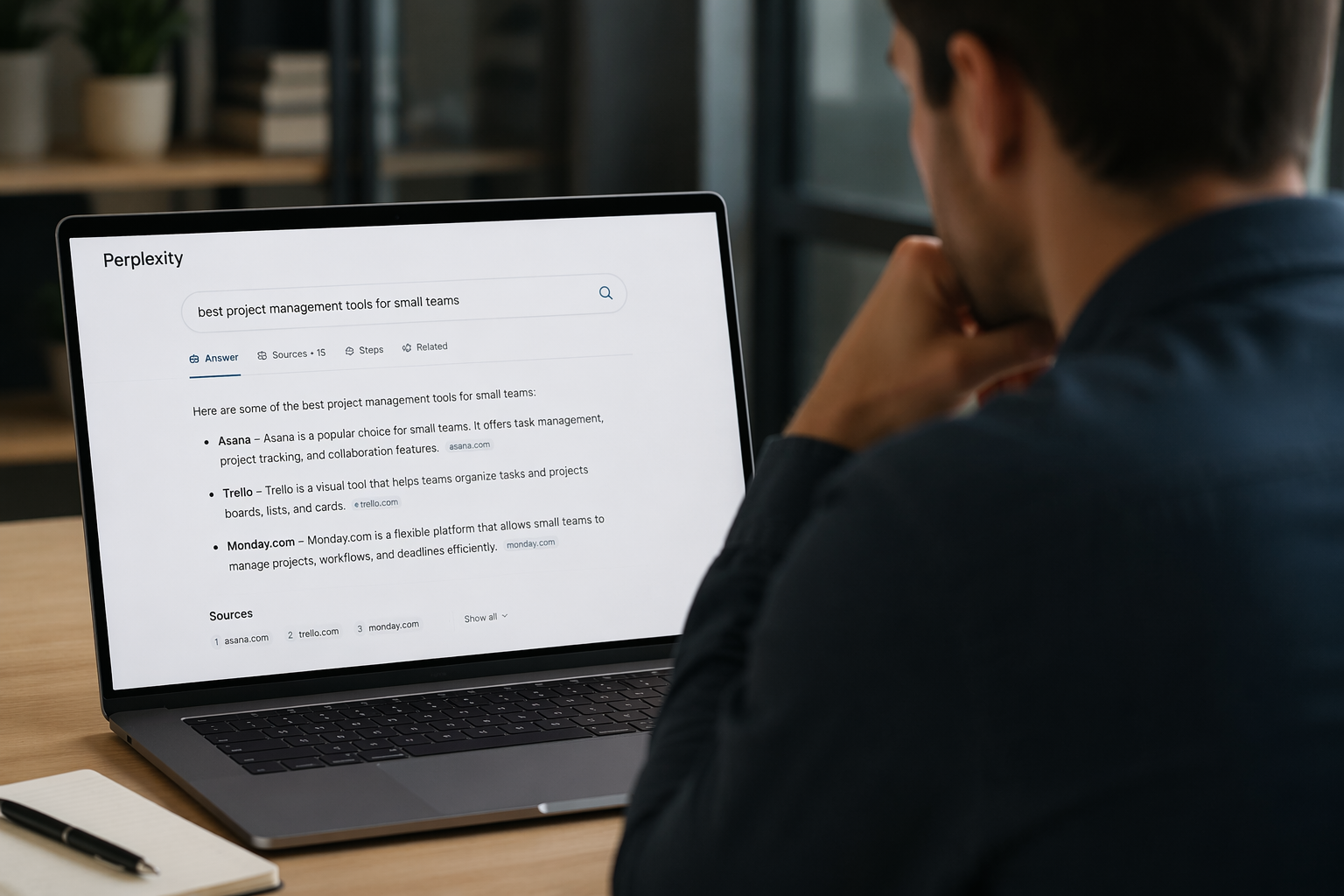
You open Perplexity and search for exactly what your business does. A confident, well-sourced answer appears. It cites three competitors. Your website isn't mentioned anywhere.
If that scenario sounds familiar, you're not alone — and the reason it's happening probably isn't what you think. It's not that your content is bad. It's that your content isn't structured, accessible, or authoritative in the specific ways Perplexity's retrieval system requires. The good news is that every one of those gaps is fixable. This post walks through exactly why your site is being skipped — and what to do about it.
Why Perplexity Is Worth Your Attention
Before we get into the fixes, it's worth understanding what's at stake.
Perplexity AI crossed 100 million monthly active users in 2025 and continues growing rapidly. UpGrowth Its Pro Search feature generates deeply researched, multi-source answers that users — particularly B2B buyers and researchers — treat as curated recommendations. When 66% of B2B decision-makers use AI tools to research suppliers, visibility in Perplexity isn't a nice-to-have — it's a pipeline issue. Discovered Labs
Here's what makes Perplexity different from other AI platforms in a way that matters for your business: it shows its sources. When Perplexity cites your content, it displays your domain name with a clickable link directly next to the answer text — not buried in a footnote, not invisible in training data. Businesses optimized for Perplexity are seeing 20–40% increases in referral traffic from AI-driven discovery. OSP And AI-referred traffic converts at 14.2% compared to Google's 2.8% Discovered Labs — meaning the visitors who arrive via a Perplexity citation are more qualified and more likely to take action than almost any other traffic source.
The platform is also selective. Perplexity includes just 5.01 links per response on average, compared to 10.42 for ChatGPT and 9.26 for Google AI Overviews. Discovered Labs Fewer citations mean each one carries more weight — and more competition to earn.
How Perplexity Actually Selects Sources
Understanding Perplexity's selection logic is the prerequisite for everything else in this guide.
Perplexity operates on Retrieval-Augmented Generation, or RAG — meaning it searches the live web first, then synthesizes answers from what it finds. Traditional SEO content optimized for Google's algorithm rarely passes Perplexity's filters for clarity, entity structure, and verifiable data. Discovered Labs Ranking well on Google does not translate automatically to being cited by Perplexity. The selection criteria are different.
The selection criteria favor content that is factually specific rather than generically informative. A page that says "email marketing delivers strong ROI" won't get cited. A page that says "email marketing delivers an average ROI of $36 for every $1 spent, according to Litmus 2024 data" will. Perplexity's system gravitates toward content with concrete numbers, named sources, and clear expertise signals because its product promise to users is accuracy. UpGrowth
Perplexity also indexes content faster than most AI platforms. Freshly published pages can appear in Perplexity answers within days, not weeks UpGrowth — which means the optimization work in this guide can start delivering results faster than traditional SEO timelines.
Reason #1: PerplexityBot Is Blocked on Your Site
This is the most common and most fixable reason websites don't show up in Perplexity — and most site owners have no idea it's happening.
Perplexity states that PerplexityBot respects robots.txt for indexing text content. If PerplexityBot is blocked, your content is less likely to be indexed and cited. Wellows Some sites have robots.txt configurations that block all non-Google bots, or that use wildcard directives that inadvertently include Perplexity's crawler. The result is that Perplexity simply cannot access your pages, regardless of how good the content is.
Check your robots.txt file right now. Look for any User-agent: * directives with Disallow rules that might catch PerplexityBot. If you want to explicitly allow Perplexity's crawler, add User-agent: PerplexityBot followed by Allow: / to your robots.txt. This one technical fix, if it's the issue, can start generating Perplexity citations within days.
While you're auditing crawl access, also check that your most important pages aren't accidentally tagged with noindex meta directives, that your key content isn't locked behind JavaScript that Perplexity's crawler can't render, and that your server isn't returning errors on the pages you most want cited.
Reason #2: Your Content Is Too Vague to Extract
Even if Perplexity can access your pages, it may be skipping them because the content isn't structured for passage-level extraction.
Perplexity doesn't cite entire articles — it pulls specific snippets from passages that directly answer user prompts. If your content is buried in fluff, it'll be skipped. Wellows The AI isn't reading your introduction, your brand story, or your extensive qualifications before deciding whether to cite you. It's scanning for the clearest, most direct answer to a specific question — and if that answer is surrounded by vague context or takes three paragraphs to arrive, it gets passed over.
Pages with proper structure earn 2.8x higher citation rates than poorly formatted content. Discovered Labs The structural formula that works is called BLUF — Bottom Line Up Front. Lead every section with the direct answer. Use the rest of the section to support, explain, and expand. Keep your answer passages to 40–60 words, use question-phrased H2 and H3 headings, and avoid winding up to your point.
Use quantified data wherever possible. "The market grew 23% in 2025" is more citable than "the market grew strongly." Explicit source citations reinforce your credibility in Perplexity's eyes — cite your own sources within your content, and Perplexity's system assigns higher trust to content that references credible primary sources. AI Labs Audit
Reason #3: Your Content Lacks Specific, Verifiable Facts
Perplexity's core product promise to its users is accuracy. That means it actively deprioritizes content that makes claims it can't verify — and actively favors content built around specific, attributable data.
When you reference data or research, link to the original source. Perplexity's system follows citation chains and assigns higher trust to content that references credible primary sources. A page that cites "according to HubSpot's 2025 State of Marketing Report" with a link is more trustworthy in Perplexity's ranking system than one that makes the same claim without attribution. UpGrowth
This has direct implications for how you write. Every factual claim in your content should be accompanied by a specific number, a named source, or a verifiable attribution. Replace "many businesses are adopting AI search" with "according to EMARKETER, 31.3% of US consumers will use generative AI search in 2026." Replace "email has good ROI" with a specific figure and a linked source.
Original data is particularly powerful here. When your content contains proprietary research, client benchmarks, or original survey findings, you become the primary source rather than a secondary one. That's the strongest citation position possible — and it gives Perplexity something it genuinely cannot get anywhere else.
Reason #4: Your Author Signals Are Weak or Missing
Anonymous content is a Perplexity disadvantage. The platform cross-references author entities across the web, and content from named, credentialed authors with consistent external presence earns more citations than content with no clear human origin.
Every page targeting Perplexity citations needs a named author with a bio that includes relevant credentials and professional links. An author who publishes consistently about their domain across multiple platforms earns more citations than anonymous content. UpGrowth
This means auditing your entire site for author attribution. Every blog post, guide, and resource page should have a named author. That author's bio should include relevant professional credentials, links to their LinkedIn profile, links to other publications they've contributed to, and any relevant certifications or affiliations. The goal is to make it as easy as possible for Perplexity's system to verify that a real expert with demonstrable knowledge created this content.
If multiple team members contribute content, build out individual author pages for each one. A URL like yoursite.com/team/jane-smith with a full professional bio and external links is both an E-E-A-T signal and an entity signal that Perplexity's system can use to assess credibility.
Reason #5: You're Not Present in the Sources Perplexity Already Trusts
Your own website is only one input into Perplexity's picture of your brand. The platform also draws heavily from third-party sources — and if those sources don't mention you, you're operating at a significant disadvantage.
Perplexity AI cites Reddit 45% more frequently than other sources. Reddit's community validation signals authority to AI engines, making strategic Reddit participation essential for Perplexity visibility. AuthorityTech Citations from Reddit in AI-generated overviews grew 450% from March to June 2025. This is not a platform you can afford to ignore.
But Reddit participation for Perplexity citations requires authenticity, not promotion. The brands winning Perplexity citations aren't posting ads. They're participating authentically in communities, answering real questions, and providing value that AI systems recognize as cite-worthy. AuthorityTech Build a consistent presence in the subreddits your customers frequent. Answer questions thoroughly. Share expertise without selling. Over time, these contributions become citation assets.
Beyond Reddit: being active on platforms like YouTube, industry forums, and LinkedIn increases your chances of being referenced by Perplexity. Wellows Get your brand mentioned in comparison articles, review roundups, and industry publications. Earn guest contributions on authoritative sites in your niche. The goal is to make your brand visible in the ecosystem of sources Perplexity already treats as credible.
Reason #6: Your Technical Performance Is Letting You Down
Perplexity cannot cite a page it cannot access or understand. AI crawlers have time constraints — a slow page risks being abandoned before its content is analyzed. Aim for a loading time under two seconds. Optimize images and minimize blocking scripts. AI Labs Audit
Run a technical audit with these specific Perplexity considerations in mind: Are your key pages loading in under two seconds? Is your core content accessible without requiring JavaScript rendering? Are you using HTTPS sitewide? Is your XML sitemap submitted and current? Do your priority pages have clean, crawlable HTML structure?
Also check your meta tags. A descriptive, question-answering meta description signals to Perplexity what the page covers before the crawler even reads the body content. Titles that reflect the specific question a page answers perform better than generic keyword-optimized titles in Perplexity's selection algorithm.
Reason #7: You're Not Using Schema Markup
Schema markup is one of the clearest signals you can send to Perplexity's system about what your content contains, who created it, and what entities it covers.
Article, FAQPage, HowTo, and Organization schema tags are particularly relevant for Perplexity citations. Implement Article schema on editorial content, FAQPage schema on any page with Q&A structure, and HowTo schema on step-by-step instructional pages. AI Labs Audit These aren't just technical decorations — they're explicit instructions to AI crawlers about how to interpret your content.
Organization schema with consistent NAP data — name, address, phone number — reinforces your entity's presence in Perplexity's knowledge model. The more consistent and complete your entity information is across schema markup, your website, and external listings, the more confidently Perplexity can identify and cite your brand.
Reason #8: Your Content Isn't Being Refreshed
A site that publishes regularly tends to be cited more than a static site, even if domain authority is comparable. Update your strategic content at least quarterly. Visibly date your articles and update the date during revisions. Publish on trending topics in your industry quickly after they emerge. AI Labs Audit
Perplexity's RAG architecture prioritizes fresh, current information because its users expect accurate, up-to-date answers. A page with a 2023 publish date and no visible updates signals to Perplexity's system that the information may be stale — and stale citations undermine Perplexity's accuracy promise to its users.
A 2025 Ahrefs study analyzing 17 million citations across multiple AI search platforms confirms that brands updating pages regularly are cited significantly more often, with fresher pages outperforming older content by as much as 30% in visibility. Wellows Build a quarterly content maintenance loop for your highest-priority pages: refresh statistics, update examples, add new context, and update the last-modified date prominently.
How to Know If It's Working
Tracking your Perplexity citation performance requires a different measurement approach than traditional SEO.
The most direct method: search your key customer queries in Perplexity regularly and note whether your domain appears in the citations. Test at least ten to twenty queries that represent what your potential customers are asking, and track citation frequency over time. Because Perplexity's responses vary, test the same query multiple times across different sessions.
For traffic measurement: Perplexity sends trackable referral traffic. You can see Perplexity referrals in Google Analytics under Acquisition reports — look for perplexity.ai as a referral source. OSP Unlike ChatGPT, which often sends traffic without clear referral attribution, Perplexity's citation links are clickable and trackable. Monitor that referral traffic monthly and correlate spikes with specific optimization changes.
For deeper monitoring, tools like OmniSEO and AI Labs Audit track citation rates across Perplexity and other AI platforms at scale, letting you measure your citation share systematically rather than manually.
The Compounding Advantage of Acting Now
Domain age matters in Perplexity's algorithm — but differently than in Google. Perplexity typically cites domains that are 10–15 years old at 26.16%, while Google's AI Overviews favor domains over 15 years old at 49.21%. This creates an opening for mid-market businesses with established domains but not decades of backlink history. Discovered Labs
That opening won't stay this wide forever. The brands building Perplexity citation authority now are establishing compounding advantages — earning citations, building entity recognition, and accumulating the fresh-content signals that make each subsequent piece more likely to be cited than the last.
The businesses waiting for Perplexity to become more mainstream before investing in optimization will face a significantly larger gap to close. The work starts now.
Ready to Start Showing Up in Perplexity?
At Ritner Digital, we audit websites for Perplexity citation readiness — identifying every technical, structural, and authority gap that's keeping your brand out of AI-generated answers — and build the strategy to fix them.
If your competitors are showing up in Perplexity and you're not, that's a solvable problem. Let's solve it.
Contact Ritner Digital today to schedule a free AI visibility audit and find out exactly why your site isn't showing up in Perplexity — and what it will take to change that.
Sources: upGrowth, Discovered Labs, AuthorityTech, AI Labs Audit, Wellows, Outbound Sales Pro, eSeospace
Frequently Asked Questions
What is Perplexity AI and how is it different from Google?
Perplexity AI is an answer engine that uses Retrieval-Augmented Generation — meaning it searches the live web in real time, synthesizes information from multiple sources, and delivers a single, direct answer with numbered citations that users can click. Unlike Google, which returns a ranked list of links for users to evaluate themselves, Perplexity makes the decision for the user and presents one synthesized response. That fundamental difference is why traditional Google SEO tactics don't automatically translate to Perplexity visibility — the selection criteria are different, and the content requirements are different.
Why would my site rank well on Google but not appear in Perplexity?
Because Perplexity selects sources based on content clarity, factual specificity, structured formatting, and verifiable authority signals — not primarily on backlink volume or keyword optimization, which are the core levers of Google ranking. A page that ranks #1 on Google through strong domain authority and keyword targeting can be completely ignored by Perplexity if it buries its answers, makes vague claims without data, lacks author attribution, or loads slowly enough to be abandoned by Perplexity's crawler. Google and Perplexity are optimizing for different things, and the content that satisfies both requires intentional overlap.
How do I check if PerplexityBot is blocked on my site?
Open your robots.txt file, typically found at yourdomain.com/robots.txt, and look for any directives that might block PerplexityBot. A wildcard User-agent: * with broad Disallow rules is the most common culprit. To explicitly allow Perplexity's crawler, add User-agent: PerplexityBot followed by Allow: / to your robots.txt file. Also check that your priority pages aren't tagged with noindex meta directives, that your core content is accessible without JavaScript rendering, and that your server is returning 200 status codes on the pages you want cited. This single technical fix, if it's the issue, can start producing citation improvements within days.
How many sources does Perplexity typically cite per answer?
Perplexity cites an average of 5.01 links per response — significantly fewer than ChatGPT at 10.42 or Google AI Overviews at 9.26. That selectivity means each citation carries more authority and more traffic value, but it also means competition for those slots is higher. Getting into Perplexity's answer requires your content to outperform competing sources on clarity, factual density, freshness, and authority signals — not just be present and indexable.
Does Perplexity send real, trackable traffic to websites?
Yes — and this is one of Perplexity's most important advantages over other AI platforms. When Perplexity cites your content, it displays your domain with a clickable link directly alongside the answer. That traffic is fully trackable in Google Analytics under Acquisition reports as a referral from perplexity.ai. Unlike ChatGPT, which often sends traffic without clear attribution, Perplexity referral sessions are identifiable, measurable, and — importantly — highly converting. Studies show AI-referred traffic converts at 14.2% compared to Google's 2.8%, making Perplexity citations among the most valuable traffic sources available.
Why does Reddit matter so much for Perplexity visibility?
Perplexity's retrieval system weights community-validated content highly, and Reddit is the single most cited domain in Perplexity answers. Perplexity cites Reddit 45% more frequently than other sources because Reddit threads naturally follow question-and-answer formats that match how Perplexity structures its responses, and community upvoting creates quality signals that Perplexity's algorithm interprets as credibility. For brands, this means strategic and authentic participation in relevant subreddits — answering real questions, sharing genuine expertise, and contributing value without promotional intent — is one of the fastest ways to earn Perplexity citations, often within 24 to 48 hours of a post gaining engagement.
How specific do my facts and statistics need to be to get cited?
Very specific. Perplexity's core product promise to users is accuracy, which means its system actively favors content with concrete, attributable data over content with vague or general claims. A statement like "the market grew 23% in 2025 according to Forrester" will consistently outperform "the market is growing strongly" in Perplexity's citation selection. Every factual claim in your content should have a number, a named source, or a verifiable attribution attached to it. When you link to the original source of data you're citing, Perplexity's system follows that citation chain and assigns higher trust to your content as a result.
How long does it take to start seeing Perplexity citations after making optimizations?
It depends on which fixes you're making. Technical changes — unblocking PerplexityBot, correcting robots.txt issues, fixing crawl errors — can yield citation improvements within two to four weeks because Perplexity indexes content faster than most AI platforms. Content structural improvements, like restructuring pages for BLUF format and adding schema markup, typically show results within four to eight weeks. Authority building — earning third-party mentions, building Reddit presence, and accumulating external citations — takes longer, with meaningful citation share gains typically appearing after 60 to 90 days of consistent effort. New content targeting queries where you currently have no coverage can appear in Perplexity answers within one to two weeks of publication.
Should I optimize separately for Perplexity versus ChatGPT and Google AI Overviews?
Yes, because each platform has distinct citation preferences. Perplexity favors Reddit, LinkedIn, and G2 as third-party sources. ChatGPT heavily cites Wikipedia and broad web content. Google AI Overviews correlate most strongly with traditional search rankings. Perplexity also differs in how it weights domain age — favoring domains 10 to 15 years old more than Google's AI Overviews, which favor older domains even more heavily. That said, the foundational requirements — answer-first content structure, schema markup, named author attribution, verifiable facts, and strong E-E-A-T signals — apply across all three platforms. Build the foundation once and apply platform-specific tactics on top of it, rather than treating each as an entirely separate optimization project.