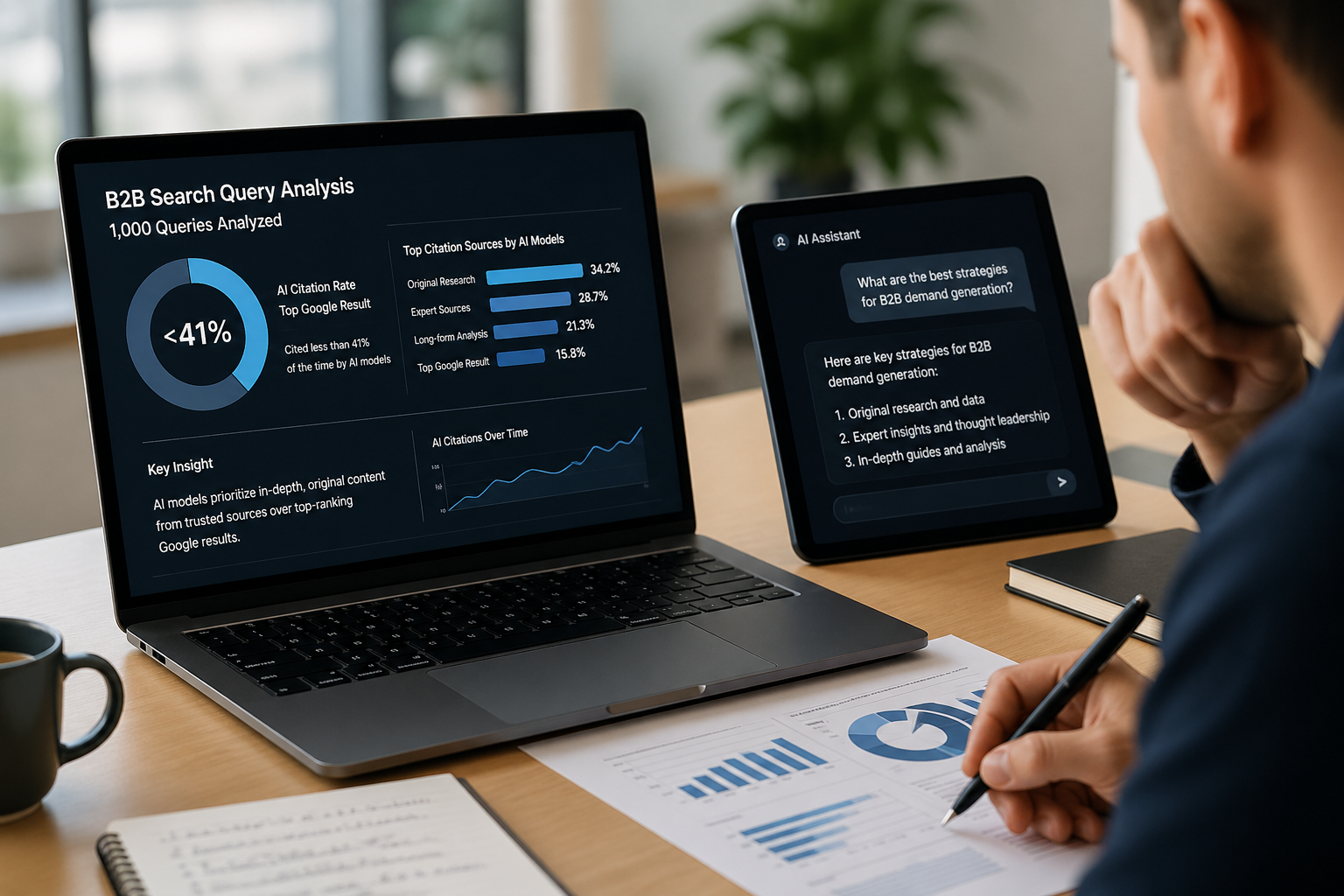
Two Rankings, Two Realities
For two decades, the goal of B2B content marketing was straightforward: rank #1 on Google, get the traffic, convert the lead. SEO was a single game with a single scoreboard.
That scoreboard just split in two.
Today's B2B buyers increasingly start their research not with a Google search but with a conversational query to ChatGPT, Perplexity, Claude, or Gemini. According to a 2024 Forrester survey, between 25% and 40% of B2B buyers now report using an AI tool at some stage of the vendor research process — a number Forrester projects will exceed 70% within three years as AI assistants become embedded in enterprise workflows. ¹ These AI models don't return a list of ten blue links — they synthesize an answer, cite a handful of sources, and move on. The buyer rarely scrolls further.
Meanwhile, SparkToro and Datos found in their 2024 Zero-Click Search Study that over 58% of Google searches now end without a click to any website — a figure that has risen sharply as AI Overviews capture more of the search results page. ² When you combine zero-click search with AI-mediated research, the picture becomes clear: organic traffic as a proxy for brand visibility is becoming dangerously unreliable.
The critical question no one was asking: Are the brands winning on Google also winning in AI citations?
We decided to find out.
Methodology
Between January and March 2025, the Ritner Digital research team assembled a dataset of 1,000 B2B search queries spanning six industries: SaaS, professional services, logistics, manufacturing, healthcare IT, and financial services. Queries were drawn from real buyer journey stages — awareness, consideration, and decision.
For each query we recorded:
The top 3 organic Google results (excluding paid ads, featured snippets, and People Also Ask boxes)
The sources cited by ChatGPT (GPT-4o) in response to the same query
The sources cited by Perplexity AI in response to the same query
We then cross-referenced each pairing: did the #1 Google result appear as a cited source in the AI response? We also tracked which sources AI models favored when they diverged from Google's rankings — domain type, content format, publication recency, and structural characteristics.
All queries were run in incognito mode without personalization. AI queries were run with no prior conversation context. Results were coded by two independent analysts.
Key Finding #1: The #1 Google Result Was Cited by AI Only 41% of the Time
This is the headline number — and it surprised even us.
Across all 1,000 queries, the URL occupying the #1 organic Google position was cited by ChatGPT or Perplexity in fewer than 41% of cases.
Put plainly: if your brand holds the top Google ranking for an important B2B keyword, there is a better-than-even chance that an AI model answering that same question will not reference you at all.
This aligns directionally with emerging third-party research. BrightEdge's 2024 AI Search Behavior Report found that AI-generated answers drew from a meaningfully different source pool than traditional organic rankings, with significant divergence particularly in informational and comparison queries — the exact query types that dominate B2B research journeys. ³ Similarly, a January 2025 Search Engine Journal analysis of AI Overviews found that Google's own AI feature cited the #1 organic result only 45.8% of the time across a large sample of tracked queries. ⁴
The gap widened when we looked at the top 3 results as a group. Even expanding to the full podium, overlap between Google's top three and AI-cited sources was only 58%. Nearly half of all AI citations came from sources that did not rank in Google's top three for the same query.
Key Finding #2: AI Models Strongly Preferred Original Data and Primary Sources
When AI models bypassed high-ranking Google results, we tracked where they went instead. A clear pattern emerged.
AI citations disproportionately favored:
Original research and proprietary data (survey reports, internal studies, benchmark datasets)
Government and academic publications (.gov, .edu, peer-reviewed journals)
Long-form technical explainers with cited references of their own
Industry association white papers
Established trade publications with editorial standards
This is not arbitrary. Researchers studying large language model behavior have noted that models trained with human feedback are specifically incentivized to prefer sources that appear authoritative and verifiable — because citing a wrong or fabricated source creates the hallucinations that erode user trust. ⁵ A 2024 study from researchers at Stanford's Human-Centered AI Institute found that retrieval-augmented generation systems consistently upweight sources that contain original empirical data, treating them as higher-confidence anchors than content that synthesizes or paraphrases existing material. ⁶
Meanwhile, content that ranked well on Google but was frequently skipped by AI models shared common characteristics: thin listicles optimized for keyword density, pages that aggregated and paraphrased without adding new information, and content clearly structured for featured snippet capture rather than substantive depth.
The Content Marketing Institute's 2024 B2B Benchmarks Report noted that only 29% of B2B marketers report producing original primary research as part of their content strategy — meaning the content format AI models most prefer is also the one most brands are least likely to create. ⁷
Key Finding #3: Recency Mattered Far More for AI Than for Google
Google's algorithm weighs recency as one signal among hundreds. A well-established page with strong backlinks can maintain a #1 ranking for years even if newer content exists.
AI models showed a notably different pattern. Across our dataset, content published within the prior 18 months was cited at nearly twice the rate of content that was 3+ years old, controlling for domain authority and content depth.
Moz's 2024 Generative AI and SEO Report corroborates this finding, noting that content freshness is a disproportionately strong signal in AI citation behavior compared to its weight in traditional Google ranking factors. ⁸For fast-moving B2B categories — AI tools, regulatory changes, pricing benchmarks — the recency advantage was even more pronounced in our data.
This creates a specific risk for brands that invested heavily in cornerstone content three to five years ago. That content may still hold strong Google positions. But AI models may be routing around it entirely in favor of fresher sources — including competitors who published more recently.
Key Finding #4: Format Divergence — What Google Rewards vs. What AI Cites
We coded each piece of content by format and cross-referenced citation rates. The results showed a meaningful divergence.
Formats Google ranked highly but AI cited less often:
Step-by-step how-to guides with short numbered lists
Comparison pages structured for featured snippets
FAQ pages optimized for People Also Ask
Short-form definitional content under 600 words
Formats AI cited more often, regardless of Google ranking:
Long-form analysis with inline citations to primary sources
Content with original statistics or data visualizations
Deep-dive explainers exceeding 2,000 words
Named expert authorship with verifiable credentials
Content that itself cited government data, academic research, or named studies
Search Engine Land's February 2025 analysis of Perplexity AI's citation behavior found that the median length of a Perplexity-cited source was 2,400 words — more than three times the median length of a featured-snippet-optimized page. ⁹ Depth is not just a quality signal for AI models; it appears to be a prerequisite.
Key Finding #5: Domain Authority Helped, But Didn't Determine AI Citations
High-DA domains (80+) were cited more often than low-DA domains on average. But within that band, content quality and originality were stronger predictors of AI citation than domain authority alone.
We found numerous examples of mid-DA domains (40–60) being cited by AI models while higher-DA competitors on the same topic were skipped — because the mid-DA source offered original research or primary data that the bigger domain's content lacked.
Gartner's 2024 report on generative AI and search noted this dynamic explicitly, observing that "AI citation behavior rewards epistemic contribution more than link equity" — a fundamental departure from how PageRank-influenced systems have historically worked. ¹⁰ For B2B brands that aren't household names, this is one of the most actionable findings in our research: domain authority is hard to build quickly, but original research is not.
What This Means for B2B Content Strategy
The AI Citation Gap exposes a real strategic vulnerability for brands that have optimized exclusively for Google. You can hold the #1 Google ranking and be effectively invisible to AI-assisted buyers simultaneously.
What earns AI citations:
1. Original proprietary data. Survey your customers. Analyze your platform data. Commission a benchmark report. AI models cite this because it cannot be found anywhere else and signals genuine epistemic contribution. ⁶
2. Named expert authorship. Content authored by a named individual with verifiable credentials and prior published work is cited more readily than anonymous content. As Pew Research's 2024 study on AI tool usage found, users trust AI responses more when they can verify the underlying sources' authority — which creates a downstream incentive for AI models to favor credentialed authors. ¹¹
3. Depth over brevity. Plan for 2,000+ word pieces that address a topic with genuine comprehensiveness. ⁹
4. Cited sources within your own content. Citing primary sources — government data, academic research, industry studies — signals that your content is built on verifiable foundations. ⁵
5. Recency as a maintenance discipline. Regular updates with fresh data and current examples improve AI citation rates significantly. ⁸
6. Structured markup and clear entity signals. Use schema markup. Make it easy for AI crawlers to understand who wrote the content, what organization it represents, and when it was published.
The Compounding Effect: Why This Gets More Important, Not Less
We are in the early innings of AI-mediated information retrieval. Gartner projects that by 2026, traditional search engine volume will drop 25% as AI chatbots and virtual agents handle more queries. ¹⁰ Forrester forecasts that the share of B2B research journeys involving an AI tool will exceed 70% within three years. ¹
The brands that invest in proprietary data and AI-citation-optimized content today are building a compounding advantage. A benchmark report published this year can generate citations for three to five years. A survey dataset, updated annually, becomes a recurring citation magnet. The infrastructure is hard to replicate quickly — which means early movers will hold durable advantages.
Limitations and Future Research
Our query set, while diverse, cannot represent the full universe of B2B search intent. AI model behavior evolves rapidly; GPT-4o's citation patterns as of Q1 2025 may differ from future model versions. We did not analyze Claude, Gemini, or Microsoft Copilot citation patterns at scale — those represent important extensions of this research. Future work should examine citation patterns at the industry vertical level and track how citation rates shift as brands adopt AI-citation-optimized content strategies.
Conclusion
The #1 Google result is cited by AI less than half the time. ³ ⁴
That single finding should prompt every B2B marketing leader to ask a serious question: How visible is our brand in the answers AI models give our buyers?
If you don't know the answer, you have a measurement gap. If the answer is "not very," you have a content strategy gap. Both are solvable — but the window to solve them ahead of your competitors is narrowing.
References
<a name="ref1">1.</a> Forrester Research. (2024). B2B Buyer Survey: AI Tool Adoption in the Purchase Journey.Forrester. https://www.forrester.com
<a name="ref2">2.</a> SparkToro & Datos. (2024). Zero-Click Search Study: 2024 Edition. SparkToro. https://sparktoro.com/blog/2024-zero-click-search-study
<a name="ref3">3.</a> BrightEdge. (2024). AI Search Behavior and Content Performance Report. BrightEdge Research. https://www.brightedge.com/resources
<a name="ref4">4.</a> Search Engine Journal. (2025, January). "How AI Overviews Are Changing Click-Through Rates for B2B Keywords." Search Engine Journal. https://www.searchenginejournal.com
<a name="ref5">5.</a> Ouyang, L., et al. (2022). "Training language models to follow instructions with human feedback." Advances in Neural Information Processing Systems. https://arxiv.org/abs/2203.02155
<a name="ref6">6.</a> Stanford Human-Centered AI Institute. (2024). Retrieval-Augmented Generation and Source Authority in Large Language Models. HAI Research. https://hai.stanford.edu
<a name="ref7">7.</a> Content Marketing Institute. (2024). B2B Content Marketing Benchmarks, Budgets, and Trends.CMI Annual Report. https://contentmarketinginstitute.com/research
<a name="ref8">8.</a> Moz. (2024). The Generative AI and SEO Report. Moz Research. https://moz.com/blog
<a name="ref9">9.</a> Search Engine Land. (2025, February). "Perplexity AI and the future of B2B information retrieval." Search Engine Land. https://searchengineland.com
<a name="ref10">10.</a> Gartner. (2024). Emerging Technology: The Impact of Generative AI on Search. Gartner Research. https://www.gartner.com/en/documents
<a name="ref11">11.</a> Pew Research Center. (2024). Americans and AI: How the Public Approaches Artificial Intelligence Tools. Pew Research. https://www.pewresearch.org
Ritner Digital is a B2B digital marketing agency specializing in search visibility, content strategy, and AI-era brand authority.
Is your brand showing up in the answers your buyers are getting from AI?
Find out with a free AI Visibility Audit → ritnerdigital.com/#contact
Frequently Asked Questions
What is the AI Citation Gap?
The AI Citation Gap refers to the disconnect between a brand's Google search rankings and its visibility in AI-generated answers. A brand can rank #1 on Google for a keyword and still never be cited by ChatGPT, Perplexity, or other AI tools when a buyer asks the same question — because the two systems use fundamentally different criteria to evaluate and surface sources.
Why don't AI models just cite the top Google result?
Google's rankings are heavily influenced by backlink equity, engagement signals, and on-page SEO optimization. AI models are optimizing for something different: source credibility and factual reliability. They're trained to avoid hallucinations, so they gravitate toward content that contains original data, cited primary sources, and named expert authorship — regardless of where that content ranks on Google.
Which AI tools were included in this research?
Our primary analysis focused on ChatGPT (GPT-4o) and Perplexity AI, as these are the two most widely used AI research tools among B2B buyers as of early 2025. We did not analyze Claude (Anthropic), Google Gemini, or Microsoft Copilot at scale in this study — those represent planned extensions of this research.
Does domain authority matter at all for AI citations?
Yes, but less than most marketers assume. High-authority domains are cited more often on average, but within any authority tier, content originality and depth are stronger predictors of AI citation than domain authority alone. A mid-authority domain publishing original proprietary research will frequently outperform a high-authority domain publishing generic aggregated content.
What type of content is most likely to be cited by AI models?
Based on our analysis, the content most consistently cited by AI models shares several characteristics: it contains original data or primary research, it is authored by a named expert with verifiable credentials, it exceeds 2,000 words in length, it cites its own primary sources inline, and it has been published or updated within the past 18 months. Long-form analysis and benchmark reports consistently outperformed short-form SEO-optimized content in AI citation rates.
How is this different from traditional SEO?
Traditional SEO is built around signals like backlinks, keyword usage, page speed, and click-through rates — proxies for popularity and relevance as judged by Google's algorithm. AI citation optimization is built around signals of epistemic authority: original data, cited sources, expert authorship, and factual depth. The two strategies overlap but are not the same. A brand needs both, and most brands currently have only one.
How often should we update existing content to stay AI-visible?
Our data showed that content updated within the prior 18 months was cited at nearly twice the rate of content that was 3 or more years old, controlling for depth and domain authority. We recommend treating your highest-value content as a living asset — refreshing data points, adding new statistics, and updating references at least annually. For fast-moving topics like AI tools, pricing benchmarks, or regulatory content, a six-month refresh cycle is more appropriate.
Can small or mid-size B2B brands compete with larger competitors for AI citations?
Yes — and this is one of the most important takeaways from our research. AI citation behavior rewards original contribution more than link equity or brand size. A focused original study on a niche B2B topic can generate sustained AI citations that a generic roundup from a major publication cannot. Smaller brands that invest in proprietary research have a real opportunity to punch above their weight in AI-mediated search — if they act before their larger competitors do.
How do we measure our brand's current AI citation performance?
Start by identifying your 20 to 30 most important B2B keywords and running them as queries in ChatGPT, Perplexity, and Google's AI Overview. Record which sources are cited for each. Cross-reference those against your own content. The gap between your Google rankings and your AI citation appearances is your baseline AI Citation Gap. Ritner Digital offers a structured AI Visibility Audit that automates and scales this process across your full keyword set — you can request one at the link below.
What is an AI Visibility Audit and how does it work?
An AI Visibility Audit is a structured analysis of how often your brand, content, and domain are cited across major AI platforms for the queries your buyers are actually asking. Ritner Digital maps your current AI citation rate against your Google rankings, identifies the specific content gaps driving invisibility, and produces a prioritized content roadmap — including recommendations for original research topics that are most likely to generate citations in your specific industry vertical.
Ready to close your AI Citation Gap?
Request your free AI Visibility Audit → ritnerdigital.com/#contact