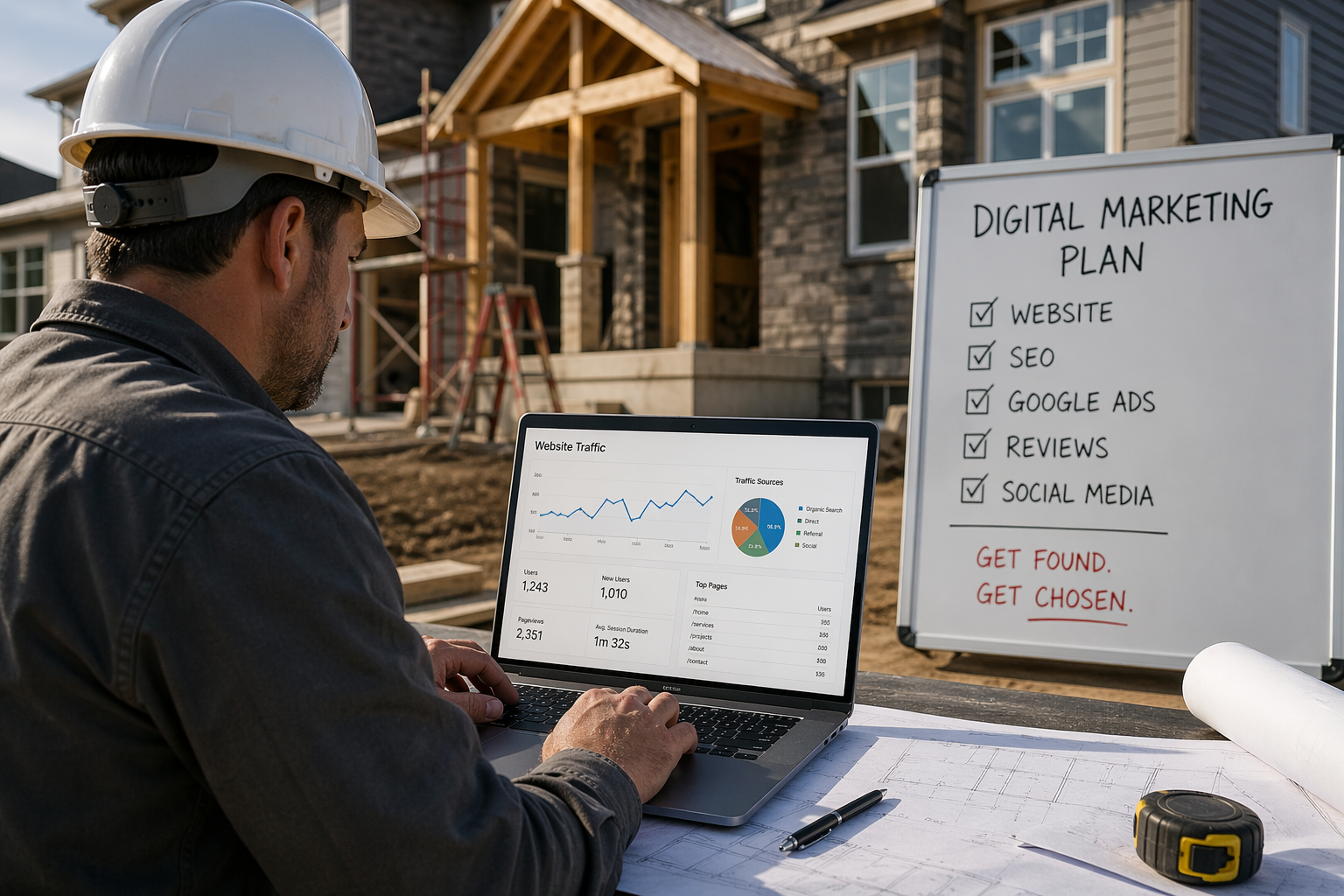
The Way Homeowners Hire Contractors Has Changed — Has Your Marketing?
Not long ago, a general contractor in Pennsylvania could build a thriving business almost entirely on referrals, yard signs, and a listing in the yellow pages. Word got around. Neighbors talked. A good reputation in your township or borough was enough to keep the calendar full.
That model hasn't disappeared entirely — referrals still matter enormously — but it no longer operates in isolation. The homeowner who gets your name from a neighbor is almost certainly going to Google you before they call. They're going to read your reviews. They're going to look at your website. They're going to check whether you show up when they type your trade and their zip code into a search bar. And if what they find doesn't build confidence quickly, they'll move on to someone who shows up better online — regardless of how good your actual work is.
Over 97% of homeowners now use Google to find local home services and general contractors. Embarque Uberall's 2025 local search report found 91% of consumers search online before visiting or contacting a local business, with Google Search leading at 77.6% and Google Maps at 51.4%. TrueFuture Media
Pennsylvania is a particularly competitive market for general contractors. The state's dense population, aging housing stock — especially throughout Philadelphia, its suburbs, and the rust belt cities of western PA — and robust homeowner renovation activity create enormous demand. The U.S. home services market hit $90.63 billion in 2024 and is on track to nearly double to $181.64 billion by 2034. Hook Agency That growth is real. But it won't benefit every contractor equally. The jobs are going to the contractors who show up first, look credible, and make it easy for homeowners to reach out.
This guide covers every major digital marketing channel available to Pennsylvania general contractors — what it costs, what it produces, how long it takes, and what you need to do to make it work in this specific market.
The Pennsylvania Market: What Makes It Different
Before diving into tactics, it's worth understanding the specific dynamics of marketing a contracting business in Pennsylvania, because they shape which strategies produce the best return.
The market is large and geographically diverse. Pennsylvania has a population of over 13 million and covers an enormous range of market types — from the dense urban neighborhoods of Philadelphia and Pittsburgh, to the affluent Main Line and South Jersey border suburbs, to the midsize cities of Allentown, Reading, Harrisburg, and Scranton, to rural counties with different competitive dynamics entirely. A marketing strategy that works for a contractor in Center City Philadelphia is not the same as one that works in Lancaster County or Erie. Geographic specificity matters.
The housing stock is old. Pennsylvania has some of the oldest housing in the country. Philadelphia's row homes, Pittsburgh's Victorian-era neighborhoods, and the historic farmhouses and colonials throughout the state's rural counties all require ongoing renovation, maintenance, and modernization. That aging stock creates consistent demand for general contractors — and consistent search volume for the services you provide.
Competition is intensifying digitally. Only 15% of construction companies have fully implemented a digital strategy, despite evidence showing significant benefits. Improve & Grow, LLC That number is rising rapidly. Private equity-backed home services rollups are entering Pennsylvania markets with aggressive digital marketing budgets. Regional and national lead aggregators are competing for the same search terms your customers are using. And large regional contractors are increasingly investing in local SEO and paid advertising that used to be the exclusive domain of smaller operators. The contractors who build their digital presence now are establishing positions that will be significantly harder to replicate in two or three years.
Reviews drive decisions more than anywhere else. 82% of homeowners consider Google reviews essential when selecting a general contractor. 87% of clients avoid contractors with a rating below four stars. Radaris In a market where homeowners can't easily verify quality before hiring, reviews function as the primary trust mechanism. Your review profile is not a nice-to-have — it is part of your marketing infrastructure.
Channel 1: Google Business Profile — Your Most Important Free Asset
If you could do only one thing to improve the digital marketing of your contracting business tomorrow, it would be to fully optimize your Google Business Profile. No other single action produces a faster or more durable return for local contractors.
Your Google Business Profile is what appears in the map pack — the three local business listings with star ratings, photos, and contact information that appear at the top of Google search results for local queries like "general contractor near me" or "home remodeling contractor Philadelphia." 93% of local searches prominently feature Google's Map Pack, and nearly half of all Google searches have local intent. Improve & Grow, LLC That map pack is the most valuable real estate in local search — and it's available to every business regardless of budget.
What a fully optimized Google Business Profile includes:
Your business name, address, and phone number must be accurate and consistent with what appears on your website and every other directory where your business is listed. Inconsistency in what SEO professionals call NAP data (name, address, phone) actively hurts your local rankings.
Your business category selection matters more than most contractors realize. "General contractor" is a valid category, but if you specialize in kitchen remodeling, basement finishing, or additions, adding those as secondary categories significantly expands the searches your profile appears for.
Photos drive engagement. Contractors who post regular project photos — before and after shots, work in progress, completed jobs — see dramatically higher profile views and customer actions than those with minimal or stock photography. This is free, and it compounds over time.
The Q&A section is an underused asset. Populating it with common questions and clear answers (licensing, service area, typical project timelines, whether you offer free estimates) reduces friction for prospects and provides additional keyword-rich content that influences rankings.
Weekly posts keep your profile active and signal to Google that the business is current and engaged. These posts can highlight completed projects, seasonal promotions, or useful information for homeowners in your area.
Review generation on Google Business Profile deserves its own emphasis. 56% of homeowners said they would likely seek out a review on Google when researching a contractor — more than any other platform, including the contractor's own website at 51%, Yelp at 43%, and Facebook at 36%. ACHR News A systematic approach to asking satisfied customers for Google reviews — at project completion, via follow-up text, through a direct link in your email signature — is one of the highest-leverage marketing activities available to any Pennsylvania contractor.
Channel 2: Local SEO — Owning Search in Your Service Area
Local SEO encompasses all the work done to help your business rank organically in Google search results for location-specific queries. It's the foundation of sustainable, long-term lead generation for contractors — and it's where many Pennsylvania contractors are significantly underinvested.
The searches you need to own are highly specific: "kitchen remodeler [town]," "basement finishing contractor [county]," "general contractor near [zip code]," "home addition contractor [city]." These are high-intent searches from homeowners who have already decided they need a contractor and are now evaluating specific options. Appearing prominently for these searches puts you in front of buyers at the exact moment they're ready to act.
The components of local SEO for Pennsylvania contractors:
Service area pages. If you serve multiple communities — and most Pennsylvania contractors serve an area spanning multiple townships, boroughs, or counties — dedicated landing pages for each primary service area significantly increase your relevance for location-specific searches. A page specifically optimized for "general contractor in Bucks County" will outperform a generic homepage for that search. These pages need genuine, specific content — not boilerplate language duplicated across locations with only the city name changed.
Service pages with depth. Each major service you offer — kitchen remodeling, bathroom renovation, home additions, basement finishing, whole-home renovation — deserves its own dedicated page that goes into real detail about your process, what homeowners should expect, typical timelines, and what makes your approach distinctive. Google rewards depth and specificity. A 200-word service page competes poorly against a competitor's 1,200-word page that genuinely answers the questions homeowners have.
Technical SEO fundamentals. Your website needs to load quickly on mobile devices — the majority of contractor searches happen on phones. It needs to be structured in a way that Google can easily crawl and understand. And it needs basic on-page optimization: title tags that include your primary service and location, meta descriptions that encourage clicks, and heading structures that organize content logically.
Citation building. Your business information should be consistently listed across the directories that matter for local contractors — Angi, HomeAdvisor, Houzz, Thumbtack, Yelp, the Better Business Bureau, and industry-specific directories. These citations both drive direct traffic and reinforce your local authority in Google's ranking algorithm.
Link building. Links from reputable local websites — your local chamber of commerce, community organizations, local media, supplier or manufacturer sites — signal local authority to Google. For Pennsylvania contractors, involvement in local business associations and community organizations isn't just good citizenship; it's good SEO.
What to expect from local SEO: SEO takes time. Most contractors doing this work from scratch should expect three to six months before rankings improve materially and six to twelve months before the full lead generation impact is visible. But once rankings are established, they generate leads continuously without ongoing media spend — making SEO the highest-ROI long-term marketing investment available to most contractors.
Channel 3: Google Local Service Ads — The Fastest Path to the Top of Search
Google Local Service Ads (LSAs) are a category of Google advertising specifically designed for local service businesses, including general contractors. They appear above both regular Google Ads and organic results, display your business name, rating, and review count directly in the search result, and include a "Google Guaranteed" or "Google Screened" badge for businesses that complete Google's verification process.
Local Service Ads with Google Guaranteed verification have become game-changers for contractors. These ads appear at the very top of search results and come with the trust-building power of Google's verification process — something particularly valuable in a market where homeowners are deeply cautious about who they let into their homes. Improve & Grow, LLC
The key structural difference between LSAs and regular Google Ads is how you pay: LSAs charge per lead rather than per click. You pay when a homeowner contacts you directly through the ad — by phone call or message — rather than paying every time someone clicks through to your website. For contractors, this pay-per-lead structure significantly reduces wasted spend.
To qualify for the Google Guaranteed badge — which increases conversion rates meaningfully — general contractors must pass background checks, verify licensing and insurance, and maintain a minimum review threshold. This process takes several weeks but is well worth completing, both for the ad performance benefits and the trust signals it sends to prospective customers.
What LSAs typically cost for Pennsylvania general contractors: Lead costs vary significantly by market. General contracting leads in competitive Philadelphia suburbs can run $40 to $80 per lead. In smaller Pennsylvania markets, costs are often lower. The important metric is not cost per lead but cost per booked job — which requires tracking which leads actually convert and at what close rate.
Channel 4: Google Ads (Pay-Per-Click) — Scalable Lead Flow for Specific Services
Standard Google Ads — text and display ads that appear in search results when homeowners search for specific terms — remain a powerful lead generation tool for Pennsylvania contractors, particularly for high-value services like kitchen remodeling, home additions, and whole-home renovations where the job value justifies a higher cost per lead.
Unlike LSAs, Google Ads give you more granular control over which search terms trigger your ads, what geographic area you're targeting, what your ads say, and where clicks land. A well-structured Google Ads campaign for a general contractor might target specific high-intent queries like "kitchen remodel cost estimate [city]" or "home addition contractor [county]" — capturing buyers who are actively evaluating options and ready to request quotes.
In competitive markets like roofing, HVAC, and emergency services, a single click on a Google Ad can cost over $40, $50, or even $60 for high-intent keywords. Without the right strategy, this is money down the drain. Many contractors make critical mistakes like sending traffic to a generic homepage, not using negative keywords, or failing to track conversions properly. Contractormarketingpros
The most common failure mode in contractor Google Ads is sending paid traffic to the business homepage rather than a dedicated landing page. A homeowner searching for "kitchen remodeler in Chester County" who clicks an ad and lands on a generic "about us" page bounces immediately. The same click sent to a page specifically about kitchen remodeling in Chester County — with photos of relevant past projects, clear pricing guidance, and a prominent call to action — converts at a dramatically higher rate.
What to expect from Google Ads: Unlike SEO, Google Ads can generate leads within days of launching. The tradeoff is that leads stop when spend stops — there's no compounding effect. Most Pennsylvania contractors use paid search as a complement to organic SEO rather than a replacement, especially during the ramp-up period when SEO is still building momentum.
Channel 5: Your Website — The Hub Everything Else Points To
Every digital marketing channel you invest in — SEO, Google Ads, LSAs, social media, email — ultimately sends traffic to your website. If the website doesn't convert that traffic into leads, every upstream investment is partially wasted. For many Pennsylvania contractors, the website is the weakest link in an otherwise reasonable marketing program.
A contractor website that converts visitors into leads needs to accomplish several things quickly — remember, the typical visitor is a homeowner on their phone who is comparing multiple options and will leave within seconds if they can't find what they need.
The elements of a high-converting contractor website:
Mobile performance is non-negotiable. 70% of homeowners now prefer to book services online Hook Agency, and the majority of contractor searches happen on mobile devices. A website that loads slowly, displays poorly on a phone screen, or requires pinching and zooming to navigate will lose leads before they've read a single word.
Social proof needs to be prominent and specific. Your best Google reviews should appear on your homepage — not buried on a testimonials page, but front and center where every visitor sees them immediately. Photos of completed projects in Pennsylvania communities your prospects recognize build instant credibility. Specific, named testimonials from real customers carry far more weight than anonymous star ratings.
Clear calls to action throughout. Every page of your website should make it easy to take the next step — call you, fill out a quote request form, or schedule a consultation. Many contractor websites make contact information hard to find, which is leaving money on the table.
Licensing, insurance, and credentials should be visible. Pennsylvania homeowners are appropriately cautious about who works on their homes. Your PA contractor registration number, liability insurance, and any manufacturer certifications or industry memberships should be easy to find — not buried in fine print but displayed as trust signals.
Project portfolio with real photography. Before-and-after photos of actual completed projects — especially projects in recognizable Pennsylvania communities — do more to convert visitors than any written description of your capabilities. Professional photography isn't always necessary; well-composed smartphone photos of quality work are entirely effective.
Channel 6: Reviews and Reputation Management — The Make-or-Break Factor
For Pennsylvania general contractors, online reputation management isn't a separate marketing initiative — it is marketing. The review profile your business presents across Google, Yelp, Angi, and Houzz is the most powerful factor in whether a homeowner who finds you decides to call you.
82% of homeowners consider Google reviews essential when selecting a general contractor. 87% avoid contractors with ratings below four stars. A one-star increase in overall review score can potentially lead to a 5 to 10% revenue boost. Radaris
The contractors winning in competitive Pennsylvania markets have systematic approaches to review generation — not waiting for happy customers to leave reviews spontaneously, but actively asking for them at the right moment. That moment is at the completion of a successful project, when the homeowner is experiencing the satisfaction of a job well done and their enthusiasm for recommending you is highest.
A simple process works: at project completion, ask the homeowner directly if they'd be willing to leave a review, send them a text with a direct link to your Google review page within 24 hours, and follow up once if you haven't heard back within a week. Over time, this system compounds — and a contractor with 80 four-and-five-star Google reviews in a market where most competitors have 12 has a structural competitive advantage that is very difficult to overcome through advertising alone.
Responding to every review — positive and negative — signals to both Google and prospective customers that you are engaged, professional, and accountable. Responses to negative reviews, in particular, can actually improve your conversion rate with future prospects who read how you handled a difficult situation.
Channel 7: Social Media — Project Documentation That Builds Trust
Social media for Pennsylvania general contractors serves a different purpose than social media for consumer brands or B2B companies. You're not trying to build a following or go viral. You're building a consistent, visual record of quality work that validates your reputation when prospective customers look you up.
Social media plays a different role than search for contractors. It helps validate whether a company looks active, trustworthy, and relevant to the homeowner's project. The smartest contractor marketing system uses Google to capture intent and social media to reinforce proof, familiarity, and confidence before the homeowner reaches out. TrueFuture Media
Facebook and Instagram are the primary platforms for residential general contractors. Facebook is particularly effective for the 35-65 age bracket that makes up the majority of homeowners undertaking significant renovation projects. Instagram's visual format is well-suited for before-and-after project documentation.
The content that performs best for contractors on social media is simple: documentation of real work. A series of photos showing a kitchen transformation from demo through completion. A time-lapse video of a deck build. Before-and-after shots of a basement finishing project. This content requires no marketing sophistication to produce — just a habit of photographing your work and the discipline to post it consistently.
Contractors can use social media platforms to showcase past projects, post client testimonials, and engage with local community groups. Social media ads, especially with Facebook's local targeting features, allow firms to reach specific demographics, driving both brand awareness and lead generation among nearby homeowners. Improve & Grow, LLC
Paid social advertising — particularly Facebook and Instagram ads targeted to homeowners within your service area — can be an effective supplemental lead generation channel, particularly for promoting specific services, seasonal offers, or special promotions. The targeting capabilities that allow you to reach homeowners by geography, age, homeownership status, and demonstrated interest in home improvement are genuinely useful for contractors who want to reach prospective customers who aren't actively searching yet.
Channel 8: Content Marketing — Building Authority That Compounds Over Time
Content marketing for Pennsylvania general contractors means creating genuinely useful content — blog posts, project guides, cost guides, FAQ pages, process explanations — that answers the questions your prospective customers are asking before they hire a contractor.
This serves two purposes simultaneously. First, it drives organic search traffic: a well-researched article on "how much does a kitchen remodel cost in Pennsylvania" or "what permits do you need for a home addition in [county]" will rank in Google for queries that prospective customers are actively searching. Second, it builds the kind of demonstrated expertise that converts skeptical homeowners into confident callers.
Construction companies that invest in creating valuable content that answers client questions are seeing significantly better results than those relying solely on traditional advertising. Improve & Grow, LLC
Content topics that perform well for Pennsylvania general contractors include cost guides for specific renovation projects in the PA market, explanations of the permit process for common projects in specific Pennsylvania counties, project timeline guides that set realistic homeowner expectations, before-and-after case studies from completed local projects, and guides to choosing the right contractor — content that positions you as a trustworthy advisor rather than just another vendor competing on price.
Channel 9: Email Marketing — Staying Top of Mind With Past Customers
Most general contractors underinvest in marketing to their existing customer base, focusing entirely on acquiring new customers. This misses a significant opportunity: past customers who had a positive experience are your most likely source of repeat business and referrals, and a systematic follow-up process keeps your name top of mind when they — or someone they know — needs a contractor again.
A simple email marketing program for general contractors doesn't need to be complex. A quarterly newsletter with useful seasonal content (winterizing your home, spring maintenance checklist, common renovation mistakes to avoid), occasional project spotlights, and a gentle prompt to refer friends and family keeps your business visible between projects without requiring significant ongoing effort.
For larger projects like whole-home renovations or significant additions, an automated follow-up sequence at 30 days, 6 months, and one year after project completion both reinforces customer satisfaction and creates natural opportunities for additional work or referrals.
Putting It Together: A Realistic Marketing Roadmap for Pennsylvania Contractors
The right sequencing of these investments matters as much as the investments themselves. Not every channel deserves equal priority, and trying to do everything simultaneously dilutes resources and produces mediocre results across the board.
Phase 1 — Foundation (Months 1-2): Fully optimize your Google Business Profile. Audit and fix your website for mobile performance, contact clarity, and basic on-page SEO. Implement a systematic review request process. Get your NAP data consistent across major directories. These steps cost relatively little and produce the fastest visible improvement.
Phase 2 — Paid Lead Generation (Months 2-4): Launch Google Local Service Ads to generate lead flow while organic SEO builds. If job values justify the cost, layer in targeted Google Ads for your highest-value services. Track every lead to booked job so you know your actual cost per customer.
Phase 3 — Organic Growth (Months 3-12): Begin creating service area pages and in-depth service pages for your primary offerings. Build out a content strategy focused on the questions Pennsylvania homeowners ask before hiring a contractor. Start consistent social media posting documenting completed projects.
Phase 4 — Compounding (Month 6 onwards): By this stage, your Google Business Profile has accumulated consistent reviews, your organic rankings are improving, and your paid campaigns are optimized based on real performance data. The focus shifts to maintaining and expanding — more service area pages, more content, more reviews, and gradual expansion of paid budgets as you prove ROI.
Conclusion: The Contractors Winning in Pennsylvania Are Building Digital Foundations Now
The demand for general contractors in Pennsylvania is real and growing. The homeowners are searching. The projects are happening. The question is which contractors capture that demand and which watch it go to someone else.
The contractors consistently winning the best projects in their markets share a common characteristic: they invested in their digital presence before it felt urgent. They built review profiles when getting to 50 Google reviews felt like a long way off. They invested in SEO when the results were six months away. They built websites that converted before they had massive traffic to convert. And now those investments compound — generating leads at lower and lower cost per acquisition as the infrastructure matures.
Only 15% of construction companies have fully implemented a digital strategy. Improve & Grow, LLC That statistic represents both a challenge and a massive opportunity. The Pennsylvania contractors who build their digital presence with intention now are establishing competitive positions that will be very difficult for late movers to overcome.
The work you do on your houses lasts for decades. The marketing infrastructure you build for your business should do the same.
Ready to Build a Digital Marketing Program That Fills Your Pipeline?
At Ritner Digital, we work with contractors and home service businesses across Pennsylvania and the Philadelphia region — building the local SEO presence, digital advertising programs, and content infrastructure that generates consistent, qualified leads.
Book a free strategy call today and let's talk about where your digital marketing stands and what it would take to get you more of the projects you actually want.
👉🏼 Schedule your call at ritnerdigital.com
Sources: TrueFuture Media Google vs Social Media for Contractors 2026 | Embarque Top Contractor SEO Agencies 2025 | ACHR News Homeowner Review Statistics | Guaranteed Removals Google Review Statistics for Home Services | Improve & Grow Lead Gen for Contractors 2025 | Improve & Grow Construction Industry Marketing Trends 2025 | Contractor Marketing Pros Home Services Marketing Stats | Hook Agency Most Searched Home Services 2026 | Inner Spark Creative Home Services Marketing Benchmarks 2025 | Uberall 2025 Local Search Report
Frequently Asked Questions
How long does it take for digital marketing to start generating leads for a Pennsylvania general contractor?
It depends on the channel. Google Local Service Ads can generate phone calls within days of launching, assuming your profile is verified and your budget is live. Google Ads typically take two to four weeks to optimize and start producing consistent lead flow. Local SEO is the slowest but most durable — most contractors see meaningful ranking improvements in three to six months, with the full lead generation impact taking closer to six to twelve months. The practical answer for most contractors is to run paid advertising for immediate leads while building organic SEO simultaneously, then gradually reduce paid spend as organic rankings mature and the cost per lead from organic channels drops. Trying to wait for SEO to work before investing in any paid channels leaves revenue on the table during the ramp-up period.
We get most of our work from referrals. Do we really need to invest in digital marketing?
Referrals are still the highest-quality lead source available to most contractors — but digital marketing and referrals aren't competing systems, they're complementary ones. The homeowner who gets your name from a neighbor is almost certainly going to Google you before they call. What they find when they do that search determines whether the referral converts. A contractor with 12 Google reviews and a dated website loses referrals to a competitor with 80 reviews and a professional online presence — even when the referring neighbor specifically recommended you. Digital marketing also reduces your vulnerability to referral dry spells, seasonal slowdowns, and the natural attrition of a referral network. The contractors who grow most consistently in Pennsylvania use referrals as the foundation and digital marketing as the system that captures demand their referral network can't fully cover.
Should a Pennsylvania general contractor use Angi, HomeAdvisor, or Thumbtack for leads?
These platforms can provide lead flow, particularly for contractors who are early in building their own digital presence and need jobs in the near term. The significant downsides are worth understanding clearly. Leads from these platforms are shared — the same homeowner inquiry often goes to three to five contractors simultaneously, creating an immediate price competition dynamic. Lead costs have risen substantially as these platforms have matured, and lead quality is inconsistent. Most contractors who rely heavily on aggregator platforms report that the cost per booked job is high relative to leads from their own organic presence. The better long-term strategy is to use aggregator platforms as a short-term supplement while building the owned digital assets — your Google Business Profile, your website, your SEO — that generate exclusive inbound leads at lower cost over time.
How many Google reviews does a Pennsylvania general contractor actually need to be competitive?
There's no single number that applies universally, because the benchmark is relative to your specific market and the competitors you're up against. The practical answer is: more than whoever is currently ranking above you, with a strong average rating. In many suburban Philadelphia and Pittsburgh markets, the top-ranked contractors in the Google map pack have 40 to 100+ reviews. In smaller Pennsylvania markets, 20 to 30 reviews with a 4.8 or better average can put you at or near the top. The more important insight is that review accumulation is a compounding process — the contractors who build systematic review request habits today will be progressively harder to catch as their review counts grow. Start now, build a consistent process, and the competitive gap works in your favor over time.
What should a Pennsylvania general contractor's website actually include to generate leads?
The bare minimum for a contractor website that converts: a mobile-optimized design that loads quickly, a prominently displayed phone number visible on every page, a simple quote request or contact form, your service area clearly stated, your licensing and insurance information visible, before-and-after photos of real completed projects in Pennsylvania communities your prospects recognize, and your best Google reviews displayed on the homepage. Beyond the basics, dedicated pages for each major service you offer and each primary geographic area you serve significantly increase your SEO visibility and your conversion rate for specific searches. The single most common failure on contractor websites is sending visitors to a generic homepage from paid ads — every ad campaign should point to a landing page specifically relevant to what the prospect searched for.
Is social media actually worth it for a Pennsylvania general contractor, or is it a distraction?
Social media is worth a focused, modest investment — but it's a supporting channel, not a primary lead generation channel. Its real value for contractors is in the validation phase: the homeowner who found you through Google or a referral checks your Facebook or Instagram to see if you're active and whether your recent work looks good. A contractor with no social media presence, or one whose last post was two years ago, creates doubt at that critical moment. The time investment doesn't need to be large. Posting project photos consistently — even just a few times per month — maintains an active, professional presence that reinforces trust during the comparison stage. Where social media becomes a meaningful lead generation channel is through paid Facebook and Instagram advertising targeted to homeowners in your specific Pennsylvania service area, which can be effective for promoting specific services or seasonal campaigns.
We serve multiple areas across Pennsylvania. How should we handle marketing across different geographic markets?
Multi-market marketing for Pennsylvania contractors requires thinking about your digital presence geographically, not just as a single entity. Each primary service area you want to rank in needs its own targeted approach. On your website, this means dedicated landing pages for each major market — not duplicated content with city names swapped, but genuinely specific pages that reference local neighborhoods, typical project types in that area, and relevant local details. On Google Business Profile, your service area settings need to accurately reflect where you work. For paid advertising, your campaigns should be segmented by geography so you can control bids and budgets by market based on where jobs are most profitable. Local SEO in each market requires citations and signals specific to that community. The practical implication is that multi-market digital marketing requires proportionally more investment than single-market — but the return scales accordingly.
How do we handle negative Google reviews? Can they hurt our business badly?
Negative reviews hurt most when they're not responded to, when there are very few total reviews so one bad one has outsized weight, and when the complaint reveals a pattern rather than an isolated incident. A single three-star review among 75 four-and-five-star reviews has minimal impact on your overall perception. The same review against a backdrop of only eight total reviews is damaging. The best response to a negative review is prompt, professional, and non-defensive — acknowledge the concern, explain what happened if there's important context the public should have, and offer to resolve it offline. Prospective customers reading a negative review pay close attention to how you responded. A gracious, accountable response to criticism often builds more trust than a perfect review record, because it demonstrates how you handle problems — which is exactly what homeowners are trying to assess before handing you the keys to their home.
What's the difference between Google Ads and Google Local Service Ads for contractors, and which should we use?
They serve different purposes and work best together rather than as alternatives. Google Local Service Ads appear above everything else in search results, display your rating and review count directly, charge per lead rather than per click, and carry the Google Guaranteed trust badge for verified businesses. They're best for capturing high-intent local searches where the homeowner is ready to contact someone now. Standard Google Ads give you more control over which search terms trigger your ads, what your ads say, and where clicks go — they're better for specific service campaigns, geographic targeting nuance, and driving traffic to pages designed for conversion. Most Pennsylvania contractors with meaningful marketing budgets should run both simultaneously: LSAs for immediate local intent capture, and standard Google Ads for specific high-value service targeting. Start with LSAs if budget is limited, since the pay-per-lead model reduces wasted spend during the learning phase.
We do both residential and commercial work. Should our marketing treat these the same?
No — residential and commercial buyers find contractors through different channels, respond to different trust signals, and make decisions through different processes. Residential homeowners search Google, read reviews, look at photos, and make relatively fast decisions based on reputation and gut feel. Commercial clients — property managers, developers, business owners, facilities managers — often use referral networks, industry associations, and direct outreach, and their decision-making involves more stakeholders and longer timelines. Your marketing should be segmented accordingly. Residential marketing should prioritize local SEO, Google Business Profile optimization, review generation, and social proof. Commercial marketing should prioritize thought leadership content, LinkedIn visibility, industry association involvement, and direct relationship-building outreach. A website that tries to speak equally to both audiences often speaks effectively to neither — consider whether separate service sections or even separate landing pages would serve your actual buyer mix better.