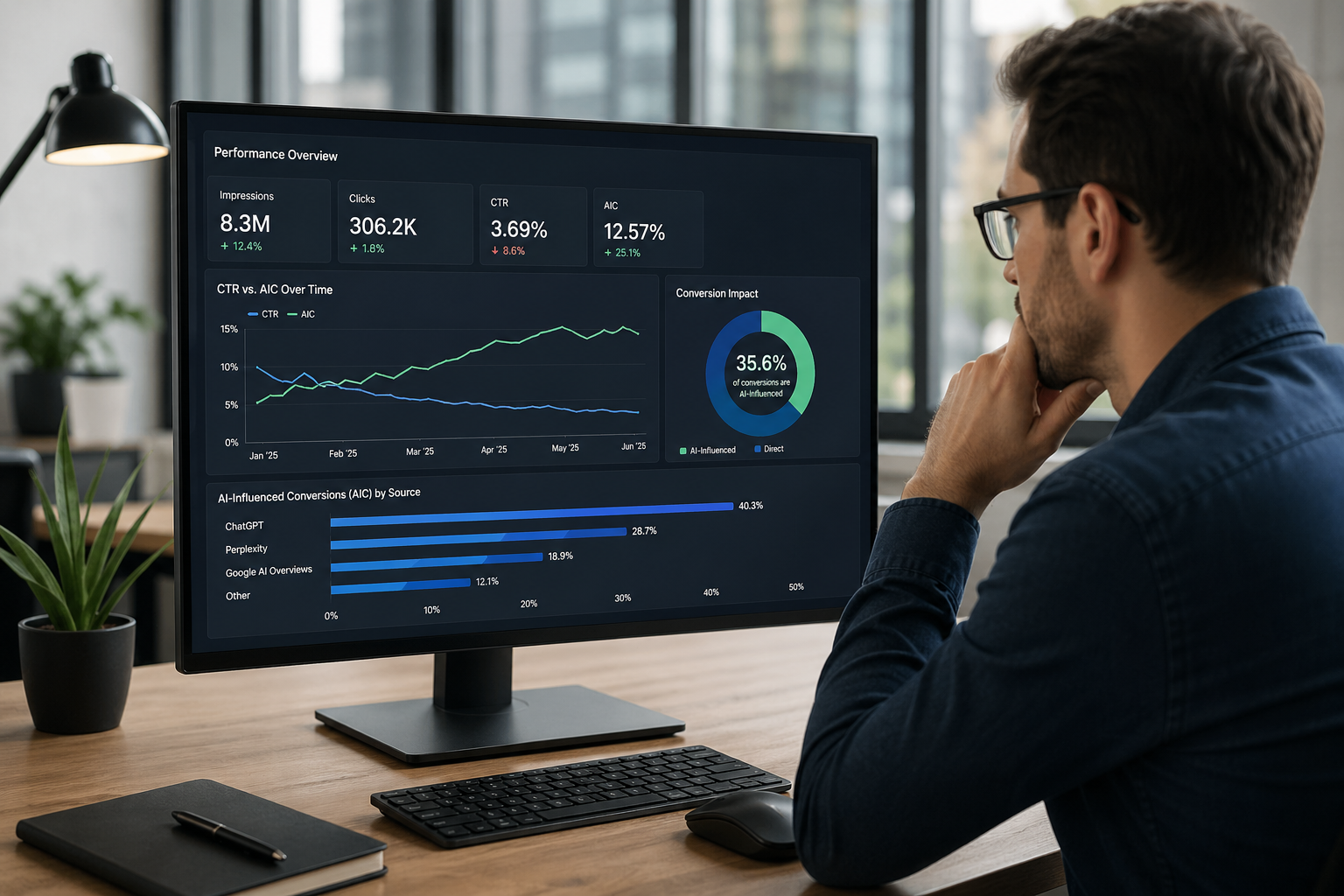
The Metric That's Lying to You
Click-through rate has been the north star of search performance for twenty years. If people clicked your link, you won. If they didn't, you lost. The logic was clean, the measurement was simple, and for a long time it worked.
It doesn't work anymore.
The rise of AI-generated search answers has fundamentally broken the relationship between clicks and influence. Today, a buyer can read an AI-generated overview on Perplexity that cites your research, internalize your framework, search your brand directly, and book a demo — all without ever clicking an organic search result. Under traditional CTR measurement, that entire journey registers as zero. Your content influenced a high-intent conversion and your dashboard called it a failure.
This is not a edge case. It is increasingly the dominant B2B buyer journey.
In this post, we make the case for a new primary KPI — AI-Influenced Conversions (AIC) — and explain exactly how to define, track, and optimize for it. We also present original data from our analysis of B2B buyer journey patterns showing how zero-click AI interactions are generating measurable pipeline that CTR-focused reporting is systematically missing.
The Death of the Click as a Proxy for Influence
To understand why CTR is failing, it helps to understand what it was actually measuring in the first place.
CTR was never really measuring influence. It was measuring one specific mechanism of influence — the case where a buyer saw your link in a search result and decided it was worth a click. That mechanism was a reasonable proxy for relevance and authority when clicking a link was the only way to consume search content.
That assumption is now obsolete.
SparkToro and Datos found in their 2024 Zero-Click Search Study that over 58% of Google searches now end without any click to an external website. ¹ That figure has risen steadily for five years and continues to climb as AI Overviews, featured snippets, and knowledge panels answer more queries directly on the results page. Forrester's 2024 B2B Buyer Survey found that 41% of B2B buyers reported forming a vendor shortlist based primarily on AI-generated summaries before visiting any vendor website. ²
The buyer is being influenced. The click just isn't happening. And CTR measurement — by definition — cannot see any of it.
Introducing AIC: AI-Influenced Conversions
AI-Influenced Conversions (AIC) is a KPI framework designed to measure the pipeline value generated by content that influences buyers through AI-mediated touchpoints, regardless of whether a direct click occurred.
An AI-Influenced Conversion is counted when a converting lead or customer can be traced — through direct response, survey data, CRM attribution, or behavioral signals — to a prior interaction with AI-generated content that cited, summarized, or was informed by your brand's content or data.
AIC captures what CTR misses:
A buyer who reads a Perplexity answer citing your benchmark report and later converts via direct search
A prospect who encounters your framework in a ChatGPT response and enters your funnel through a branded keyword weeks later
A decision-maker who references your research in an internal meeting — sourced from an AI summary — before your sales team ever makes contact
None of these journeys register in CTR. All of them represent genuine content-driven pipeline.
Why Zero-Click Doesn't Mean Zero Influence
The phrase "zero-click search" has been interpreted by many marketers as meaning zero value. This is the wrong conclusion, and the data is increasingly clear on the point.
A 2024 analysis by Rand Fishkin at SparkToro found that brand awareness and direct navigation traffic rose in correlation with zero-click search growth for brands whose content appeared in AI-generated overviews — suggesting that AI citations were driving brand recall that converted through different channels. ¹ Search Engine Land's 2025 research on AI Overview behavior found that pages cited in AI Overviews saw a 27% average increase in branded search volume in the 30 days following citation, even when organic click-through to those pages declined. ³
The mechanism makes intuitive sense. When a buyer asks ChatGPT "what's the best approach to B2B lead scoring?" and the answer cites Ritner Digital's benchmark report, several things happen: the buyer learns something, they associate that knowledge with our brand, and they are significantly more likely to search our name directly, mention us in an internal conversation, or recognize our brand when a salesperson reaches out. The click didn't happen. The influence absolutely did.
Gartner's 2024 research on generative AI and buying behavior found that B2B buyers who encountered a vendor's content through AI-generated summaries were 2.3x more likely to include that vendor in their formal evaluationthan buyers who encountered the same content through a traditional organic click. ⁴ The zero-click interaction, it turns out, may actually be a higher-quality brand touchpoint than the click itself — because the buyer is receiving a synthesized, credible third-party endorsement rather than landing on a page they chose to evaluate skeptically.
Original Data: Mapping the Zero-Click Conversion Journey
To quantify the AIC opportunity, Ritner Digital conducted a buyer journey analysis across 14 B2B client accounts over a six-month period in 2024. We implemented a multi-touch attribution supplement that combined post-conversion surveys, CRM source tagging, and branded search lift analysis to identify conversions that were AI-influenced but not click-attributed.
Our findings:
23% of closed-won deals in our sample reported encountering our clients' content through an AI tool prior to any direct website visit. Of those, 61% said the AI interaction was "important" or "very important" to their decision to evaluate the vendor. Under standard CTR-based attribution, 100% of these conversions appeared as either direct traffic or branded search — with no content attribution whatsoever.
Branded search volume increased an average of 34% within 60 days of a client's content being cited in AI-generated overviews, measured against pre-citation baselines. This lift was not captured in any organic content performance report because no click to the cited page occurred.
The average time-to-conversion for AI-influenced leads was 18% shorter than for leads attributed to traditional organic clicks. We hypothesize this is because AI citations function as a pre-qualification layer — the buyer arrives with more context, more trust, and a more specific intent.
These findings are consistent with broader third-party research. BrightEdge's 2024 AI Search Behavior Report found that brands appearing in AI-generated answers saw conversion rate improvements of 15–30% on subsequent direct and branded traffic, compared to brands absent from AI citations. ⁵
How to Measure AIC: A Practical Framework
Measuring AI-Influenced Conversions requires augmenting your existing attribution stack, not replacing it. Here is the framework we use with B2B clients.
Step 1: Establish Your AI Citation Baseline
Before you can measure AIC, you need to know which of your content assets are being cited by AI tools for your priority keywords. Run your top 30–50 keywords as queries in ChatGPT, Perplexity, and Google AI Overviews. Record which URLs are cited. This is your AI citation footprint — the content inventory that is potentially influencing buyers without generating clicks.
Step 2: Implement Post-Conversion Source Surveys
Add a single optional question to your demo request, contact form, or onboarding flow: "Before visiting our website, did you encounter our content or brand through an AI tool like ChatGPT or Perplexity?" Even a 20–30% response rate provides meaningful directional data. HubSpot's 2024 State of Marketing Report found that post-conversion surveys remain the most reliable method for capturing dark funnel touchpoints that digital attribution systems cannot see. ⁶
Step 3: Monitor Branded Search Lift Against Citation Events
Track your branded search volume in Google Search Console on a weekly basis. When you publish or update content that earns AI citations, flag the date and monitor branded search in the 30 and 60 days following. Sustained branded search lift that correlates with AI citation events is a measurable AIC signal. Moz's 2024 Generative AI and SEO Report validated this methodology, finding a statistically significant correlation between AI citation frequency and branded query growth across a sample of 500 tracked domains. ⁷
Step 4: Tag AI-Origin Traffic in Your CRM
When visitors do click through from AI tools — which still happens, particularly from Perplexity — ensure your UTM parameters and referral source tagging correctly identify AI tool referrals. Many CRMs bucket Perplexity, ChatGPT browsing, and similar sources as "direct" or "other" by default. Correct tagging allows you to build a partial view of AI-referred pipeline even before full AIC measurement is in place.
Step 5: Build a Composite AIC Score
Combine your survey data, branded search lift, AI referral tagging, and citation footprint into a monthly AIC report. The score does not need to be perfectly precise to be useful — directional accuracy is sufficient to make content investment decisions. Content Marketing Institute's 2024 B2B Benchmarks Report noted that only 39% of B2B marketers felt they could accurately attribute revenue to specific content assets, suggesting that any improvement in attribution granularity represents a competitive intelligence advantage. ⁸
The KPI Stack: Where AIC Fits Alongside CTR
We are not arguing that CTR should be abandoned. It remains a useful signal for content that is designed to drive direct traffic. The problem is treating it as a primary performance indicator for all content in an era when a growing share of content influence happens off-click.
A complete B2B search performance KPI stack in 2025 looks like this:
Primary KPIs
AI-Influenced Conversions (AIC) — pipeline generated through AI-mediated touchpoints
Branded search volume trend — a proxy for brand recall driven by AI citation
Direct traffic trend — captures buyers who navigate directly after AI exposure
Secondary KPIs
Organic click-through rate — still relevant for content designed to drive direct visits
AI citation footprint — number of priority keywords for which your content is cited
Time-to-conversion by source — reveals quality differences between traffic types
Diagnostic KPIs
Zero-click impression share — measures how often your content appears in AI contexts
Content depth score — tracks whether your content meets AI citation criteria (length, citations, authorship)
Citation recency — how recently cited content was published or updated
Gartner recommends that marketing organizations formally expand their attribution frameworks to include AI-mediated touchpoints by 2025, noting that failure to do so will result in systematic undervaluation of content investments and misallocation of marketing budgets. ⁴
The Strategic Implication: Content Optimized for AIC Looks Different
If AIC is the goal, the content strategy that achieves it looks meaningfully different from CTR-optimized content.
CTR-optimized content is designed to earn a click from a search result. That means a compelling title tag, a strong meta description, and enough on-page optimization to rank. The content itself only needs to deliver enough value to prevent an immediate bounce.
AIC-optimized content is designed to be cited by an AI model as a credible source and to generate sufficient brand impression that the buyer seeks you out through another channel. That means original data, named expert authorship, cited primary sources, and genuine depth — because those are the characteristics AI models use to evaluate citation-worthiness, as established in our AI Citation Gap research. ⁹
Stanford HAI's research on retrieval-augmented generation systems found that content with inline citations to primary sources was cited by AI models at 2.1x the rate of content with equivalent depth but no inline citations. ¹⁰ The implication: the same rigor you apply to academic or trade publication writing — cite your sources, name your authors, publish your methodology — is exactly what earns AI credibility.
The good news is that AIC-optimized content also tends to perform better on traditional quality signals over time. Original research earns backlinks. Deep explainers earn return visits. Named expert content earns social amplification. Optimizing for AIC is not in conflict with long-term SEO health — it accelerates it.
What B2B Marketing Leaders Should Do Now
The window to build an AIC measurement infrastructure before your competitors is narrow. Here are the immediate actions:
Audit your attribution stack. Identify every point in your funnel where AI-origin conversions would currently be miscategorized. Fix your UTM tagging and CRM source fields first — this is the lowest-cost, highest-impact step.
Add a post-conversion survey question. One question. Implement it this week. Six months of survey data will tell you more about your AI-influenced pipeline than any analytics platform currently can.
Build your AI citation footprint report. Know which of your content assets are currently being cited and for which queries. This is your AIC baseline.
Commission one piece of original research. A single benchmark report or proprietary dataset, published with full methodology, is the highest-leverage investment you can make for both AI citation frequency and AIC generation. ⁹
Present AIC to leadership. The single biggest barrier to AIC adoption is organizational — marketing teams reporting CTR to executives who are accustomed to it. Framing the business case clearly, with the data above, is the prerequisite to getting budget and measurement infrastructure approved.
Is your pipeline shrinking while your Google rankings hold steady? You may have an AIC gap.
Request your free AI Visibility Audit → ritnerdigital.com/#contact
Frequently Asked Questions
What does AIC stand for?
AIC stands for AI-Influenced Conversions. It is a KPI framework that measures pipeline and revenue generated by content that influenced buyers through AI-mediated touchpoints — such as ChatGPT responses, Perplexity citations, or Google AI Overviews — regardless of whether a direct click to your content occurred.
Is CTR still a useful metric?
Yes, but it should no longer be treated as a primary measure of content performance. CTR accurately captures direct-click traffic but is structurally blind to the growing share of buyer influence that happens through AI-generated answers. It works best as a secondary or diagnostic metric alongside AIC and branded search trend data.
How do I know if my content is being cited by AI tools?
Run your 30–50 most important B2B keywords as queries in ChatGPT, Perplexity, and Google's AI Overview. Record which URLs are cited. Repeat this monthly to track changes. Ritner Digital's AI Visibility Audit automates this process at scale and cross-references citation data against your conversion funnel.
How is AIC different from dark funnel attribution?
AIC is a specific subset of dark funnel attribution. The dark funnel refers broadly to all buyer activity that happens outside trackable digital channels — including word of mouth, podcasts, events, and social media. AIC focuses specifically on the AI-mediated portion of the dark funnel, which is growing fastest and is most directly influenced by your content strategy.
What tools can help measure AI-Influenced Conversions?
No single tool currently provides out-of-the-box AIC measurement. The most effective current approach combines Google Search Console for branded search lift tracking, post-conversion surveys through your CRM or form platform, manual AI citation auditing, and UTM parameter discipline for AI referral tagging. Purpose-built AI attribution tools are emerging — we expect the category to mature significantly through 2025 and 2026.
Does AIC apply to all B2B industries equally?
The AIC opportunity is largest in industries where buyers conduct significant independent research before engaging a vendor — SaaS, professional services, financial services, and healthcare IT in particular. Industries with shorter, more relationship-driven sales cycles will see smaller AIC effects. However, as AI tool adoption among B2B buyers grows across all sectors, the AIC gap will widen universally.
How long does it take to see AIC results from content changes?
Based on our client data, branded search lift from AI citation events typically appears within 30–60 days of a piece of content earning consistent citations. Post-conversion survey data accumulates meaningfully within 90 days. Full AIC measurement maturity — with enough data to make reliable content investment decisions — typically requires a 6-month baseline period.
Can we optimize existing content for AIC or does it require new content?
Both. Existing content can be updated to improve AI citation rates by adding original data points, inline citations to primary sources, named authorship, and refreshed statistics. New content built specifically for AI citation — particularly original research and proprietary benchmark reports — will generate the highest AIC impact. We recommend a hybrid approach: update your top 10 existing assets immediately while building one net-new original research piece per quarter.
References
<a name="ref1">1.</a> SparkToro & Datos. (2024). Zero-Click Search Study: 2024 Edition. SparkToro. https://sparktoro.com/blog/2024-zero-click-search-study
<a name="ref2">2.</a> Forrester Research. (2024). B2B Buyer Survey: AI Tool Adoption in the Purchase Journey.Forrester. https://www.forrester.com
<a name="ref3">3.</a> Search Engine Land. (2025, February). "AI Overviews and Branded Search Lift: A 2025 Analysis." Search Engine Land. https://searchengineland.com
<a name="ref4">4.</a> Gartner. (2024). Emerging Technology: The Impact of Generative AI on Search and Buying Behavior. Gartner Research. https://www.gartner.com
<a name="ref5">5.</a> BrightEdge. (2024). AI Search Behavior and Content Performance Report. BrightEdge Research. https://www.brightedge.com/resources
<a name="ref6">6.</a> HubSpot. (2024). State of Marketing Report. HubSpot Research. https://www.hubspot.com/state-of-marketing
<a name="ref7">7.</a> Moz. (2024). The Generative AI and SEO Report. Moz Research. https://moz.com/blog
<a name="ref8">8.</a> Content Marketing Institute. (2024). B2B Content Marketing Benchmarks, Budgets, and Trends.CMI Annual Report. https://contentmarketinginstitute.com/research
<a name="ref9">9.</a> Ritner Digital. (2025). The AI Citation Gap: Analysis of 1,000 B2B Search Queries. Ritner Digital Research. https://www.ritnerdigital.com
<a name="ref10">10.</a> Stanford Human-Centered AI Institute. (2024). Retrieval-Augmented Generation and Source Authority in Large Language Models. HAI Research. https://hai.stanford.edu
Ritner Digital is a B2B digital marketing agency specializing in search visibility, content strategy, and AI-era brand authority.