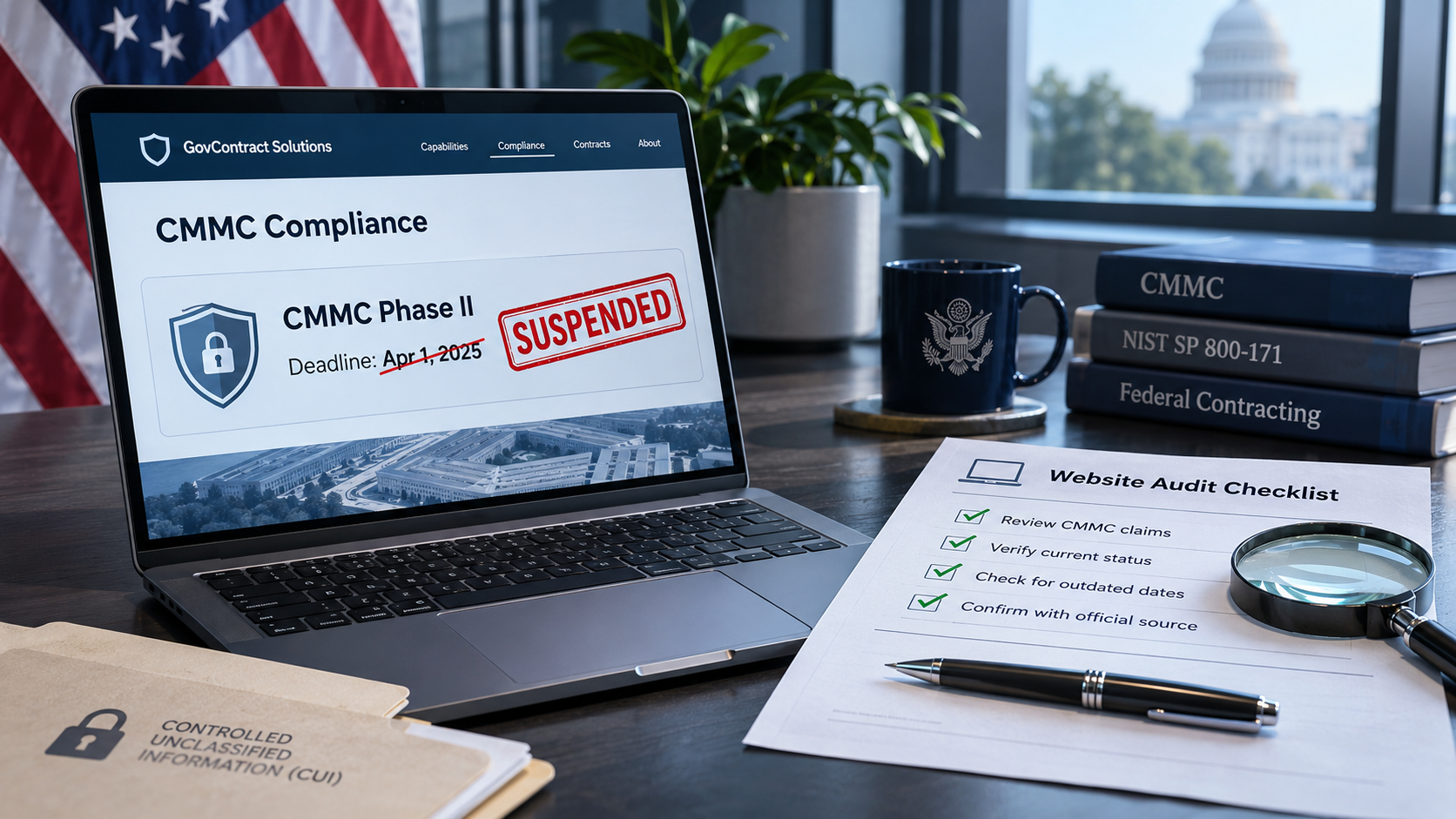
The Defense Department suspended the next phase of CMMC implementation in July 2026, but existing cybersecurity obligations didn't disappear. If your government contracting website still promotes the old rollout schedule, uses vague certification language, or confuses self-assessments with independent certification, it's time for a content audit.
Imagine a prime contractor's business development team researching your cybersecurity company.
Your firm provides security engineering, compliance support, cloud security services, or other technical capabilities relevant to the defense industrial base.
The visitor opens your website.
Your homepage looks professional.
Your capability pages appear current.
And a prominent banner announces:
"CMMC Phase II Begins November 10, 2026. Get Certified Before the Deadline."
There's just one problem.
That message is outdated.
On July 13, 2026, the Defense Department announced the immediate suspension of Cybersecurity Maturity Model Certification (CMMC) Phase II requirements.
Phase II had been scheduled to begin on November 10, 2026.
Under the department's current published implementation guidance, that transition is suspended, and implementation remains in Phase I while the program undergoes review.
Yet your website still promotes the original schedule as though nothing changed.
Maybe the banner was added earlier in the year.
Perhaps an agency wrote a series of compliance articles and nobody reviewed them afterward.
Or your marketing team built a landing page around the anticipated deadline and never established responsibility for updating it.
Whatever the reason, the public information is no longer accurate.
And the timing makes the problem particularly visible.
Tomorrow is November 10, 2026—the date Phase II had originally been scheduled to begin.
If your website still describes November 10 as an unchanged mandatory Phase II certification deadline, it needs immediate review.
But correcting the headline isn't the entire job.
Some contractors may be using broad language such as "CMMC certified" without identifying the actual assessment level, method, status, or scope.
Others may describe NIST SP 800-171 compliance as though it were a universal government certification.
Some cybersecurity service providers may imply they can certify customers even though they are not authorized third-party assessment organizations.
And a few websites may now have the opposite problem.
They suggest that the suspension means CMMC no longer matters or that defense contractors can stop protecting controlled information.
That conclusion is also incorrect.
The Department's July announcement expressly preserved applicable Phase I self-assessment requirements and underlying cybersecurity safeguarding obligations.
For companies working in this market, the marketing challenge is clear.
Your website needs to reflect what the rules actually say today—not what your content calendar predicted earlier this year.
That requires more than search engine optimization.
It requires coordination among marketing, cybersecurity leadership, contracts personnel, and whoever is authorized to verify your company's assessment and compliance status.
A credible website should communicate real expertise.
It should identify what the company actually does.
And it should represent changing federal requirements with appropriate precision.
Let's examine what changed, what didn't, and how to update your digital presence responsibly.
What Actually Happened to CMMC Phase II in July 2026?
On July 13, 2026, the Defense Department announced that it was suspending the transition to CMMC Phase II.
The official announcement, titled Forging the Arsenal of Freedom: Department of War Suspends CMMC Phase II Requirements, explained that Phase II had originally been scheduled to take effect on November 10, 2026.
The department also established a CMMC Reform Task Force to review the program and recommend changes intended to reduce unnecessary burdens while maintaining cybersecurity protections.
The announcement specifically stated that Phase I self-assessment requirements remained in place.
It also emphasized that contractors were still responsible for safeguarding covered defense information under applicable contractual requirements.
The Timeline Matters
The original CMMC phased implementation began on November 10, 2025.
The previously scheduled second phase would have expanded the use of independent CMMC Level 2 assessments across applicable acquisitions.
In July 2026, the department suspended that planned transition.
The department's current CMMC About page describes implementation as paused in Phase I.
As of November 9, 2026, the official guidance reviewed for this article still reflects that suspension.
Phase II Was Suspended, Not the Entire Cybersecurity Program
The distinction is essential.
The department did not announce that defense contractors no longer need cybersecurity controls.
It did not eliminate contractual safeguarding responsibilities.
It did not turn every contractor into a compliant entity by default.
And it did not declare that prior assessments or authorized security processes were meaningless.
The Future Schedule Is Not Something Your Website Should Invent
The original rollout included later phases.
The July suspension also put pending and future implementation milestones on hold while the program is reviewed.
A marketing website should not simply assume that the previously published Phase III and Phase IV dates will proceed unchanged.
Nor should it invent a replacement timeline.
The responsible statement is that the original Phase II transition was suspended and future implementation details must be verified against current official guidance.
That's more useful than a dramatic countdown timer based on a date that no longer represents the announced implementation plan.
Phase, Level, Assessment, and Certification Are Not the Same Thing
One reason GovCon websites become inaccurate is that marketers use CMMC terminology interchangeably.
They shouldn't.
These terms describe different concepts.
CMMC Implementation Phases
Implementation phases describe the government's schedule for introducing requirements into applicable acquisitions.
The July 2026 action suspended the advancement to Phase II.
CMMC Levels
CMMC levels relate to cybersecurity assessment requirements and the type of information or protection involved.
The level is not the same as the phase of the rollout.
Self-Assessment
A self-assessment is conducted by the organization seeking assessment, subject to the relevant methodology and reporting requirements.
It is not equivalent to an independent assessment performed by an authorized third party.
Independent Assessment
An independent assessment involves the applicable authorized assessment organization or government assessment process.
The appropriate method depends on the requirement and program rules.
Assessment Status
A company may have a documented result or status for a particular assessment scope.
That doesn't mean every system, subsidiary, affiliate, employee, or service offered by the company is covered.
Why Marketing Needs the Distinction
Consider a website that says:
"Fully CMMC Phase II Certified."
That phrase combines implementation timing with certification terminology in a way that may be misleading.
A visitor cannot tell which level was assessed, who performed the assessment, which entity and systems were covered, or whether the status is current.
The company may have legitimate assessment information it could communicate accurately.
But the current claim isn't sufficiently precise.
The more consequential the compliance claim, the more specific the supporting facts need to be.
What Remains in Effect Under the Current CMMC Guidance?
The suspension shouldn't become an excuse to ignore existing requirements.
The official CMMC implementation guidance identifies continuing Phase I requirements and describes the assessment framework currently being applied.
Level 1: Basic Safeguarding of Federal Contract Information
Level 1 addresses basic safeguarding requirements associated with Federal Contract Information, or FCI.
The department's current guidance describes an annual self-assessment and annual affirmation associated with the applicable Level 1 requirements.
Those requirements are tied to the fifteen security requirements identified in FAR 52.204-21, where applicable.
Level 2: Protection of Controlled Unclassified Information
The department's current Phase I guidance also addresses Level 2 self-assessment requirements associated with NIST SP 800-171 Revision 2.
The official model describes Level 2 self-assessments on a three-year cycle, with annual affirmations, under the applicable program provisions.
This doesn't mean every contractor has identical requirements.
The information handled, contract terms, assessment scope, and governing rules matter.
Cybersecurity Safeguarding Continues
The department's July announcement specifically emphasized DFARS 252.204-7012.
That clause addresses safeguarding covered defense information and cyber incident reporting.
Its application is contractual and depends on the relevant circumstances.
Supplier Performance Risk System Requirements Still Matter
Applicable assessments and reporting obligations may involve the Supplier Performance Risk System, or SPRS.
The current DFARS safeguarding policy addresses NIST SP 800-171 assessments and relevant assessment currency requirements.
A marketing team should not assume that a pause in Phase II removes every existing SPRS obligation.
Protecting Information Is Different From Advertising a Badge
A contractor may have significant ongoing cybersecurity responsibilities even if its website has no public compliance badge.
Conversely, displaying an impressive badge doesn't establish that the organization fulfills every applicable requirement.
The appropriate standards must be verified by qualified personnel.
Cybersecurity obligations are determined by applicable requirements, not by the language on a marketing page.
The Eight Outdated Claims to Look for on Your Website
If your company publishes cybersecurity or GovCon compliance content, start by searching for the following types of statements.
1. "Phase II Starts November 10, 2026"
That was the originally scheduled date.
The transition was suspended on July 13, 2026.
An article discussing the historical schedule may be accurate if it clearly identifies the information as historical.
But a current landing page or countdown promoting the date as an unchanged requirement is outdated.
2. "Every Contractor Handling CUI Must Obtain Third-Party Certification by November 2026"
This claim fails to account for the suspension and may oversimplify applicability.
The company should consult current department guidance and actual contract requirements.
3. "The CMMC Rollout Is Proceeding Through All Previously Announced Phases"
Future milestones were placed on hold during the review.
Don't present the former schedule as an established current commitment.
4. "We Are Fully CMMC Certified"
This statement may lack the detail required to understand the company's actual status.
Verify the assessed entity, level, assessment method, scope, date, and any relevant limitations.
A verified independent assessment status should not be conflated with a self-assessment.
5. "Our Company Is NIST Certified"
NIST publishes standards and guidance, but referencing NIST SP 800-171 doesn't automatically establish a universal NIST-issued certification.
Identify the specific requirement, assessment, and actual status.
6. "The Phase II Suspension Means CMMC Is No Longer Required"
That statement is also misleading.
Phase I requirements remain, and applicable contractual safeguarding obligations continue.
7. "We Can Guarantee Your Company Will Pass CMMC"
A cybersecurity consultant may help organizations prepare.
But it should not promise an independent assessment result it doesn't control.
8. "Our CMMC Status Covers Every Service and Affiliate"
A status may relate to a defined organizational and technical scope.
Don't automatically apply one entity's assessment to subsidiaries, joint ventures, unrelated systems, or every service.
These are examples of claims that deserve review.
They aren't proof that a particular contractor is violating a rule.
The audit should establish the actual wording, supporting records, and appropriate corrective action.
A Fictional Example: The Landing Page That Became Outdated
Imagine a fictional Northern Virginia cybersecurity contractor called Meridian Defense Cyber.
The company provides security engineering, compliance preparation support, and technical assessment readiness services.
Early in 2026, it created a marketing campaign around the anticipated November Phase II rollout.
The campaign included a dedicated website page.
Its headline read:
"Get CMMC Level 2 Certified Before November 10, 2026."
The page explained the expected rollout.
It urged defense subcontractors to schedule consultations before the deadline.
And it linked to a series of blog posts discussing the original implementation timeline.
In July, the department announced the Phase II suspension.
But Meridian's marketing calendar kept running.
The Problem
The company wasn't necessarily making a false statement when the page was originally drafted.
The published guidance subsequently changed.
The business failed to update a time-sensitive claim.
By November, the webpage had become misleading.
The Better Approach
Meridian's compliance leadership reviews the latest official materials.
The marketing team removes the outdated countdown and deadline language.
It updates the main page to explain the suspension accurately.
It clarifies which preparation and safeguarding services the company actually provides.
And it adds a visible review date to the time-sensitive guidance.
A Revised Message
Instead of:
"Mandatory Phase II Certification Begins November 10."
The updated page could say:
"CMMC Phase II Implementation Was Suspended in July 2026. Phase I Requirements and Applicable Cybersecurity Obligations Continue."
The body could then explain the company's verified services without offering a fabricated certification timeline.
What This Accomplishes
The company can continue helping appropriate clients understand cybersecurity readiness.
But it no longer relies on an obsolete government deadline to generate urgency.
This example is fictional.
It doesn't describe an actual Ritner Digital client, verified marketing campaign, or measured business outcome.
Why Outdated Compliance Claims Are a Branding Problem
This issue goes beyond having an old article on your website.
For a cybersecurity contractor, technical accuracy is part of the company's public positioning.
Your business may claim expertise in federal requirements.
You may help customers interpret technical obligations.
You may work with prime contractors operating in regulated environments.
Those audiences can reasonably expect your website to distinguish current rules from historical plans.
A Prime Contractor May Notice the Error
A prospective teaming partner researching cybersecurity expertise could encounter your outdated CMMC page.
That doesn't establish that the partner will reject your company.
But it may create questions about how recently the information was reviewed.
A Customer May Be Misled About Timing
A visitor seeking compliance assistance might rely on an incorrect deadline.
If your marketing uses the obsolete date to encourage purchases, the problem becomes more consequential.
Your Own Employees May Repeat the Claim
Business-development teams often use website content in emails, presentations, or capability statements.
An outdated page can spread into other company materials.
SEO Can Extend the Life of Old Information
A page written for an earlier implementation schedule may continue appearing in search results.
Search visibility doesn't make its claims current.
Accuracy Can Be a Differentiator
A contractor that explains the suspension responsibly, acknowledges ongoing obligations, and avoids invented deadlines may provide more useful public information than a competitor relying on urgency-driven slogans.
Credibility comes from accurate, appropriately limited claims—not from sounding more certain than the available guidance permits.
What Should a Cybersecurity Contractor Say Instead?
There is no single approved marketing statement for every contractor.
The correct wording depends on the business and the information being described.
But a useful approach separates three things.
First: Current Government Implementation Status
Explain the dated policy change.
Reference the official source.
Avoid treating a historical timeline as current.
Second: The Company's Actual Services
Does your firm provide NIST SP 800-171 readiness support?
Security engineering?
Assessment preparation?
Documentation assistance?
Remediation planning?
Security control implementation?
Describe only the services it genuinely performs.
Third: The Company's Actual Qualifications
If the company has a legitimate certification, accreditation, or assessment-related qualification, identify it precisely and obtain appropriate approval before publication.
Don't imply the company can issue certifications simply because its personnel have compliance expertise.
An Example of Appropriate Positioning
A fictional company that genuinely performs these services might say:
"We support defense industrial base organizations with NIST SP 800-171 readiness activities, cybersecurity engineering, and assessment preparation. Engagements are tailored to the applicable contract requirements and current CMMC implementation guidance."
This description doesn't promise certification.
It doesn't invent a deadline.
And it identifies the company's service categories.
It must still be reviewed against the actual business and current obligations before use.
Self-Assessment, Readiness, and Certification Require Different Language
Many websites use these terms as though they mean the same thing.
They don't.
Readiness Support
A consultant may help a company prepare documentation, identify gaps, or implement relevant security controls.
That work can be valuable.
But readiness assistance isn't the same as official certification.
Self-Assessment
The organization seeking assessment performs the applicable self-assessment using the relevant methodology.
The result may have specific reporting, affirmation, and scope requirements.
Independent Certification Assessment
An authorized independent assessment follows the applicable CMMC program rules.
The fact that Phase II implementation was suspended doesn't mean every previously issued independent certification is automatically invalid.
Nor does it mean a voluntary assessment is the same as a contractually mandated one.
Assessment Consulting Is Not Assessment Authority
If your company provides preparation services, explain that function.
Don't imply that it independently certifies another business unless it actually holds the required authorization for the relevant role.
"Compliant" Is a Scope-Dependent Claim
A blanket statement that a company is compliant with every requirement may be impossible to interpret.
Compliance depends on the specific requirements, systems, information, and circumstances involved.
A credible website should reflect that complexity without overwhelming visitors.
Why NIST SP 800-171 Still Belongs in the Conversation
The suspension changes the implementation schedule.
It doesn't remove the underlying need to protect applicable information.
The department's July announcement specifically identified NIST SP 800-171 Revision 2 as the baseline being enforced during the interim period through self-assessments and selected government-led assessments.
What Is NIST SP 800-171?
NIST SP 800-171 addresses security requirements for protecting Controlled Unclassified Information in specified nonfederal systems and organizations.
Why Revision Numbers Matter
NIST has published more than one revision of the publication.
The existence of a newer revision does not automatically mean every defense contract or CMMC assessment uses it.
As reflected in the department's July 2026 suspension guidance, the interim baseline refers specifically to Revision 2.
A company's website should not silently substitute a different revision without verifying the applicable requirements.
Framework Familiarity Isn't Compliance
Knowing the NIST framework or publishing educational content about it doesn't establish that the company or its customers have implemented all applicable controls.
Technical Implementation Is Not a Marketing Deliverable
A website writer can explain the company's approved cybersecurity service offerings.
Only the responsible technical and compliance personnel can verify the actual implementation status.
This is a key boundary for any agency working with government contractors.
Where Your Outdated CMMC Language May Be Hiding
Many companies update their homepage and assume the digital presence is current.
But compliance claims may exist in several locations.
Old Blog Posts
An article published before July 2026 may accurately describe the schedule as it was understood at that time.
If it remains prominent, consider adding a dated update explaining the suspension.
Service Pages
A cybersecurity compliance page may promise certification before the old November deadline.
Review that language carefully.
Homepage Banners
A promotional banner may display a countdown or deadline statement that no longer applies.
Downloadable PDFs
White papers, capability statements, checklists, and slide decks can remain accessible after website copy is updated.
SEO Titles and Meta Descriptions
An old title or description may continue presenting the abandoned deadline.
Search-result snippets are partly automated, but correcting source content and metadata is still important.
FAQ Sections
A page may answer "When does CMMC Phase II begin?" with the original November 10 date.
Update the answer.
LinkedIn Posts and Company Descriptions
Historical posts don't necessarily need to disappear.
But a pinned or prominently featured post may need a current correction.
Event and Webinar Pages
An upcoming or recently recorded presentation may use pre-suspension language.
Add context to avoid implying the information is current.
Sales Materials
Email templates, pitch decks, proposal boilerplate, and outreach sequences may repeat the old timeline.
Automated Marketing Campaigns
An older email series can continue sending outdated deadline warnings long after the policy changed.
Your compliance content audit should follow the claim wherever it appears—not stop at the homepage.
Should You Delete Old CMMC Articles or Update Them?
The answer depends on the content.
An older article may still offer useful historical context.
For example, a post written in 2025 may accurately explain what the department originally planned.
That information can remain valuable when clearly dated.
But a page designed to advise readers about current obligations needs more attention.
Preserve Accurate History
An article describing the original rollout plan can explain that the plan was later suspended.
Correct Present-Tense Instructions
A page that currently directs readers to complete certification by the suspended deadline needs revision.
Add a Meaningful Update
Explain what changed and when.
Provide the relevant official source.
Don't Change Dates Just to Appear Fresh
Google's people-first content guidance specifically cautions against changing publication dates merely to create an appearance of freshness.
Update the substance first.
Review Redirects Carefully
If you consolidate outdated pages, use appropriate redirects so visitors can reach the most relevant current content.
Keep an Internal Version History
Knowing what changed can help business development and compliance personnel distinguish former guidance from current statements.
The objective isn't to erase history.
It's to prevent historical information from masquerading as current advice.
How This Affects Cybersecurity Service Providers, Not Just Defense Contractors
There are two distinct audiences for this article.
The first consists of defense contractors that need to represent their own assessment and safeguarding status accurately.
The second consists of cybersecurity service providers marketing CMMC-related assistance.
Their website risks overlap, but the claims differ.
Contractors Describing Their Own Status
These companies should verify what assessment was performed, which entity and systems were covered, and what may accurately be stated.
Consultants Offering Compliance Support
These businesses should describe their actual readiness, documentation, engineering, assessment-preparation, or remediation services.
They shouldn't promise a government certification outcome.
Authorized Assessment Organizations
Any claim concerning formal assessment authority should correspond to the company's actual authorization and role.
Managed Service Providers
An MSP or MSSP may support customers with technical controls.
But the customer's compliance status is not automatically established by the provider's services or credentials.
Marketing Agencies
An agency can help present approved claims clearly.
It cannot replace an assessment organization or determine compliance on behalf of its client.
These distinctions matter whenever a website uses language designed to establish trust.
A Practical 15-Question CMMC Website Audit
You don't need a chart or complex scoring system.
Review the questions below with the appropriate company stakeholders.
1. Does any public page still present November 10, 2026, as the unchanged Phase II deadline?
If so, verify and correct the statement.
2. Does the website explain that Phase II was suspended on July 13, 2026?
Current educational content should reflect the change.
3. Does the site distinguish the suspension from continuing Phase I requirements?
Avoid suggesting that all CMMC obligations disappeared.
4. Are future phase dates presented as guaranteed?
Remove unsupported assumptions about when the rollout will resume.
5. Does the company use "CMMC certified" without identifying the actual status?
Review the precise entity, level, assessment method, and scope.
6. Are self-assessments confused with independent assessments?
Correct the terminology.
7. Does the website accurately describe NIST SP 800-171 requirements?
Check the version and applicable context.
8. Are DFARS safeguarding obligations discussed accurately?
Avoid blanket claims that the suspension eliminated them.
9. Does the company suggest that compliance consulting guarantees certification?
Review service promises and disclaimers.
10. Are logos, badges, or credentials used appropriately?
Verify authorization and scope.
11. Are downloadable materials current?
Review PDFs, capability statements, and presentations.
12. Have search metadata and FAQ answers been updated?
Old wording can continue appearing in search and on-page content.
13. Are automated emails still promoting the old deadline?
Review active campaigns.
14. Is the current information linked to an authoritative source?
Use official department and acquisition references where relevant.
15. Is someone responsible for monitoring future CMMC changes?
Without ownership, the same problem can recur.
The audit should produce a list of specific pages, statements, corrections, and responsible reviewers.
A generic note to "update cybersecurity content" is not enough.
A 30-Day Plan to Correct Outdated CMMC Website Claims
Because this issue involves potentially inaccurate public compliance statements, some corrections should happen sooner than a normal marketing project.
The following is an illustrative workflow.
First 48 Hours: Identify Material Errors
Search the website for the old November 2026 deadline.
Review prominent certification and compliance claims.
Identify pages that may mislead readers about current requirements.
Flag the highest-risk statements for urgent review.
Where authorized, remove misleading promotional banners or pause campaigns while replacement language is approved.
Week One: Verify the Official Guidance
The responsible cybersecurity, contracts, and compliance personnel review current CMMC guidance.
They identify which obligations apply to the company.
They confirm the organization's actual assessment status and scope.
They approve public wording.
Week Two: Correct Priority Pages
Update the homepage where needed.
Revise CMMC landing pages.
Correct inaccurate service claims.
Add appropriate dated updates to older educational content.
Replace outdated PDFs.
Week Three: Review the Broader Digital Presence
Check LinkedIn, scheduled content, email campaigns, webinars, sales decks, and capability statements.
Correct material inconsistencies.
Week Four: Test and Establish Maintenance
Verify the revised pages.
Check important links.
Review search-result presentation where practical.
Document the approved language.
Assign ongoing responsibility for monitoring official changes.
What the Project Should Produce
Current, approved public compliance messaging.
A record of material corrections.
Clearer service descriptions.
And a maintenance process for future updates.
A full website redesign isn't necessarily required.
A focused compliance-content audit may be the more immediate need.
What a Credible CMMC Marketing Page Should Contain
If your business provides cybersecurity or compliance services, your landing page should help readers understand the work—not simply pressure them with a deadline.
Identify Your Actual Services
Explain whether the company provides technical implementation, documentation support, readiness assessments, training, or other verified services.
Explain the Current Policy Context
Where relevant, state that Phase II implementation was suspended in July 2026.
Clarify Continuing Requirements
Help visitors understand that applicable safeguarding and self-assessment responsibilities remain.
Avoid Universal Claims
Requirements depend on contract terms, information types, systems, and program provisions.
Identify Real Credentials
If the business has particular authorized assessment-related qualifications, describe them precisely.
Provide a Clear Contact Path
A prospective customer should be able to discuss relevant services with the appropriate team.
Don't Collect Sensitive Information Unnecessarily
A public marketing form shouldn't encourage the upload of CUI, sensitive architecture diagrams, or protected contract data.
Keep the Page Reviewable
Use a visible substantive update date when appropriate.
Provide official source links.
Assign an internal owner.
A good CMMC page helps the reader understand the current environment and the services your company actually offers.
It doesn't manufacture urgency to force a conversion.
SEO and Timely Authority: Why Accuracy Matters More Than Publishing Speed
CMMC is a topic that can attract substantial search interest when rules change.
That may encourage companies to publish quickly.
But a rushed article can become misleading if it confuses program levels, assessment types, or implementation status.
Search Traffic Isn't a Substitute for Expertise
A blog post may rank for a compliance-related question without providing accurate guidance.
A Useful Update Should Explain the Change
Don't simply replace an old deadline with a vague statement that "everything is paused."
Describe what was suspended and what remains in effect.
Use Primary Sources
Official department guidance, acquisition regulations, and applicable policy documents should anchor the explanation.
Show the Date
Readers need to know when a time-sensitive interpretation was reviewed.
Don't Promise Instant Search Results
Updating content doesn't guarantee higher Google rankings.
Keep Technical Content Under Review
The CMMC implementation environment may continue changing.
An article accurate today may need another update after a new official announcement.
Treat Authority as a Responsibility
If your cybersecurity company positions itself as knowledgeable about federal compliance, maintaining accurate published information is part of that positioning.
Being first to publish a deadline warning is less valuable than remaining accurate after the deadline changes.
Should You Still Market CMMC Preparation Services?
Potentially, yes—if they are real services your company provides.
The suspension does not eliminate the need for cybersecurity risk management.
Nor does it remove applicable contractual safeguarding obligations.
But the marketing message should align with the current circumstances.
Focus on Actual Readiness Work
Your company may help customers evaluate existing controls, improve documentation, address technical gaps, or prepare for appropriate assessments.
Avoid Invented Deadlines
Don't claim the government has announced a replacement certification date when it hasn't.
Avoid Fear-Based Guarantees
Statements such as "Buy Now or Lose Every Defense Contract Tomorrow" oversimplify the requirements and can mislead readers.
Make Contract-Specific Applicability Clear
Different contractors may face different obligations depending on their work and agreements.
Separate Your Services From Official Decisions
A consultant can assist with preparation.
It does not control federal rulemaking, contracting officer decisions, or independent assessment outcomes.
Coordinate With Qualified Experts
Marketing should rely on current, verified guidance from the company's technical and compliance professionals.
A company's service offering can remain relevant even when the implementation schedule changes.
The credibility of its marketing depends on explaining why—accurately.
How to Measure the Value of a Compliance-Content Audit
A content audit doesn't need to promise new contract awards to provide value.
Useful outcomes include correcting material errors.
Fewer Inaccurate Claims
Identify how many significant compliance statements required correction.
Track whether the updates were completed.
Better Public Clarity
Can visitors distinguish Phase I from the suspended Phase II transition?
More Accurate Qualifications
Are certification, assessment, and consulting claims properly described?
Improved Internal Consistency
Do website pages, capability statements, and sales materials agree?
Clearer Ownership
Is a responsible team assigned to monitor changes?
Relevant Inquiries
Are visitors contacting the company about services it genuinely provides?
Better Business-Development Support
Can employees share approved pages without needing to explain away inaccurate deadlines?
Avoid Unsupported ROI Claims
A company shouldn't automatically credit later federal awards to a corrected blog post.
The marketing project can demonstrate that it improved accuracy, usefulness, and reliability.
Those are worthwhile results on their own.
Questions to Ask a Marketing Agency About CMMC Content
If your government contracting company is hiring an agency to produce compliance-related content, ask how it verifies changing rules.
Does it check official government sources?
Does it distinguish current implementation guidance from older schedules?
Can it explain the difference between Phase II and CMMC Level 2?
Will it obtain technical review before publishing certification claims?
How does it verify the company's actual qualifications?
Will it correct outdated material proactively?
How does it handle older blog posts and downloadable PDFs?
Does it use AI to draft compliance content?
Who reviews AI-generated claims?
What happens when a new government announcement changes the information?
And can the agency distinguish website marketing from legal or cybersecurity compliance advice?
The Right Process Matters More Than the Article Count
An agency promising eight compliance articles every month isn't necessarily offering better value than one that carefully maintains a smaller library of accurate information.
Define the Review Responsibility
The client should identify who is authorized to approve substantive claims.
Protect Sensitive Information
The agency shouldn't request unrestricted access to CUI or sensitive compliance records merely to write website copy.
Require Source-Based Corrections
When a rule changes, the provider should be able to identify affected content and recommend updates.
Keep the Scope Clear
A marketing company can improve public communications.
It cannot certify its client or determine whether every contract obligation has been met.
Frequently Asked Questions
1. Was CMMC Phase II suspended in 2026?
Yes. On July 13, 2026, the Defense Department announced the immediate suspension of the CMMC Phase II transition, which had originally been scheduled for November 10, 2026. The department also established a program review process. Its current official guidance describes implementation as paused in Phase I.
2. Is November 10, 2026, still the mandatory Phase II start date?
No. That was the original scheduled date. The transition was suspended before it took effect. A website describing November 10 as an unchanged mandatory Phase II certification deadline needs updating.
3. Does the suspension mean CMMC was canceled?
No. The department preserved applicable Phase I requirements and continued cybersecurity safeguarding obligations. The suspension concerns implementation milestones, not a blanket elimination of defense contractor cybersecurity responsibilities.
4. Are CMMC Phase I self-assessments still required?
Where applicable, yes. The official department guidance describes Level 1 and Level 2 self-assessment requirements during Phase I. Exact applicability depends on the information, contract, program provisions, and assessment requirements involved.
5. What happened to mandatory Level 2 third-party assessments?
The planned Phase II expansion of independent Level 2 certification requirements was suspended. Contractors should review current official implementation direction and applicable solicitation or contract terms rather than assuming the original rollout still applies.
6. Do defense contractors still have to comply with NIST SP 800-171?
Where the relevant contractual requirements apply, yes. The July 2026 announcement expressly preserved safeguarding obligations and identified NIST SP 800-171 Revision 2 as the applicable interim baseline for the described assessment approach.
7. Does DFARS 252.204-7012 still matter?
Yes. The department specifically stated that the Phase II suspension did not eliminate applicable obligations to protect covered defense information under DFARS 252.204-7012. Contractors should review the actual clause and their contractual circumstances.
8. What is the difference between CMMC Phase II and CMMC Level 2?
Phase II describes a stage in the planned government implementation schedule. Level 2 refers to a category of CMMC assessment requirements associated with protecting CUI. They are not interchangeable terms.
9. Is a Level 2 self-assessment the same as a third-party certification?
No. Self-assessment and independent certification are different methods. A company should describe the assessment actually performed, together with its level, scope, status, and relevant limitations.
10. Can a company still have a valid CMMC third-party certification?
The suspension of a rollout requirement does not automatically invalidate an existing properly issued certification. Current status and scope should be verified through the applicable program records and qualified personnel.
11. Should our website remove every reference to CMMC?
No. CMMC may remain relevant to the company's services and applicable cybersecurity obligations. The goal is to correct outdated implementation statements and represent actual qualifications accurately.
12. Can we call ourselves "CMMC certified" after a self-assessment?
A company should not use that phrase without explaining the actual assessment status and method. A self-assessment should not be presented as independent third-party certification. Verify the approved terminology before publication.
13. Can a cybersecurity consultant guarantee CMMC certification?
No responsible provider should guarantee an independent outcome it doesn't control. Consultants may assist with readiness, remediation, documentation, or technical implementation, but those services are different from official assessment decisions.
14. Does CMMC apply to every government contractor?
Not identically. Applicability depends on the relevant contractual requirements, information, systems, and program provisions. CMMC is particularly associated with the defense industrial base. Broad statements that every government contractor needs the same certification should be avoided.
15. Should we update older blog posts with the original timeline?
Yes, when they may mislead readers about current requirements. Historical information can remain useful if clearly dated and updated with the suspension. Correct current advice, promotional claims, and obsolete deadline warnings.
16. Do outdated CMMC pages affect Google rankings?
There is no guaranteed ranking penalty simply because a page contains an old date. However, inaccurate information can reduce its usefulness to readers. Google recommends reliable, people-first content and meaningful updates rather than cosmetic changes to publication dates.
17. What if an existing solicitation still contains older CMMC requirements?
Review the current solicitation, amendments, applicable policy direction, and contractual provisions with the responsible contracting and compliance personnel. Seek appropriate clarification through the official procurement channel. A marketing article cannot determine the legal effect of a particular contract.
18. Does the suspension mean we can stop cybersecurity preparation?
No. Applicable safeguarding duties continue, and cybersecurity risk management remains important. The appropriate preparation program depends on the company's actual requirements and business circumstances.
19. Who should approve CMMC claims on our website?
Appropriate cybersecurity, compliance, contracts, and leadership personnel should verify the substantive statements. Marketing can develop clear language, but it should not independently determine certification status or interpret contractual obligations.
20. What should we fix first on a website with outdated CMMC claims?
Start with the most prominent material errors: outdated mandatory deadlines, misleading certification badges, incorrect statements about Phase I requirements, and unsupported claims about the company's status. Then review older articles, PDFs, sales materials, search metadata, and automated campaigns.
The CMMC Schedule Changed. Your Website Should Have Changed With It.
Cybersecurity contractors operate in a market where technical details matter.
A date can matter.
An assessment method can matter.
A particular regulatory revision can matter.
And the difference between a self-assessment and an independent certification can matter.
Those distinctions are not minor copyediting concerns.
They affect how a company communicates its expertise and qualifications.
The July 13, 2026, suspension of CMMC Phase II created an obvious need to review existing public guidance.
The original November 10 rollout date was no longer an unchanged requirement.
But applicable cybersecurity safeguarding responsibilities remained.
For some contractors, the website may now overstate an approaching deadline.
For others, it may falsely imply that the entire CMMC program disappeared.
And for businesses marketing compliance services, outdated urgency-based messaging may no longer accurately explain the value of their work.
The solution isn't to remove every mention of CMMC.
It's to publish accurate information.
Explain what changed.
Distinguish the implementation phase from the assessment level.
Represent actual qualifications precisely.
Link to authoritative sources.
And establish a process for reviewing future updates.
That process doesn't need to be elaborate.
But someone needs to own it.
The website is often the public version of your company's expertise.
If it claims to understand changing federal cybersecurity requirements, its content should reflect the requirements that actually exist.
A credible cybersecurity contractor shouldn't be marketing tomorrow's suspended deadline as though July's announcement never happened.
And it shouldn't use the suspension to suggest that protecting covered defense information has become optional.
The stronger position is accurate, measured, and specific.
Your company may still provide valuable cybersecurity engineering.
It may still help customers prepare for applicable assessments.
It may still support NIST SP 800-171 readiness and implementation.
And it may still have legitimate assessment-related qualifications.
Communicate those facts responsibly.
Don't borrow credibility from a deadline that is no longer current.
Because in cybersecurity contracting, a website that explains the rules correctly can demonstrate more professionalism than one that simply sounds urgent.
Does Your Government Contractor Website Still Contain Outdated CMMC Messaging?
At Ritner Digital, we believe technical companies need websites that reflect what their businesses actually do—and information their audiences can rely on.
For cybersecurity and government contracting firms, that means accurate service descriptions, current public-facing content, clear qualifications, and a website maintenance process that responds when important guidance changes.
Your company may need a focused compliance-content audit.
Updated cybersecurity service pages.
Corrections to outdated blogs and downloadable materials.
Better coordination between your website and capability statement.
Or a broader redesign if your current site no longer represents the business accurately.
The right starting point should be an assessment of the content and website experience—not an assumption that every company needs more articles or a complete rebuild.
Ritner Digital helps businesses improve website design, content strategy, SEO, and digital positioning around their actual goals.
Contact Ritner Digital to discuss your government contracting website, outdated compliance messaging, and opportunities to create a clearer, more reliable digital presence.
Ritner Digital's marketing services do not replace authorized cybersecurity assessments, legal advice, or contract-specific compliance determinations.
Because the government changed the implementation schedule.
Your website should tell the current story.